



Is the TANCHJIM Bunny G Worth Buying?
Absolutely, with one frustrating caveat! The TANCHJIM Bunny G is a remarkably capable budget IEM that delivers clean, controlled bass, powerful midrange presence, excellent clarity, and a surprisingly wide soundstage for approximately $29. Designed around competitive gaming, the Bunny G features an updated DMT5 G dynamic driver, USB-C DSP connectivity, customizable parametric EQ, and gaming-oriented audio processing. Its black-and-green design looks fantastic, and the underlying sound quality is impressive enough to appeal to music enthusiasts as well as gamers.
What surprised me most wasn’t the stock tuning, which can lean bright. It was how much more enjoyable the Bunny became after experimenting with narrow-bore tips, different connections, EQ, and complementary amplification. With my Topping DX5 II and Loxjie P20 tube amplifier, this little IEM sang, delivering a musical experience that challenged my expectations of what budget audio can accomplish.
Unfortunately, TANCHJIM’s software experience doesn’t extend that same flexibility to Apple users. While Android and PC owners can configure the Bunny G’s DSP directly, iPhone and iPad users must make those adjustments elsewhere and save them to the device. I verified full DSP functionality on my HiBy R4 Evangelion running Android, but the extra steps are especially frustrating for anyone who games or listens primarily on Apple devices.
✅ Pros: Excellent clarity, clean and controlled bass, powerful and articulate mids, cohesive frequency transitions, pleasantly wide soundstage, bright and airy treble, excellent EQ responsiveness, impressive synergy with complementary amplification, lightweight and comfortable shells, attractive translucent black-and-green design, useful gaming functionality, and exceptional sound quality for the price.
⛔ Cons: Bright stock tuning may require adjustment, modest instrument separation, limited holographic depth, basic accessories, simple cloth pouch, no native iOS DSP configuration for wired Bunny G functionality, and the need for Android or PC access to customize TANCHJIM’s DSP settings.
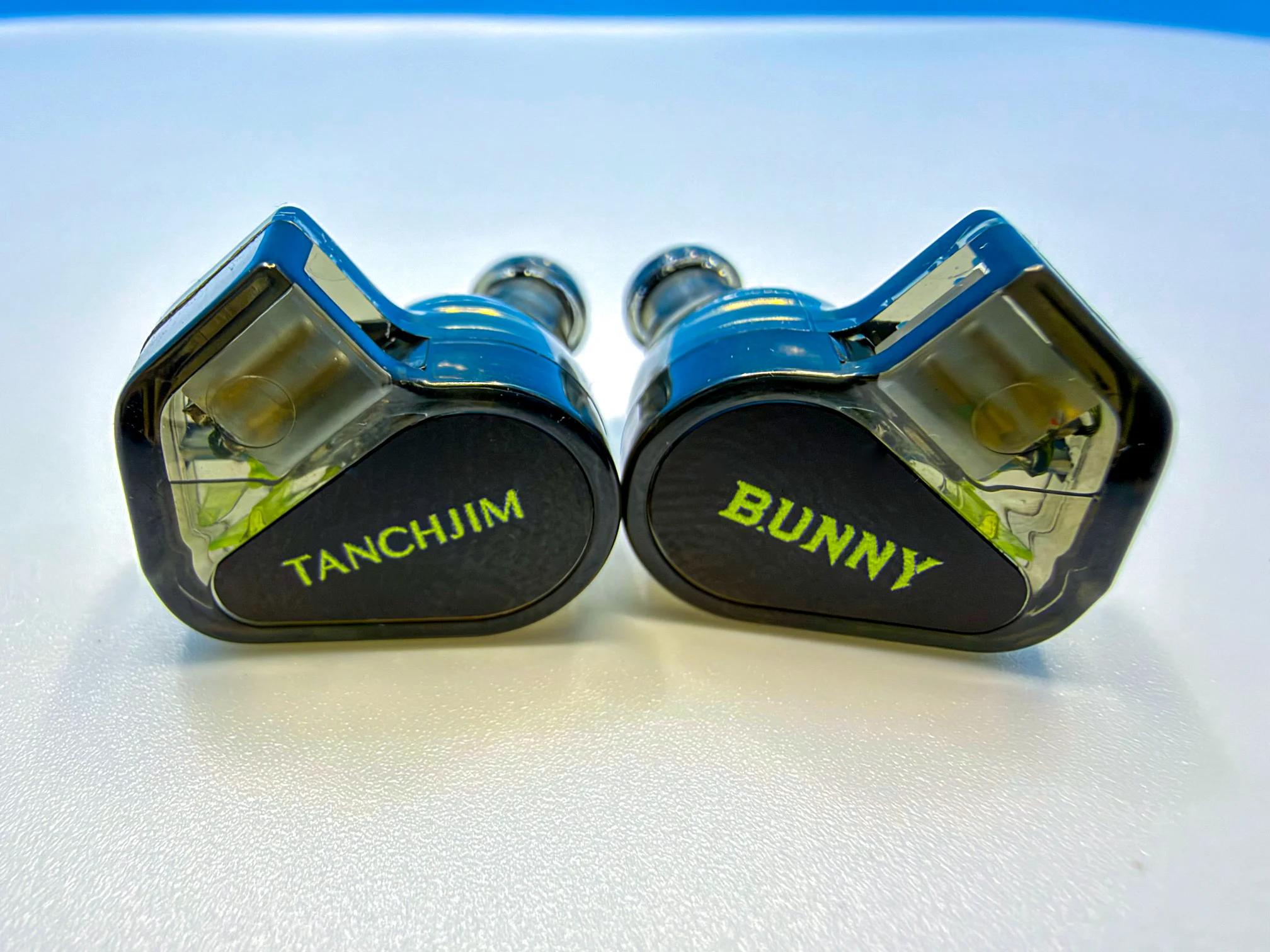
🐇 The Little Gamer Bunny That Refused to Act Its Price
I’ve reviewed enough audio equipment to know that price and performance don’t always enjoy a particularly honest relationship.
I’ve heard expensive IEMs with impressive specifications that left me wondering where the money went. I’ve also heard inexpensive models that delivered so much musical enjoyment that their modest price became almost irrelevant.
That’s one of my favorite things about this hobby. Every once in a while, something comes along that reminds me why I started exploring better audio in the first place.
I wasn’t collecting driver configurations or memorizing spec sheets.
It was to enjoy music.
Enter the TANCHJIM Bunny G.
When TANCHJIM sent me its black-and-green Bunny G for review, I wasn’t expecting to discover something extraordinary. I figured I’d be spending time with a capable little gaming IEM, perhaps something worth recommending to someone looking for better sound without spending much money.
And initially, that expectation seemed reasonable.
The stock tuning was enjoyable, although undeniably bright. The bass sounded clean and controlled, the midrange had satisfying energy, and the overall presentation had a clarity that immediately caught my attention.
Instrument separation wasn’t tremendous, and the soundstage, while pleasantly wide, wasn’t especially multidimensional. This wasn’t a holographic experience with instruments floating independently around my head.
But I liked what I was hearing.
The presentation felt refreshingly uncomplicated. It sounded clean without feeling forced, and the transitions between bass, mids, and treble were smoother than I expected.
Then I started experimenting.
I tried different ear tips, swapped in a copper cable, explored the supplied USB-C DSP functionality, and began playing with source equipment and EQ.
Eventually, I connected the Bunny to my Topping DX5 II and Loxjie P20 tube amplifier.
And that’s when this little Bunny came alive!
The treble edge softened, the presentation became more engaging, and the clarity that had initially impressed me remained beautifully intact. Later, the iFi GR2 gave me additional sound-shaping options, allowing me to refine the presentation even further.
At that point, I wasn’t thinking about a budget gaming IEM anymore. I was enjoying familiar music through a system that sounded remarkably satisfying, particularly considering how little the Bunny G itself costs.
But there’s another part of this story, and it isn’t quite as cheerful.
Because after falling in love with how well this IEM responds to tuning adjustments, I discovered that TANCHJIM makes those adjustments unnecessarily inconvenient for Apple users.
We’ll get to that.
For now, let’s appreciate something worth celebrating.
The Bunny G may be small, inexpensive, and designed for gaming, but there’s a genuinely enjoyable musical personality hiding inside those gorgeous little shells.
🦖 Disclosure
Huge thanks to Isabel and the amazing TANCHJIM Audio team for sending the Bunny G to the GearZilla listening lab for review!
I appreciate the opportunity to explore an affordable product that brings customizable audio and genuinely enjoyable sound within reach of more listeners.
As always, complimentary equipment doesn’t purchase a positive review, and the manufacturer hasn’t controlled my conclusions or influenced my final rating.
My listening impressions, opinions, and evaluations are entirely my own.
My approach remains simple.
Listen first. Figure out the story later.
And the Bunny G gave me quite a story to tell.

🏭 The Story Behind TANCHJIM: Why a Bunny?
TANCHJIM has become a recognizable name in enthusiast audio through a growing collection of affordable and premium products, many built around the company’s dynamic-driver technology.
From the OLA and ONE to the original Bunny and more ambitious models, TANCHJIM has shown a willingness to experiment across price categories while maintaining a distinctive design identity.
The Bunny G expands the original Bunny concept into gaming-oriented territory.
The G stands for Gaming, and TANCHJIM markets the product under a particularly appropriate slogan:
Born to Compete.
But why call it Bunny?
I haven’t found a definitive explanation from TANCHJIM about the original product name, and I’m not going to invent a charming story involving rabbits with particularly sensitive hearing.
What I can say is that the name fits.
The Bunny G is small, approachable, lightweight, and surprisingly capable. Its compact design doesn’t suggest anything particularly intimidating, and the price certainly doesn’t announce an ambitious audio product.
But give it the right source, a little EQ, and some musical encouragement, and this little creature becomes far more entertaining than its name suggests.
The gaming version also looks fantastic.
The translucent black shells and vibrant green accents give the Bunny G an attractive identity without resorting to an excessively aggressive gaming aesthetic.
I absolutely love the combination.
It’s distinctive enough to stand out, but restrained enough that I’d happily wear these IEMs while listening to music, working, or enjoying a game.
This Bunny has some personality, and I appreciate that before playing a single note.

🎮 Born to Compete: Gaming DNA With Musical Ambitions
TANCHJIM’s decision to build the Bunny G around competitive gaming is more interesting than simply adding a microphone and changing the shell color.
Gaming audio places some different demands on equipment than casual music listening.
For competitive players, the ability to distinguish footsteps, environmental movement, directional effects, and other positional information may matter more than enormous bass impact or a particularly warm presentation.
An IEM that exaggerates every explosion can be entertaining, but that same excessive low-frequency energy may make quieter environmental sounds more difficult to distinguish.
The Bunny G takes a relatively disciplined approach.
Its clean bass, articulate midrange, and energetic upper frequencies create a presentation that seems well suited to making important details easier to recognize.
That makes sense when you look at its frequency-response measurements.
It has a restrained low-frequency foundation, a dip in parts of the lower midrange, and a rise into the upper-midrange presence region that helps emphasize articulation.
That doesn’t automatically guarantee superior positional accuracy, and I haven’t run controlled competitive-gaming tests to see whether the Bunny G improves performance in any particular title.
But the tuning philosophy makes sense for its intended audience.
What makes the Bunny G more interesting is how well those same qualities translate into music listening.
The controlled bass helps preserve clarity. The midrange has enough energy to give instruments and vocals authority, and the soundstage possesses respectable width.
Instrument separation is relatively modest, but it’s organized enough to enjoy complicated recordings without everything collapsing into a single, indistinguishable mass.
The Bunny G doesn’t deliver exceptional instrument separation, but it delivers enough for gamers and music enthusiasts to enjoy what it’s doing.
At about $29, that’s a worthwhile accomplishment.

⚙️ What’s Inside the Bunny G? One Driver, Plenty of Possibilities
TANCHJIM equips the Bunny G with its DMT5 G dynamic-driver platform, an updated design intended to support the product’s gaming-oriented acoustic performance.
I find the single-driver approach refreshing.
In a market where increasingly complicated driver configurations are often treated as evidence of superior performance, TANCHJIM has created a capable product without relying on an enormous collection of components.
Of course, driver count alone tells us very little about sound quality.
I’ve encountered wonderful single-dynamic-driver IEMs and disappointing multi-driver designs. The opposite is equally true.
What matters is how effectively the manufacturer integrates the complete acoustic system.
And with the Bunny G, I appreciate the results.
🧬 DMT5 G Dynamic Driver
The Bunny G uses a single dynamic driver built around TANCHJIM’s DMT5 G platform, featuring a nano-ceramic composite diaphragm.
A dynamic driver generates sound by moving a diaphragm connected to a voice coil within a magnetic field.
Its final sonic character depends on the diaphragm’s mechanical properties, motor system, acoustic chambers, damping, nozzle design, and overall tuning.
The diaphragm material alone doesn’t tell us whether the sound will be warm, bright, bass-heavy, or particularly resolving.
From the Bunny G, I hear a cohesive presentation with controlled bass, energetic mids, and a clean upper-frequency character.
There isn’t an obvious sense of the frequency ranges fighting one another.
Instead, everything transitions smoothly across most of the audible spectrum.
That’s an appealing quality, particularly in an affordable IEM.
🎛️ PureBridge DSP and Parametric EQ
One of the Bunny G’s major selling points is its USB-C DSP cable, which adds digital sound processing and customizable EQ.
The TANCHJIM software provides an 8-band parametric equalizer, letting users adjust selected frequencies, gain levels, and filter characteristics.
This offers more precise customization than a basic bass-and-treble adjustment.
Rather than being locked into a single tuning, owners can explore different tonal balances and save configurations for future listening.
And because the Bunny G responds so well to EQ, I consider this one of its most valuable features.
The software also provides gaming-oriented tools, including Game EQ, Tactical Perception, and virtual-channel processing intended to support positional audio.
These features expand the Bunny’s potential beyond conventional music playback, although their practical effectiveness depends on the game, source device, processing configuration, and listener.
The important thing is that TANCHJIM gives users meaningful flexibility.
Unfortunately, that flexibility isn’t equally convenient across platforms.
🎙️ Microphone and Gaming Functionality
The Bunny G’s USB-C configuration includes microphone functionality intended to make it practical for gaming, communication, and everyday use.
The associated software offers microphone adjustments, including gain control, along with gaming audio features.
That’s a welcome addition for people who want to use the same IEMs for music, online communication, and gaming.
However, I haven’t conducted dedicated microphone intelligibility, background-noise rejection, or end-to-end latency measurements, so I won’t award the Bunny G performance claims that I haven’t verified.
The features are useful on paper.
Their effectiveness in a competitive gaming environment deserves separate testing.
📋 Technical Specifications
| Feature | Specification |
| Model | TANCHJIM Bunny G |
| Product focus | Gaming and music listening |
| Driver | Single dynamic driver |
| Driver platform | DMT5 G |
| Diaphragm | Nano-ceramic composite |
| Impedance | 30Ω, published specification |
| Sensitivity | 123 dB/Vrms, published specification |
| Frequency range | 8Hz-48kHz, manufacturer-rated |
| Connector | Recessed 0.78mm 2-pin |
| Included connection | USB-C DSP cable |
| DSP architecture | PureBridge-based |
| EQ | 8-band parametric equalizer |
| Gaming processing | Game EQ, Tactical Perception, virtual-channel functions |
| Microphone | Integrated USB-C cable microphone |
| Software configuration | Supported Android devices and Windows PC |
| iOS | Saved settings work; native wired-DSP configuration unavailable |
| Color reviewed | Translucent black and green |
| Reference price | Approximately $28.99 USD |
Manufacturer-rated specifications describe the product’s intended engineering and supported features. They don’t independently establish audible resolution, soundstage, or gaming performance.
📦 First Impressions: Modest Packaging, Immodest Performance
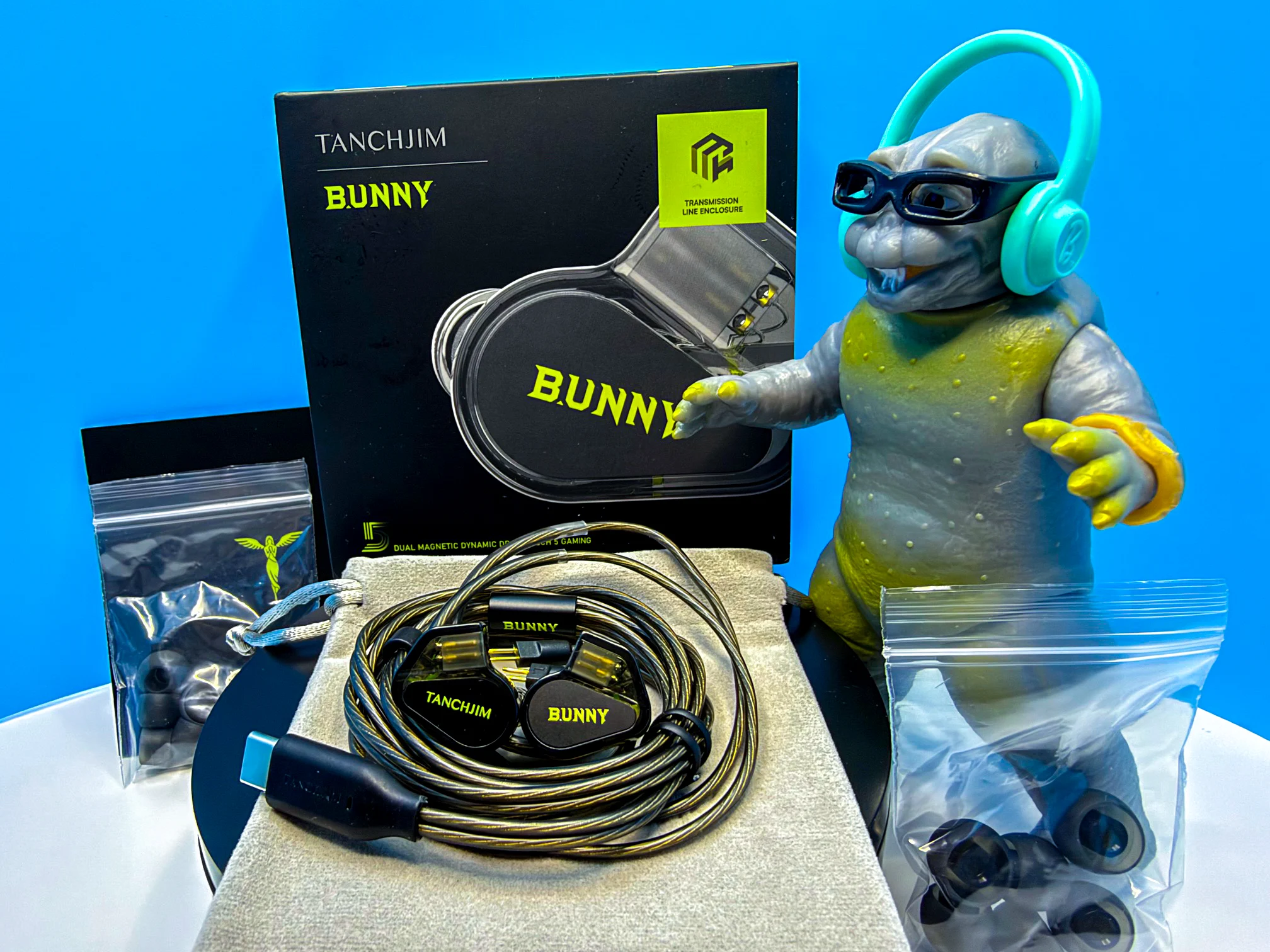
TANCHJIM knows how to present an affordable audio product, and the Bunny G follows the company’s familiar packaging approach.
The presentation is tidy and straightforward, with recognizable branding and a basic accessory selection appropriate for the price.
There isn’t an elaborate collection of interchangeable parts or an expensive-looking display case.
And frankly, there doesn’t need to be.
The package includes the IEMs, USB-C DSP cable, silicone ear tips, a cloth carrying pouch, and documentation.
Everything necessary to get started is provided.
🎨 Black and Green: An Absolutely Gorgeous Combination
I have to give TANCHJIM credit for the design.
The Bunny G’s translucent black shells and green accents look fantastic.
It has enough visual character to communicate its gaming identity without getting excessively flashy or complicated.
The compact shell shape is another advantage.
As someone with smaller ears, I’ve developed a healthy appreciation for manufacturers that remember an IEM must actually fit inside a human ear.
The Bunny G doesn’t require enormous housings or aggressive protrusions to accommodate a complicated driver configuration.
Its small form factor makes it an appealing everyday listening option.
🧳 The Cloth Pouch: Nothing to Write Home About
The included cloth carrying pouch is exactly that.
A cloth pouch.
It keeps the earpieces and cable together, but it isn’t a substitute for a protective hard case.
Would I have preferred something more substantial?
Absolutely.
But let’s remember the price.
At about $29, I’m not expecting a luxury carrying case, interchangeable modular connectors, or a museum-worthy display box.
I’m expecting a decent set of earphones.
And that’s where TANCHJIM has invested its effort.
The accessories are modest, the packaging is standard TANCHJIM, and the cloth pouch is nothing special. But for the money, the Bunny G is an absolute overachiever.
🎧 Review Setup: Listen First, Analyze Later
My approach to reviewing audio equipment is straightforward.
Listen first. Figure out the story later.
I don’t begin with a frequency-response graph and decide what I’m supposed to hear.
I begin with music.
I’ve heard familiar recordings through numerous headphones, IEMs, DACs, and amplifiers.
Then I ask a simple question.
Does this equipment help me enjoy familiar music in a new way?
With the Bunny G, my enthusiasm grew as I explored different listening configurations.
Its stock tuning was already enjoyable, but some experimentation revealed an even more satisfying musical presentation.
🖥️ Sources & Testing Rigs
My primary streaming source is Apple Music Lossless, supported by a collection of desktop and portable audio equipment that provides a broader perspective on different sound signatures, amplification approaches, and listening experiences.
Desktop Reference Equipment
- Fosi Audio S3 Lite
- Topping DX5 II
- FiiO K11
- Loxjie P20
- xDuoo DM-01
Portable DAPs & DAC/Amps
- HiBy R4 Evangelion Edition
- HiBy W4
- iBasso DC-Tonfa
- Cayin RU3
- TANCHJIM SPACE II
- iFi GO blu
- iFi iDSD GR2
- Astell&Kern PD20
- Astell&Kern HC5
- Astell&Kern SP4000T
Wireless Headphone References
- Sony WH-1000XM6
- Bose QuietComfort Ultra
- Apple AirPods Max
My documented Bunny G listening focused primarily on the included USB-C DSP cable, the Topping DX5 II, Loxjie P20, iFi GR2, and HiBy R4 Evangelion. The other equipment listed above is part of my broader reference collection and isn’t presented as evidence that every component was used in a dedicated Bunny G listening session.
I also experimented with narrow-bore ear tips, an aftermarket copper cable, and EQ adjustments.

🔌 The Source-Pairing Surprise
Here’s where the Bunny G caught me off guard.
When I connected it to my Topping DX5 II and Loxjie P20, the presentation became considerably more engaging.
The P20 softened the sharp treble edges I occasionally noticed, while the overall sound retained the clarity and articulation that made the Bunny enjoyable in the first place.
The experience was smoother, more musical, and substantially more satisfying.
When I explored the iFi GR2’s sound-shaping options, I found another combination that let the Bunny’s personality shine.
I wouldn’t take those results as proof that this sensitive IEM needs enormous power.
Amplifier output impedance, gain, EQ, source characteristics, and listening-level differences can all influence perceived changes.
Likewise, swapping an analog cable doesn’t automatically change the frequency response simply because the new conductor is copper.
But the overall configuration absolutely matters, and the combinations I tried produced meaningful differences in my enjoyment.
The Bunny G doesn’t demand expensive amplification, but it certainly rewarded my experimentation.

Every monster has its own genetic signature.
The Bunny G’s DNA centers on clarity, control, adaptability, and value rather than maximum driver count or extraordinary spatial performance.
K • Kill Shot: Clean, Effortless Clarity
The Bunny G’s defining strength is its naturally clear presentation, without excessive muddiness or exaggerated bass.
The sound’s appealing directness makes familiar recordings enjoyable.
A • Anatomy: One Driver, Multiple Personalities
The DMT5 G dynamic driver provides a cohesive acoustic foundation, while the DSP cable, interchangeable analog connection, ear-tip selection, and EQ flexibility let listeners customize the presentation.
I • Impact: Bass Without the Mess
The Bunny G doesn’t need enormous low-frequency impact to impress me.
Its bass is clean, controlled, and well integrated into the overall tuning, keeping the midrange and upper frequencies articulate.
J • Joy: The Unexpected Musical Surprise
My most enjoyable Bunny G listening came through the DX5 II and P20, followed by additional experimentation with the iFi GR2.
The improvement in musical engagement surprised me, especially considering the IEM’s modest price.
U • Unleashed: Gaming and Music Without Compromise in Purpose
The Bunny G was developed with gaming in mind, but its fundamental strengths translate well to everyday music listening.
Instrument separation is modest, yet there’s enough organization for both gaming-oriented audio and enjoyable musical reproduction.
Its DSP flexibility gives listeners additional ways to customize the experience, provided they have access to a supported configuration platform.
The Bunny G isn’t technically extraordinary in every category. It’s an extraordinary value.
📈 Understanding the Bunny G: What the Measurements Reveal
One of my favorite parts of reviewing audio equipment is comparing my listening impressions with frequency-response measurements.
I don’t use graphs to decide whether a product sounds good.
I use them to understand why I hear particular characteristics.
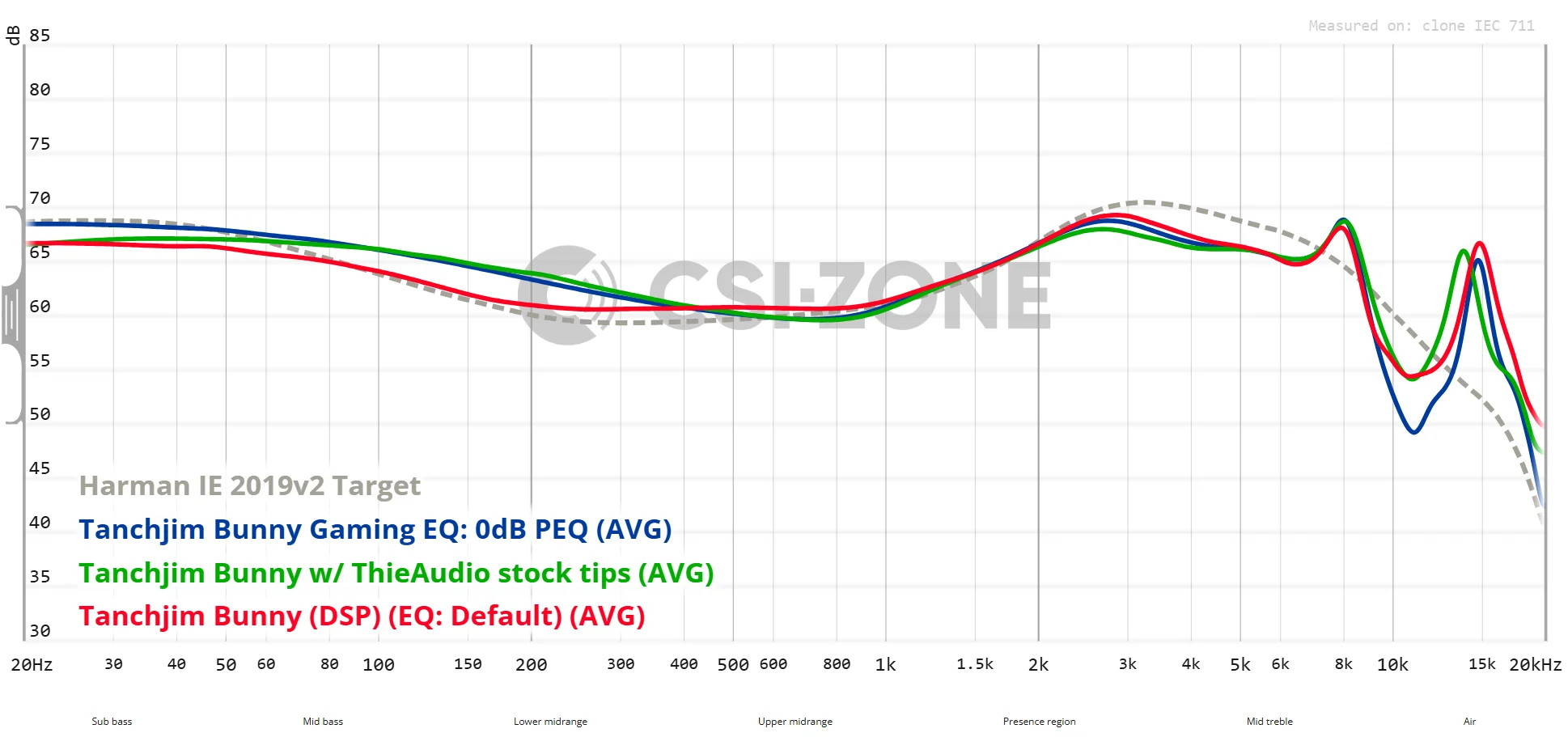
For the Bunny G, the frequency-response comparison CSL-ZONE shared provides helpful context.
The graph compares three configurations, including the Bunny Gaming EQ at 0dB PEQ, a configuration using ThieAudio stock tips, and the Bunny DSP Default response. The Harman IE 2019v2 target provides a useful reference.
A few things immediately stand out.
🥁 Bass: Less Than Harman, but Beautifully Controlled
The Bunny G doesn’t follow the Harman target’s more substantial low-frequency elevation.
Instead, it maintains a relatively restrained bass foundation with a gradual transition into the lower midrange.
That matches what I hear.
The bass doesn’t get bloated or muddy, and it has enough low-frequency support to preserve the music’s structure without overwhelming the rest of the presentation.
The measurement illustrates the tonal balance, while listening confirms a satisfying sense of control.
🎤 Midrange: A Smooth Transition Into Presence
The frequency-response curve gradually dips in the lower midrange before rising toward the upper-midrange presence region around 2-3 kHz.
That helps explain why the Bunny G can sound relatively lean while still delivering meaningful vocal and instrumental presence.
The mids aren’t thick or excessively warm, but they have enough energy to make music engaging.
And importantly, the progression through these frequency regions is relatively smooth.
That’s something I appreciate.
✨ Treble: Air, Energy, and an Interesting Upper-Frequency Dip
The upper frequencies show more pronounced variation.
There’s a peak near 8 kHz, a substantial dip around approximately 10-13 kHz, and additional energy farther into the upper treble.
Different measured configurations show variations in the depth and shape of those higher-frequency features.
I found the DSP presentation cleaner and more enjoyable to listen to, although I wouldn’t claim the processing definitively corrects a specific 12 kHz problem.
Measurements in this region are particularly sensitive to insertion depth, ear-tip geometry, coupler resonance, and measurement technique.
A clone IEC 711 coupler can help with comparative measurements, but it doesn’t perfectly reproduce every individual’s ear canal or upper-treble response.
What matters is that I can adjust the Bunny G’s tuning and that those adjustments produced audible benefits for me.
🎛️ The Graph Doesn’t Measure Everything
One additional distinction is worth emphasizing.
A frequency-response graph doesn’t directly establish instrument separation, imaging precision, or the perceived dimensions of the soundstage.
Those qualities require careful listening and comparison.
The Bunny G’s measured balance helps explain its clarity, bass restraint, and upper-frequency personality.
It doesn’t prove that the IEM is holographic, exceptionally resolving, or unusually spacious.
The graphs help explain the sound. My ears determine whether I enjoy it.
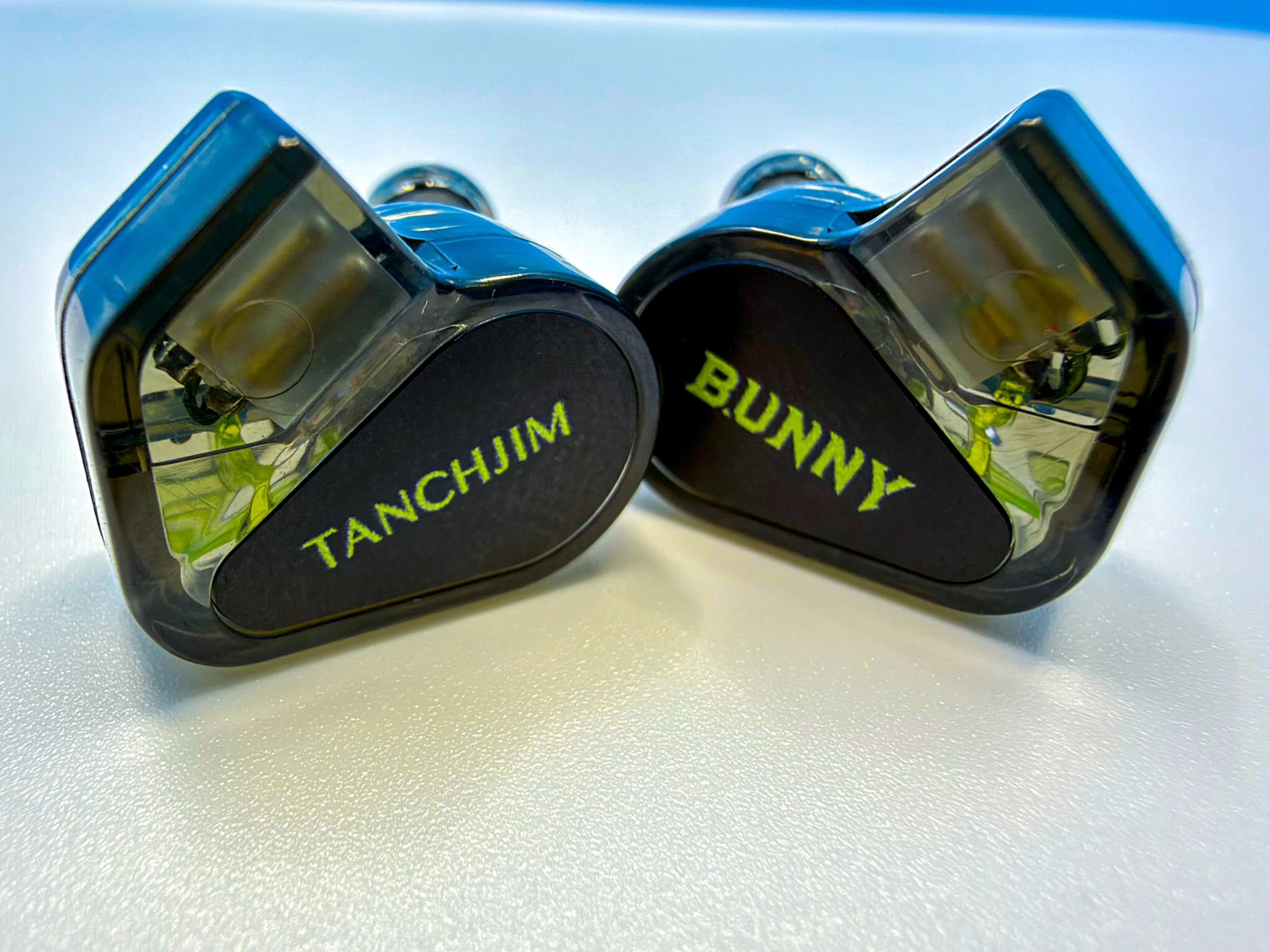
🎼 Sound: Clean, Controlled, and Better Than It Has Any Right to Be
The Bunny G doesn’t impress me with enormous sound, outrageously bass-heavy output, or technical flash.
It impresses me because it sounds clean.
And I mean genuinely clean.
The presentation feels refreshingly disciplined. The bass stays controlled, the mids have authority, and the upper frequencies introduce clarity and air without making every recording feel artificially exaggerated.
That doesn’t mean the sound is perfectly balanced.
The stock tuning can be bright, and some recordings expose an edge that benefits from a little adjustment.
But the underlying presentation is cohesive, with smooth transitions between much of the frequency range.
That’s something I appreciate, especially at this price.
The Bunny G isn’t particularly multidimensional, and it doesn’t possess the extraordinary separation or holographic staging I personally chase.
But it delivers enough technical performance to make music enjoyable, and the overall sound is far more satisfying than its modest price suggests.
This isn’t a little IEM pretending to be a flagship. It’s a little IEM doing the fundamentals exceptionally well.
🥁 Bass: Control Over Chaos
I love good bass.
My fondness for the ZiiGaat Doscinco should make that abundantly clear.
But I don’t believe every IEM needs enormous low-frequency energy to deliver satisfying music.
The Bunny G demonstrates why.
Its bass is clean, controlled, and impressively free from muddiness. It has enough low-frequency presence to establish the recording’s foundation, but it doesn’t overwhelm the vocals or intrude unnecessarily into the midrange.
And I love that approach.
The Bunny doesn’t attempt to impress me through excessive bass quantity. Instead, it delivers low frequencies that support the music without dominating it.
That restraint contributes to the overall clarity.
Bass instruments stay recognizable, and the presentation avoids the bloated warmth that can make inexpensive IEMs sound congested.
When I experimented with EQ, I appreciated how well the Bunny responded to adjustments.
There’s room to explore additional low-frequency weight without immediately sacrificing the clean character that makes the stock presentation enjoyable.
But I didn’t feel the need to turn it into a bass monster.
The Bunny G doesn’t need to shake my skull to impress me. It delivers bass without making a mess.
🎤 Midrange & Vocals: More Power Than You Might Expect
One thing I initially questioned about the Bunny G was its midrange.
The stock presentation isn’t particularly thick or warm, and that relative restraint can make some recordings feel slightly lean.
But the more I listened, the more I appreciated the mids’ presence.
There’s energy here.
Vocals come through clearly, instruments retain their articulation, and the overall presentation has enough authority to keep the music engaging.
The frequency-response measurements help explain that balance.
There’s a dip in parts of the lower midrange, followed by a rise into the upper mids that supports clarity and presence.
That doesn’t automatically produce a lush or intimate vocal presentation.
And the Bunny certainly doesn’t deliver the floating, holographic vocals I typically chase.
But the mids aren’t powerless.
Quite the opposite.
The vocals and instruments come across with an appealing directness, and with my better-matched sources, I found the presentation much more engaging.
The Loxjie P20 was particularly enjoyable because it helped soften the upper-frequency edge while preserving the midrange clarity that makes the Bunny so appealing.
The Bunny G’s mids don’t need excessive warmth to have personality. They’ve got clarity, presence, and enough power to stand on their own.
🎯 Instrument Separation & Placement: Enough Is Enough
Here’s where I want to keep expectations grounded.
The Bunny G doesn’t deliver extraordinary instrument separation.
And that’s perfectly fine.
Individual instruments remain reasonably identifiable, and the presentation stays organized enough to make everyday music listening enjoyable.
But complicated arrangements don’t consistently unravel into distinct, independently positioned layers.
There’s a difference between hearing instruments clearly and hearing them occupy convincing spaces within a three-dimensional performance.
The Bunny does the former considerably better than the latter.
And that distinction matters.
For music lovers, there’s enough separation to follow the arrangement and appreciate the recording.
For gamers, the same clean presentation may help environmental details remain recognizable, although imaging precision and competitive positional accuracy deserve dedicated testing.
I wouldn’t recommend the Bunny G to someone whose primary goal is maximum instrument layering or holographic imaging.
But I also wouldn’t criticize a $29 IEM for failing to compete with far more technically sophisticated equipment in those categories.
The Bunny G gives gamers and music fans enough separation to enjoy the experience without pretending to deliver flagship-level technical performance.
At this price, that’s a perfectly respectable accomplishment.
🏟️ Soundstage & Imaging: Wide, but Not Holographic
Ah, soundstage.
My favorite rabbit hole.
And this time, apparently, the rabbit came with the package.
I love an expansive presentation. I want width, depth, air, believable instrument placement, and vocals that seem to float beyond the IEM shells’ physical boundaries.
The Bunny G offers surprisingly enjoyable width.
The presentation feels open rather than cramped, with a respectable left-to-right spread that gives the music room to breathe.
That’s a welcome characteristic, particularly in an affordable single-dynamic-driver design.
However, the width doesn’t translate into extraordinary dimensionality.
There’s limited front-to-back depth, and the Bunny doesn’t create a particularly immersive holographic environment.
It’s more of a wide, relatively straightforward stereo presentation than an elaborate three-dimensional stage.
And I’m perfectly comfortable with that.
The Bunny isn’t trying to recreate an entire concert hall inside my head.
It provides enough space to keep the music enjoyable, while its clean tuning helps prevent the presentation from becoming overly congested.
The Bunny G has a wide stage, but it doesn’t pretend to be a holographic powerhouse.
And that’s exactly how I’d describe it to someone considering a purchase.
🔬 Detail & Resolution: Clarity Isn’t the Same as Technical Wizardry
One of the Bunny G’s greatest strengths is its clarity.
But I want to make an important distinction.
An IEM can sound clear without being exceptionally resolving.
Emphasizing certain upper-midrange and treble frequencies can make musical details more noticeable, but that doesn’t necessarily mean the driver is recovering information that another IEM couldn’t reproduce.
The Bunny G demonstrates that difference.
Its presentation is clean and articulate, and I genuinely enjoy how easily I can follow familiar recordings.
But I don’t hear the extraordinary microdetail, layering, or low-level spatial information that would distinguish a truly high-resolution technical performer.
And that’s not a problem.
What impresses me is how naturally the Bunny handles the information it does present.
It doesn’t sound desperate to manufacture excitement through exaggerated brightness or artificially sharpened outlines.
The clarity feels relatively effortless.
There’s a difference between turning up the lights and revealing more of what’s actually in the room. The Bunny G gives you an appealingly clear view without pretending to uncover every hidden corner.
✨ Treble & Air: Bright, Open, and Surprisingly Adaptable
The Bunny G is bright.
There’s no getting around that.
And honestly, I don’t mind brightness when it’s executed well.
I enjoy upper-frequency sparkle, clear articulation, and enough air to prevent music from sounding closed in or overly intimate.
The Bunny delivers plenty of that character.
Its upper frequencies give the presentation an appealing sense of openness, helping percussion, vocals, and instrumental details remain articulate.
But the stock tuning can occasionally become edgy.
Some recordings expose a sharper upper-frequency character that may become distracting, particularly during longer listening sessions or at higher volumes.
That’s where experimentation pays off.
Switching to narrow-bore ear tips helped me find a smoother balance, while my tube-amplifier setup further reduced the perceived sharpness.
The iFi GR2 offered additional sound-shaping flexibility, allowing me to refine the presentation while preserving the clarity that made the Bunny enjoyable.
And that’s what I appreciate most.
I didn’t need to eliminate the Bunny’s personality.
I simply wanted to smooth some of its edges.
The Bunny G has sparkle and air, and with the right pairing, that brightness becomes part of its charm rather than a distraction.
🎵 Tonality & Timbre: It’s All About the Flow
One of the Bunny G’s most appealing qualities is how smoothly its frequency regions transition into one another.
The bass doesn’t overwhelm the mids, and the upper frequencies don’t feel completely disconnected from the musical foundation.
The presentation has a cohesive character that makes the Bunny surprisingly enjoyable.
The low end stays controlled, the midrange adds articulation and energy, and the treble brings brightness and air.
That combination isn’t especially warm or lush, but it has a recognizable personality.
It’s also remarkably adaptable.
The stock presentation provides a clean, relatively lean foundation, while EQ and complementary source equipment can produce a smoother, more musically satisfying balance.
For me, the Bunny’s greatest tonal achievement is that it doesn’t need to exaggerate any single frequency region to remain engaging.
Sometimes the best tuning isn’t the one that makes the biggest first impression. It’s the one that keeps you enjoying the music after the novelty wears off.

☁️ Comfort & Fit: Small Shells, Big Appreciation
I’ve reviewed enough oversized IEMs to appreciate manufacturers that remember comfort matters.
The Bunny G’s compact shells are a welcome design choice.
They’re lightweight, relatively unobtrusive, and easier to accommodate than some of the enormous multi-driver housings I’ve encountered.
For someone with smaller ears, that’s a meaningful advantage.
The included silicone tips offer a starting point for a proper seal, but as with most IEMs, tip selection can affect comfort, insertion depth, bass response, and perceived upper-frequency balance.
In my own listening, narrow-bore tips proved particularly useful.
They helped me achieve a more enjoyable tonal balance while maintaining the comfortable fit I wanted.
That doesn’t mean the same tip style will work equally well for everyone.
Ear anatomy varies, and the final acoustic result depends on more than bore diameter alone.
But the Bunny’s compact design makes experimenting relatively approachable.
An IEM doesn’t need enormous shells to sound great, and the Bunny G is a welcome reminder of that.
🔥 Source Pairing, Tip Rolling & EQ: When the Bunny Came Alive
Here’s where the Bunny G became one of my more entertaining recent audio discoveries.
I already liked it as-is.
The clarity was appealing, the bass was disciplined, and the overall presentation had enough energy to keep me interested.
But I began wondering how much more enjoyable it could be with a few thoughtful adjustments.
I started with ear tips.
The narrow-bore tips helped smooth the presentation, making the upper frequencies a little more comfortable without sacrificing the articulation that caught my attention.
Then I experimented with an aftermarket copper cable and different sources.
I wouldn’t claim the copper conductor alone produced a specific tonal transformation. Changes in connection type, electrical characteristics, and associated source equipment can all influence the listening experience.
But the broader experimentation was worthwhile.
🖥️ Topping DX5 II + Loxjie P20: The Revelation
When I connected the Bunny to my DX5 II and Loxjie P20, the presentation became noticeably more engaging.
The P20 softened the treble edge that occasionally distracted me, while preserving the clarity and overall coherence that made the Bunny enjoyable.
And suddenly, this inexpensive little IEM was singing.
It was one of those moments that reminds me why I keep experimenting with audio equipment.
The Bunny hadn’t magically transformed into an enormously resolving, holographic flagship.
Instrument separation was still relatively modest, and the spatial presentation remained wider than deep.
But the overall musical enjoyment increased substantially.
I found myself appreciating the sound rather than thinking about what the equipment lacked.
And in that respect, the Bunny began challenging my expectations of far more expensive IEMs.
🎛️ iFi GR2: Finding Another Personality
The iFi GR2 gave me another chance to explore the Bunny’s tuning flexibility.
Its sound-shaping options allowed me to refine the presentation further, preserving the clean character I enjoyed while exploring a more satisfying tonal balance.
The Bunny responded beautifully to those changes.
That’s one of the things I appreciate most about this IEM.
It has a strong enough foundation to remain enjoyable in relatively simple configurations, but enough flexibility to reward enthusiasts who like experimenting.
⚡ Does the Bunny Need More Power?
Not necessarily.
I wouldn’t recommend purchasing a powerful desktop amplifier simply because the Bunny sounded especially enjoyable through my equipment.
A sensitive IEM generally doesn’t need much electrical power to reach normal listening levels.
What mattered in my testing was the overall pairing.
Amplifier characteristics, output impedance, EQ, gain, listening level, and other variables may influence the final result.
I haven’t done controlled testing to isolate which factor contributed most.
But the listening experience was unmistakable.
The Bunny G rewarded experimentation, and my favorite combinations delivered musical enjoyment that far exceeded my expectations for the price.
📱 The iOS Problem: TANCHJIM, We Need to Talk
Here’s where the Bunny G lost some serious points.
One of its biggest selling features is customizable DSP.
TANCHJIM offers an adjustable parametric equalizer, gaming-specific sound options, and extra processing tools to help listeners personalize their experience.
And as I’ve already explained, this little IEM responds wonderfully to tuning adjustments.
There’s just one rather frustrating problem.
You can’t configure the Bunny G’s wired DSP settings directly through TANCHJIM’s iOS app.
Seriously, TANCHJIM?
The company’s instructions say Apple users must configure the Bunny G on an Android device or PC, save the settings to the hardware, then reconnect it to an iPhone or iPad.
Once saved, the settings remain active.
That’s certainly better than losing the configuration every time you switch devices, but it’s not particularly convenient.
And I didn’t simply take TANCHJIM’s word for it.
🎮 I Tested It With My HiBy R4 Evangelion
I’m not primarily an Android user, but I do own the HiBy R4 Evangelion digital audio player.
So I connected the Bunny G to the R4, opened TANCHJIM’s Android app, and explored its DSP functionality.
Everything worked.
I accessed the settings and used the available DSP controls through Android, confirming that the Bunny G’s customization features work as intended on a supported device.
That’s encouraging.
The problem isn’t that the Bunny’s DSP lacks functionality.
Apple users can’t access those controls directly on the devices they use every day.
And that creates a very real inconvenience.
Imagine gaming on an iPad and deciding that a particular sound profile isn’t quite right.
Maybe you want to adjust the bass, emphasize certain environmental cues, or reduce some upper-frequency energy.
Instead of opening the TANCHJIM app on the iPad and making a quick adjustment, you have to switch to an Android device or PC, change the configuration, save it, and then return to your Apple device.
That’s a ridiculous amount of effort for something that should be simple.
For a product marketed specifically around competitive gaming, it feels especially disconnected from the intended experience.
🍎 An App That Doesn’t Support the Feature You Bought
To be clear, TANCHJIM does offer an iOS app.
But the iOS app doesn’t offer the same wired USB-C DSP configuration support that the Bunny G gets on Android and PC.
That distinction matters.
I don’t want readers to think the Bunny G can’t be used with Apple devices or that saved EQ configurations stop working on iOS.
They don’t.
The issue is that you can’t make those changes directly.
And that’s enough to affect my rating.
If you’re an Android user, this limitation may be largely irrelevant. The app works, and the ability to modify the Bunny’s sound is genuinely valuable.
If you’re an Apple user, however, the experience is considerably less convenient.
I can forgive the modest accessory selection. I can forgive a basic cloth pouch. I can forgive average instrument separation in an inexpensive IEM.
But when customization is one of the product’s defining features, making it inaccessible on an entire major mobile platform is a different matter.
The Bunny G deserves praise for its sound-shaping flexibility, but TANCHJIM loses points for making Apple users jump through unnecessary hoops to enjoy it.
💰 Value: For the Money? Come On!
Let’s talk about the price.
Approximately $29.
Seriously.
At that price, I’d consider the Bunny G a worthwhile purchase based on its underlying sound quality alone.
The bass is clean and controlled. The mids have real presence. The treble offers clarity and air, and the soundstage is pleasantly wide.
Instrument separation is modest, and the overall presentation isn’t particularly holographic, but neither limitation prevents the Bunny from being enjoyable.
Paired with complementary equipment, the listening experience becomes considerably more satisfying.
That’s where the value proposition gets interesting.
I’m not suggesting the Bunny G replaces expensive, technically accomplished IEMs. It doesn’t offer the layering, dimensionality, or refinement of stronger high-end performers.
But it still delivers basic musical competence and enjoyment, making comparisons with more expensive equipment surprisingly entertaining.
The DSP functionality adds another layer of value on supported platforms, letting listeners tailor the sound without buying separate EQ hardware.
The microphone and gaming-oriented processing also make the Bunny useful for more than casual music listening.
Of course, the iOS limitation is worth considering.
An Apple user who wants to modify EQ frequently may find the configuration process frustrating enough to prefer a different product.
But even with that drawback, the Bunny G remains a remarkably capable little IEM.
At $29, the Bunny G isn’t merely inexpensive. It’s genuinely good audio equipment at an exceptionally approachable price.
👹 Who Is This For?
The Bunny G makes an excellent case for gamers who want clear, articulate sound without investing in an expensive headset or complicated audio system.
Its relatively restrained bass and energetic upper frequencies suit listeners who prioritize audibility and clarity over massive low-frequency impact.
Music lovers also have plenty to appreciate.
Controlled bass, powerful mids, an enjoyable soundstage width, and strong EQ responsiveness make it a rewarding everyday IEM.
For enthusiasts who enjoy experimenting with different tips, sources, and EQ settings, the Bunny offers far more flexibility than its price suggests.
However, listeners seeking enormous bass impact, lush warmth, holographic dimensionality, or exceptional instrument separation should keep their expectations realistic.
The Bunny G doesn’t attempt to deliver every desirable technical characteristic.
Apple users who want seamless access to its native DSP settings should consider the software limitations before buying.
The Bunny G suits listeners who want clean sound, adaptable tuning, and outstanding value without demanding flagship-level technical performance.

✨ Clarity: 4.7/5
Excellent clarity for the price, with a clean and relatively effortless presentation that makes familiar recordings enjoyable without excessive muddiness or artificially exaggerated intensity.
🎤 Midrange & Vocals: 4.5/5
Present, articulate, and surprisingly powerful, although the relatively restrained lower mids prevent the presentation from becoming especially lush or full-bodied.
🥁 Bass: 4.6/5
Clean, controlled, and beautifully integrated into the overall tuning. The Bunny doesn’t deliver enormous bass quantity, but its restraint contributes to the clarity and cohesion I appreciate.
🎯 Separation & Placement: 4.0/5
Adequate instrument separation and generally understandable placement, but limited layering and spatial independence compared with stronger technical performers.
🏟️ Width & Depth: 4.2/5
Pleasantly wide soundstage with welcome openness, although front-to-back depth and holographic dimensionality remain relatively modest.
🔬 Detail & Resolution: 4.3/5
Good articulation and perceived detail for the price, though the Bunny’s technical resolving power shouldn’t be confused with the added clarity from its energetic tuning.
✨ Treble & Air: 4.3/5
Bright, open, and articulate, with enjoyable air and sparkle. The stock presentation can occasionally become edgy, but thoughtful pairing and EQ help refine its character.
🦴 Slam & Dynamics: 4.3/5
Controlled dynamic expression with enough impact to keep the music enjoyable, though it isn’t built around enormous physical slam or exaggerated excitement.
🎤 Vocal Lift: 4.3/5
Good vocal presence and articulation, but limited floating or holographic presentation.
⚡ Speed & Transients: 4.5/5
Crisp attacks and clean articulation give the Bunny an energetic, responsive character that complements both music listening and its gaming-oriented tuning.
🎵 Tonality & Timbre: 4.5/5
Cohesive frequency transitions and an appealing overall balance, particularly after refining the brighter stock tuning.
🎛️ Tuning & Pairing Flexibility: 4.7/5
Excellent response to EQ, ear-tip changes, and complementary amplification. The DSP offers meaningful customization, though iOS limitations reduce how convenient it is to access.
☁️ Comfort & Fit: 4.6/5
Compact, lightweight shells with an approachable design that avoids unnecessary bulk.
🎨 Design & Build: 4.7/5
Beautiful translucent black-and-green styling with a distinctive gaming identity and appealing physical construction for the price.
📦 Accessories & Presentation: 4.0/5
Functional, tidy packaging with a basic, appropriate accessory selection. The included cloth pouch provides limited protection, but the package is reasonable for an inexpensive IEM.
📱 Software & Platform Compatibility: 3.0/5
Useful DSP functionality on supported Android and PC platforms, verified on my HiBy R4 Evangelion. However, the inability to configure wired DSP settings directly on iOS creates an unnecessary inconvenience, particularly for Apple gamers.
💰 Value: 4.8/5
Outstanding acoustic performance and substantial tuning flexibility for approximately $29. Software limitations keep this from a stronger recommendation, but the underlying audio value remains exceptional.
🦖 Overall GearZilla Score: 4.2/5 | A-Class Kaiju
The overall score reflects my editorial assessment of the Bunny G’s sound, design, functionality, compatibility, accessories, and complete ownership experience, not a simple arithmetic average of the individual categories.
🦖 Final Roar: Born to Compete, Built to Surprise
Great sound doesn’t always come with an enormous price tag. Sometimes it arrives wrapped in premium packaging, exotic driver technologies, and beautifully machined metal shells. Other times, it shows up in a modest little box with a cloth pouch, a USB-C cable, and a name better suited to a children’s cartoon than a competitive gaming product.
The TANCHJIM Bunny G belongs firmly in that second category, and I absolutely love it.
What surprised me most wasn’t any single technical achievement, but how naturally this little IEM brings everything together. Its bass is controlled and satisfying, its mids carry enough weight to keep vocals and instruments engaging, and its treble adds welcome clarity and air. The soundstage offers surprising width for the price, even if instrument separation isn’t particularly remarkable and the presentation never becomes truly holographic.
But the Bunny G isn’t trying to rewrite the rules of spatial audio. Its strength is getting the fundamentals right while making music genuinely enjoyable.
The more I experimented, the more I appreciated what TANCHJIM accomplished. Different ear tips, EQ adjustments, and source pairings revealed surprising flexibility. The Topping DX5 II and Loxjie P20 brought additional smoothness and musicality, while the iFi GR2 gave me more room to refine the presentation without losing the character that made the Bunny appealing in the first place.
It’s the kind of experience that reminds me why affordable audio equipment can be so exciting. When a $29 IEM sounds this enjoyable, it makes you question just how much more you really need to spend.
Unfortunately, the Bunny G’s software experience doesn’t quite match its acoustic performance. TANCHJIM promotes customizable DSP as part of its gaming-focused appeal, and while I verified that those features work through the Android app on my HiBy R4 Evangelion, iPhone and iPad users can’t make those adjustments directly on their devices. Switching to Android, configuring the settings, saving them, and reconnecting adds unnecessary friction for Apple gamers.
That’s a meaningful limitation for a product built around convenience and customization, and it’s ultimately what brought my final score down from the higher rating I initially considered.
Still, there’s far more to celebrate here than criticize. Gamers get a lively, articulate presentation with useful DSP capabilities; music lovers get an engaging, well-balanced listening experience; and enthusiasts willing to experiment with their audio chains may discover even more performance hiding inside those unassuming little shells.
The TANCHJIM Bunny G earns a 4.2/5 and my A-Class Kaiju rating. It’s an outstanding value with an impressive acoustic foundation, held back mainly by a software ecosystem that still needs to catch up to the hardware.
TANCHJIM calls it Born to Compete, and I think that’s fitting. The Bunny G doesn’t need to outperform every expensive IEM, deliver holographic imaging, or dominate every technical category to ea

🎶 GearZilla Listening Playlist: New Music, New Monsters
Every GearZilla Field Report deserves a soundtrack, and the TANCHJIM Bunny G gave me the perfect excuse to explore everything from intimate jazz vocals and Brazilian samba to Puerto Rican salsa, atmospheric alternative rock, and modern R&B.
This playlist puts the Bunny G’s controlled bass, expressive midrange, treble clarity, and soundstage width through different musical challenges. The goal isn’t simply to hear whether a song sounds good, but to understand how an affordable IEM handles the rhythm, emotion, layering, and subtle details that make music come alive.
1. James – Laufey
Testing: Vocal intimacy, midrange timbre, and instrumental balance.
Laufey’s jazz-inspired delivery is a wonderful test of vocal texture and naturalness. I’m listening for how the Bunny G handles her voice’s warmth and body without pushing the accompanying instrumentation into the background.
2. Gabriela (A COLORS SHOW) – Mari Froes
Testing: Vocal articulation, rhythmic texture, and clarity.
Mari Froes brings a captivating combination of vocal expression and Brazilian musical character. This is an opportunity to hear whether the Bunny G preserves the subtle textures of her performance while keeping the rhythmic elements distinct and engaging.
3. samba do moço bonito – Clara Valverde
Testing: Percussion, acoustic instrumentation, and rhythmic separation.
Brazilian samba offers a terrific workout for an IEM’s sense of timing. With nylon-string guitar, percussion, and playful vocals, I’m listening for clean transients and enough separation to keep the arrangement lively without getting congested.
4. Tú Con Él – Frankie Ruiz
Testing: Bass control, brass energy, percussion, and complex arrangements.
A little salsa romántica from El Papá de la Salsa! This track challenges the Bunny G to keep the bass groove disciplined while preserving the attack and excitement of horns, piano, and Latin percussion. When the arrangement gets busy, can everything retain its musical identity?
5. In This Shirt – The Irrepressibles
Testing: Dynamic buildup, orchestral layering, and spatial expansion.
Few selections here offer a more dramatic opportunity to explore the Bunny G’s soundstage. The gradual orchestral buildup and emotional vocal performance challenge the IEM to maintain clarity as the arrangement grows in intensity and scale.
6. Pyramid Song – Radiohead
Testing: Depth, ambiance, instrumental decay, and imaging.
The haunting piano, spacious atmosphere, and unusual rhythmic feel make this a revealing track for spatial performance. I’m listening for the space surrounding individual notes, the natural decay of the instrumentation, and whether the Bunny G communicates a convincing sense of depth rather than simply spreading sound from left to right.
7. I Hate U – SZA
Testing: Sub-bass extension, vocal layering, and modern production.
SZA takes us into contemporary R&B territory, where low-frequency weight and vocal clarity must coexist. This is a useful test of whether the Bunny G can deliver satisfying bass presence without masking vocal detail or crowding the mix.
🎧 What I’m Listening For
Seven songs, several languages, and wildly different production styles, but one consistent question: Can the TANCHJIM Bunny G preserve the music’s personality without sacrificing clarity, balance, or enjoyment?
That’s the beauty of testing with a diverse soundtrack. Great audio isn’t just about hearing more detail. It’s about hearing more of the story each artist is trying to tell.
Listen bigger. Even when the monster is small.
✅ Buy If
- You want excellent clarity and controlled bass at an affordable price.
- You appreciate articulate mids and an open, bright presentation.
- You prefer a wider soundstage over excessive bass quantity.
- You enjoy experimenting with EQ, ear tips, and source pairing.
- You want affordable, gaming-oriented IEMs with customizable sound.
- You have access to Android or Windows for native DSP configuration.
- You want enjoyable music reproduction without spending much money.
- You appreciate compact, lightweight shells and distinctive styling.
- You believe good sound matters more than extravagant accessories.
⛔ Skip If
- You want enormous bass impact or consistently warm tuning.
- You’re particularly sensitive to bright upper frequencies.
- You prioritize exceptional instrument separation and holographic imaging.
- You need native iOS access to the manufacturer’s wired-DSP customization tools.
- You don’t have access to Android or Windows and expect to adjust DSP frequently.
- You demand a premium carrying case and generous accessories.
- You want independently verified competitive gaming positional performance.
- You expect a budget IEM to match flagship-level technical resolution.
🧡🦖 GearZilla Verdict: 4.2/5 | A-Class Kaiju
The TANCHJIM Bunny G proves that genuinely enjoyable audio doesn’t have to cost a fortune.
Its clean, controlled bass; articulate midrange; bright, airy treble; cohesive presentation; and surprisingly wide soundstage make it an excellent value for music lovers and a promising, affordable option for gamers.
It’s not an instrument-separation champion or a holographic monster, but it delivers enough technical performance to be satisfying in either role.
The Bunny also responds beautifully to experimentation, and my time with the Topping DX5 II, Loxjie P20, and iFi GR2 revealed a level of musical enjoyment that exceeded my expectations.
Unfortunately, the inability to configure its wired DSP functionality directly on iOS keeps the complete experience from matching its underlying sound quality.
TANCHJIM has created an impressive little IEM, but it needs to make its best features more convenient for Apple users.
For approximately $29, the Bunny G is still an outstanding audio bargain. Just understand its software limitations before you buy.
The Bunny was born to compete.
For the price, this little monster absolutely deserves a spot in the conversation.
🦖 Ready to meet the Bunny G?
Explore TANCHJIM’s Born to Compete product page.
Hear the GearZilla Roar.
Listen Bigger! 🦖
Share This Story, Choose Your Platform!