



🧪 Welcome to the SpinFit Challenge
In August, I reached out to Annie and the SpinFit team with a novel idea.
Actually, calling it an idea might be a little generous.
It was more like an insane, possibly unprovable audio hypothesis involving tiny pieces of silicone, a ridiculous number of IEMs, and way too much curiosity.
Perfect GearZilla territory. 🦖
I’ve spent enough time rolling ear tips to know they matter.
Change the seal, insertion depth, bore, angle, or the way an IEM physically sits in your ear, and you can change the entire listening experience.
Sometimes the difference is immediate.
Other times you’re swapping back and forth for twenty minutes wondering whether you actually heard something or whether the fumes in the Kaiju Lab are finally getting to you.
But I wanted to go farther than simply asking:
Do ear tips make a difference?
I think we’re past that.
My question was much more interesting.
Can tip rolling become predictable?
Could I take several very different SpinFit designs, rotate them across IEMs I know extremely well and eventually begin recognizing patterns?
If an IEM won’t stay planted, could I predict which tip might help?
If the nozzle is huge, could I narrow the choices before randomly trying everything in the box?
If the bass sounds a little light, how can I tell whether I’m dealing with tuning or simply a poor seal?
If vocals seem farther away than I prefer, could a different insertion depth or angle change the presentation?
If the IEM sounds fantastic but starts to annoy my ears after 45 minutes, is there a SpinFit that could save the relationship?
That became the SpinFit Challenge.
And to their enormous credit, Annie and the SpinFit team didn’t run away when I explained what I wanted to do.
They leaned into it.
💌 Then They Sent Me a Sticky Note
This deserves its own section.
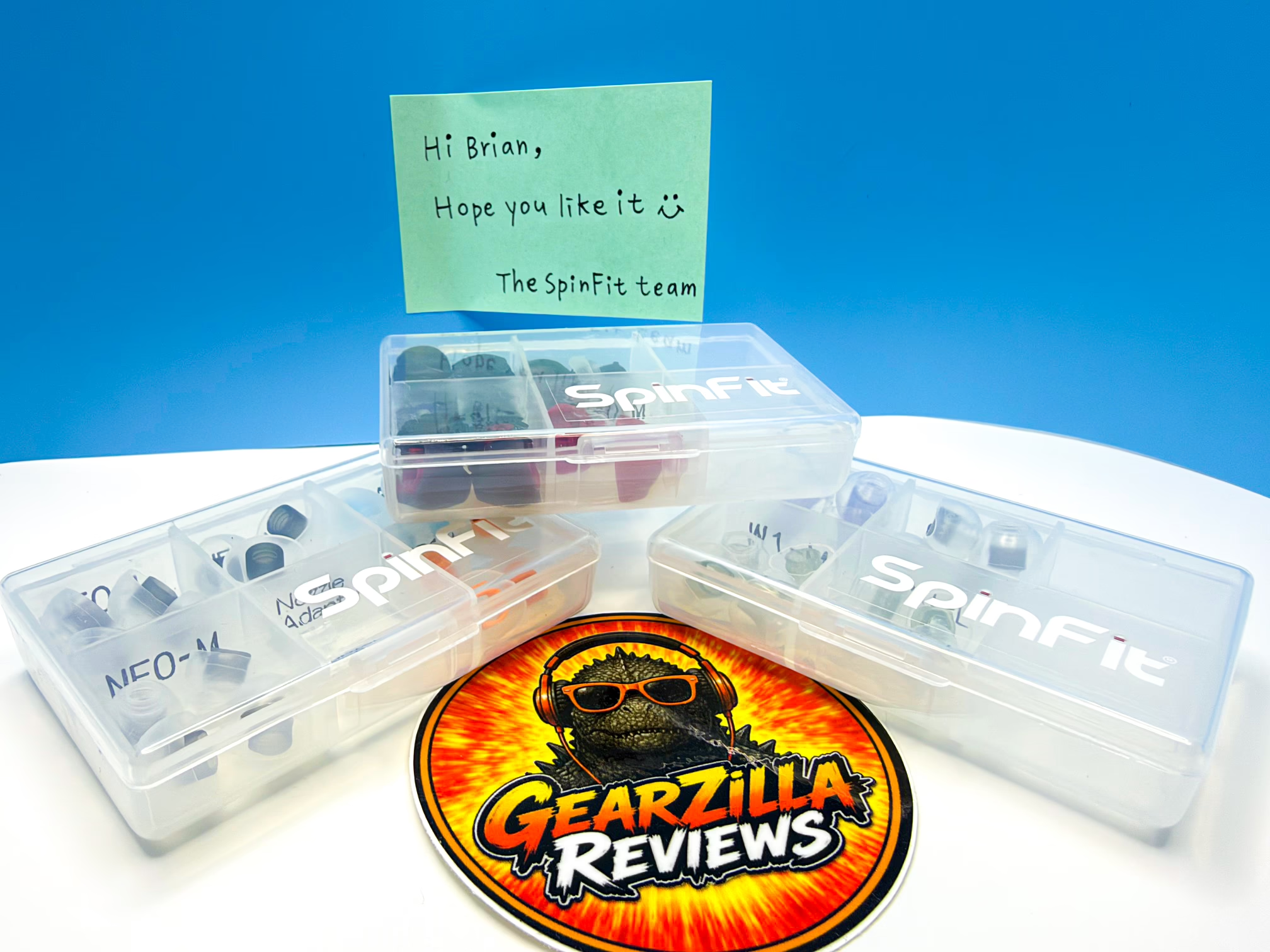
SpinFit sent over a beautifully organized assortment of tips, sizes, and adapters for the experiment.
And tucked inside was a handwritten sticky note.
Oh, come on, people…
I’m a storyteller. Of course that got me.
Companies spend incredible amounts of money trying to create some kind of connection with customers, and sometimes the thing you actually remember is somebody taking thirty seconds to write you a note.
It was small.
It was personal.
And I absolutely loved it.
Customer for life – Just take my money!
That has absolutely nothing to do with how any of these tips perform in the Kaiju Lab, and it doesn’t affect my conclusions.
But it says something about the humans behind the product, and those little moments are worth recognizing.
So thank you, Annie.
Then, naturally, I did the only responsible thing possible.
I took SpinFit’s beautifully organized package and began systematically dismantling its organization by placing tiny silicone tips on everything within reach.
Science.
Sort of.
📦 What SpinFit Sent Into the Lair
The SpinFit Challenge includes 6 very different designs:
That was exactly what I wanted, because this experiment needed more than six slightly different versions of the same idea. I wanted different geometries, stem lengths, insertion possibilities, approaches to nozzle compatibility, and ways for an IEM to physically interact with the ear. That gave the challenge enough scope to actually test the hypothesis, rather than simply collecting six impressions and calling it a guide.
Each model also gave me a different question to chase. The W1 could serve as a modern all-around reference, while the OMNI made sense as a test of versatility and compatibility. The NEO gave me a chance to focus more heavily on everyday comfort and long listening sessions, while the CP145 offered a different geometry for those moments when another design simply didn’t sit quite right. The CP155 opened the door to larger nozzles and varied insertion behavior, while the CP240, with its double-flange design and adapters, introduced a more specialized option for deeper insertion and isolation.
That’s really what made this lineup interesting. I wasn’t just asking whether one sounded better than another. I wanted to know whether one design consistently improved stability, whether another made difficult nozzles easier to manage, whether deeper insertion improved the seal, or whether one tip could work beautifully on one IEM but completely fall apart on another.
Most importantly, I wanted to see whether those same behaviors would start repeating across multiple IEMs.
Because if they did, then my ridiculous little hypothesis might actually have something to it.
And if they didn’t, I’d have six boxes of silicone proving that human ears are even more chaotic than I thought.
Either outcome sounded fun.
📢 Disclosure
Many thanks to Annie and the SpinFit team for providing the ear tips featured in this guide and indulging what may be one of my more ridiculous experiments. SpinFit had no editorial control over this article and didn’t review or approve my conclusions before publication.
And one more disclaimer, because this is important: this isn’t exact science. No laboratory was rented, there’s no clinical trial, and nobody is getting a doctorate from this. There are also no scientists in white coats standing behind me measuring nozzle insertion depth while I shout “AGAIN!” and dramatically swap another CP145.
What this is, instead, is experiential testing built around repetition and familiarity. I’m using IEMs I know well, music I know well, multiple SpinFit designs, different sizes, repeated comparisons, and eventually different sources, amplification, and EQ to see whether the same kinds of patterns keep showing up.
The impressions here are based on one listener, one set of ears, and one very overworked Kaiju Lab, so your anatomy, fit, and preferences can absolutely produce different results. In fact, I expect them to.
That variability isn’t something I’m trying to eliminate from the experiment.
It’s part of what I’m trying to understand.
🦖 The Hypothesis: Can We Make Tip Rolling Less Random?
Most of us (I mean me) learn to roll tips through trial and error. We open a box, stare at a dozen tiny pieces of silicone, pick one, decide it’s too small, try another, decide that one’s too big, finally land on something that feels right, play a song, and then immediately start second-guessing ourselves.
Was there more bass?
Did the vocals move forward?
Did the treble smooth out a little?
Was the seal actually better, or did I just insert the IEM differently this time?
So we go back. Then forward. Then back again until we can barely remember what the first combination sounded like.
Congratulations.
Whether you call yourself an audiophile, an audio enthusiast, or just someone who owns way too many tiny pieces of silicone, welcome to the club. 🦖
But there has to be a better way to approach this, and that became the core of my hypothesis. Instead of starting with “Which tip is best?”, I wanted to start with a much more useful question:
“What problem am I trying to solve?”
That simple shift changes the entire exercise.
Maybe there’s nothing wrong with the tuning at all. Maybe the shell keeps sliding outward, the bass disappears when you move your jaw, the nozzle is so wide half your collection won’t fit, or the IEM sounds fantastic for thirty minutes before your ear starts begging for mercy.
Those aren’t all sound problems. Some are fit problems, some are seal problems, some are geometry problems, and some are just your ears reminding you that nature never agreed to standardized dimensions.
The real challenge was determining whether certain SpinFit designs could consistently solve specific kinds of problems across different IEMs. If they could, tip rolling might become a little less random and a lot more useful.
🌀 What Makes SpinFit Different?
The defining idea here is movement.
SpinFit’s design allows the tip to flex and articulate around the nozzle rather than acting as a completely rigid extension of it. That sounds simple, but once you start thinking about what happens when an IEM settles into your ear at a slightly different angle, the implications get much more interesting.
A small change in position can affect pressure, insertion depth, seal, and how the shell rests against your outer ear. It can also change how the nozzle aligns with your ear canal, meaning the physical relationship between the IEM and your ear changes before we even start talking about sound.
And that matters because the listening experience begins with fit.
If the shell sits more naturally, the seal may become more consistent. If the insertion depth changes, the presentation may change with it. If the nozzle aligns differently, you may perceive differences in bass, vocals, treble, openness, or placement even though the IEM itself hasn’t changed at all.
That doesn’t mean SpinFit is secretly installing a new crossover every time you swap tips. The tip isn’t creating information that wasn’t already in the recording.
What it can do is change the conditions under which that information reaches your ear.
That’s a much more grounded way to think about tip rolling, and it’s exactly why SpinFit made such an interesting subject for this challenge.
🎧 Seal First. Always.
Before we start talking about bass texture, floating vocals, or the triangle player hiding somewhere in the back of a 1976 recording, we need to deal with the least glamorous part of the entire process: seal.
If an IEM isn’t sealing correctly, everything downstream gets messy. Bass can disappear, isolation suffers, channel balance can feel inconsistent, and the overall presentation can change every time the shell shifts slightly in your ear.
That’s what makes this such an easy problem to misdiagnose. You can spend hundreds of dollars upgrading your source, cable, or amplification, connect an expensive IEM to a gorgeous desktop chain, fire up lossless audio, and still end up disappointed because a tiny piece of silicone isn’t sealing properly.
When you put it that way, audiophilia is occasionally hilarious.
A slightly undersized tip can lead you to question the IEM, the DAC, the recording, and possibly several of your recent purchasing decisions, when the actual problem is a tiny air leak in your left ear.
That’s why seal became the first checkpoint in the SpinFit Challenge. Before I start talking about perceived changes in bass, vocals, treble, depth, or placement, I want to know that I’m getting a reliable and repeatable seal.
Otherwise, I’m not really comparing ear tips.
I’m comparing different leaks. 🦖
👂 Stop Saying “I’m a Medium”
I’m guilty of this one.
I usually reach for Medium tips, and after a while, that starts to feel less like a size choice and more like part of your identity.
“I’m a Medium.”
No.
You’re not.
You’re a human being with two oddly shaped ear canals that may not even agree with each other, and a Medium in one design isn’t guaranteed to fit like a Medium in another.
Diameter is only part of the equation. Stem height, umbrella shape, silicone flexibility, insertion depth, and nozzle geometry all change how that tip actually behaves once it’s attached to an IEM and sitting in your ear.
That’s why one SpinFit may work beautifully for me in Medium while another fits better one size up or down. I may even find that my left and right ears prefer different sizes with the same model, which sounds ridiculous until you remember that our ears weren’t manufactured as a matched pair.
They’re anatomy, not accessories.
So I’m trying to stop thinking in terms of “my size” and start thinking in terms of “the right size for this tip, this IEM, and this ear.”
That mindset matters because getting stubborn about size can wreck the rest of the experiment before the music even starts.
If the seal is wrong, the comparison is wrong. If the insertion is wrong, the comfort may be wrong. And if the shell is sitting differently because I insisted on using the size I usually wear, I’m not really evaluating the tip fairly.
Nature didn’t read the spec sheet. 🦖
🦖 Welcome to the GearZilla Testing Lair
I didn’t want to throw these tips on one or two IEMs, jot down a few quick impressions, and call it a guide. If I was going to test whether tip rolling could become even slightly more predictable, I needed a real process.
Not laboratory science.
Not a measurement rig.
But enough structure and repetition that I could start spotting patterns instead of just chasing impressions around the room.
So we went full Kaiju Lab. 🧪🎧
That meant building the test around IEMs I already knew well, familiar tracks, familiar sources, and a flat EQ profile. I’d establish a baseline, swap the tip, listen again, go back, reinsert, listen, swap, and repeat. Same IEM. Same source. Same music. One variable at a time.
That was the whole point.
I didn’t want six boxes of SpinFits turning into six random opinions. I wanted to know whether certain tip designs kept solving the same kinds of problems across different IEMs — stability, seal, comfort, insertion depth, isolation, or just getting a shell to sit properly in my ears.
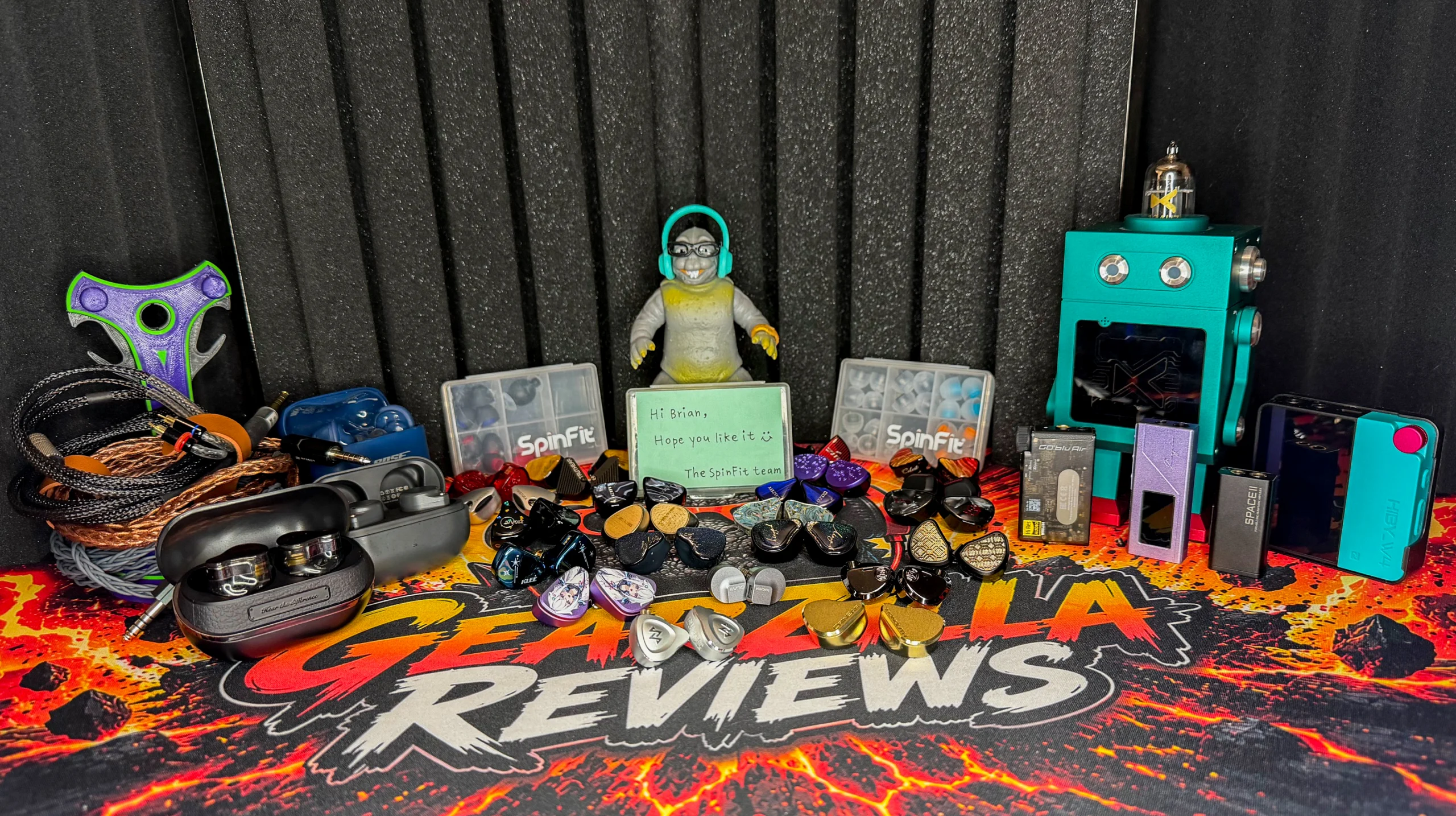
So yes, the desk got crowded.
The sources piled up.
The IEM collection came out in force.
And the tiny handwritten note from the SpinFit team sat right there in the middle of the madness like a reminder that this entire ridiculous experiment started with a very simple question:
Can tip rolling become a little less random?
It isn’t glamorous.
Then again, neither is spending ten minutes crawling under your desk because a CP145 launched itself into another dimension.
🎧 The IEM Rotation
I deliberately wanted very different IEMs in this experiment because testing a tip on one set only tells me whether I like that particular pairing. That’s useful, but it doesn’t tell me much about whether the tip itself has a repeatable personality or solves a particular kind of problem.
For this challenge, I wanted variety in just about every direction. Small shells and big shells. Lightweight single-driver sets and chunkier multi-driver designs. Narrower and wider nozzles. Different insertion depths, venting approaches, tuning styles, and physical shapes. Some of these IEMs already fit me beautifully, while others require a little more negotiation before my ears and the shell agree to coexist peacefully.
That variety matters because the same ear tip can face completely different challenges depending on what’s attached to it. A tip might help anchor a heavier shell like the ZiiGaat Doscinco, while that extra stability may be far less important on a smaller, lighter IEM like the TANCHJIM OLA II. Something that works beautifully with the nozzle and shell geometry of the XENNS Mangird Tea Pro might behave very differently on the CrinEar Project Monolith or FATfreq Deuce.
That’s exactly what I wanted.
The testing rotation included:
- Celest IgniteX Beast
- COZOY D1
- COZOY D2
- CrinEar Project Monolith
- CVJ Nozomi
- FATfreq Deuce
- iBasso Jr. KLEE KiSEKi
- Kefine Arnar
- NF ACOUS NM25
- NICEHCK Tears
- PULA Unicrom
- Sivga Que
- TANCHJIM OLA II
- TANGZU Wan’er S.G II Red Lion
- TANGZU Yu Xuan Ji
- TANGZU Zetian Wu
- TRUTHEAR PURE
- TWISTURA Delta
- TWISTURA Woodnote
- XENNS Mangird Tea Pro
- ZiiGaat Doscinco
- ZiiGaat x Vivir Digital RUMBA
There’s another reason I wanted familiar gear in the rotation: I need to know what changed.
If an IEM arrived yesterday and I immediately started swapping SpinFits onto it, I’d be learning the IEM and the tip at the same time. That’s a lot harder to untangle. With something like the Doscinco, Tea Pro, OLA II, KLEE KiSEKi, or RUMBA, I already have a strong sense of how the IEM fits, where its vocals usually sit, how its bass behaves, and how the presentation normally comes together.
That gives me a baseline.
From there, I’m not simply asking whether a SpinFit makes the IEM sound “better.” I’m looking at why the combination behaves differently. Did the seal improve? Did the shell stop moving? Did insertion become shallower or deeper? Did the nozzle sit at a more natural angle? Did comfort improve enough that I stopped fiddling with the IEM every fifteen minutes?
And then comes the important part.
If a SpinFit works beautifully on one IEM, I’ve discovered a good pairing.
If that same SpinFit keeps solving the same kind of problem across several completely different IEMs, I’ve discovered a pattern.
That’s what the SpinFit Challenge is really hunting for.
Twenty-plus IEMs aren’t sitting in the Kaiju Lab because I needed an excuse to dump my collection onto the desk and take a ridiculous photo.
Okay, not only because I needed an excuse to do that. 🦖
They’re there because the more different shells, nozzles, and designs I throw at these tips, the better chance I have of separating a lucky pairing from something genuinely repeatable.
And if we’re trying to make tip rolling a little less random, repeatability is where things start getting interesting.
📡 TWS Joined the Experiment Too
Wireless earbuds bring their own flavor of chaos, so I wanted TWS in the SpinFit Challenge too.
For that part of the testing, I rotated compatible tips through:
TWS adds a problem traditional wired IEMs don’t have to worry about nearly as much: the charging case.
You can find an aftermarket tip that feels spectacular, provides a great seal, improves stability, and seems perfect in every way. Then you put the earbud back into its case, and nothing happens because the tip is too tall or too wide, or it changes how the bud seats against the charging contacts.
Congratulations.
You’ve created a pair of wireless earbuds that can no longer recharge.
That’s why the TWS portion of this experiment had to go beyond sound. I was still paying attention to seal, comfort, insertion depth, and shell stability, but I also wanted to know whether the earbuds would actually sit correctly in their case and make reliable contact with the charging pins.
ANC adds another layer. With noise-canceling earbuds, the ear tip does more than just affect comfort and sound. A better passive seal can change how much outside noise reaches your ear before the ANC system even gets involved, which means fit can affect the whole noise-control experience.
That makes TWS tip rolling a little more complicated than simply asking whether one tip sounds better than another.
The tip has to fit your ear.
It has to fit the earbud.
It has to fit the case.
And ideally, it should do all three without turning daily use into a tiny silicone negotiation every time you want to listen.
For TWS, that makes compatibility part of performance rather than an afterthought.
🔄 The Reinsertion Test
This turned out to be one of the most useful parts of the entire process because a good ear tip shouldn’t just work once. It should help you achieve a reasonably repeatable fit every time you put the IEM back in.
So the test was simple: insert the IEM, listen, remove it, wait a moment, put it back in, and listen again.
Then do it again.
It sounds almost too basic to matter, but it does.
If one insertion gives me strong bass and the next sounds noticeably leaner, something changed. Maybe the seal shifted, the nozzle sat slightly deeper, the angle changed, or the shell ended up in a different position.
And once that happens, the comparison gets messy fast.
It’s incredibly easy to mistake a fit difference for a sonic characteristic. You hear a little more treble energy and think:
“Whoa. This tip really opened things up.”
Maybe it did.
Or maybe the nozzle is sitting 2 mm farther out than it was five minutes ago.
That’s why repeatability became so important in the SpinFit Challenge. Before I trusted what I thought I was hearing, I wanted to know I could remove the IEM, put it back in, and get essentially the same seal, fit, and presentation.
If I couldn’t, I wasn’t ready to blame or credit the tip for anything yet.
Sometimes the biggest breakthrough in audio testing is realizing the variable you thought you were studying wasn’t actually the variable changing. 🦖
🦖 The Jaw Test
Yes, the jaw test became a real thing.
Once I had an IEM seated properly, I’d talk, smile, yawn, and move my jaw around to see whether the seal stayed intact. It probably looked less like audio testing and more like a kaiju attempting facial yoga, but there was a reason for the nonsense.
Your ear canal doesn’t stay perfectly static when your jaw moves, and some otherwise excellent fits start falling apart the moment you begin talking or chewing. If the shell shifts, the seal loosens, or the bass suddenly thins out when I move my jaw, that tells me the fit may not be as secure as it seemed at first.
That matters with wired IEMs, but it becomes even more important with TWS. Wireless earbuds are often used while walking, talking, working, commuting, or doing anything other than sitting perfectly still in an audiophile’s throne. A seal that only survives under ideal conditions isn’t really a dependable everyday seal.
So the jaw test became a quick way to stress the fit before I trusted it. If the tip could maintain its seal and keep the shell stable while I moved naturally, that gave me much more confidence in the pairing.
My family already thinks I look ridiculous testing audio gear.
Aggressively chewing invisible food while wearing IEMs probably isn’t helping my case.
But at this point, the Kaiju Lab has standards. 🦖
🚶 The Movement Test
Then I got out of the audiophile throne.
A tip can feel perfectly secure while I’m sitting at a desk, but that isn’t necessarily how I’ll use the IEM. I listen while walking around the house, working, looking down at my phone, reaching for things, turning my head, and generally behaving like a human instead of a headphone measurement fixture.
So once a combination passed the basic fit and reinsertion tests, I started moving.
I’d walk around, turn my head, look up and down, bend over, and occasionally pretend I’d dropped something under the desk while quietly questioning why I own this many IEMs.
The question was simple: does the fit hold up under real movement?
I was watching for the shell shifting position, the tip slowly working itself outward, the seal breaking, or the bass changing as the IEM moved. Sometimes the difference between a tip that feels secure and one that actually is secure doesn’t show up until gravity and movement join the experiment.
That distinction matters because a tip can still be excellent for stationary listening even if it needs occasional adjustment while moving. Maybe it becomes my choice for long desk sessions but not something I’d grab for walking around or traveling.
And that’s useful information too.
The SpinFit Challenge isn’t necessarily about finding one tip that does everything. It’s about understanding where each design works best and why.
If a tip stays perfectly planted during a three-hour desk session but slowly creeps outward on a walk, I haven’t discovered a bad tip.
I’ve discovered its use case. 🦖
⏱️ The Five-Minute Trap
First impressions can lie, especially with ear tips.
A tip can feel fantastic for the first five minutes because it creates a strong seal and keeps the IEM firmly in place. That initial grip can feel reassuring, and the tighter seal may even make the bass sound fuller immediately.
Then an hour passes.
Suddenly, that same pressure you barely noticed at first starts to feel irritating, the edge of the tip begins to make itself known, or the deeper insertion that initially felt secure starts to feel like your ear canal has submitted a formal complaint to HR.
That’s why I separated initial comfort from long-session comfort during the SpinFit Challenge. A promising combination didn’t get judged after a couple of tracks. Songs became albums, albums became work sessions, and some combinations stayed installed for hours while I wrote, edited, or simply listened.
Those longer sessions also gave me something quick A/B testing can’t: the opportunity to stop thinking about the equipment.
Sometimes the best result wasn’t noticing a dramatic change at all. It was looking up two hours later and realizing I’d completely forgotten there was an IEM in my ear.
That’s high praise.
Comfort isn’t just about whether something hurts. It’s also about pressure, stability, how often you feel the need to adjust the shell, whether the seal remains consistent over time, and whether the tip eventually disappears from your attention.
A tip might win the first five minutes with an impressively secure fit, only to lose the next two hours.
And for something designed to stay inside my ear, the two-hour result matters a lot more than the five-minute honeymoon. 🦖
🎚️ Why Most of the Testing Stayed Flat
I love EQ. I use it all the time, and eventually someone will probably have to physically remove the sliders from my hands.
But for the baseline testing, I kept things flat because the whole point was to understand what the tip itself was doing before I started changing everything else around it.
If I swap the eartip, add 3 dB somewhere, change the DAC, switch cables, and then decide the presentation has changed, I haven’t really learned anything about the tip.
I’ve just made soup.
So I kept the starting point as controlled as I reasonably could: same IEM, same source, same music, same general listening level, flat EQ, then change the tip and listen again.
Once I had a better sense of the fit, seal, insertion, and basic presentation, I could start bringing the rest of the chain back into play. Different sources, different amplification, different cables, and eventually EQ all became useful because I already had a baseline for comparison.
That’s where the mischief starts. 🦖
The distinction matters because ear tips and EQ solve different problems. If an IEM isn’t sealing properly, boosting the bass slider may only be masking a fit issue. If the fit is excellent but I want more upper-midrange energy, that probably isn’t a job for silicone.
So my approach was simple: let the tip handle the physical interface first, then use EQ for the larger tonal changes when I actually want EQ.
Simple enough.
Which means audiophiles will inevitably find a way to complicate it.
🎵 Music Matters Too
I don’t think one test playlist can answer every question, because different music reveals different things about a setup.
If I’m testing sub-bass behavior, I want tracks with real low-frequency information, not something where I’m straining to decide whether the tip changed a region that barely exists in the recording. If I’m focusing on vocals, I want singers whose tone, placement, and texture I already know well enough to notice when something shifts. If I’m evaluating depth and placement, I want recordings with clearly defined instruments and enough spatial information to tell whether the presentation feels more layered, more congested, or simply different.
That means the music has to match the question.
And when the question is comfort, music alone isn’t enough.
I need time.
You can learn a lot from a quick A/B comparison, but you can’t really judge long-session comfort in ninety seconds. That requires albums, work sessions, and enough time for the initial novelty to disappear.
Sometimes the best test track is an entire album.
Sometimes it’s two.
Sometimes it’s realizing you’ve been writing for three hours, the IEM is still in your ear, and you completely forgot about it.
That tells me more about comfort than any spec sheet ever could.
Because at that point, the tip isn’t calling attention to itself.
It’s just doing its job.
👂 What Exactly Am I Listening For?
This isn’t simply a matter of asking, “More bass? Less bass? Done.”
If the whole point of the SpinFit Challenge is to determine whether certain designs consistently solve specific problems, then I need to pay attention to more than just tonal changes. Fit, seal, insertion, pressure, stability, and comfort all matter because they can influence what I hear before the tip ever becomes a “tuning” tool.
Fit and Stability
First, does the IEM actually stay where I put it?
I’m watching for shells that slowly migrate outward, rotate, loosen when I move, or simply never feel fully planted. This becomes especially important with larger or heavier IEMs, where a tip that provides better stability can completely change the experience without dramatically changing the sound.
Sometimes the most valuable upgrade isn’t more detail or bass.
It’s not having to shove the IEM back into your ear every ten minutes.
Seal Consistency
A good seal once isn’t enough. I want to know whether I can remove the IEM, reinsert it, and get roughly the same result again.
If one insertion sounds full and balanced while the next suddenly feels leaner, I don’t trust the comparison yet. Something about the fit, depth, or angle is moving, and until that becomes repeatable, assigning a sonic personality to the tip gets risky.
Insertion Depth
I’m also watching how deeply the nozzle sits and how that changes the position of the entire shell.
A different tip may allow the IEM to sit farther into the canal or sit slightly farther out, which can affect both comfort and presentation. Sometimes that tiny shift is enough to stop a shell from pressing against part of my outer ear. Other times it changes how secure the entire fit feels.
Pressure
A strong seal isn’t automatically a comfortable seal.
Some tips feel fantastic initially but create pressure that becomes noticeable over time. Others might not feel quite as locked in at first, but remain far more comfortable after an hour or two.
That’s why pressure gets judged over time rather than during the first few songs.
Bass
With bass, I’m listening for much more than simply more or less.
Does sub-bass remain present and properly extended? Does mid-bass keep its shape and definition? Does the low end feel supported without becoming bloated or loose?
And before I decide a tip changed the bass, I ask the most important question:
Am I actually hearing a tonal difference, or did I simply fix a bad seal?
That distinction matters.
Vocals
Vocals are especially important to me because I tend to gravitate toward presentations where they feel clear, lifted, and well separated from the rest of the mix.
So I’m paying attention to whether voices feel more centered, closer, farther away, denser, or more clearly defined within the presentation.
If something changes, I want to know whether it recurs across multiple tracks and insertions before I start giving silicone credit.
Treble
The same caution applies up top.
Does the treble feel smoother, more exposed, or more energetic? Do cymbals and upper harmonics seem easier to notice? Does the presentation feel more relaxed?
Or did nothing meaningful happen?
That last answer is completely valid.
No meaningful change is still a result.
Space, Depth & Placement
I’m also listening for whether instruments and vocals become easier to locate, whether there’s more perceived breathing room between them, and whether front-to-back placement feels different.
Not because SpinFit secretly hid a miniature spatial processor inside a piece of silicone.
The more likely explanation is that changes in seal, insertion, and nozzle position altered the physical relationship between the IEM and my ear, thereby changing how I perceive the presentation.
Comfort
And finally, the simplest question of all:
Do I actually want to keep wearing it?
Because I can spend paragraphs talking about bass, vocals, treble, and placement, but if the tip starts irritating my ear after forty minutes, none of that matters very much.
A successful pairing has to work as a complete package.
It needs to fit.
It needs to seal.
It needs to stay put.
And ideally, after a while, it needs to disappear.
Because the best ear tip in the world isn’t doing me much good if my ear is trying to file a restraining order against it. 🦖
🎧 SpinFit W1: The Modern Reference
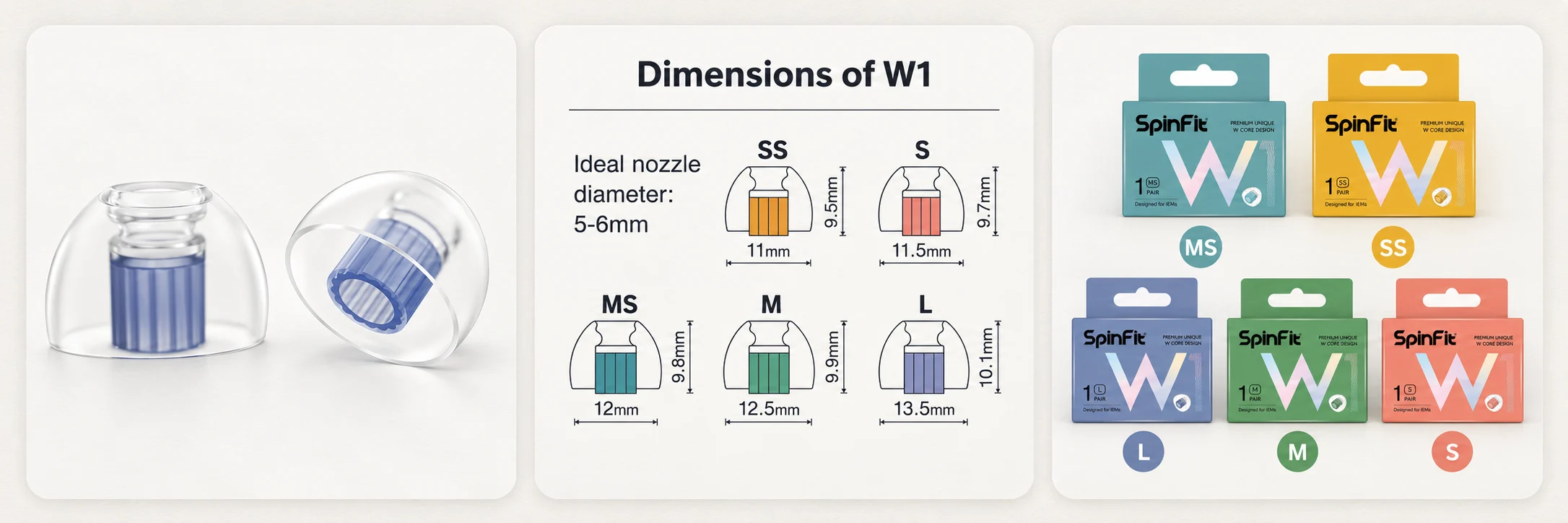
The SpinFit W1 became an obvious place to start because it gave me a strong baseline for the rest of the challenge.
Rather than deciding in advance what W1 should sound like, I treated it as a reference point and focused first on the physical experience. Did it stay seated? Could I remove and reinsert the IEM and get the same result? Did the shell settle naturally? Could I wear it for a long session without feeling pressure build? And just as importantly, did the presentation remain consistent as I moved around?
That last part matters because if the IEM shifts in your ear, the seal can shift with it, and suddenly what sounds like a tonal change may really be a fit change. That’s exactly the kind of false signal I was trying to avoid throughout the SpinFit Challenge.
For W1, I started with familiar IEMs on purpose. The ZiiGaat Doscinco made sense because I know its low-end behavior extremely well, so any change in seal or bass support was easier to recognize. The XENNS Mangird Tea Pro gave me a very different shell and presentation to work with, while the TANCHJIM OLA II changed the equation again with a much smaller and lighter design.
Same tip, very different physical demands.
That’s where the W1 became useful as a reference. I wasn’t just asking whether I liked it. I was asking whether the same strengths kept showing up across different shells, nozzle positions, and weights.
🔍 What I’m Looking For
With W1, the big questions are consistency, stability, comfort, and repeatable positioning.
If it keeps helping very different IEMs settle naturally, maintain a dependable seal, and stay in place without requiring constant adjustment, that tells me a lot more than simply calling it “good.”
That would tell me what kind of problem W1 is good at solving.
👂 Who Are They For?
The W1 makes the most sense for listeners looking for a dependable all-rounder that prioritizes stable fit, repeatable positioning, and long-session comfort without making the ear tip feel like the star of the show.
It’s also a strong place to start if you’re getting into aftermarket tips for the first time or want a reliable reference point for comparing designs across different IEMs.
In other words, W1 doesn’t need to perform some dramatic act of silicone sorcery to earn its place in the box.
If it consistently helps an IEM fit right, seal properly, and stay in place, that’s already a pretty compelling job description. 🦖
🟢 SpinFit OMNI: The Compatibility Experiment
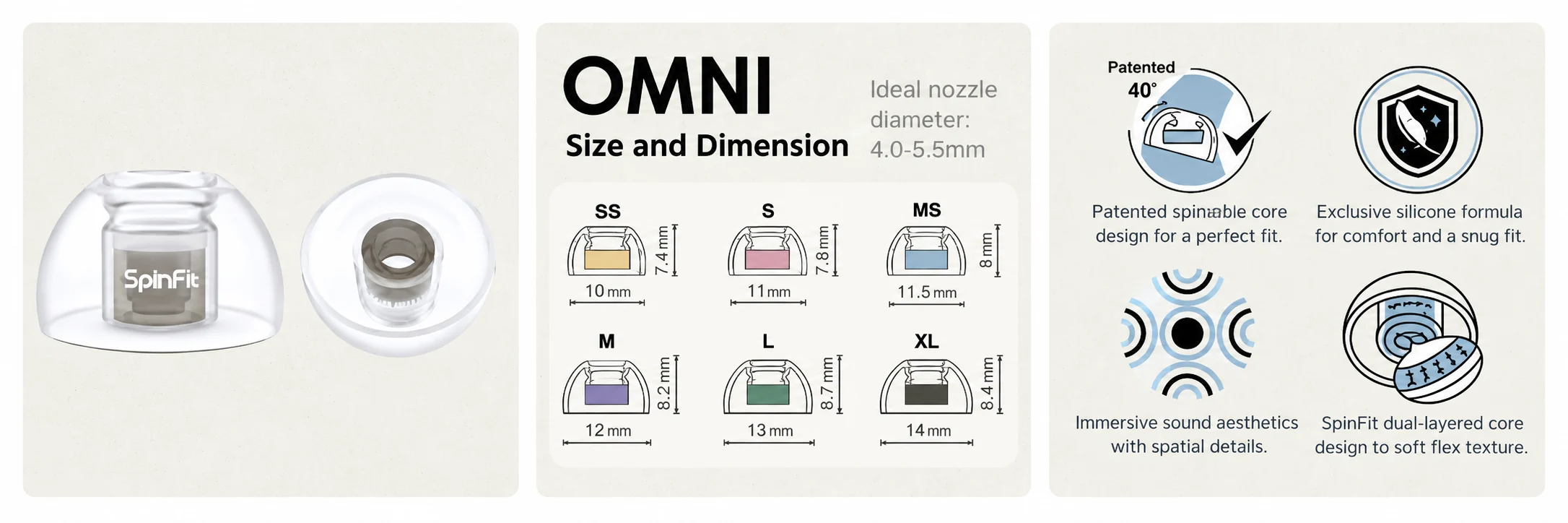
The SpinFit OMNI may fit the spirit of the SpinFit Challenge better than almost anything else in the box because its whole appeal is versatility.
Rather than asking whether OMNI sounded better than another tip, I wanted to know whether it could become one of the first options I reach for when a new review sample arrives and I don’t yet know exactly what the IEM needs. Could it handle different nozzle sizes, different shell shapes, and even different types of earphones without immediately forcing me into a full-scale excavation of the GearZilla tip collection?
That’s a genuinely useful question because this happens all the time. A new IEM arrives, the stock tips don’t quite work, the shell sits awkwardly, or the seal feels inconsistent. Instead of opening every box I own like some silicone-obsessed raccoon digging through a dumpster, I wanted to know whether OMNI could become an early troubleshooting step.
I also wanted to push it beyond wired IEMs. Because OMNI can work with suitable TWS models, it gave me another chance to test whether the same tip could work across very different use cases without sacrificing what matters most: fit, seal, comfort, and stability.
That meant putting it through both sides of the GearZilla collection. On wired IEMs, I could focus on nozzle compatibility, shell position, and repeatable insertion. On TWS models like the ROSESELSA CERAMICS ULTRA or SOUNDPEATS H3, I could add another requirement that traditional IEMs don’t have to worry about nearly as much:
Will the earbud still fit in the charging case?
Because a fantastic seal doesn’t mean much if the bud suddenly refuses to charge.
Same tip, very different jobs.
That’s where OMNI becomes interesting. I’m not asking whether it dominates one particular pairing. I’m asking whether it can keep working across enough different products that its adaptability becomes the reason to own it.
🔍 What I’m Looking For
With OMNI, the big questions are versatility, compatibility, comfort, and dependable sealing across different earphones.
If it can transition from wired IEMs to compatible TWS models, handle different shell and nozzle combinations, and still deliver a repeatable fit without introducing new problems, then OMNI earns a very specific role in the GearZilla tip box.
That would tell me it isn’t just another option.
It’s a troubleshooting tool.
👂 Who Are They For?
The OMNI makes the most sense for listeners who use a variety of earphones and want a flexible starting point that works across different IEMs and compatible TWS models without requiring a completely different tip strategy each time.
It’s especially appealing if you rotate gear often, review multiple products, or simply want one design that gives you a better chance of solving fit and seal issues across a broader collection.
In other words, OMNI doesn’t need to be the perfect tip for absolutely everything.
If it can become the one I reach for when I don’t yet know what the problem is, that’s already a pretty powerful job description. 🦖

⚪ SpinFit NEO: The Everyday Test
The SpinFit NEO gets what I affectionately call the boring test.
And that’s absolutely a compliment.
The question here isn’t whether NEO immediately jumps out and demands attention. It’s whether I can put it on an IEM, get the fit right, start listening, and eventually stop thinking about the tip altogether.
Not every part of the audio chain needs to announce:
LOOK WHAT I’M DOING!
Sometimes the best ear tip is the one that fits properly, seals consistently, stays comfortable, and quietly gets out of the way so the music can take over.
That’s why NEO gets longer sessions. Albums become work sessions. Work sessions turn into hours at the desk. I take the IEM out, put it back in, walk around, move my jaw, and see whether the fit keeps behaving the same way without constantly reminding me that there’s a piece of silicone sitting in my ear.
If I eventually forget which tip is installed because I’m too busy listening to music, that’s not boring.
That’s success.
🔍 What I’m Looking For
With NEO, the big questions are long-term comfort, ease of use, repeatable fit, and whether it can simply disappear into the listening experience.
If it keeps sealing properly, reinserts easily, and stays comfortable over longer sessions without making me constantly adjust the shell, then NEO earns a very clear role in the lineup.
It becomes the tip I reach for when I don’t want to think about the tip.
👂 Who Are They For?
NEO makes the most sense for listeners who prioritize comfort, simplicity, and everyday use, especially those who spend long stretches listening at a desk, working, walking around, or switching between different IEMs throughout the day.
It’s also a strong option for people who don’t necessarily want an ear tip to dramatically “tune” the experience. They just want something that fits, seals, and stays comfortable enough to fade into the background.
Sometimes disappearing is the whole job. 🦖

🔵 SpinFit CP145: Different Geometry, Different Possibilities
The SpinFit CP145 gave me something especially valuable for this challenge: a different physical option when the obvious choice wasn’t working.
That matters because ear-tip rolling isn’t always about changing the sound. Sometimes an IEM simply doesn’t sit correctly. The shell presses against the wrong part of my ear, the insertion feels awkward, or I can get a seal but never quite reach that point where everything feels naturally locked into place.
That’s where CP145 becomes interesting.
Rather than treating it as an older design that needs to compete with W1, OMNI, or NEO, I wanted to see what would happen if I used its different geometry as another troubleshooting tool. Could it change the way an awkward shell rested against my ear? Could a different insertion position relieve pressure? Could it rescue an IEM I’d previously blamed for being uncomfortable?
Those questions became more useful than asking whether CP145 was somehow “better” or “worse” than SpinFit’s newer options.
Your ears don’t care when an ear tip launched.
They care whether it fits.
That’s also why I wanted CP145 in a broad rotation. A design that feels unnecessary on one IEM might suddenly make perfect sense on another because the nozzle length, angle, or shell shape changed. Sometimes solving the problem isn’t about finding a more advanced tip. It’s simply about finding a different shape.
🦖 Newer Doesn’t Automatically Mean Better
Audio loves replacement narratives. A new product arrives, everyone gets excited, and suddenly whatever came before it is supposed to shuffle quietly toward retirement.
Except ears aren’t processors.
There’s no benchmark showing that the latest ear tip provides 14 percent more anatomical compatibility.
Sometimes the older geometry simply works better with a particular IEM and a particular ear.
If CP145 lets a shell settle more naturally, creates a reliable seal, and stays comfortable longer than another option, then CP145 wins that job. It doesn’t need to win every other one.
That distinction is becoming increasingly important throughout this challenge.
I’m not building a podium.
I’m building a toolbox.
🔍 What I’m Looking For
With CP145, the big questions are geometry, insertion, shell positioning, and whether changing the tip’s physical shape solves problems that initially seemed to belong to the IEM itself.
If an uncomfortable or unstable IEM suddenly falls into place after switching to CP145, that tells me exactly why this design still deserves a spot in the box.
Sometimes the solution isn’t more technology.
It’s just a different fit.
👂 Who Are They For?
CP145 makes the most sense for listeners who already have an IEM that almost fits correctly but never quite settles into the sweet spot. Maybe the seal is inconsistent, the shell rests awkwardly against the ear, or another tip feels slightly too deep or too shallow.
It’s also a useful option for anyone building an aftermarket tip collection because it adds a genuinely different geometry rather than simply another variation on the same fit.
In other words, CP145 is the tip I’d reach for when my first choice isn’t obviously wrong, but something still feels slightly off.
Sometimes that little change in geometry is all it takes to turn:
“I love this IEM, but…”
into:
“There it is.” 🦖

🔴 SpinFit CP155: Send in the Big Nozzles
Then there’s the SpinFit CP155, which gave me a very different job to investigate: what happens when nozzle size and insertion become the problem rather than tuning?
This is where the big-nozzle IEMs come into play.
You know the ones. You open the box, look at the nozzle, look at your ear, look back at the nozzle, and think:
“We’re really doing this?”
Apparently we are. 🦖
CP155 is useful because there are IEMs in which the nozzle itself changes the entire fit conversation. A tip may technically fit, but that doesn’t mean the finished combination is comfortable, stable, or sitting at the right depth. With larger nozzles in particular, the interaction between the stem, the silicone, and the shell can determine whether the IEM feels natural or like you’re trying to dock industrial plumbing in your ear canal.
That’s why I wanted CP155 in the challenge.
I wasn’t only asking whether it could physically fit a larger nozzle. I wanted to know whether it could help the entire IEM sit more naturally, whether it changed insertion enough to improve comfort, and whether it created a more dependable seal across larger or more awkward designs.
And this is also where I had to be especially careful with sonic conclusions.
Suppose I heard substantially stronger bass after switching to CP155. Did the tip somehow “add” bass?
Maybe the changed fit affected the acoustic relationship.
But the first question had to be simpler:
Did I finally get a proper seal?
The same goes for vocals. If they suddenly felt closer or more present, was that something inherent to the CP155, or did the new insertion depth alter the way the nozzle was interacting with my ear canal?
Those distinctions matter because a successful tip change can absolutely alter what you perceive without the tip acting like some tiny silicone EQ preset.
Sometimes it just fixes the geometry.
🧪 This Is Where Things Get Messy
CP155 is also a good reminder of where subjective testing reaches its limits.
Without measuring the exact acoustic result at my eardrum, I’m describing what I perceive. I can identify recurring differences; I can observe changes in fit and insertion; and I can make reasonable connections between them.
What I don’t want to do is pretend I can prove the exact mechanism behind every change I hear.
That’s why this remains the SpinFit Challenge rather than the GearZilla Institute for Advanced Silicone Sciences.
I’m looking for repeatable behavior, not pretending I’ve discovered a new branch of acoustics.
Curiosity first.
Claims second.
🔍 What I’m Looking For
With CP155, the big questions are large-nozzle compatibility, insertion depth, seal consistency, and how its structure changes where bigger IEM shells sit against the ear.
If it repeatedly helps large-nozzle IEMs fit more naturally, seal more reliably, and sit at a more comfortable depth, then CP155 has a very clear role in the box.
That’s much more useful than simply saying it sounds “better.”
👂 Who Are They For?
CP155 makes the most sense for listeners dealing with larger nozzles, awkward insertion, or IEMs that feel like they’re fighting your ears before the music even starts.
It’s especially useful when a standard tip technically fits but never quite feels right, or when you suspect the real problem is the relationship between the nozzle, insertion depth, and shell position rather than the tuning itself.
In other words, CP155 is the one I’d reach for when the nozzle shows up looking like it has its own area code.
If it can turn:
“There is absolutely no way this thing is going in my ear.”
into:
“Okay… that actually works.”
Then CP155 has done its job. 🦖
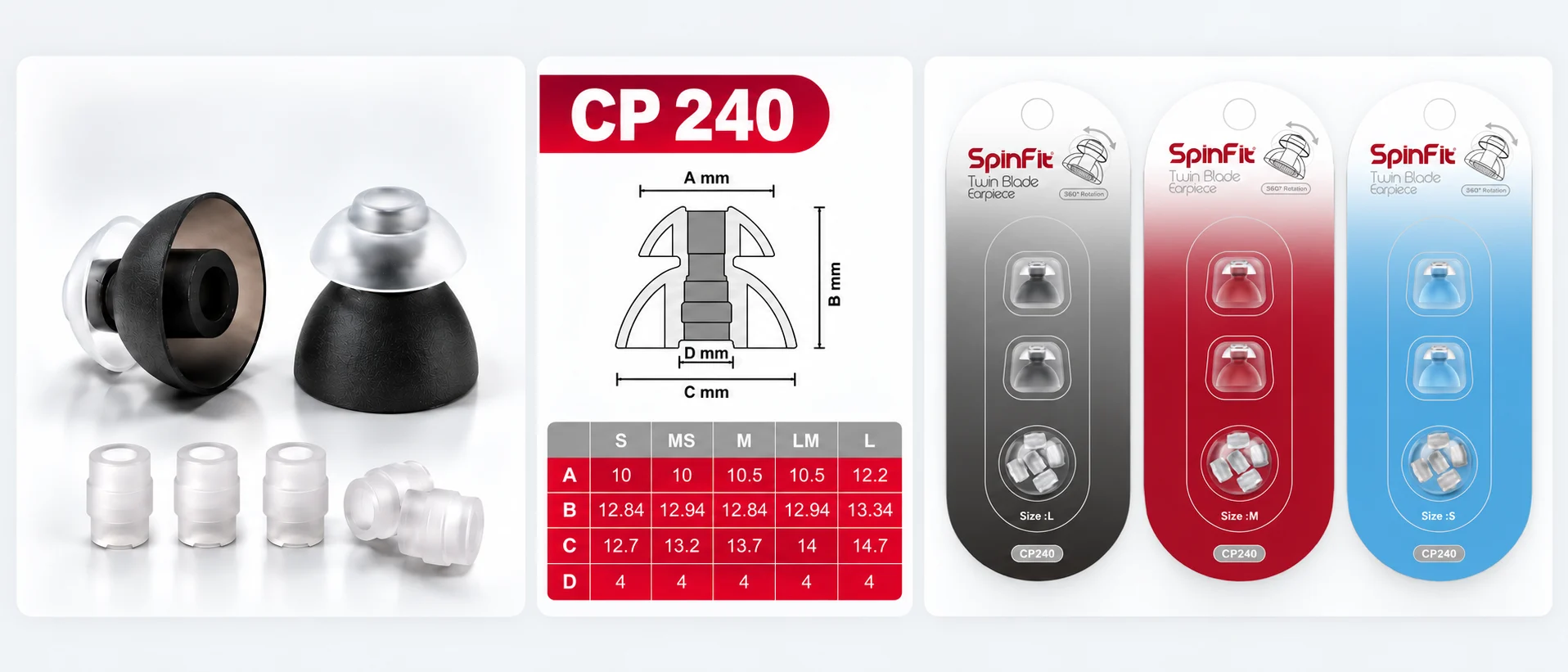
🛸 SpinFit CP240: Double-Flange Mode Activated
And then there’s the SpinFit CP240, which immediately changes the nature of the experiment because one flange apparently wasn’t enough.
We’ve gone double.
That double-flange design creates a very different physical relationship with the ear canal than the single-flange options in the rest of the lineup. Instead of simply sealing near one point, CP240 reaches farther in and creates additional contact, which means insertion depth, isolation, pressure, and anatomy become much bigger parts of the conversation.
That also makes CP240 one of the most ear-dependent tips in the challenge.
Some listeners love deeper-fitting designs because they can feel more secure and provide stronger isolation. Other ears take one look at the CP240 and immediately respond:
“Get this alien probe out of me.”
Both reactions are completely legitimate.
That’s why I’m not asking CP240 to become an everyday option for every IEM in the collection. It doesn’t need to. If its deeper fit solves a stubborn seal or isolation problem that none of the other SpinFits can address, then it has already earned a very specific place in the box.
This is where the idea of the SpinFit lineup as a toolbox really starts making sense. CP240 isn’t necessarily the tool I reach for first. It’s the one I reach for when the usual tools aren’t getting the job done.
🔧 Those Little Adapters Matter
SpinFit also included nozzle adapters with the CP240 setup, and those tiny pieces could easily disappear into the bottom of the case without getting much attention.
They deserve better than that.
The adapters potentially expand the range of IEMs I can test by allowing the CP240 to work with narrower nozzles that might otherwise be a poor physical match. That adds another variable to the experiment because now I’m not only testing whether the double-flange design works for my ears. I’m also testing how useful it is across different nozzle sizes once the adapter is involved.
That turns CP240 into the strange specialty tool buried at the bottom of the GearZilla toolbox.
You may not use it every day.
But when you need it, suddenly nothing else quite does the same job.
🔍 What I’m Looking For
With CP240, the big questions are deeper insertion, isolation, seal stability, pressure, and long-session comfort.
I want to know whether the additional flange actually helps difficult IEMs stay sealed, whether the deeper fit remains comfortable after the first few minutes, and whether the increased contact with the canal feels secure or simply intrusive.
If CP240 works, I want to understand where and why it works.
And if my ears reject it?
That’s useful information too.
👂 Who Are They For?
CP240 makes the most sense for listeners who want deeper insertion, stronger passive isolation, or another option for stubborn fit and seal problems that conventional single-flange tips haven’t solved.
It may also appeal to people who already know they’re comfortable with deeper-fitting ear tips and want something more specialized than an everyday all-rounder.
This probably isn’t the SpinFit I’d blindly recommend as everyone’s first aftermarket tip.
It’s the one I’d pull out when the normal solutions have failed, and the situation calls for something a little more… invasive.
If the other tips are regular members of the Kaiju response team, CP240 is the specialist they call when somebody says:
“We’re going to need the double flange.” 🦖
🎧 The IEM Matters Just as Much as the Tip
One of the biggest things I want people to take from the SpinFit Challenge is that you can’t really evaluate an ear tip in isolation from the IEM it’s attached to.
The shell matters. Nozzle diameter and length matter. The nozzle lip, insertion angle, overall weight, and how the housing rests against your ear all affect how a tip behaves once everything is in place.
That means the exact same SpinFit can feel completely different on two different IEMs.
Take the ZiiGaat Doscinco and the TANCHJIM OLA II. They create very different physical experiences in my ears. A tip that helps anchor the larger Doscinco and keep it from shifting may be to solve a problem that simply doesn’t exist on the lighter OLA II.
Then the XENNS Mangird Tea Pro introduces another shell-and-nozzle combination, the CrinEar Project Monolith brings another, and sets like the Kefine Arnar, TANGZU Zetian Wu, CVJ Nozomi, COZOY D1, and whatever else wanders into the GearZilla lair keep changing the equation again.
That variety is exactly what makes the experiment useful.
Test one tip on one IEM to see whether I like that particular pairing.
Test the same tip across a wide range of very different IEMs, and I can start asking a more interesting question:
Does this tip keep solving the same kind of problem?
If the answer is yes, then I’m no longer just learning about a pairing.
I may actually be learning something about the tip itself.
🧼 Clean Tips Are Happy Tips
Here’s the glamorous section nobody puts on the box: clean your ear tips.
Silicone naturally picks up skin oils, dust, lint, and whatever microscopic civilization has decided to establish itself inside the Kaiju Lab. Beyond the obvious hygiene issue, that buildup can also change how the material feels and behaves. A tip that was slightly tacky when clean may feel slicker after repeated use, which can affect grip, stability, and even seal consistency.
That matters in an experiment like this because I don’t want to compare a freshly cleaned tip with one that’s been collecting desk debris for three days and then pretend the difference is entirely due to design.
So part of the process was simply keeping the tips clean enough that I was comparing tip to tip, not clean silicone to oily silicone.
It isn’t exciting.
It isn’t audiophile sorcery.
It’s maintenance.
And sometimes the most useful control variable in the Kaiju Lab isn’t a DAC, a cable or a measurement rig.
Sometimes it’s just soap and water. 🦖
🔬 What Ear Tips Can Change, and What They Can’t
This may be one of the most important distinctions in the entire guide because ear tips can absolutely change the listening experience, but they also have limits.
An ear tip changes the physical interface between the IEM and your ear, which can affect seal, insertion depth, stability, isolation, comfort, and the nozzle’s position. Once those variables shift, the way you perceive the IEM can shift with them, too.
That can show up as changes in:
- Seal
- Insertion depth
- Stability
- Isolation
- Comfort
- Nozzle position
- Perceived bass response
- Perceived vocal position
- Treble presentation
- Perceived openness, depth, and placement
But this is where it’s easy to get carried away.
If you fundamentally dislike the tuning of an IEM, a silicone ear tip isn’t rebuilding the crossover, replacing the driver, or transforming a bass cannon into a neutral reference monitor through ancient audiophile magic.
Tip rolling is fine-tuning.
Sometimes that fine-tuning can feel surprisingly substantial, especially when you’ve corrected a major seal or fit problem. A better seal alone can make the bass feel fuller, the presentation more stable, and the entire IEM more convincing.
Other times the difference is subtle.
And occasionally, you swap tips, and almost nothing changes at all.
That’s useful information too.
Not every tip needs to transform an IEM to be worthwhile. Sometimes the win is simply better comfort, a more secure fit, or a seal you can repeat every time you put the IEM back in.
And if the sound stays basically the same while the fit gets better?
That still counts as a successful roll. 🦖
🧠 Don’t Listen for the Answer You Want
Expectation bias deserves its own Kaiju warning label because once you know what you’re supposed to hear, it becomes very easy to start hearing exactly that.
If somebody tells me, “This tip smooths the treble,” and I put it on already expecting a softer top end, I’ve influenced the experiment before the first note even plays.
That’s why I keep coming back to familiar IEMs, familiar music, and repeatable comparisons. I want to hear what changes first, then describe it, rather than reading a claim, deciding what should happen, and listening until I can convince myself I found it.
The process is simple:
Listen. Swap. Listen. Describe.
Not:
Read the marketing. Decide what you’re supposed to hear. Then hunt for it.
That second approach is backward, and it’s incredibly easy to fall into, especially when the differences we’re talking about can be subtle.
So throughout the SpinFit Challenge, I’m trying to keep the question open:
What actually changed?
Maybe the treble did feel smoother.
Maybe the bass became more convincing.
Maybe vocals moved a little closer.
Or maybe the only real difference was that the IEM fit better and stayed in place.
All of those are valid outcomes.
The important part is not deciding on the answer before the music gets a chance to give me one.
🛠️ The SpinFit Troubleshooting Method
This is where the SpinFit Challenge starts becoming genuinely useful.
Instead of opening the box and randomly swapping tips until something feels right, I started thinking about tip rolling more like troubleshooting. Identify the problem first, then choose the tool that might actually address it.
That doesn’t guarantee the first tip I try will be the answer. Human ears are far too chaotic for that. But it gives me a much better starting point than throwing silicone at the problem and hoping for the best.
If the Bass Seems Weak…
Before touching EQ, I check the seal.
I’ll try another size, reinsert the IEM, move my jaw, and gently press the shell inward while music is playing. If the bass suddenly fills out when I apply a little pressure, that tells me something important: the IEM may not be bass-light at all.
I may simply be losing the seal.
That’s a very different problem, and adding 3 dB of bass to compensate for an air leak is basically the audio equivalent of turning up the heat because somebody left a window open.
Fix the window first.
If the IEM Keeps Slipping…
My first instinct used to be simple: bigger tip.
Sometimes that works.
Sometimes it just creates a larger uncomfortable tip that still doesn’t sit correctly.
Now I’m paying more attention to geometry, insertion depth, and how the tip changes the angle of the entire shell. A slightly different shape may allow the IEM to settle more naturally and remain stable without requiring more pressure against the ear canal.
The question isn’t simply, “Do I need something larger?”
It’s “Why is the IEM moving?”
That distinction can save a lot of pointless rolling.
If the Shell Hurts Your Outer Ear…
The obvious conclusion is that the shell doesn’t fit.
Sometimes that’s true.
But sometimes the ear tip is determining where that shell sits.
A different stem length or insertion depth can move the IEM slightly farther in or out, or allow it to rest at a slightly different angle. A tiny adjustment at the nozzle can change where a much larger shell contacts your ear.
So before declaring an IEM physically incompatible with my anatomy, I’m giving the tips a chance to move the furniture around.
Sometimes the shell isn’t the problem.
It’s where the tip is putting it.
If the Nozzle Looks Enormous…
Please stop trying to stretch a clearly incompatible ear tip onto it like you’re mounting a tire.
We’ve all done it.
You hold the IEM in one hand, pull the silicone with the other, and convince yourself that surely another millimeter of stretching is perfectly reasonable.
This is where something like the CP155 starts making much more sense. Instead of fighting the hardware, use a tip designed to accommodate the physical problem you actually have.
Your fingertips will thank you.
Probably the ear tip too.
If You Want More Isolation…
Start with the seal.
A deeper-fitting tip won’t automatically improve isolation if it still doesn’t create reliable contact with your ear canal. Get the sizing right first, then start experimenting with insertion depth and different geometries.
That’s where something like the CP240 becomes especially interesting. Its double-flange design gives me another way to approach a stubborn seal when a conventional single-flange tip isn’t getting the job done.
More isn’t automatically better, though.
The goal is enough isolation without making your ear feel like it’s undergoing a medical procedure.
If Everything Sounds Great but Your Ears Hurt…
Change something.
Seriously.
Audiophiles sometimes tolerate ridiculous levels of physical inconvenience because we’ve convinced ourselves the sound is worth it.
It isn’t.
Try another size. Try another geometry. Change insertion depth. Look at how the shell is sitting. Give up a tiny perceived sonic advantage if the alternative is wanting to rip the IEM out after forty minutes.
The best-sounding ear tip in your collection is useless if you don’t actually want it in your ear.
And that may be the biggest lesson behind the whole troubleshooting approach.
Don’t start with the tip. Start with the problem.
Once I know what I’m actually trying to fix, the SpinFit box stops looking like a collection of random silicone and starts looking much more like a toolbox. 🦖
🗺️ The Decision Tree I’m Trying to Build
This is ultimately where I want the SpinFit Challenge to end.
Not with a podium.
Not with W1 in first place, NEO in second, OMNI in third, followed by everyone arguing over whether CP145 got robbed.
That’s entertaining, but it doesn’t really help anyone.
What I want instead is something practical enough that a reader can come back to this guide months from now, buy a completely different IEM, and still have a useful place to start.
If the IEM keeps moving, which designs should I try first?
If the nozzle is huge, where should I start?
If I want deeper insertion, which tip makes the most sense?
If comfort is the priority, which models deserve the first audition?
If I’m using TWS, which options are worth testing before I empty the entire tip drawer onto the desk?
And if I own a big collection and just want something versatile enough to move between different setups, which SpinFit should become the first grab?
That’s the decision tree I’m trying to build.
Not “Which SpinFit is best?”
But:
“Which SpinFit makes the most sense for the problem I’m trying to solve?”
That distinction is what could make this whole experiment useful beyond the specific IEMs sitting in front of me right now.
Because in six months, the gear will change.
New IEMs will arrive.
Different shells will show up.
Some manufacturer will inevitably design another nozzle that looks like it belongs on industrial machinery.
But the problems themselves will probably look familiar: fit, seal, comfort, stability, insertion, and compatibility.
So I don’t need another ranking.
I need a toolbox.
And ideally, by the end of the SpinFit Challenge, I’ll know which tool to reach for first. 🦖
🤔 What If Nothing Changes?
Then nothing changes.
Seriously.
Audio reviewing gets strange when every accessory is expected to produce some profound revelation. Sometimes two tips fit and seal equally well and sound virtually identical to me.
That’s not a failed test.
That’s a result.
At that point, the decision shifts away from chasing a tiny sonic difference and toward what may matter more in everyday use: comfort, stability, ease of insertion, long-session wear, and how reliably the fit repeats.
There’s no rule saying every ear-tip swap has to produce:
“OH MY GOD, THE VOCALS HAVE ASCENDED.”
Sometimes the most accurate note in the Kaiju Lab is simply:
“Sounds basically the same. This one fits better.”
And honestly, that can be more useful than trying to manufacture a difference that isn’t really there.
If two tips sound the same to me but one stays put longer, seals more consistently, and disappears in my ear after ten minutes, that’s the one I’m keeping installed.
Not every experiment needs fireworks.
Sometimes the win is just finding the tip that quietly gets out of the way, letting the IEM do its job.
I wish audio reviews said that more often.
💰 Before You Buy Another IEM…
This experiment also bumps into a much bigger habit in the hobby:
We love buying new stuff.
I’m certainly not standing on any moral high ground here. One look around the GearZilla lair and that argument collapses immediately. I surrendered that position a long time ago. 🦖
But sometimes we start shopping for an upgrade before we’ve really figured out whether the gear we already own is working as well as it could.
Maybe that IEM doesn’t need to be replaced.
Maybe it needs a better seal.
Maybe the shell isn’t actually too large. Maybe a different tip changes the insertion depth just enough that the housing rests more naturally against your ear.
Maybe the bass isn’t missing.
Maybe it’s leaking.
That’s why ear tips are such an interesting part of the IEM chain. They’re inexpensive compared with the hardware we obsess over, physically tiny, and easy to dismiss as an accessory.
But they sit at one of the most important junctions in the entire system.
The driver can be excellent. The tuning can be exactly what you wanted. Your DAC can cost more than your first car.
None of that changes the fact that the final handoff still happens through a little piece of silicone sitting between the nozzle and your ear.
So before deciding an IEM needs to be replaced, it’s worth asking whether you’ve actually optimized the fit you already have.
Because sometimes the next upgrade isn’t another box arriving at the door.
Sometimes it’s sitting in the tip case.
Right at the point where the gear meets you.
🦖 What If My Whole Theory Falls Apart?
Here’s the thing.
I could be completely wrong about all of this.
Maybe there isn’t a clean pattern.
Maybe W1 works beautifully on one IEM but behaves completely differently on the other. Maybe OMNI isn’t the universal problem-solver I expect it to be. Maybe CP155 only makes sense on a handful of very specific nozzles. Maybe CP240 works great in one ear and gets immediately launched across the room in another.
That’s part of the experiment.
I’m not trying to prove some grand theory about ear tips.
I’m trying to answer a much simpler question:
Can I stop tip rolling completely at random and start making better first guesses based on fit, seal, nozzle size, insertion depth, and comfort?
If the same kinds of solutions keep working across different IEMs, great. Then I’ve found something useful.
If they don’t?
That tells me something useful too.
Maybe ears really are too individual for any neat decision tree, and the answer is still:
Try it and see what happens.
That wouldn’t make this experiment a failure.
It would just mean the GearZilla Tip Toolbox comes with a very large warning label:
Your ears may ignore everything I just wrote. 🦖

📝 The GearZilla Tip Log
With this many IEMs, six SpinFit designs, and multiple sizes moving through the Kaiju Lab, I needed some way to keep track of what was actually happening without turning the experiment into a second full-time job.
So I kept it simple.
For each combination, I’m logging the things that actually matter to the experiment:
IEM:
SpinFit:
Size:
Seal:
Comfort:
Stability:
Insertion:
Bass:
Vocals:
Treble:
Space / Depth / Placement:
Keep it installed? Yes or no.
That last question might ultimately tell me more than some of the detailed listening notes.
I can spend 300 words trying to explain a subtle difference in bass texture, vocal position, or perceived depth. But when the listening session is over, there’s a much simpler test waiting for me.
Do I leave the tip on the IEM?
If I finish testing and immediately pull it off to reinstall something else, that tells me something.
If three days later I grab the same IEM and suddenly realize:
Wait. I never took these off.
That tells me something too.
Because at some point the best combination stops being the one I can describe most impressively and becomes the one I actually want to keep using.
And that may be the most brutally simple data point in the entire SpinFit Challenge. 🦖
🏆 There May Never Be a SpinFit Champion
And I kind of hope there isn’t.
Because the more interesting outcome is discovering that the SpinFit lineup behaves less like a leaderboard and more like a toolbox.
Different ears create different problems. Different IEMs bring different shell shapes, nozzle sizes, weights, and insertion requirements. Different situations call for different solutions.
That means W1 doesn’t need to beat OMNI.
OMNI doesn’t need to destroy NEO.
And CP240 doesn’t have to storm into the arena and double-flange everyone into submission. 🗡️
Although I would absolutely watch that movie. 🦖
The point of this challenge was never to crown:
THE SpinFit.
It was to get better at answering a much more useful question:
Which SpinFit makes the most sense for this IEM, this ear, and this problem right now?
That answer may change from one setup to the next, and that’s not a weakness in the experiment.
It may actually be the whole point.
Because if the lineup really does function like a set of tools, then the goal isn’t to find one winner and retire the rest.
It’s to understand which tool to reach for first.
That’s harder than a ranking.
But it’s also a lot more useful.
🦖 Final Roar
I started the SpinFit Challenge with what I freely admit was a slightly insane question:
Maybe ear-tip rolling doesn’t have to be completely random.
Maybe if we pay closer attention to fit, seal, nozzle geometry, shell design, insertion depth, and comfort, we can better understand why one tip works when another doesn’t.
Not with absolute certainty.
We’re still dealing with human ears, and they’re bizarre little caves with absolutely no respect for standardized manufacturing.
But maybe we can get from:
“Try everything and see what happens.”
to:
“Here’s what I’d try first, and here’s why.”
That’s what I wanted from this experiment.
Not a winner.
Not six arbitrary scores.
Not another list telling everyone that one particular piece of silicone is THE TIP and the rest can go home.
I wanted a map.
W1. OMNI. NEO. CP145. CP155. CP240.
Six different approaches, different geometries, and different potential solutions for the things that actually make tip rolling frustrating in the first place.
An IEM that won’t stay put.
A nozzle that looks like plumbing equipment.
A shell that sits awkwardly.
A seal that disappears when you move your jaw.
A TWS earbud that fits beautifully until you discover it no longer fits inside its own charging case.
Or maybe everything already sounds great, and you just want to wear the thing for three hours without your ears filing a formal complaint.
That’s where I think this gets interesting.
The goal isn’t necessarily to know the answer before trying a tip. It’s to have enough understanding that you’re no longer starting completely blind.
Annie and the SpinFit team gave the Kaiju Lab everything I needed to chase that idea, right down to that handwritten sticky note that somehow survived, even as I completely destroyed the beautiful organization of everything else.
Sorry, Annie.
Science happened. Sort of.
So where does the hypothesis land?
Maybe tip rolling will always involve some experimentation. Honestly, it probably should. Your ears are your ears, my ears are my ears, and no guide on the internet gets the final vote.
But if this challenge can make that experimentation a little more intentional, help somebody diagnose a bad seal before replacing an IEM, or give them a smarter first tip to try when a new set arrives?
Then the whole ridiculous silicone adventure was worth it.
Ready. Set. Roll.
And yes, even after everything I just wrote, we both know what’s going to happen when the next IEM lands on the desk.
I’m still going to try all of them.
Excited to get rolling? 🤘🦖🎧Head over to SpinFit’s website to explore the full lineup, compare designs and sizes, and pick up the tips that make the most sense for your ears and your gear.
Listen Bigger!