



✅ Pros: Ridiculously comfortable and lightweight, outstanding 10-band Professional PEQ, dramatically better sound once properly tuned, coherent dual-coaxial driver system, excellent codec support with aptX Lossless, aptX Adaptive and LDAC, Bluetooth 6.0, Auracast, multipoint, USB-C and 3.5mm audio, excellent battery life, physical controls, good call quality, strong app support, easy everyday usability, and an absolutely stacked feature set for $129.99. EarFun has built a consumer headphone with enough flexibility to become genuinely interesting to audio enthusiasts.
⛔ Cons: Stock tuning is too bass-heavy for my preferences, with muddy mids, recessed vocal presence, and some peaky treble. ANC offers plenty of modes and adjustability, but it simply doesn’t block out the outside world as effectively as I want from a dedicated ANC headphone. There’s no wear sensor to automatically pause playback when you remove the headphones, and while I appreciate the physical buttons, I wish they offered more functionality directly from the headphone.
🦖 Disclosure
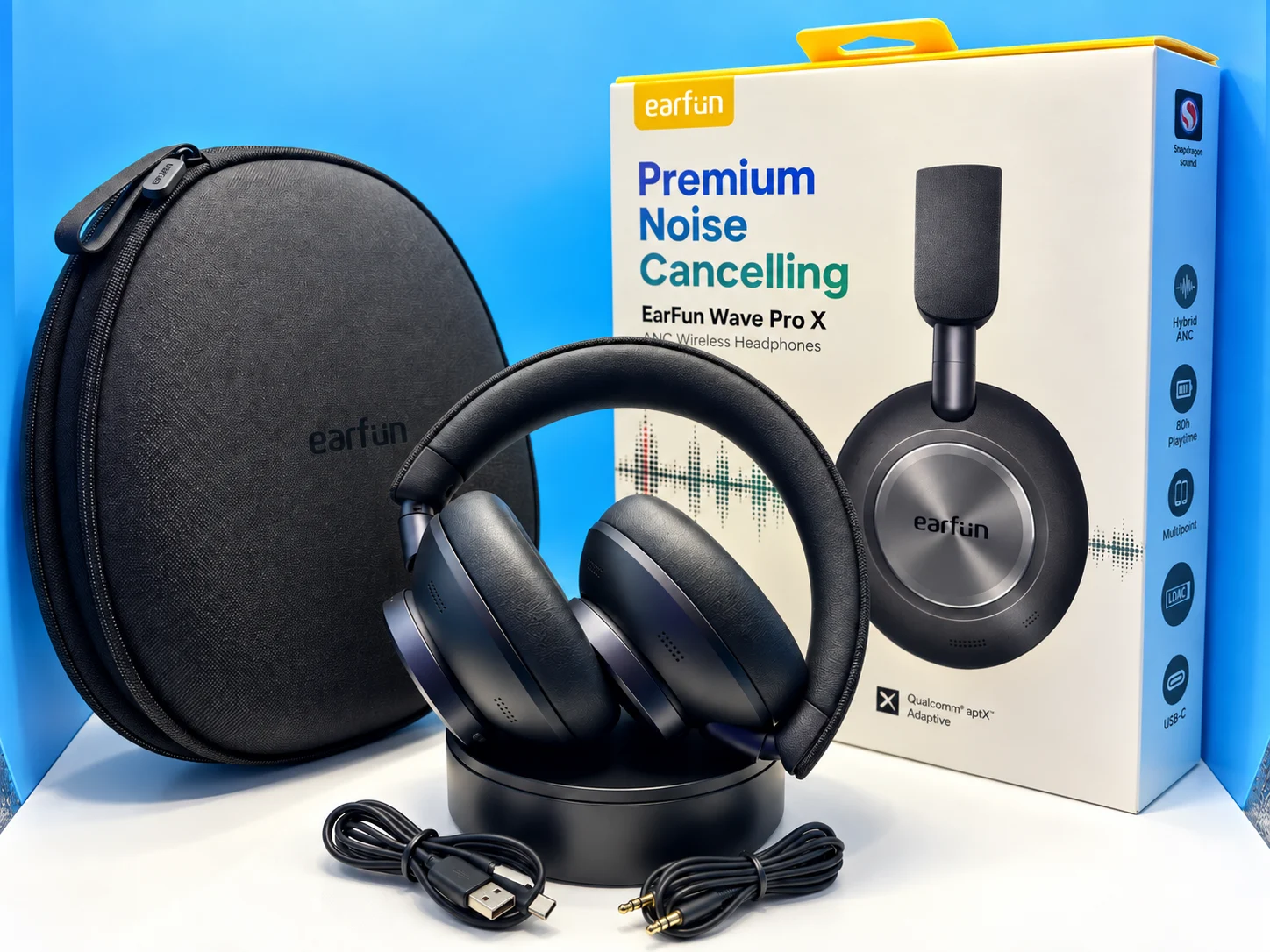
A huge thank you to EarFun for providing the Wave Pro X for this review.
That support means a lot to me, but it doesn’t buy a positive review. Gear provided to GearZilla Reviews doesn’t guarantee favorable coverage, a particular score, protection from criticism, or any influence over my conclusions.
I want to understand what a product was designed to do. I want to hear it before I start trying to change anything, live with it long enough for the specification sheet to stop being the story, and eventually answer the question that matters most to me:
Does this thing help me enjoy the music I already love in a new way?
With the Wave Pro X, answering that question became considerably more interesting than I expected.
Because straight out of the box?
I wasn’t sold.
Then I opened the EarFun Audio app.
And everything changed.
🤯 Wait… Why Do I Keep Grabbing These?
I have better headphones.
There. That’s probably a strange way to begin a review of something I ultimately really enjoy, but it’s important to establish exactly where the EarFun Wave Pro X fits into my world.
I have headphones capable of higher resolution, passive cans that scale beautifully with serious amplification, and gear I’ve specifically chosen to dig deeper into recordings, create larger spaces, uncover finer textures, and squeeze every last drop of information from the music.
The Wave Pro X isn’t replacing any of them.
And yet, I can’t stop grabbing this thing.
Think about the cars enthusiasts dream about owning. There’s the exotic sitting beautifully in the garage, the weekend machine you polish, admire, and take out when the conditions are just right.
Then there’s the car whose keys are hanging beside the door.
That’s the one you actually drive.
The Wave Pro X has become that headphone for me. Going on a flight? Grab it. Working around the house or cutting the grass? Grab it. Heading somewhere I don’t particularly want to carry an expensive pair of audiophile cans? I’m probably reaching for the Wave Pro X.
And the reason isn’t complicated. It’s incredibly light and comfortable, the battery life is absurd, wireless connectivity is loaded, calls work well, and the EarFun Audio app gives me far more control than I expected at this price. It’s the kind of headphone I can toss into its case and bring along without turning the decision into an audiophile equipment checklist.
But there’s one enormous qualifier to all of this.
I had to fix the sound first.
Once I got into Professional PEQ and dialed the Wave Pro X in line with my preferences, something changed. I stopped spending nearly as much time thinking about what I was giving up compared with my more expensive gear.
I stopped evaluating every compromise.
I was just listening.
And for a $129.99 wireless ANC headphone, sitting alongside substantially more serious audio gear, the Wave Pro X became really interesting.

🧠 EarFun Has Clearly Been Doing Its Homework
The Wave Pro X makes more sense when you look at where EarFun has been.
The original Wave Pro arrived in 2024 as EarFun’s first wireless over-ear headphone, bringing LDAC, ANC, long battery life, wired connectivity, and app-based EQ into a very affordable package. Reviewers praised how much EarFun delivered for the money, particularly its comfort, battery life, and overall feature set.
Two years later, the Wave Pro X doesn’t feel like EarFun simply changed the shell, added another codec, and slapped an X on the box.
This thing feels intentional.
EarFun moved to Qualcomm’s QCC3095 platform, Bluetooth 6.0, an eight-microphone ANC and call system, Auracast, aptX Adaptive Lossless, a new dual-coaxial driver architecture and, most importantly for enthusiasts, a legitimate 10-band parametric EQ system.
That last part matters.
A lot.
Because EarFun still hasn’t created my ideal stock tuning.
What it has done is something arguably more interesting.
It gave me the tools to create it myself.
That’s a very different proposition.
And it tells me EarFun isn’t merely trying to make another inexpensive wireless headphone.
The company appears to be exploring just how far it can push enthusiast functionality down into consumer-priced audio.
I’m paying attention.
🎧 Review Setup
Every GearZilla review starts from the same place:
Listen first. Figure out the story later.
With the Wave Pro X, I started completely stock.
No EQ.
No immediate tweaking.
No rushing into the app because I already knew what frequency response I wanted.
I wanted to hear what EarFun intended before I started telling EarFun what I wanted.
Then the tinkering started.
Because, well…
I’m me.
My testing focused on:
- 🎧 Stock Bluetooth listening
- 🎚️ EarFun’s included EQ presets
- 🧪 Extensive Professional PEQ experimentation
- 🔇 ANC and adaptive ANC modes
- 🌎 Ambient/transparency listening
- 🎤 Calls in different environments
- 🌬️ Wind and outdoor use
- 📱 Everyday app usability
- 🔘 Physical controls
- 🎶 Different genres and recording styles
- 🎤 Vocal-focused material
- 🥁 Bass-heavy material
- 🌌 Spatial and imaging-focused recordings
- ☁️ Long listening sessions to evaluate comfort
- 🔄 Multipoint and general everyday use
The more I listened, the clearer the story became.
The Wave Pro X isn’t remarkable because EarFun created a perfect $129.99 headphone.
It didn’t.
It’s remarkable because EarFun created a $129.99 platform with enough capability to become something significantly better than what comes out of the box.
🧬 KAIJU DNA SCAN
Every monster leaves behind a genetic signature.
Here’s what this one looks like.
K • Kill Shot
Professional PEQ. Full stop.
There’s plenty for EarFun to splash across the Wave Pro X box. Dual drivers, Bluetooth 6.0, aptX Lossless, LDAC, Auracast, adaptive ANC, and up to 90 hours of battery life make for one seriously loaded feature sheet.
But none of those things changed my opinion of the Wave Pro X as dramatically as opening the EarFun Audio app and discovering a legitimate 10-band parametric EQ.
That’s because my first experience with the stock tuning didn’t exactly have me roaring. There’s too much bass for my taste, the mids don’t have the presence I want, and the treble can occasionally poke in places I’d rather it didn’t.
Then I started working with Professional PEQ.
I pulled back the low end, brought vocals forward, cleaned up the upper frequencies, and started shaping the Wave Pro X around my sound. The hardware responded so well that I went from questioning the tuning to reaching for the headphones repeatedly.
Stock?
I wasn’t particularly impressed.
After PEQ?
I couldn’t stop listening.
That’s the Kill Shot.
A • Anatomy
EarFun calls its driver implementation DCAA, or Dual-Coaxial Acoustic Architecture, which pairs a 40mm DLC dynamic driver with a 10mm LCP driver, rather than asking a single driver to handle the entire frequency range. DSP helps manage how those drivers operate together, while the coaxial arrangement is designed to keep them acoustically aligned and improve phase coherence.
That’s the technical explanation.
But marketing language is marketing language. What I really care about is whether I can hear two drivers arguing over who gets to reproduce what.
I don’t.
The Wave Pro X sounds remarkably cohesive. There’s no obvious transition where one driver suddenly taps the other on the shoulder and says, “My turn.” Independent testing has reached a similar conclusion, finding the two-driver implementation well integrated, with no obvious discontinuity across the crossover region.
That became even more impressive once I started applying PEQ. I could make meaningful changes across the frequency range without exposing some awkward handoff between the drivers or making the presentation feel disconnected. The Wave Pro X continued to behave like a single, coherent headphone.
That’s exactly what I want from a multi-driver design. I shouldn’t be sitting there listening for the technology. I should be listening to the music.
More drivers don’t automatically mean better sound.
Good implementation does.
I • Impact
The Wave Pro X creates impact in a slightly different way than I’m used to talking about in an audio review. Normally, this part of the KAIJU DNA Scan is about slam, dynamics, bass, or that glorious moment when a track hits hard enough that your face involuntarily does the thing.
Here, the bigger impact comes from versatility.
The Wave Pro X can move from music to work calls, from a flight to the office, and from wireless listening to USB or a traditional wired connection without asking much from me. There’s multipoint when I’m bouncing between devices, lossless-capable Bluetooth when I want better wireless quality, ANC when I need some separation from the world, Ambient mode when I don’t, and Professional PEQ when I inevitably decide EarFun’s tuning needs a little GearZilla intervention.
Then I fold it up, throw it in the case, and go.
That’s what makes this headphone increasingly compelling to me. The Wave Pro X isn’t trying to be the most technically sophisticated headphone in my collection, and it doesn’t need to be. It’s trying to be the one that’s useful almost everywhere.
For a headphone that’s quickly becoming my grab-and-go daily driver, that’s a different kind of impact.
J • Joy
Comfort. Good grief, these things are comfortable.
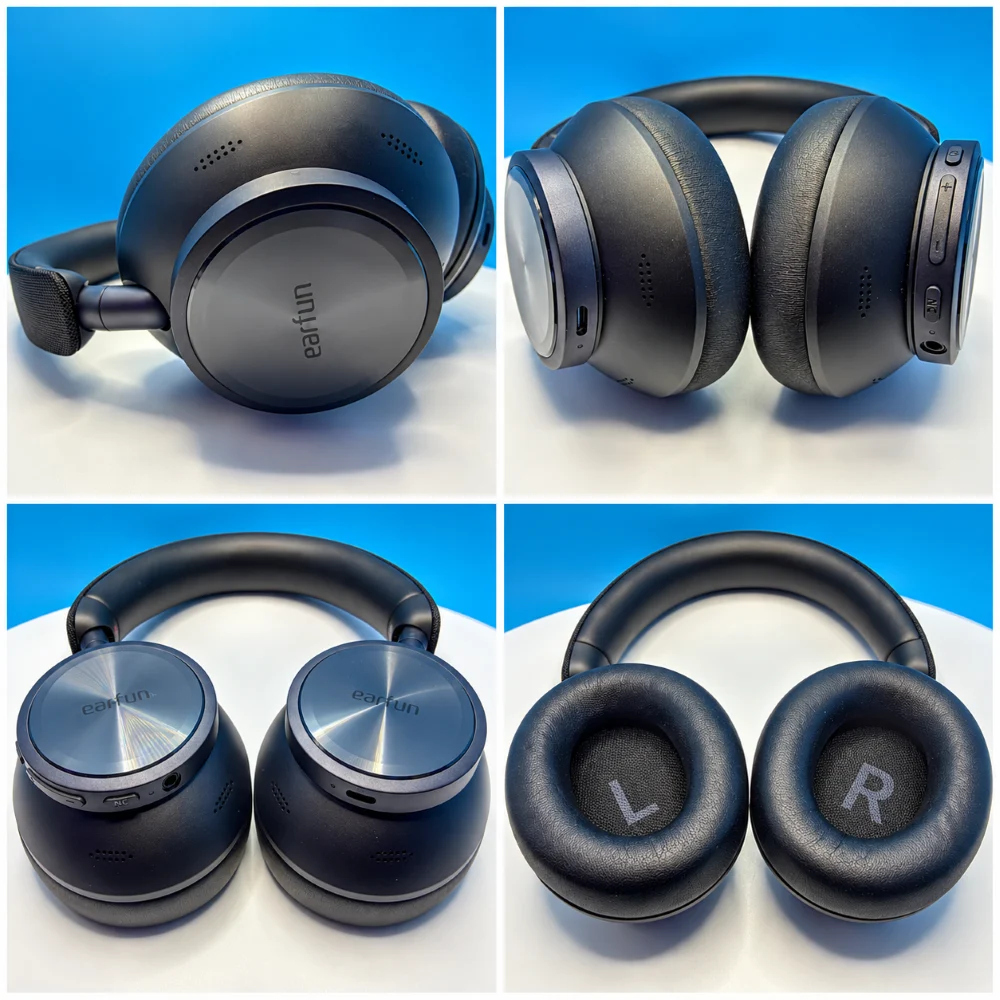
At around 259 grams, the Wave Pro X feels remarkably light the moment I put it on. The pads are soft and surprisingly breathable; the cups and arms have enough articulation to settle naturally around my head, and the clamping force never becomes distracting, even during longer listening sessions.
And perhaps most importantly, my ears don’t immediately become two tiny saunas. That’s a bigger compliment than it sounds. Closed-back wireless headphones can heat up quickly, and once they do, I don’t care how good they sound. I’m already thinking about taking them off.
That never became an issue here. I can wear the Wave Pro X for hours without constantly adjusting the cups, giving my ears a break, or becoming increasingly aware that there’s a pair of headphones strapped to my head.
Comfort doesn’t show up on a frequency-response graph, but it absolutely determines how often I reach for a pair of headphones. The most technically impressive set in the world doesn’t do me much good if I want it off my head after forty minutes.
The Wave Pro X goes in the opposite direction.
I forget I’m wearing it.
That’s Joy.
U • Unleashed
The Wave Pro X isn’t unleashed when you take it out of the box.
It’s unleashed when you take control of it.
That’s probably the most important distinction in this entire review.
This isn’t an audiophile-curious headphone because EarFun magically created perfect $129 stock tuning.
To my ears, it didn’t.
It’s interesting to audiophiles because EarFun built capable hardware and then gave us unusually powerful tools to shape it ourselves.
That’s what turns the Wave Pro X from another feature-packed consumer ANC headphone into something I think the enthusiast community should actually notice.
🎼 Sound
Let’s deal with the monster in the room.
I don’t particularly like the stock tuning.
There. I said it.
My first listen was bass. Then more bass. And somewhere underneath all of that low-end weight, I found myself searching for the mids.
To my ears, the stock Wave Pro X is simply too bass-heavy. There’s plenty of extension and physicality down low, but that extra weight can creep upward, leaving the mids sounding muddy and lacking in presence. Then, just when I’m wishing for a little more energy and clarity through the middle, the treble occasionally finds a way to become peaky enough to grab my attention.
It’s an unusual combination. Too much weight down low, not enough presence through the middle, and occasional bursts of unwanted energy up top.
Vocals are where the stock tuning really loses me. I want singers to rise naturally out of the mix rather than feel buried inside it. I want presence, separation, and enough air around a voice that it can occupy its own space. Female vocals, in particular, can give me that wonderful sensation of floating slightly in front of the instrumentation when headphones present it right.
The stock Wave Pro X doesn’t consistently give me that.
Independent measurements help explain some of what I’m hearing, showing a broad recession through roughly the 3.5 to 5kHz region, followed by narrower peaks higher in the treble. That combination lines up remarkably well with my listening experience: vocal presence can feel pushed backward while certain upper-frequency information still manages to jump forward.
If that were the end of the story, my feelings about the Wave Pro X would be very different.
But then something wonderful happens.
I open the EarFun Audio app, tap Professional EQ, and start making a few adjustments.
And suddenly, this becomes a completely different pair of headphones.
🥁 Bass
There’s no shortage of bass here, and for some listeners that’s going to be exactly what they want. The Wave Pro X can dig deep and deliver plenty of low-frequency weight, and that 40mm DLC driver certainly isn’t afraid to move some air when the music calls for it.
My issue isn’t capability. It’s proportion.
In the stock tuning, there’s simply too much low-end emphasis for my preferences. That extra weight gives bass plenty of authority, but it can also push upward into the rest of the presentation and contribute to some of the muddiness I hear through the mids. Instead of giving me a strong foundation underneath the music, the bass occasionally starts occupying space I’d rather give to everything above it.
So I pulled it back with PEQ, and that’s where the Wave Pro X became much more interesting. I could keep the extension, impact, and physicality while bringing the overall quantity into better balance with the mids. The bass didn’t lose its personality. It just stopped trying to dominate the conversation.
That’s an important distinction because I didn’t want less capable bass. I wanted better-behaved bass. The Wave Pro X gave me enough control to get there.
There’s also an interesting wrinkle for anyone planning to build their own PEQ profile. Independent measurements found a substantial difference in bass response across ANC modes, with roughly 6dB more output below 150Hz when ANC was disabled. That’s large enough that a tuning created with ANC on may not translate exactly the same way when you turn it off.
For me, ANC is part of how I normally use wireless headphones like this, so that’s the mode I used as the basis for my tuning. If you’re going to spend the time dialing in the Wave Pro X, tune it around the way you actually listen.
🎤 Midrange & Vocals
This is where Professional PEQ really changed my relationship with the Wave Pro X. Stock, the vocals are there and perfectly intelligible, but they don’t have the presence or immediacy I crave. The extra bass weight, combined with recessed energy farther up, pushes the center of the presentation backward, which is especially noticeable with vocal-focused music.
I want a singer to feel anchored in the mix without being buried by everything happening around them. And when the recording calls for it, I want vocals to float, reaching forward into their own space with enough air and separation that I can focus on the voice itself.
Stock, the Wave Pro X doesn’t quite get me there.
Once I started working with PEQ, though, the picture changed dramatically. Pulling some weight from the low end, restoring presence in the mids, and smoothing the upper-frequency areas that occasionally become too aggressive allow the singer to step forward naturally.
There you are.
Vocals become more expressive and immediate, with noticeably better separation from the surrounding instrumentation. Instead of searching for the singer in the mix, I can settle into the performance and let the voice occupy the center.
This was probably the moment when I realized just how much capability was hiding underneath EarFun’s stock tuning. The hardware wasn’t the problem. It simply needed a little help getting out of its own way.
🎯 Instrument Separation
Instrument separation is surprisingly good once the tonal balance is cleaned up. I’m not talking about the kind of hyper-separated presentation where every performer gets carved into a perfectly defined holographic space. More sophisticated audiophile gear can do that, but that’s not what $129.99 is buying here.
What the Wave Pro X does well is stay organized. Individual elements remain easy to follow, percussion retains its edges, guitars don’t collapse into vocals, and once I get the bass under control with PEQ, that extra low-end weight stops bleeding upward and crowding the rest of the mix. Even on denser recordings, there’s enough separation that I can follow the arrangement instead of hearing everything congeal into one giant wall of sound.
I think the dual-driver implementation deserves some credit here, too. Multiple drivers always look impressive on a spec sheet, but adding another driver doesn’t automatically make a headphone better. If the integration isn’t right, you can hear different parts of the frequency range behaving as if they came from different places.
I don’t get that with the Wave Pro X.
The transition feels cohesive, and nothing calls attention to the fact that two drivers are working together inside each cup. The Wave Pro X sounds like one headphone, not two drivers fighting over custody of the frequency range.
That’s exactly how it should be.
🏟️ Soundstage & Imaging
The Wave Pro X isn’t going to fool you into thinking you’re listening to a giant open-back headphone, but I was pleasantly surprised by how much the presentation opened up once I started working with PEQ.
Stock, everything feels a little more constrained than I want. Vocals don’t have quite enough presence, and some of that recessed lower-treble energy takes away from the sense of space around instruments. Bring those areas back into better balance, though, and the stage starts to breathe. Performers gain more room around them, depth becomes easier to follow, and individual elements occupy more convincing positions instead of bunching together toward the center.
Imaging is actually one of the stronger parts of the presentation. Placement feels stable and easy to follow, and once the tonal balance is cleaned up, there’s enough separation to create a convincing sense of where things are happening within the mix.
I’m also keeping my expectations grounded. This is still a closed-back wireless ANC headphone, and physics hasn’t been canceled along with the background noise. I’m not going to pretend PEQ suddenly turns the Wave Pro X into some enormous holographic staging monster.
What it does is let the capable hardware underneath breathe a little more freely. Once dialed in, I spend considerably less time thinking, ” This is pretty good for an inexpensive wireless headphone, and considerably more time simply enjoying the space it creates.
That’s the win.
✨ Treble & Air
Treble is the other area where the stock Wave Pro X gets a little tricky. To my ears, there’s a strange push-pull happening, with some of the lower-treble energy feeling recessed while narrower areas farther up can occasionally become prominent enough to sound peaky. The result is a headphone that sometimes lacks the presence and openness I want, yet still manages to poke me with a little too much energy in exactly the wrong place.
Again, PEQ is the answer, and this is where having a true parametric EQ, rather than a simple graphic equalizer, really matters. Broad tonal issues and narrow peaks aren’t the same problem, so I don’t necessarily want to reach for a slider labeled “Treble” and pull everything down with it.
Professional PEQ lets me be surgical. I can choose the frequency that’s bothering me, decide exactly how much I want to reduce it, and use Q to control how wide or narrow that adjustment should be. That’s the difference between “turn down the treble” and “turn down this treble.”
For an enthusiast, that’s a big deal because I can tame the areas that bother me without sacrificing the air, detail, and sparkle I actually want to keep. And the Wave Pro X responds well to that kind of fine-tuning.
Once I had the upper frequencies dialed in around my ears and preferences, the presentation became smoother and cleaner without becoming dull. I could keep enough energy up top to give instruments definition and space while removing the occasional bite that pulled me out of the music.
That’s really the recurring Wave Pro X story: I don’t always agree with EarFun’s out-of-the-box choices, but I love how much freedom they give me to make my own.
🎚️ Professional PEQ: This Changes Everything
This deserves its own section because Professional PEQ is the Wave Pro X story.
EarFun gives you the usual collection of presets for quick tonal changes, and for plenty of listeners, that’s probably all they’ll ever need. Pick the flavor you like, hit play, and enjoy your music.
But we’re GearZilla. We’re going deeper.
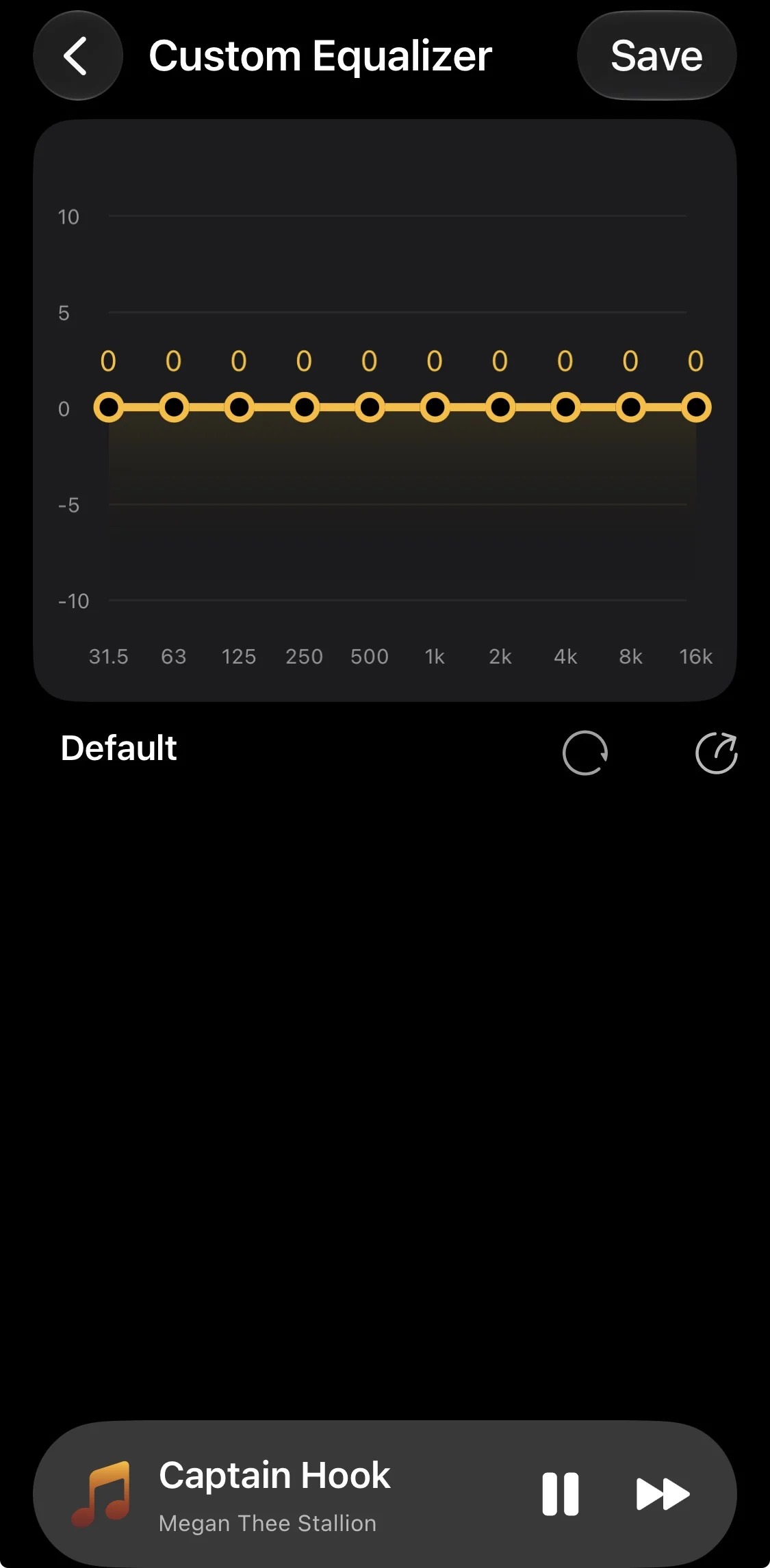
Professional EQ gives you 10 parametric bands, providing considerably more control over the final sound than a handful of presets or a traditional graphic EQ. More importantly, the Wave Pro X responds beautifully when you start digging in.
That’s when my entire experience with these headphones changed.
I could pull back the bass without neutering it, restore some of the vocal presence I felt was missing, tame the upper-frequency energy that occasionally bothered me, and start shaping the Wave Pro X around my ears and my preferences, rather than simply accepting someone else’s target.
And the difference wasn’t subtle.
PEQ fundamentally changed my relationship with this headphone.
That’s why I don’t consider the EarFun Audio app an accessory to the Wave Pro X; it’s part of the audio system. Without it, I have a comfortable, feature-packed wireless headphone with stock tuning I don’t particularly love. With it, I have a headphone I keep reaching for because I’ve been able to make it sound remarkably close to how I want it to.
There’s also something important happening underneath all that EQ. The drivers don’t seem to protest when you start making meaningful adjustments. Independent distortion testing measured less than 0.25 percent distortion across the tested range at high playback levels, which tracks with what I heard: there’s enough capability and headroom here to make substantial corrections without the sound unraveling.
And that’s where the audiophile angle really starts to click for me.
EarFun isn’t asking an enthusiast to blindly accept its idea of the perfect tuning. It’s giving us capable hardware, opening up the toolbox, and saying, go find yours.
That’s not just EQ. That’s EarFun handing the audiophile the keys.
🔇 ANC: Good, But I Crave Great
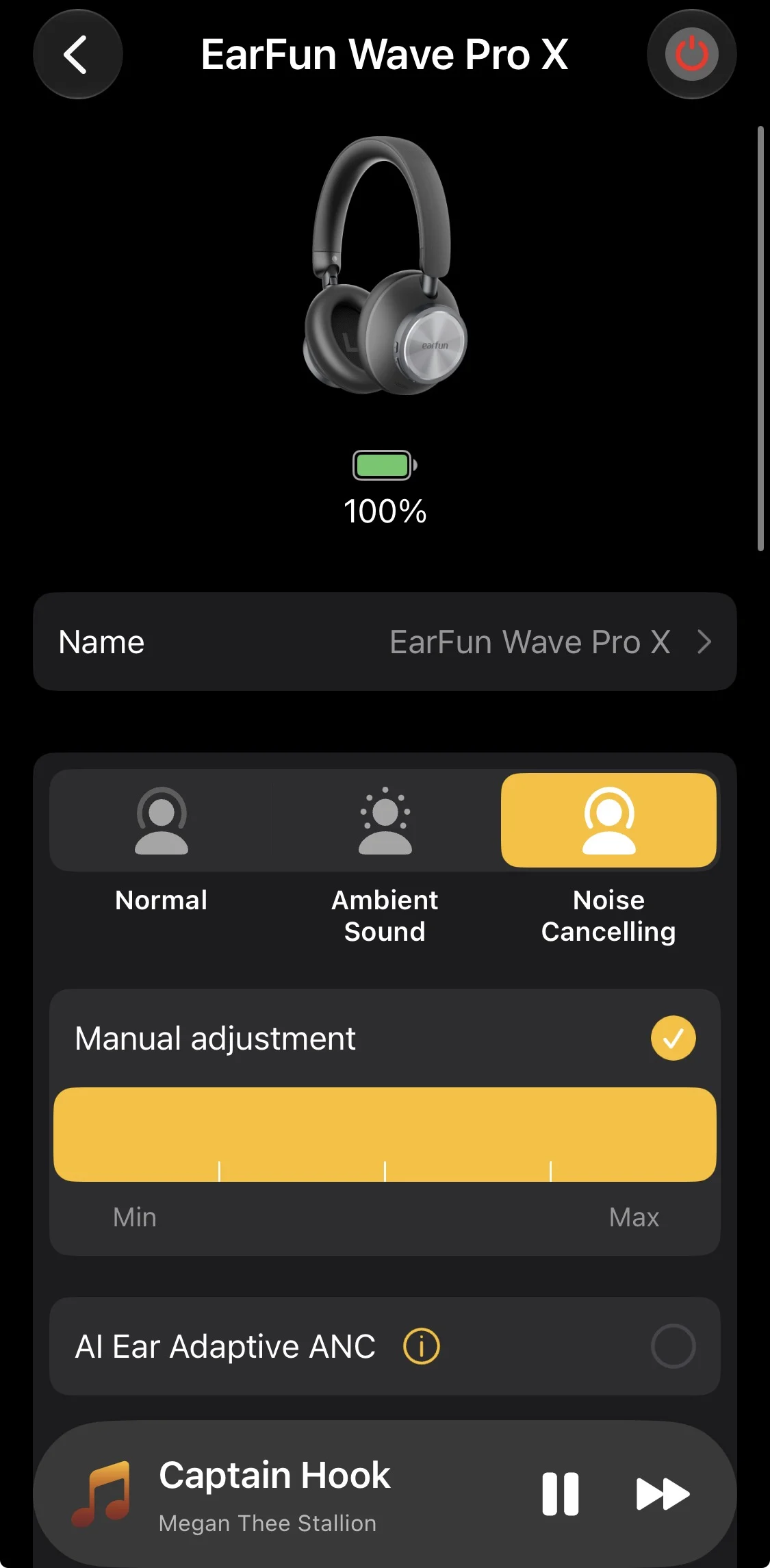
This is one of the areas where the Wave Pro X leaves me wanting more, which is frustrating, given that EarFun has clearly put serious effort into ANC. The eight-microphone system is paired with QuietSmart 3.5 Adaptive Hybrid ANC, and the app gives you multiple levels and modes to play with.
There’s plenty of control. The actual noise cancellation is good.
But I crave great.
Ultimately, I judge ANC by a much simpler standard: Can I turn off the world and lean into my music? I want to hit that button and feel the environment fall away around me, leaving nothing between me and whatever I’m listening to.
The Wave Pro X doesn’t quite get me there. It does a respectable job reducing low-frequency environmental noise, and I’m certainly not suggesting the ANC is ineffective. But enough of the outside world continues to slip through that I’m still aware of what’s happening around me when I’d rather disappear into the music.
Maybe that’s also a consequence of how ambitious the rest of these headphones feel. If the Wave Pro X were merely an inexpensive wireless headphone with decent ANC, I’d probably shrug and call it perfectly acceptable for the price. But EarFun has raised my expectations everywhere else. The comfort is fantastic, the connectivity is robust, the app is excellent, and PEQ completely transformed what I thought these headphones were capable of.
Good ANC suddenly isn’t enough. I want the ANC to be as impressive as the rest of the package.
That’s the next step for me. Don’t just give me more ANC settings. Give me that wonderful moment when I press the button and the world disappears.
🌎 Ambient Mode: Let the World Back In
Ambient mode does what I need it to do.
Voices become easier to hear.
Environmental information returns to the presentation.
I can quickly interact with someone without completely removing the headphones.
That’s useful.
And given how comfortable these are, I found myself using ambient mode more often than I expected, since taking the Wave Pro X off feels almost unnecessary.
Which brings us directly to something EarFun really needs to fix.
⏸️ Wear Detection: Where Is My Sensor?
This one bugs me more than it probably should, because there is no wear sensor. Take the Wave Pro X off your head, and the music keeps playing. Put it back on and nothing resumes automatically because, well, nothing ever stopped.
A few years ago, I might have shrugged that off as a premium convenience feature. In today’s wireless audio market, though, wear detection increasingly feels like a minimum requirement. I’ve become so accustomed to earbuds and wireless headphones knowing when I’ve taken them off that I immediately notice when a product doesn’t.
And that’s what makes its absence particularly strange here. EarFun packed the Wave Pro X with Bluetooth 6.0, dual drivers, eight microphones, Auracast, premium codecs, Professional PEQ, adaptive ANC, USB audio, and multipoint. This is an incredibly feature-rich headphone, yet somehow it doesn’t know when it’s sitting on my head.
At $129.99, the omission isn’t catastrophic, but it does work against one of the Wave Pro X’s greatest strengths: convenience. This is supposed to be the headphone I grab without thinking, and automatic pause and resume is exactly the kind of small feature that makes that everyday experience feel seamless.
EarFun, the next Wave needs a wear sensor. At this point, it feels less like a luxury and more like part of the basic wireless-headphone checklist.
🔘 Controls: Thank You for the Buttons… Now Give Them More to Do
I like buttons. There, I said it. Touch controls can feel wonderfully modern until you’re walking, wearing gloves, sweating, or lying in bed and your pillow decides it would also like control of your headphones.
Nothing says relaxation quite like rolling onto your side and having a sensitive touch panel pause your music, skip a track, or summon some feature you absolutely did not ask for.
Give me a button.
The Wave Pro X gets that part right with physical controls that are straightforward, easy to find, and easy to use without taking the headphones off. I never have to wonder whether my finger actually registered a command, or whether my pillow is about to take over DJ duties.
But considering how much customization EarFun gives me inside the app, I wish that same philosophy extended further into the controls. Give me more flexibility over what those buttons do, which functions I can access directly, and how I want everything mapped. If you’re already trusting me with a 10-band parametric EQ, you can probably trust me to decide what happens when I hold down a button.
The hardware is already there. Now let me make those buttons mine.
🎤 Calls: Nobody Knew
Call quality was a pleasant surprise. I used the Wave Pro X for plenty of normal conversations, and not once did anyone stop and ask whether I was talking through headphones. There were no complaints about my voice, no repeated requests to say something again, and no underwater quality that immediately gives away a mediocre headphone microphone.
I also didn’t encounter any significant wind-related problems during my testing. The Wave Pro X uses its eight-microphone system for both noise cancellation and call processing, and while I have some complaints about the ANC side of that equation, the call side worked very well for me.
That’s especially important for a headphone I’ve increasingly come to treat as a daily driver. If I’m going to grab it for work, travel, errands, or just moving through the day, I need to be able to take a call without having to switch devices or pull out my phone.
Sometimes the best compliment I can give a microphone is that nobody talks about the microphone. It simply did its job, and that’s exactly what I wanted.
☁️ Comfort: This Might Be the Real Killer Feature
PEQ may be the technical Kill Shot, but comfort might be the reason I keep using the Wave Pro X. At around 259 grams, these are ridiculously easy headphones to wear, with soft, breathable pads, plenty of articulation in the cups, and a headband that distributes what little weight there is nicely across my head.
More importantly, I don’t get that immediate hot-ear problem that can make some closed-back wireless headphones feel like winter earmuffs after twenty minutes. I’ve worn the Wave Pro X for long stretches without feeling the need to pull them off, adjust them constantly, or give my ears a break.
Comfort is one of those things we sometimes underestimate in this hobby because you can’t measure it in kilohertz or decibels, but it absolutely affects how much we use our gear. A technically superior pair of headphones doesn’t do me much good if I’m ready to rip them off my head after forty-five minutes. Give me something I can comfortably wear for three hours, and I’m probably going to reach for it a whole lot more often.
That’s exactly what happened here. The Wave Pro X practically disappears on my head, and once I dialed in the sound with PEQ, it got surprisingly close to disappearing from the equation altogether. I could simply settle in and enjoy the music.
🎨 Design: Nothing Fancy, Nothing Stupid
The Wave Pro X isn’t trying to look like jewelry, and I think that’s the right call. The design is clean, modern, and relatively understated, without unnecessary lighting, aggressive gamer styling, or shiny accents desperately trying to convince you that you’re holding something more expensive than it is.
It simply looks like a nice pair of headphones.
The cups and arms have plenty of articulation, the folding design makes them easy to travel with, and the included case fits perfectly with that daily-driver personality I’ve been talking about throughout this review. The materials aren’t luxurious, but nothing about the construction struck me as unnecessarily cheap either. In fact, the lightweight build feels deliberate, especially once you experience how comfortable the Wave Pro X remains over longer listening sessions.
And that’s really how I judge the design. I don’t need these to look like a $1,000 pair of headphones. I need to be able to toss them into my travel bag, take them on a flight, carry them around all day, and not spend the entire time worrying about putting the first scratch on some gorgeous piece of audio jewelry.
The Wave Pro X looks good, travels easily, and feels built to be used. That’s exactly the point.
🔌 Connectivity: Pick a Door
Connectivity is another area where the Wave Pro X feels like EarFun simply decided to give you everything.
You get Bluetooth 6.0 with LDAC, aptX Adaptive, aptX Lossless, LC3, Auracast and Google Fast Pair, along with multipoint for bouncing between devices. If wireless isn’t what you want at the moment, USB audio and a traditional 3.5mm connection are there too.
That’s an outstanding connectivity package at this price, but what I appreciate most is how easily the Wave Pro X adapts to whatever I’m doing. I can connect to my phone and keep things simple, use a higher-quality codec when I want to squeeze more out of my music, jump between devices during the workday, or plug in when wireless simply isn’t the best option.
And once again, this feeds directly into that Bridge-Fi idea.
The Wave Pro X doesn’t make you choose between being a casual listener and an enthusiast. You can ignore almost everything under the hood and have a ridiculously convenient wireless headphone, or start digging into codecs, connections, and PEQ to see how much more you can squeeze from the hardware.
It meets you wherever you happen to be on the audio rabbit hole, and I really like that.
🔋 Battery: Charge It… Eventually
EarFun rates the Wave Pro X for up to 90 hours with ANC disabled and 50 hours with ANC enabled. It also advertises up to 10 hours of playback from a 15-minute quick charge.
Ninety hours.
At some point, battery life stops being something I actively monitor and becomes:
“Oh yeah. I should probably charge these.”
That’s where we are.
I didn’t come anywhere near killing the battery during normal testing.
And that’s exactly what I want from a travel headphone.
Battery anxiety shouldn’t be part of the listening experience.
Here, it isn’t.
🌉 Bridge-Fi: This Is Where Things Get Interesting
Here’s where I think the Wave Pro X deserves more attention from the audiophile community.
There’s always been something of an invisible wall between consumer and enthusiast audio. Consumer headphones tend to prioritize convenience: wireless connectivity, ANC, apps, calls, battery life, and the ability to throw something on your head and get moving. Audiophile gear generally asks different questions. How good are the drivers? How thoughtful is the tuning? How much resolution, separation, and texture can I pull from a recording? What happens when I give this headphone a better source or amplifier? How much control do I have over the final sound?
Historically, crossing from one side of that wall to the other required compromise. Choose convenience, and you usually surrender some sound quality and control. Choose performance, and you might find yourself carrying a DAC, an amplifier, cables, adapters, and enough audio equipment to make a TSA agent wonder exactly what you’re doing with your life.
The Wave Pro X makes that wall feel a little thinner.
I’m not suggesting it replaces my serious passive headphones. It doesn’t. PEQ doesn’t magically transform a $129 wireless headphone into a kilobuck reference system, and Bluetooth hasn’t suddenly made dedicated source gear irrelevant. My better audiophile headphones can still reach deeper into recordings, uncover finer textures, create a more convincing sense of space, and deliver the kind of technical performance that reminds me why I fell down this ridiculous rabbit hole in the first place.
But that’s not what makes the Wave Pro X interesting.
What’s changing is the size of the compromise.
EarFun gives the everyday listener almost everything you’d expect from a modern consumer headphone, then leaves a surprisingly large door open for the enthusiast who wants to go further. Open Professional EQ, start shaping the frequency response to your preferences, and the Wave Pro X responds with enough capability that I stopped thinking of it merely as a cheap wireless headphone.
That’s why I keep coming back to the term Bridge-Fi.
It’s accessible enough that someone who couldn’t care less about frequency-response curves can pair it with a phone, pick a preset, and get on with their day. But it’s also customizable enough that someone like me can disappear into the app, start manipulating a 10-band parametric EQ, and discover just how much performance is hiding underneath that stock tuning.
And once I got it dialed in, something unexpected happened.
I stopped thinking about the price.
I wasn’t sitting there saying, “This sounds really good for $129.”
I was just enjoying the music.
For a consumer-grade wireless headphone, trying to reach across that invisible wall toward the enthusiast side of audio is a meaningful accomplishment.
🚗 The Daily Driver
This is the analogy I kept coming back to throughout my time with the Wave Pro X.
It’s not the exotic car sitting in my garage. It’s not the machine I take out on a Sunday morning specifically because I want to experience every last thing the engineering can do.
It’s the car with the keys hanging beside the door.
The one that’s comfortable, reliable, easy, and efficient. It has enough performance to make the drive enjoyable, but enough practicality that I never have to think twice about using it. You don’t plan around it. You don’t baby it. You grab the keys and go.
And eventually, you realize something.
You’re putting more miles on that car than anything else you own.
That’s exactly what happened with the Wave Pro X. I’m not taking my expensive audiophile headphones outside to cut the grass. I’m not tossing them into a backpack when I’m heading somewhere they might get knocked around, and I’m certainly not dragging a dedicated amplifier onto a plane because I desperately need that final five percent of resolution at 35,000 feet.
Sometimes I just want music. Good music. Good sound. No fuss.
That’s where the Wave Pro X makes so much sense. It’s comfortable enough to wear for hours, capable enough that I don’t feel like I’m abandoning good sound, and convenient enough that reaching for it never becomes a decision.
And now that I’ve dialed in the sound with PEQ?
These are the headphones hanging beside the door.
💰 Value: The Floor Keeps Rising
EarFun currently lists the Wave Pro X at $129.99, and when I look at everything packed into these headphones, that price starts feeling a little ridiculous.
You’re getting dual-coaxial drivers, Bluetooth 6.0, aptX Lossless, aptX Adaptive, LDAC, LC3, Auracast, multipoint, USB and analog audio, adaptive ANC, an eight-microphone system, a legitimate 10-band Professional PEQ, up to 90 hours of battery life, and a proper carrying case. Add excellent comfort and good call quality, and there’s an awful lot happening here for $129.99.
Personal audio has been in a race to push better sound, better technology, and more functionality into increasingly accessible price brackets. The Wave Pro X feels like one of those products where you can actually see the floor moving upward.
That doesn’t mean everything here is class-leading. It isn’t. The ANC is good, but I want it to be great. Wear detection is inexplicably absent; I’d like more customization over the physical controls, and EarFun’s stock tuning isn’t remotely where I’d leave it.
But that’s almost what makes the value proposition more interesting. Look at what’s already here, then consider what happens when an enthusiast opens the app and starts using the tools EarFun provided. Professional PEQ allows me to address my biggest complaint with the headphone instead of simply living with it.
And once I do that, I’m left with an incredibly comfortable, ridiculously versatile wireless headphone that sounds far better than my first listen suggested and handles an enormous percentage of what I actually need from day to day.
That’s where $129.99 starts feeling slightly absurd.
👹 Who Is This For?
The obvious answer is anyone looking for a comfortable, feature-packed wireless headphone without paying premium-brand money. The Wave Pro X makes plenty of sense for that listener right out of the gate.
But that’s not the audience I find most interesting.
I’m talking to you, fellow audio nerd. The person with a nice DAC sitting on the desk. The person who knows what Q means and has surprisingly strong opinions about whether a 2dB shelf at 120Hz is tasteful tuning or an act of violence. The person who probably already owns headphones that are technically better than this one.
Take the Wave Pro X seriously anyway.
Not as a replacement for your favorite audiophile gear. As an addition to it.
This is the headphone you grab when bringing the expensive stuff simply doesn’t make sense. It’s the flight headphone, the yard-work headphone, the travel headphone, the work headphone, and the “I need to walk out the door in thirty seconds” headphone. It’s the set I can toss into a bag and actually use without worrying about babying it or assembling half my desktop chain just to listen to music.
And unlike a lot of convenience-first consumer gear, I don’t have to completely surrender the sound to somebody else’s idea of what I should like. Professional PEQ gives me enough control to take capable hardware and shape it around my preferences.
That’s the part I think enthusiasts should pay attention to.
The Wave Pro X doesn’t ask me to choose between convenience and curiosity. I can simply use it when I want something easy, or I can dig into the app, start tweaking, and see how much more performance I can pull out of it.
That’s what makes the Wave Pro X more interesting than just another $129 wireless headphone.
🦖 GearZilla Scorecard
🎚️ Professional PEQ: 5.0/5. This is the Wave Pro X’s superpower. Ten-band parametric control fundamentally changes what this headphone can become and gives enthusiasts legitimate authority over the final sound.
☁️ Comfort: 5.0/5. Outstanding. Lightweight, breathable, nicely articulated, and easy to wear for hours. This is one of the primary reasons I keep reaching for it.
📱 App & Customization: 4.9/5. Excellent. Presets are available for casual users, while Professional EQ gives enthusiasts much deeper control. This isn’t a throwaway companion app.
🔌 Connectivity: 5.0/5. Bluetooth 6.0, aptX Lossless, aptX Adaptive, LDAC, LC3, Auracast, multipoint, USB, and analog. EarFun came loaded for bear.
🔋 Battery Life: 5.0/5. Up to 90 hours without ANC and 50 with it puts battery anxiety firmly in the “things I don’t need to think about” category.
🎤 Call Quality: 4.6/5. Very good in my testing. Callers didn’t complain, nobody seemed to notice I was using headphones, and the wind didn’t cause any meaningful problems.
🥁 Bass: 4.2/5. Excellent extension and plenty of capability, but too heavy for my preferences in stock form. PEQ dramatically improves the balance.
🎤 Midrange & Vocals: 4.2/5. Stock vocal presence leaves me wanting more, but the underlying hardware responds beautifully once the midrange is brought forward through PEQ.
🎯 Separation: 4.4/5. Respectable organization and coherence, particularly after tuning. The dual-driver architecture integrates nicely without calling attention to itself.
🏟️ Soundstage & Imaging: 4.2/5. More intimate than expansive, but imaging remains coherent, and PEQ helps restore some breathing room.
✨ Treble & Air: 4.1/5. Stock tuning combines recessed presence with occasional peaky energy. Professional PEQ gives you the precision needed to substantially improve it.
🔇 ANC: 3.7/5. Functional and adjustable, but not strong enough for what I want from a dedicated ANC headphone. The outside world simply gets through too easily.
🔘 Everyday Controls: 4.0/5. I appreciate the physical buttons and find them easy to use, but greater functionality and customization would make the experience considerably better.
⏸️ Wear Detection: 3.0/5. Because there isn’t any. At this price, I can forgive it. With this feature set, I can’t understand it.
💰 Value: 4.9/5. The combination of comfort, connectivity, battery life, dual-driver hardware, and genuinely useful PEQ makes the overall package exceptionally compelling at $129.99.
🦖 Overall GearZilla Score: 4.0/5.
🦖 Final Roar
The EarFun Wave Pro X surprised me, but not because it sounds perfect. It doesn’t. Its ANC isn’t suddenly dethroning the established heavyweights, and EarFun certainly hasn’t produced a $129.99 wireless headphone that makes expensive audiophile equipment irrelevant.
What surprised me is how much the Wave Pro X challenged my assumptions about what a consumer wireless headphone at this price is supposed to be.
My first listen didn’t exactly inspire love. The bass was too heavy, the mids felt muddy and pushed back, the vocals lacked the presence I wanted, and certain areas of the treble occasionally poked more than I liked. Had EarFun stopped there, this would’ve been a very different review.
But EarFun didn’t stop there.
It handed me a 10-band parametric EQ.
So I started tuning. I pulled the bass into proportion, brought the vocals forward, and dealt with the upper-frequency energy that bothered me. The drivers responded beautifully, and somewhere along the way something happened that ultimately became the entire story of this review.
I stopped reviewing the Wave Pro X and started using it.
I grabbed it when I sat down to work. I grabbed it before heading outside. I grabbed it when I needed to make a call, when I was traveling, and when I simply wanted music without thinking about sources, amplification, cables, or whether I really wanted to take an expensive pair of headphones wherever I was going.
I just kept grabbing it.
That’s why the daily-driver analogy works so well for me. The Wave Pro X isn’t the exotic in my garage. It’s the car with the keys hanging beside the door. And there’s something incredibly valuable about owning gear that makes you want to use it rather than admire it.
The comfort is outstanding, battery life is borderline silly, connectivity is exceptional, and call quality is good enough that nobody ever commented on the microphone. The app isn’t an afterthought. It’s part of the audio system. The dual-coaxial drivers behave like a coherent whole, and Professional PEQ gives me enough control to transform a stock tuning I don’t particularly enjoy into a sound I genuinely do.
There are still things EarFun needs to improve. The ANC is good, but I crave great. If noise cancellation is supposed to let me disappear into my music, I don’t want the world sneaking back into the room. The lack of wear detection is increasingly difficult to excuse on a headphone this feature-rich, and while I love having physical buttons, I’d like more control over what those buttons actually do.
Those aren’t insignificant complaints. They’re why this isn’t a 4.5 or a 5.
But here’s what excites me about the Wave Pro X. EarFun’s first Wave Pro arrived only a couple of years ago, and we’re already looking at a follow-up with a dual-driver architecture, a newer Qualcomm wireless platform, broader codec support, Auracast, more sophisticated ANC, and a legitimately excellent PEQ implementation.
That’s one hell of a trajectory.
Affordable audio isn’t simply a race to make cheap products cheaper anymore. It’s about pushing better hardware, more functionality, deeper customization, and increasingly legitimate performance into price brackets where we didn’t expect to find them.
And that’s where I think the Wave Pro X becomes more important than its $129.99 price tag suggests.
It doesn’t replace my audiophile headphones.
It doesn’t embarrass them.
But it doesn’t embarrass itself beside them, either.
The line between “consumer audio” and “enthusiast audio” is getting increasingly difficult to draw. The Wave Pro X doesn’t erase that line.
It moves it.
And for $129.99?
That’s one hell of an accomplishment.
🏆 GearZilla Bridge-Fi Daily Driver
Tune it. Grab it. Go.
✅ Buy If
- 🎚️ You love EQ and want legitimate parametric control built directly into your wireless headphone ecosystem.
- ☁️ Comfort is one of your highest priorities.
- 🎧 You already own serious audiophile gear but want something considerably easier to grab every day.
- 🌉 You want a headphone that bridges consumer convenience and enthusiast customization.
- 🥁 You enjoy substantial bass but want the ability to pull it back precisely.
- 🎤 You care about vocals and are comfortable using PEQ to bring them forward.
- 🔌 You want Bluetooth, USB, and traditional wired connectivity in one headphone.
- 📡 aptX Lossless, aptX Adaptive, LDAC, LC3, or Auracast matter to you.
- 🔄 You regularly switch between multiple devices.
- 🎤 You need solid call quality for work or everyday conversations.
- 🔋 You hate constantly charging headphones.
- ✈️ You want a lightweight travel headphone that you won’t be terrified to actually travel with.
- 🔘 You prefer real buttons over touch controls.
- 🧪 You enjoy tinkering with sound.
- 💰 You want an enormous amount of functionality for $129.99.
- 🦖 You’re an audiophile who’s willing to admit that sometimes convenience is pretty freaking awesome.
⛔ Skip If
- 🎼 You demand excellent tuning straight out of the box and have absolutely no interest in EQ.
- 🔇 Maximum-strength ANC is your highest priority.
- 🌎 You want the outside world to virtually disappear when noise cancellation is engaged.
- ⏸️ Automatic pause/resume when removing your headphones is mandatory.
- 🔘 You need extensive control customization directly from the earcups.
- 🌌 You’re chasing a huge, open-back-style soundstage.
- 🔬 You expect $129.99 wireless headphones to replace high-end passive cans for critical listening.
- 🎤 You want strongly forward vocals without touching PEQ.
- 🥁 You dislike elevated bass and refuse to adjust it.
- 📱 You don’t want your phone or an app involved in getting the best out of your headphones.
- 🎧 You already own a premium ANC headphone, and your only reason for changing is substantially stronger noise cancellation.
🧡🦖 The EarFun Wave Pro X Is Available Now!
The EarFun Wave Pro X is officially available, and EarFun gave GearZilla readers a 20% discount code, bringing the regular $129.99 price down to just $103.99.
GearZilla Reader Code: EFWPXKOL
Regular Price: $129.99
Your Price: $103.99
Full specs and details:
https://www.myearfun.com/products
Amazon:
https://www.amazon.com/dp/B0H8N49DSC
I already thought the Wave Pro X made a compelling Bridge-Fi argument at $129.99. At $103.99, that argument gets a whole lot louder.
Tune it. Grab it. Go. 🦖🎧
Hear the GearZilla Roar.
Listen Bigger!