



✅ Pros: Beautifully balanced and deeply musical tuning, rich textured bass from the dual dynamic drivers, exceptional vocals, smooth and energetic treble, precise imaging, convincing layering, excellent passive isolation, outstanding long-session comfort, gorgeous artisan faceplates, and a practical modular cable with both 3.5mm and 4.4mm terminations.
⛔ Cons: The soundstage feels more intimate than expansive to my ears, leaving me wanting a little more width, depth, and overall scale. The Tea Pro favors musical connection over ruthless analysis, so listeners chasing maximum technical sharpness may want something more clinical. The thick stock cable also has some memory and can hold bends more than I’d like.

🦖 Disclosure
This review reflects my own listening experience with the XENNS Mangird Tea Pro.
As always, my goal isn’t to stare at the specification sheet until I convince myself something sounds good. I want to live with the gear, move through the music I actually enjoy, try different sources and tips, and eventually answer the question that matters most to me:
Does this thing help me enjoy the music I already love in a new way?
With the Tea Pro, that answer isn’t complicated.
Absolutely.
In fact, this one went further.
It became one of the IEMs I compare everything else against.

💎 The Jewel of My Collection
Some IEMs impress you immediately.
Some throw giant bass, laser-focused detail, or an enormous stage at you and make sure you notice every technical trick they’re performing.
Then there are the rare ones that quietly work their way into your rotation until one day you realize you’re reaching for them more than almost anything else.
That’s the XENNS Mangird Tea Pro.
This IEM didn’t just sound beautiful to me.
She sang to me.
The Tea Pro never seemed interested in overwhelming me with bass or in manufacturing excitement through exaggerated treble. Instead, it found a balance that feels more aligned with the newer Meta-style tuning philosophy I’ve come to enjoy, rather than the more obvious Harman-inspired character I hear in plenty of modern IEMs.
The result feels natural, full, and remarkably easy to live with.
Every session became one more song.
Then one more album.
Eventually I stopped looking for things to critique and simply started listening.
That’s when I knew the Tea Pro was different.
For me, it isn’t simply another excellent IEM.
It’s the jewel of my collection.

📦 First Impression: This One Sings
The Tea Pro didn’t take long to show me what it does well.
Vocals immediately grabbed me.
There was body, texture, and enough forward presence to make singers feel emotionally connected to the recording without pushing them so close that the presentation became shouty or claustrophobic.
Then the bass started making its case.
XENNS uses two custom 8mm dynamic drivers with reinforced bio-composite diaphragms, paired with six balanced armatures for the rest of the frequency range. The dual-DD system gives the Tea Pro a genuinely substantial low-end foundation, but the bass remains controlled enough that those wonderful mids never disappear beneath it.
The treble completed the picture.
There’s sparkle and energy, but the overall presentation remains smooth enough that I never feel like the Tea Pro is forcing detail in my face.
Nothing seemed to be fighting for attention.
That balance is the secret.
🎧 Review Setup
Every GearZilla review starts with the same philosophy:
Listen first. Figure out the story later.
The Tea Pro spent time across portable dongles, DAPs, and desktop gear, as well as various ear tips and both single-ended and balanced connections.
At 13 ohms with a rated sensitivity of 104 ± 1 dB, the Tea Pro isn’t particularly difficult to drive. It’ll work comfortably from portable sources, but better gear still gives it room to tighten up, improve layering, and sharpen dynamic contrast.
That’s the kind of scaling I like.
The Tea Pro doesn’t punish you for plugging it into a modest dongle.
It simply rewards you when you give it something better.
I also spent plenty of time experimenting with tips because the Tea Pro uses a 5.8mm nozzle, and fit affects both the bass response and that wonderful passive isolation. Linsoul lists compatibility with approximately 4.5mm ear-tip bores.
Once I landed on the right combination, comfort basically disappeared from the conversation.
Exactly how I want it.
🧬 KAIJU DNA SCAN
K • Kill Shot
Vocals.
That’s the Tea Pro’s kill shot for me.
There’s a fullness and emotional quality to voices that keeps pulling me back. Male vocals have body without becoming bloated, while female vocals carry sweetness, intimacy, and enough upper-mid energy to feel alive without crossing into shoutiness.
Plenty of IEMs resolve vocals.
The Tea Pro makes me care about them.
That’s different.
A • Anatomy
The Tea Pro is an eight-driver hybrid built around two custom 8mm dynamic drivers and six balanced armatures.
The dual dynamic drivers use reinforced bio-composite diaphragms and handle the low end, while the balanced armature array uses updated Knowles, RAF, and RDB-family drivers selected to improve timbre, texture, and micro-detail over previous Tea designs.
Official specifications list a 20 Hz to 22 kHz frequency response, 13-ohm impedance, 104 ± 1 dB sensitivity, THD of 0.6% or lower at 1 kHz, a 0.78mm 2-pin connector, and an approximately 1.2-meter modular cable with 3.5mm and 4.4mm plugs.
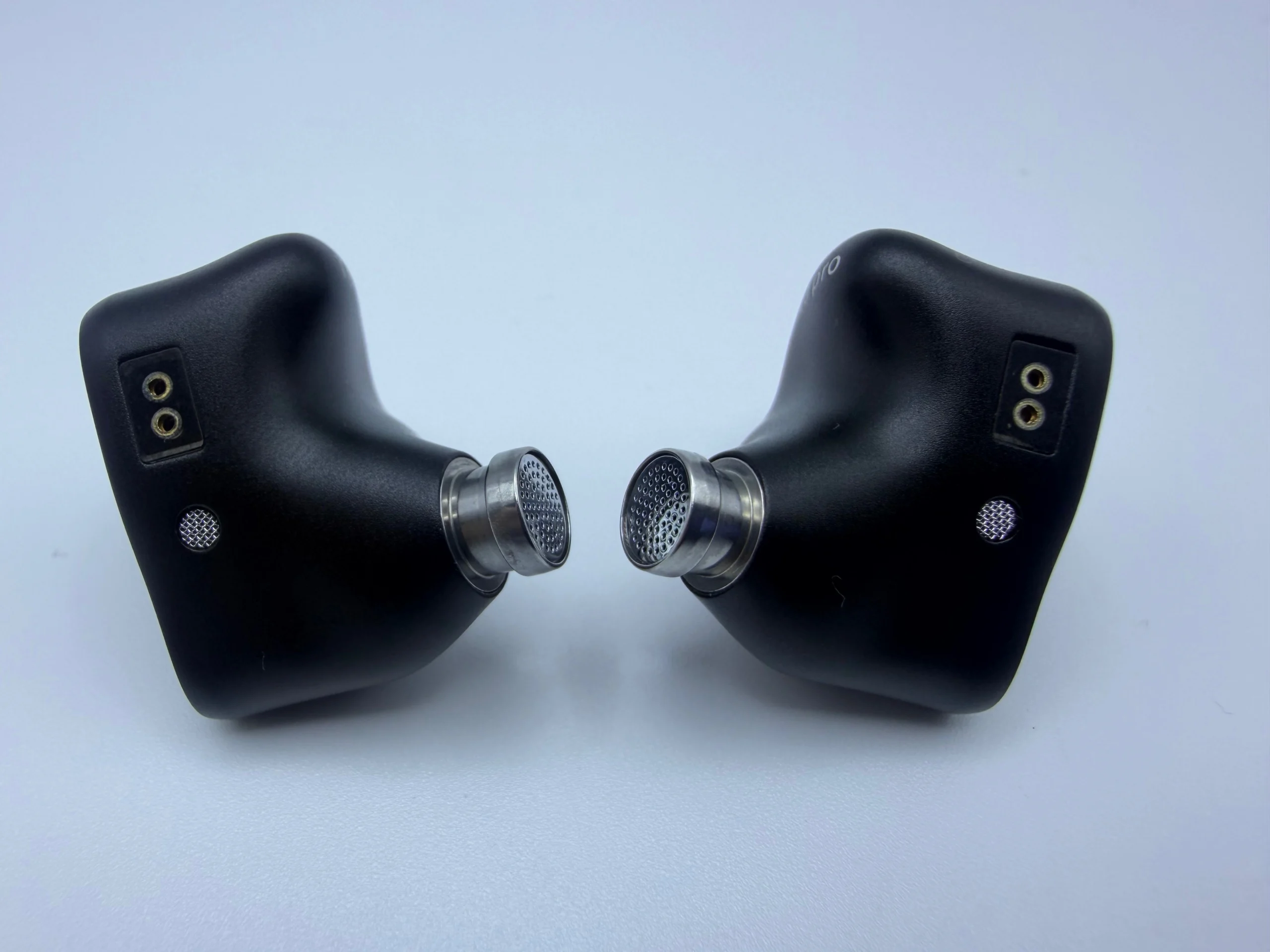
The standard Tea Pro pairs an opaque dark shell with its signature artisan faceplate, which shifts between green, violet, blue, and other tones depending on the light. It’s one of those designs that looks significantly better in person than it does in flat product photography.
I • Impact
The Tea Pro creates impact without turning itself into a basshead caricature.
Those dual dynamics give the low end real authority, particularly in the sub-bass, and there’s enough mid-bass presence to give drums satisfying weight and bass guitars proper texture.
But the impact isn’t only coming from quantity.
It’s coming from how naturally the bass connects to the midrange.
The Tea Pro feels grounded without feeling heavy.
That balance matters.
J • Joy
The joy is simple.
I kept reaching for it.
That sounds almost too obvious, but it’s one of the most useful things I’ve learned reviewing gear.
The products I admire technically aren’t always the products I actually use.
The Tea Pro became the opposite.
I’d finish testing another IEM and put the Tea Pro back in.
I’d be done writing for the evening and put the Tea Pro back in.
Eventually the review period ended.
I kept putting the Tea Pro back in.
There’s your Joy Factor.
U • Unleashed
The Tea Pro works with almost everything I throw at it, but vocals, jazz, acoustic music, rock, pop, indie, soul, and singer-songwriter material really show why I love it.
It has enough bass to make modern recordings feel alive, enough separation to keep busy arrangements organized, and enough smoothness to make long sessions ridiculously easy.
This isn’t the IEM I reach for when I want to dissect a recording.
It’s the IEM I reach for when I want to stay in one.

🎼 Sound
The Tea Pro understands something that many technically impressive IEMs forget.
Music isn’t a competition. It’s an experience.
To my ears, the tuning has a balanced, modern character that feels closer to the newer Meta-style direction than the classic Harman presentation I hear in plenty of competitors. There’s substantial bass, natural mids, an intelligently lifted vocal region, and enough treble energy to preserve openness without making the upper frequencies the entire story.
It’s musical without becoming syrupy.
Technical without becoming sterile.
Warm enough to feel inviting without losing clarity.
That combination is harder to pull off than it sounds.
🥁 Bass: Two Drivers, One Purpose
The dual dynamic drivers aren’t there for bragging rights.
You can hear what they’re doing.
Sub-bass reaches deep with genuine rumble, while the mid-bass has enough impact and texture to keep drums satisfying. The low end feels substantial, but I never found it routinely bleeding into the mids or masking vocal information.
That control is the important part.
There’s plenty of bass.
It just knows when to leave.
Some listeners may still want more raw slam, which is why I’ve never scored this as a full-blown basshead set. But compared with a lot of “balanced” IEMs, the Tea Pro has much more authority than the word balanced might suggest.
Independent reviewers have similarly noted the Tea Pro’s strong low-end presence and deeper rumble from the dual-DD system.
🎤 Midrange & Vocals: This Is Why She’s the Jewel
Here’s the heart of the Tea Pro.
Vocals are wonderful.
Male voices have enough lower-mid body to sound substantial, while female vocals get that little extra upper-mid lift that brings them forward without making them aggressive.
There’s texture here too.
You hear breath.
You hear little inflections.
You hear the movement from chest voice into head voice.
But none of that feels like the Tea Pro is shining a spotlight on every microscopic detail simply to prove that it can.
The information is there in service of the performance.
That’s exactly how I want vocals presented.
🎯 Separation & Imaging
The Tea Pro does an excellent job keeping the stage organized.
Imaging is precise, and individual instruments hold their positions even when arrangements become busy. That makes it easy to follow percussion, guitars, backing vocals, and smaller production elements without the whole presentation turning clinical.
This is also where I distinguish technical ability from technical personality.
The Tea Pro is technically capable.
It simply doesn’t make technical performance its personality.
I prefer that.
🌌 Soundstage & Holography
Here’s the area where I still want more.
The Tea Pro doesn’t sound cramped, and I wouldn’t call the stage small.
But I want the edges pushed farther outward.
I want a little more front-to-back depth.
I want the performance to feel bigger.
Other reviewers have described the Tea Pro’s staging as wide and deep, and the imaging is widely praised. My own experience is simply more intimate.
That’s subjective audio in a nutshell.
For me, the imagery on the stage is better than the stage’s sheer size.
And the reason I complain about that is almost funny.
I want more space because I love what’s already happening inside it.
✨ Treble & Air
The treble is refined rather than flashy.
There’s enough upper-frequency energy to bring out cymbal texture, string harmonics, and small recording cues without creating the kind of aggressive sparkle that wears me out after an hour.
The Tea Pro can lean slightly bright in spots, but I’ve never found it fundamentally harsh.
That’s one of the reasons it works so well for long sessions.
It gives me enough air to keep the presentation open without constantly reminding me that I’m listening to balanced armatures.
🔬 Resolution: Musical Detail
The Tea Pro resolves plenty of information, but it doesn’t present itself as a microscope.
That may be one reason some listeners describe it as “safe.”
I don’t consider that an insult.
There’s a difference between an IEM that lacks detail and one that doesn’t weaponize detail.
The Tea Pro gives me the small information I want, including backing textures, subtle reverberation, and layered vocal cues, while keeping the main performance intact.
The result feels more like musical detail than analytical detail.
That suits me perfectly.
☁️ Build & Comfort
Comfort is outstanding.
The shells are slightly larger than some simpler IEMs, but the ergonomic contour fits my ears beautifully. Once seated properly, the Tea Pro stays secure, isolates extremely well, and remains comfortable for sessions that last several hours.
That isn’t just my experience. Headfonics also praised both the fit and unusually strong passive isolation, calling the Tea Pro one of the more comfortable hybrids they’d used around this price.
Then there are the faceplates.
XENNS calls the look “Northern Lights,” and that description fits. Depending on the light, the finish shifts between violet, green, blue, and metallic tones with small gold details floating through the pattern.
Mine looks like jewelry.
Which feels appropriate.
🧵 Cable: Great Idea, Slightly Stubborn Execution
I like the stock cable more than I dislike it.
The modular design is genuinely useful. You get both 3.5mm single-ended and 4.4mm balanced terminations, so I can switch between portable and desktop sources without immediately having to buy another cable.
It also feels substantial and premium.
The downside is stiffness.
The cable is thicker than average and tends to retain bends and curves rather than fully relaxing. That memory effect isn’t catastrophic, but it’s noticeable enough that I wish the cable were a little more compliant.
Headfonics reported essentially the same complaint, describing the stock cable as stiff and difficult to fully straighten.
Great connectivity.
Could use a little yoga.
⚡ Power & Pairing
The Tea Pro doesn’t need enormous amounts of power.
At 13 ohms and 104 dB sensitivity, portable gear has no problem reaching a satisfying volume, and I never felt like I needed a giant amplifier just to make it behave properly.
What better sources bring is refinement.
Cleaner sources improve dynamic control, separation, and layering rather than transforming the fundamental tuning.
That’s exactly how I like an IEM to scale.
Easy enough to enjoy anywhere.
Good enough to reveal when you’ve upgraded the chain.
🧬 EQ Potential
The Tea Pro doesn’t need EQ to make me happy.
That should be the first sentence in this section.
But the underlying tuning is balanced enough to respond well if you want to experiment.
You can slightly bring up the sub-bass or mid-bass for more physicality, gently soften the upper mids if your ears are particularly sensitive, or add a touch of upper treble for more openness.
The important thing is that the Tea Pro has a strong foundation.
You’re customizing.
You’re not performing emergency surgery.
💰 Value
The Tea Pro currently sits at $359, right in one of the most brutally competitive parts of the IEM market.
There’s no shortage of alternatives promising more drivers, crazier measurements, gigantic soundstage, or some completely new tuning philosophy.
The Tea Pro’s response to all of that feels almost boringly mature.
It sounds good.
It fits well.
It’s beautifully built.
The accessory package is useful.
It works across genres.
And months later, I still want to listen to it.
That last point matters more to me than almost anything else.
A product can win comparison charts all day long.
If it stays in the drawer, who cares?
The Tea Pro doesn’t stay in my drawer.
🦖 GearZilla Scorecard
🦴 Slam: 4.0/5. The dual dynamic drivers deliver excellent depth, texture, and satisfying impact, but hardcore bassheads can still find heavier hitters.
🎤 Vocal Lift: 4.75/5. This is one of the Tea Pro’s defining strengths. Vocals are expressive, textured, forward enough to engage, and beautifully balanced against the rest of the mix.
🌌 Holography: 4.75/5. Imaging and layering are excellent, although I still want a little more sheer scale and stage expansion.
🎯 Target Lock: 4.5/5. Positioning is precise and complex recordings stay organized without the presentation becoming clinical.
🌬️ Air: 4.25/5. Treble is smooth, open, and fatigue-resistant, but listeners chasing huge amounts of upper-treble sparkle may want more.
🧬 EQ Potential: 4.5/5. The Tea Pro’s balanced foundation responds well to subtle adjustments without losing its musical identity.
☁️ Comfort: 4.9/5. Ergonomics, isolation, and long-session wear are all outstanding for my ears.
🧵 Cable & Accessories: 4.4/5. The modular 3.5mm and 4.4mm system is excellent, but the cable’s stiffness and memory keep it from scoring higher.
💰 Value: 4.5/5. At $359, the Tea Pro isn’t cheap, but the combination of sound, craftsmanship, comfort, versatility, and long-term appeal makes the value easy to understand.
🏆 Overall GearZilla Rating: 4.5/5 • S-Class Kaiju 🦖👑
🦖 Final Roar
Every collection eventually develops a centerpiece. Not necessarily the most expensive thing you own or the product with the biggest technical flex, but the one you instinctively reach for when you stop thinking about reviewing and simply want to listen.
For me, that’s the XENNS Mangird Tea Pro.
It doesn’t win by being extreme. The bass has authority without taking over, the treble has enough energy to keep things open without becoming exhausting, and the imaging is technically capable without turning every recording into an exercise in dissecting individual notes.
Then there are the vocals.
That’s where the Tea Pro becomes personal for me. There’s something about the way it gives singers weight, texture, and intimacy that keeps pulling me deeper into performances I already know. It doesn’t feel like the Tea Pro is showing me a vocal track. It feels like it’s letting the singer communicate.
Would I like a bigger soundstage?
Absolutely.
I’d gladly take more width, more depth, and a little more overall scale.
But that criticism exists because I want more of what the Tea Pro already does so beautifully, not because I’m disappointed by what’s there.
The Tea Pro doesn’t need to chase trends.
It doesn’t need to overwhelm me with technical tricks.
It simply keeps making me want to hear another song.
Then another.
And months after the review should’ve been finished, I’m still reaching for it.
That’s why it’s not just one of my favorite IEMs.
It’s the jewel of my collection.
✅ Buy If
- 💎 You want an IEM that can become the centerpiece of your collection.
- 🎤 Vocals are one of the most important parts of your music.
- 🥁 You want deep, textured bass without burying the midrange.
- 🎶 You value musicality and emotional connection over analytical flexing.
- 🎯 You appreciate precise imaging and clean layering.
- ✨ You want treble energy without constant fatigue.
- ☁️ Long-session comfort and strong passive isolation matter to you.
- 🎨 You appreciate distinctive artisan faceplates and premium presentation.
- 🔌 You want a useful modular cable with both 3.5mm and 4.4mm options.
- ⚡ You want something easy enough for portable gear but capable of rewarding better sources.
- 🧬 You enjoy having EQ flexibility without needing to fix the stock tuning.
- ❤️ You want the kind of IEM that makes you stop reviewing and start listening.
⛔ Skip If
- 🌌 You want the widest, most enormous soundstage possible.
- 🔬 You prioritize ruthless analytical detail above musical engagement.
- 🥁 You’re a hardcore basshead chasing maximum physical slam.
- 🎢 You want an aggressively V-shaped presentation.
- ✨ You’re chasing extremely bright, ultra-sparkly treble.
- 🧵 You strongly dislike thick cables that retain some memory.
- 🎚️ You want a deliberately clinical or studio-monitor-style presentation.
- 💸 You’re looking for maximum technical performance per dollar above everything else.
Hear the GearZilla Roar. 🦖🎧
The jewel doesn’t shout. It shines.
Listen Bigger!
Share This Story, Choose Your Platform!