


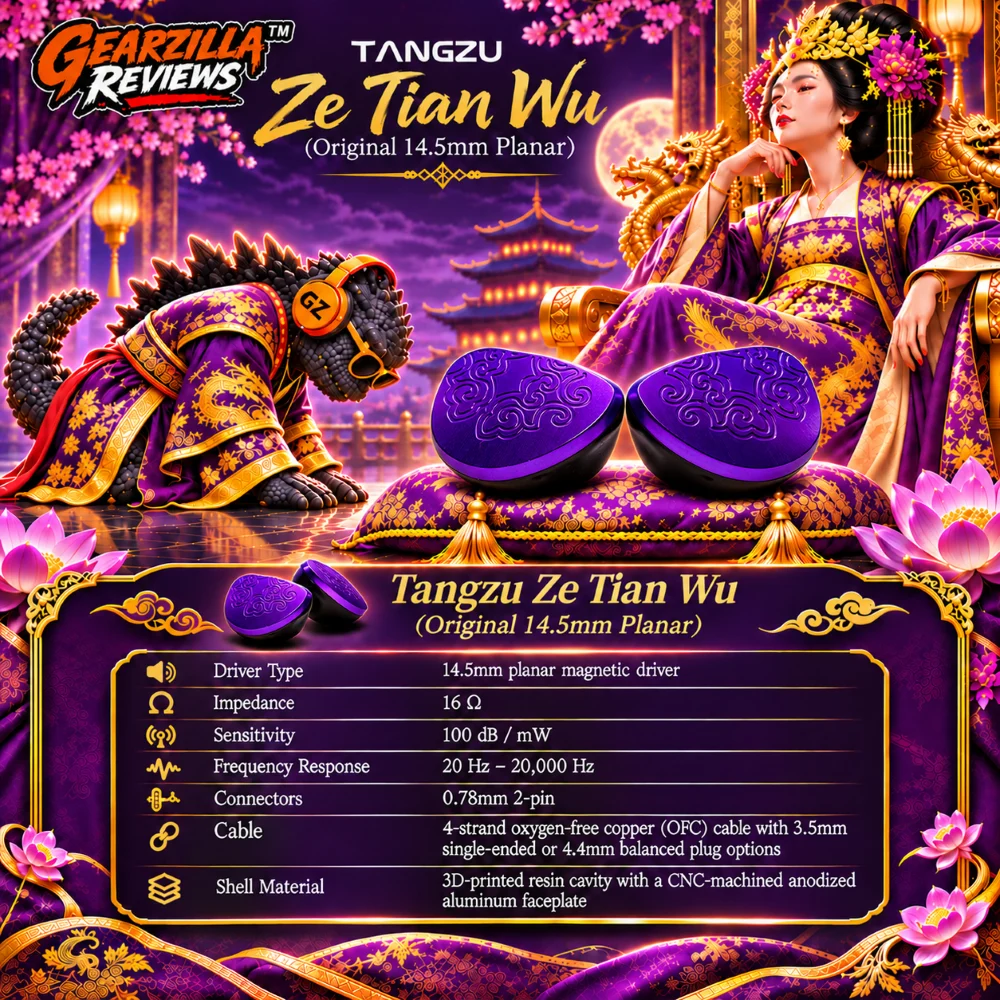
Not every planar needs to conquer the world with razor-sharp technicalities. Some just need to win your heart.
🎧 Is the Original TANGZU Ze Tian Wu Still Worth Listening to in 2026?
Absolutely. And this little purple Empress has reminded me that impressive sound and emotionally satisfying sound aren’t always the same thing.
More than thirteen centuries ago, a woman did something the established rulers of imperial China never expected.
She took the throne.
Not as a queen consort. Not as a ceremonial figurehead. As emperor.
Her name was Wu Zetian, and she didn’t simply challenge the political conventions of her time. She shattered them, established her own dynasty, and became the only woman in Chinese history to formally rule as emperor.
She was ambitious, controversial, politically formidable, and unwilling to let tradition determine her destiny.
And now, more than 1,300 years later, her name lives on in an unlikely place.
A purple pair of in-ear monitors.
Folks, I love this hobby.
In 2022, the planar magnetic IEM wars were heating up. Manufacturers were chasing speed, resolution, separation, and enough treble energy to illuminate every microscopic detail hiding in our favorite recordings.
Some of those IEMs were spectacular.
But I’ve learned something after years of exploring personal HiFi.
An IEM can impress the hell out of me without ever making me fall in love with it.
I’ve heard extraordinary technical performers that reveal every subtle breath, every guitar-string vibration, and every tiny background detail with surgical precision.
I’ve admired their engineering.
I’ve appreciated their capabilities.
And sometimes, after an hour, I’ve been perfectly happy to take them out.
Because impressive doesn’t always mean enjoyable.
Enter the original TANGZU Ze Tian Wu, a 14.5mm planar magnetic IEM released in 2022 with beautiful purple faceplates, an exceptionally generous accessory package, and a tuning that seems remarkably uninterested in showing off.
And I have a confession.
I absolutely love this set.
Not because it’s the most technically impressive planar I’ve heard. Not because it delivers extraordinary sparkle, unlimited treble extension, or microscopic instrument separation.
I love it because it’s pleasant.
Wonderfully, unapologetically pleasant.
The Ze Tian Wu has a natural, relaxed musicality that makes me want to settle into a recording rather than spend the entire evening analyzing it.
Does it have shortcomings?
Absolutely.
For a planar magnetic IEM, it lacks some of the upper-frequency brilliance, incisive transient definition, and perceived resolution that I’ve come to associate with the technology.
But here’s the delicious irony.
Its refusal to chase those qualities is exactly what makes it so enjoyable.
And when you consider the extraordinary woman whose name it carries, that feels like a particularly fitting place to begin our story.
✅ Pros: Wonderfully pleasant and emotionally satisfying tuning; natural, cohesive musical presentation; generous sub-bass foundation; smooth and forgiving treble; enjoyable vocal reproduction; excellent long-session listening potential; distinctive purple aluminum faceplates; lightweight resin shells; beautiful, spacious carrying case; outstanding selection of included silicone ear tips; quality detachable copper cable; and a flagship-worthy accessory experience that elevates the entire package.
⛔ Cons: Doesn’t deliver the sparkle or upper-treble brilliance some listeners expect from planar magnetic drivers; perceived resolution and microdetail aren’t class-leading; instrumental edges can lack razor-sharp definition; complex arrangements can become less distinct; bass texture and transient impact could be more precise; the relaxed presentation may feel too polite for listeners who prefer aggressive technical performance; and the oversized carrying case isn’t especially pocket-friendly.

🤝 Disclosure: A Personal Favorite, Revisited
The TANGZU Ze Tian Wu featured in this review is from my personal collection. TANGZU or a retailer didn’t provide it, and this review isn’t part of a sponsored collaboration.
I’ve owned this set for some time, so I can revisit it with fresh ears and a broader perspective shaped by the many IEMs I’ve experienced since its 2022 release.
And that’s what makes this review particularly meaningful to me. This isn’t about chasing the latest release or celebrating a new toy. It’s about returning to an older favorite and discovering that its musical personality still brings me genuine enjoyment.
As always, my philosophy remains simple.
Listen first. Figure out the story later. 🦖🎧
👑 The Empress Who Refused to Follow the Rules
Before we talk about drivers, diaphragms, or frequency-response curves, we need to meet the woman whose name is engraved into this IEM’s identity.
Wu Zetian (624–705 CE) remains one of the most extraordinary and controversial figures in Chinese imperial history.
Born during the early Tang dynasty, she entered the imperial court as a consort of Emperor Taizong. After his death, she returned to court under his successor, Emperor Gaozong, and became empress consort in 655.
But Wu Zetian wasn’t content to occupy a ceremonial role.
As Gaozong’s health deteriorated, she became increasingly influential in imperial administration. After his death in 683, she continued to exercise political authority as empress dowager during the reigns of her sons.
Then, in 690 CE, she did something unprecedented.
She declared herself emperor.
Not empress consort.
Not simply empress dowager.
Emperor.
Wu Zetian established her own Zhou dynasty, interrupting Tang rule, and governed under her own imperial authority until 705.
While that achievement remains historically extraordinary, her legacy is far more complicated than a simple story of breaking barriers.
Her administration cultivated capable officials, supported the imperial examination system, and used Buddhist religious symbolism to reinforce her political legitimacy.
She was also ruthless.
Her rise involved court intrigue, political repression, purges, and executions. Historians still debate her accomplishments, methods, and how later chroniclers portrayed her, especially in a political tradition that expected imperial authority to remain male.
But one detail about Wu Zetian fascinates me.
🌞 The Emperor Who Created Her Own Name
Wu Zetian adopted an unusual written character for her personal name, Zhao (曌), combining the imagery of the sun and moon above the sky.
Think about that.
Here was a woman who didn’t simply demand recognition within an existing system of authority.
She fashioned a new symbol to represent herself.
She challenged political conventions, reshaped imperial legitimacy, and established an identity that would survive for centuries.
Even the famous blank stele associated with her burial monument at the Qianling Mausoleum has become part of her enigmatic legacy. Historians still debate its purpose and meaning.
A monument without a conventional inscription.
A ruler whose reputation would be argued over long after her death.
Now, I’m not about to compare the political upheavals of seventh-century China with the considerably less consequential drama of the audiophile community.
That said, some online arguments about planar magnetic drivers could probably use an imperial decree or two.
But the historical inspiration gives this product something I genuinely appreciate.
A story.
And in a market overflowing with products identified by increasingly confusing combinations of letters and numbers, TANGZU created something with a distinct cultural identity.
The original Ze Tian Wu isn’t just a name.
It carries the memory of a woman who refused to follow the rules.
And as we’ll discover, this planar has its own rebellious streak.
🎼 TANGZU: A Brand With History in Its DNA
TANGZU’s fascination with Chinese imperial history didn’t begin with the Ze Tian Wu
Previously known as T-Force, the company introduced products like the Yuan Li and Shimin Li, both named after figures from China’s Tang period.
The Ze Tian Wu continued that tradition while introducing a new acoustic direction.
In 2022, planar magnetic IEMs became increasingly popular among enthusiasts seeking higher perceived resolution, faster attacks, and a more revealing sound.
The 7Hz Timeless had already established itself as an important player in the affordable planar market. LETSHUOER’s S12 was also attracting attention for its energetic, detailed presentation.
Technical performance was becoming a major selling point.
And understandably so.
Planar magnetic drivers can deliver wonderfully responsive and revealing sound when implemented effectively.
But some of the emerging designs also emphasized upper-frequency energy, creating presentations that listeners sometimes found bright, lean, or fatiguing.
TANGZU took a different approach.
Rather than building an IEM around maximum perceived technical excitement, the original Ze Tian Wu leaned toward greater musical body, stronger low-frequency presence, and a more forgiving treble response.
And that’s where this story becomes interesting.
The Empress didn’t arrive to play by everyone else’s rules.
She arrived with her own idea of what a planar magnetic IEM should sound like.
Not necessarily sharper.
Not necessarily brighter.
Just more enjoyable.
And four years later, I think that decision is worth celebrating.
🎨 Design & Build: Purple Really Is the Color of Royalty
Let’s talk about the physical design, because the original Ze Tian Wu certainly doesn’t look ordinary.
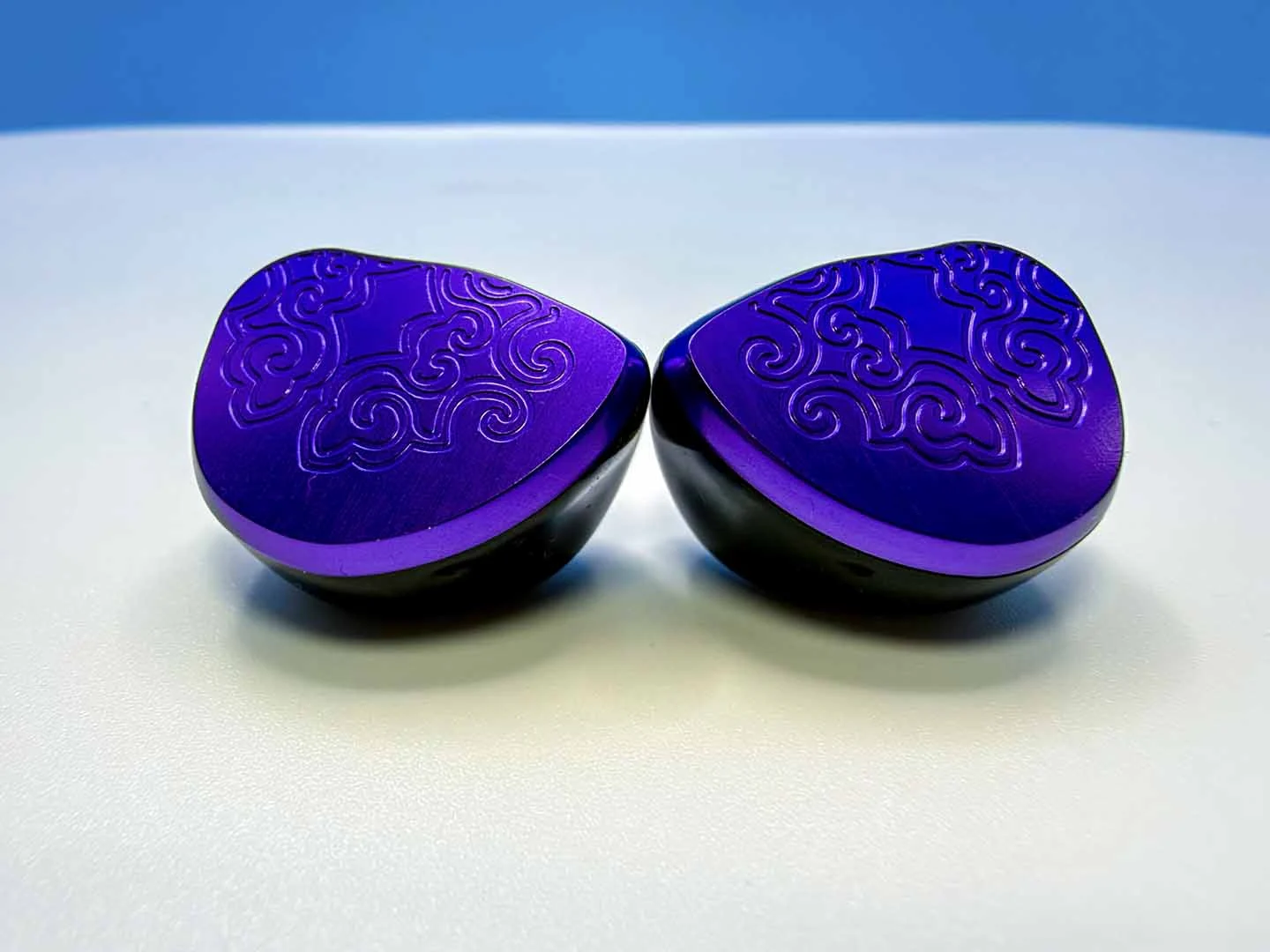
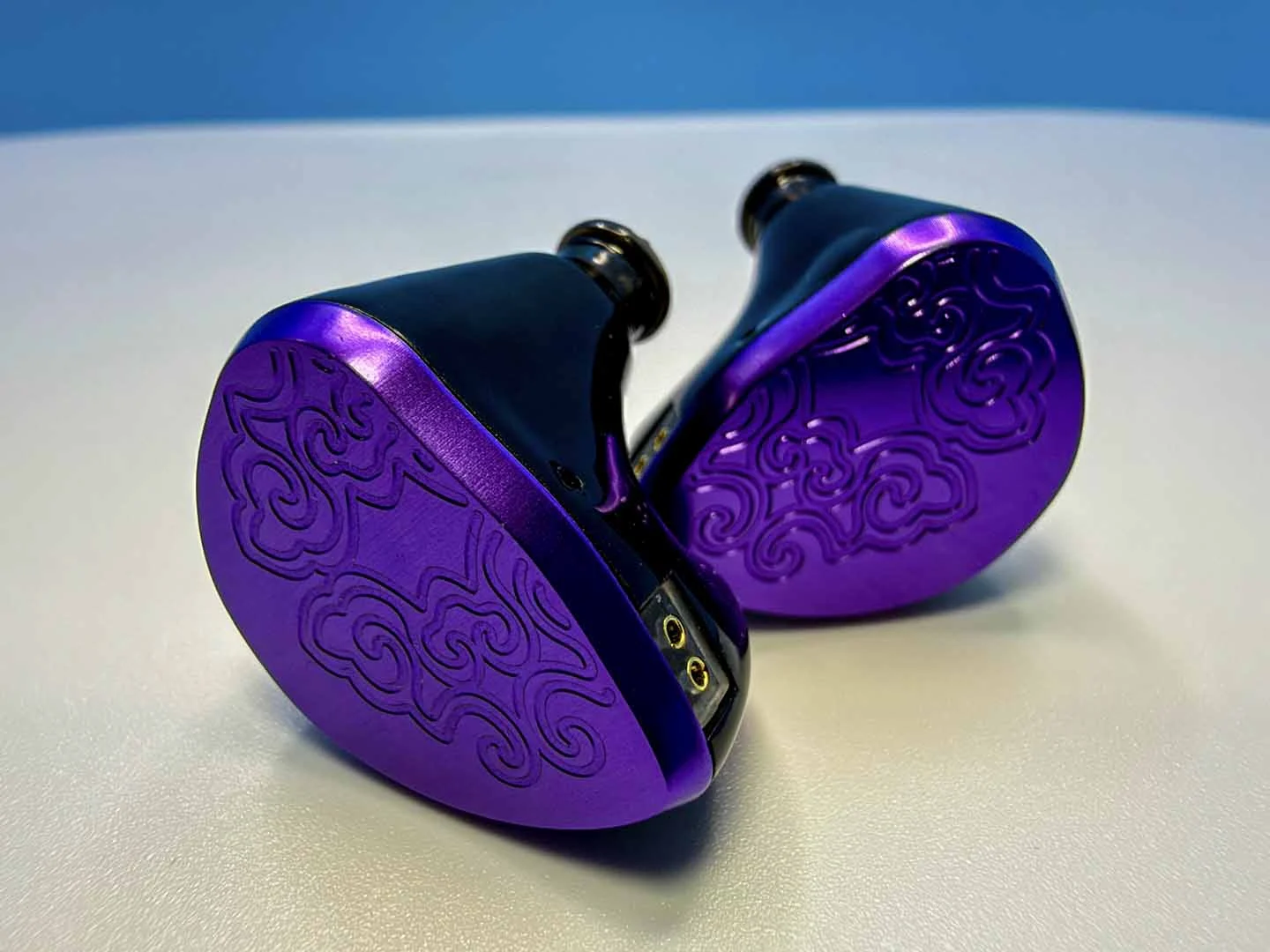
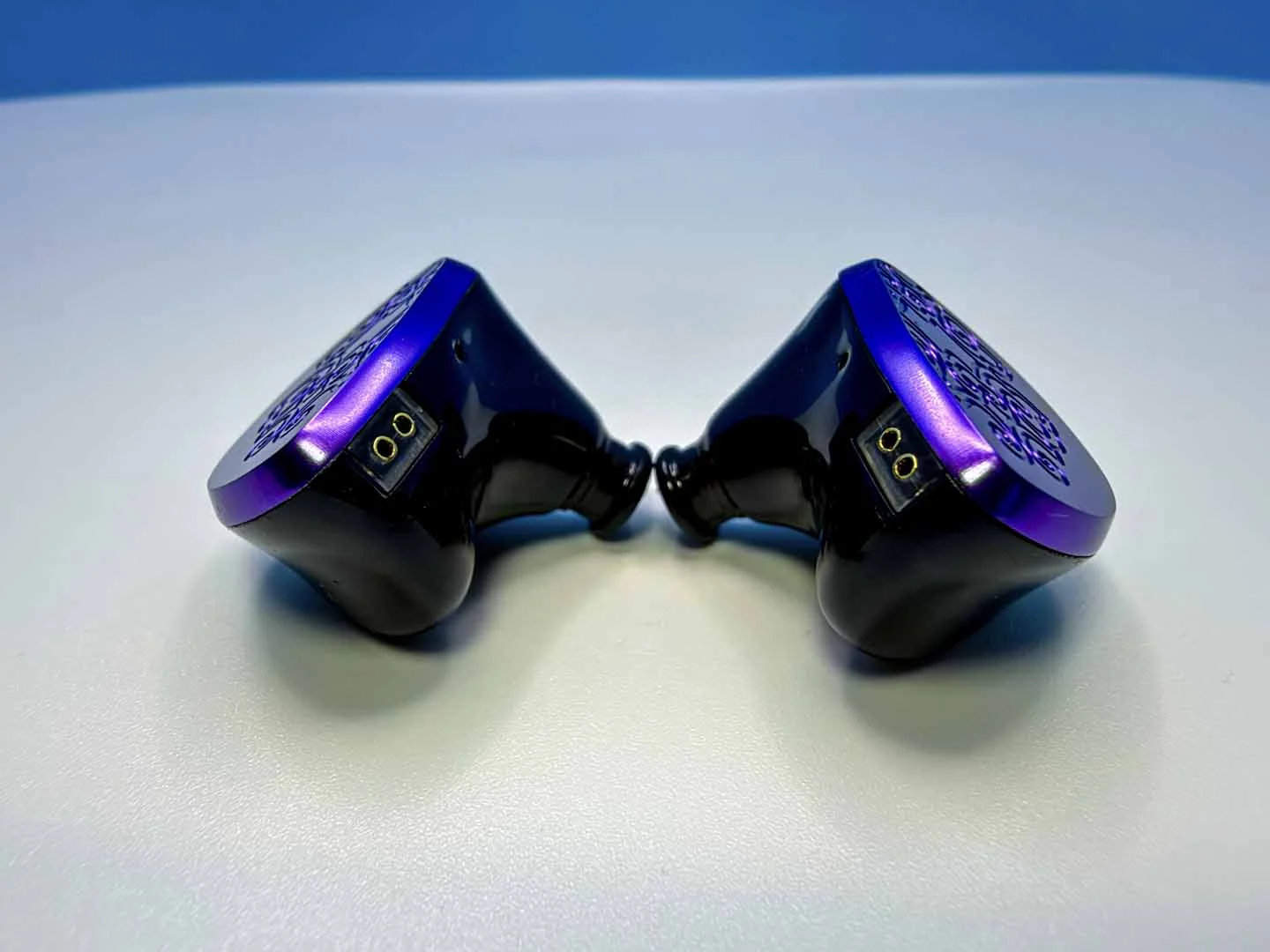
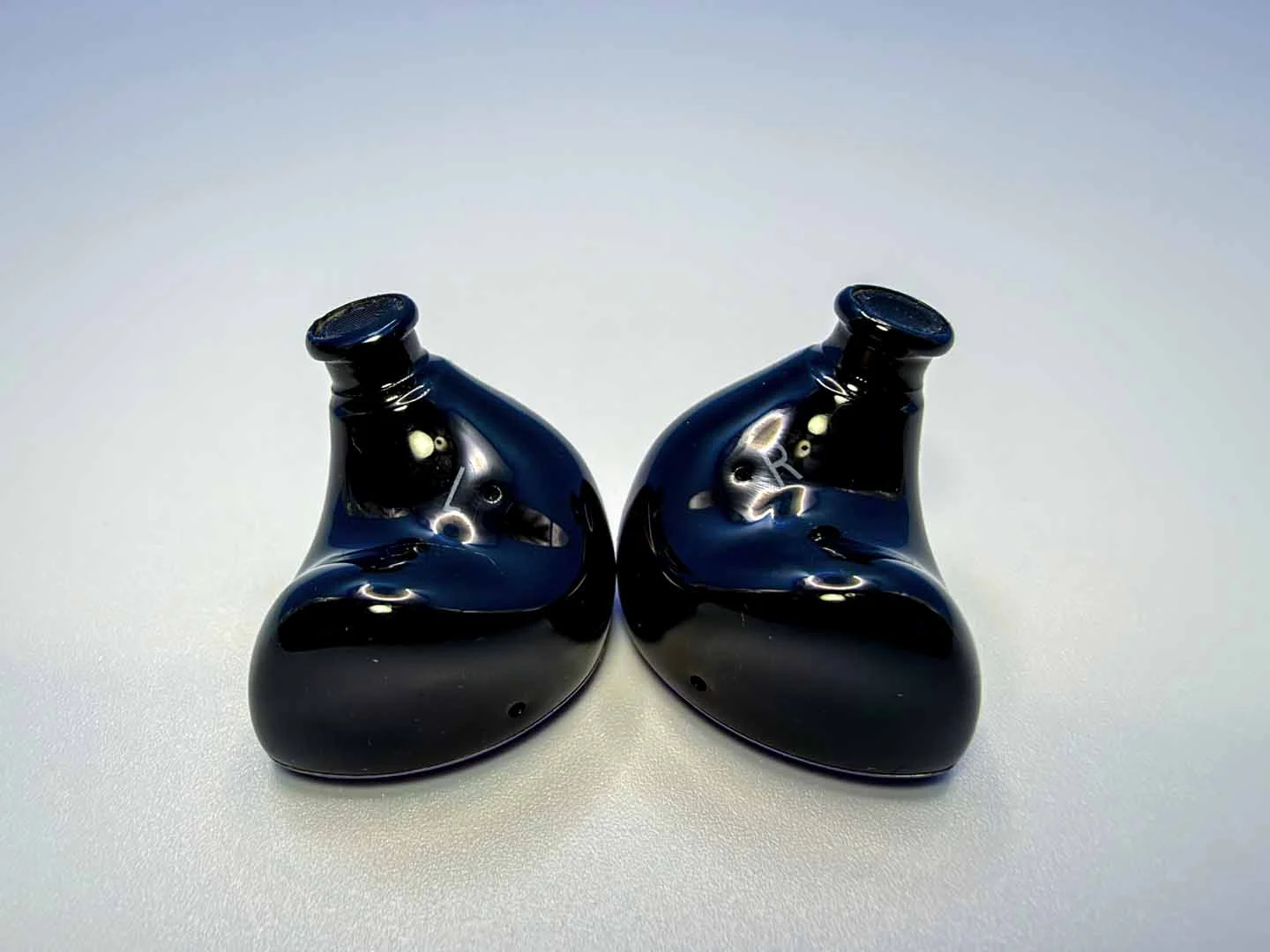
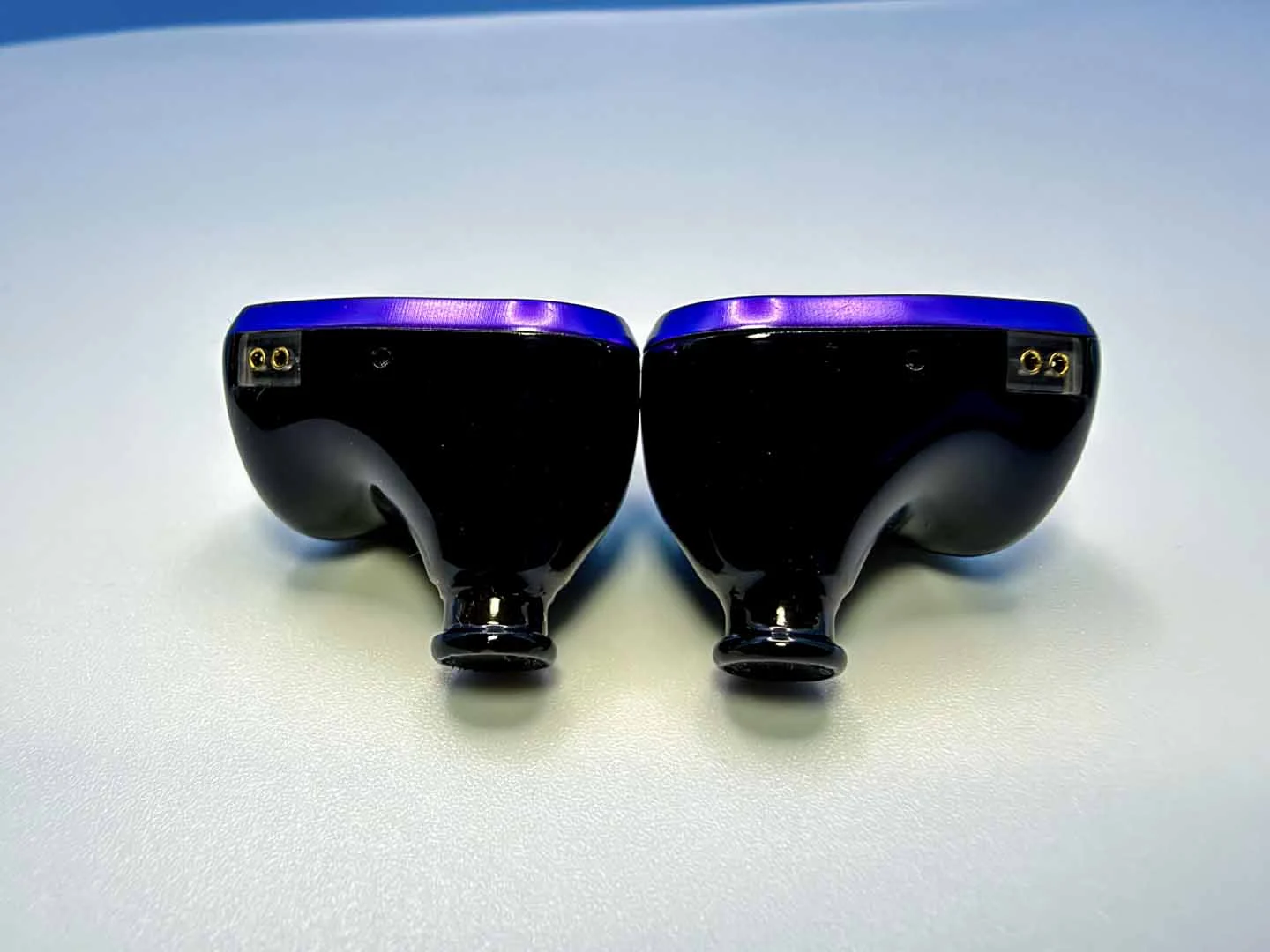
The shells combine lightweight 3D-printed resin with striking purple CNC-machined aluminum faceplates decorated with traditional cloud-inspired engravings.
It’s an elegant combination.
The purple finish immediately distinguishes the Ze Tian Wu from the endless parade of black, silver, and transparent earphones competing for our attention.
There’s a sense of visual purpose here.
Purple carries historical associations with nobility and imperial prestige in Chinese cultural imagery, making it a fitting choice for an IEM honoring Wu Zetian.
The engraved patterns add traditional ornamentation without making the design feel unnecessarily busy.
And I appreciate the contrast between the metallic faceplates and the darker resin bodies.
It’s attractive.
It’s distinctive.
And most importantly, it looks like TANGZU actually cared about the complete product experience.
The resin construction also keeps the earpieces relatively light despite the substantial 14.5mm planar magnetic driver inside.
Comfort remains personal, of course. Shell geometry, nozzle depth, insertion angle, and ear-tip selection all influence the final fit.
But the lightweight body and ergonomic over-ear design give the Ze Tian Wu a solid foundation for extended listening.
And this IEM encourages exactly that.
Design & Build: Beautifully executed, historically inspired, and full of personality.
📦 Unboxing: Now THIS Is How You Treat an Empress!
Folks, TANGZU absolutely deserves applause here.
The original Ze Tian Wu arrives with an accessory presentation that feels far more luxurious than its original asking price of about $149 suggests.
And I’m not talking about some cheap decorative box designed to look expensive for five minutes before disappearing into a closet.
I mean genuinely useful accessories.
The kind of stuff I’d expect with a flagship IEM.
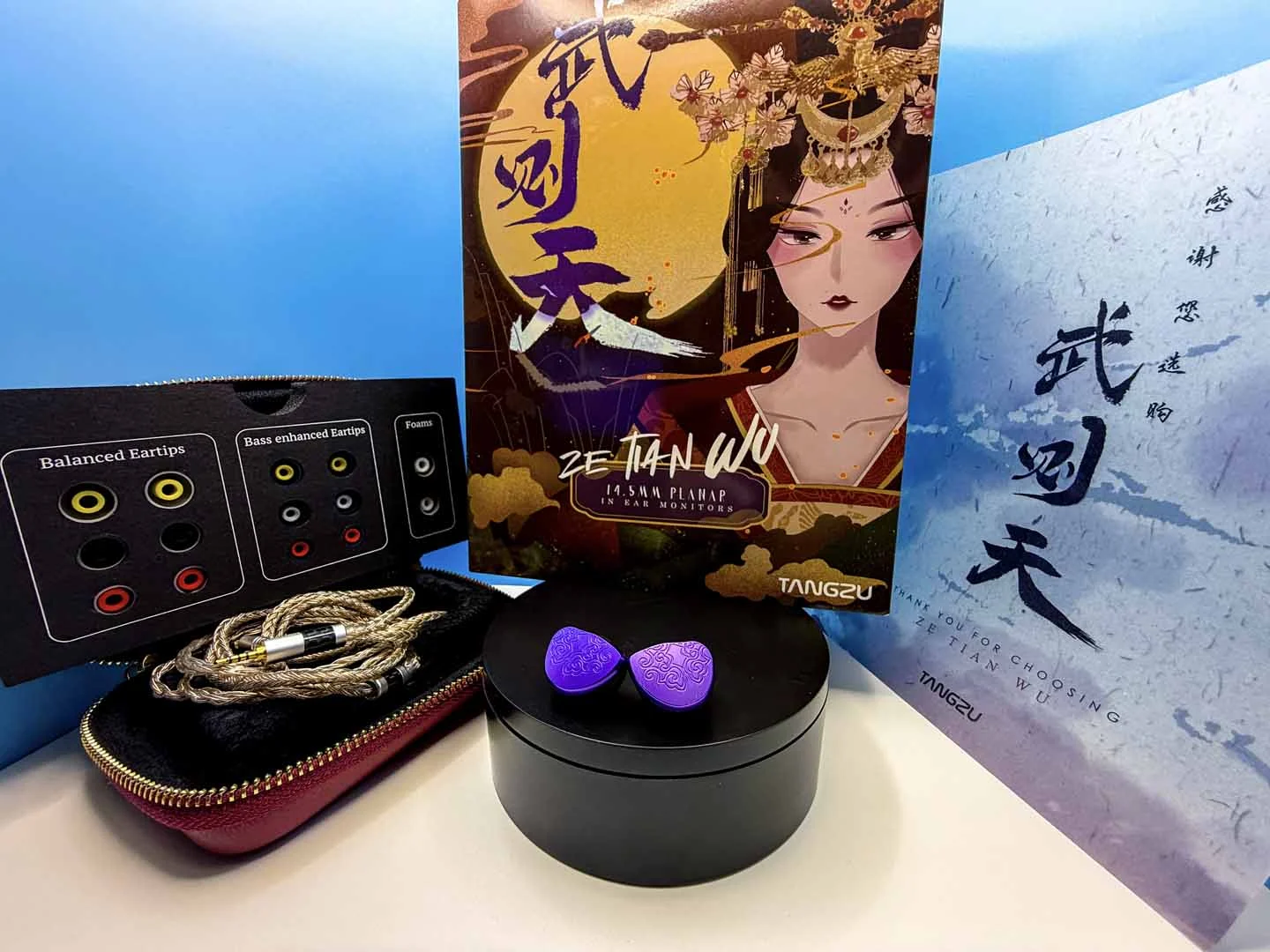
The presentation opens with attractive illustrated packaging that celebrates the product’s historical inspiration.
Inside, TANGZU includes a generous collection of silicone ear tips, a substantial detachable copper cable, and a beautiful carrying case.
And that case?
Oh, we’re definitely talking about that case.
👑 A Carrying Case Worthy of the Throne
The original Ze Tian Wu includes a large, red faux-leather zippered carrying case with a soft-lined interior and enough space to accommodate more than just a single pair of earphones.
It’s substantial.
It’s attractive.
And it feels like something that belongs with a much more expensive product.
I love a beautiful carrying case.
Not because it makes an IEM sound better, but because it completes the ownership experience.
There’s something satisfying about opening a well-made case, carefully retrieving your earphones, and feeling as though the manufacturer considered how you’d actually live with the product.
The Ze Tian Wu delivers that experience.
Unlike the countless tiny pouches and generic zipper cases included with many IEMs, this one makes a statement.
Of course, there’s a practical trade-off.
It’s big.
You’re probably not stuffing this thing into the front pocket of your jeans.
But for organizing IEMs, cables, additional tips, and small audio accessories, the extra room is genuinely useful.
And I appreciate that.
🌸 Ear Tips: A Royal Collection
TANGZU didn’t stop with the case.
The original Ze Tian Wupackage typically includes multiple silicone ear-tip families, including balanced and bass-enhanced options in small, medium, and large sizes.
Some documented packages also include additional wide-bore silicone tips, bringing the assortment to about seven or eight pairs, depending on the package configuration.
That’s an unusually generous selection.
And it matters because ear tips can substantially influence the listening experience.
Different bore widths, stem designs, and insertion depths may alter seal quality, low-frequency performance, and the perceived upper-frequency balance.
Rather than simply including three generic pairs and calling it a day, TANGZU gives owners an opportunity to explore different fits and tonal presentations.
That is exactly the kind of enthusiast-friendly thinking I want to see.
And I’ll say something that might surprise you.
The Ze Tian Wu’s accessories are more immediately impressive than its sound.
Not because the sound is disappointing.
Far from it.
But because the accessory package makes an unmistakable first impression, while the tuning reveals its charm more gradually.
One delivers the royal entrance.
The other earns your affection over time.
Accessories & Presentation: Flagship-level generosity and one of the standout strengths of the entire package. 👑
🔌 The Cable: Copper Fit for Royalty
TANGZU also deserves credit for the stock cable.
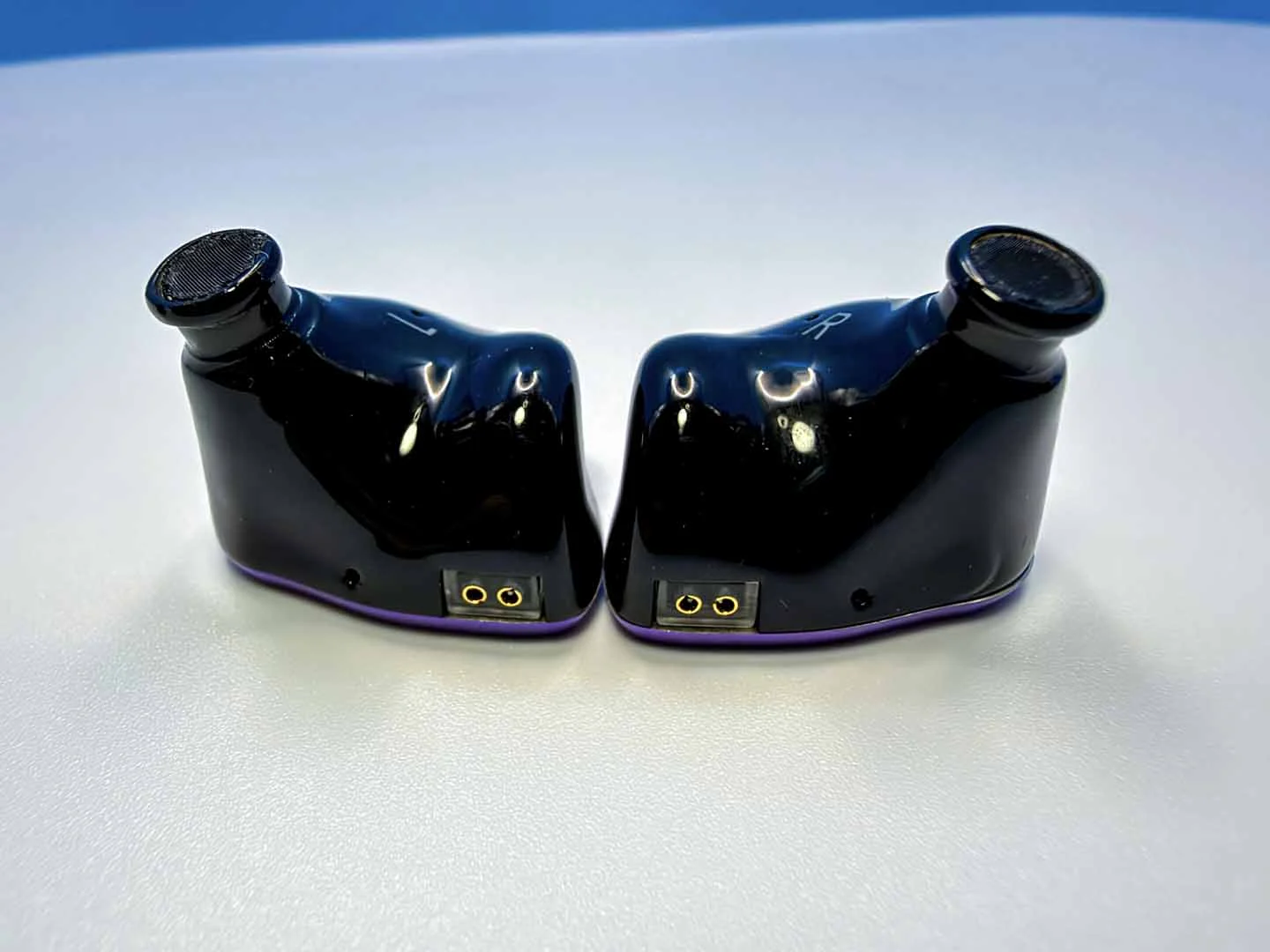
The original Ze Tian Wu uses a braided 5N oxygen-free copper cable with detachable 0.78mm two-pin connections.
Original buyers could choose 3.5mm single-ended or 4.4mm balanced termination, depending on the configuration.
And I appreciate that flexibility.
As someone who regularly moves between portable DACs, digital audio players, and desktop systems, detachable connectivity is practically essential.
The copper cable looks attractive alongside the purple shells, creating a cohesive, intentional look rather than an accidental pairing.
The darker metallic tones complement the royal purple faceplates beautifully.
But let’s separate the aesthetics from the audio claims.
A copper conductor doesn’t automatically guarantee warmer sound, smoother treble, or greater musicality.
Cable construction, electrical characteristics, compatibility, and ergonomics all matter, but we shouldn’t treat conductor material as proof of an audible tuning change.
What I appreciate here is the complete package.
An attractive cable.
Useful termination choices.
Detachable connections.
And an aesthetic that complements the IEM itself.
Would a modular termination system have made the package even better?
Absolutely.
But the original Ze Tian Wu already offers cable quality and accessory consideration that many newer products could learn from.
The Empress arrived properly dressed for the occasion.
⚙️ Technical Specifications: One Driver, One Unusual Personality
Underneath the purple exterior sits a single 14.5mm planar magnetic driver.
It’s a relatively straightforward configuration compared with the increasingly elaborate hybrids and multi-driver designs that have become common in the IEM market.
But I’ve said this before, and I’ll keep saying it.
Driver count doesn’t determine sound quality. Implementation does.
Here’s what we know about the original Ze Tian Wu.
Model: TANGZU Ze Tian Wu (Original 2022 Edition)
Manufacturer: TANGZU Audio
Type: Wired in-ear monitor
Driver configuration: Single 14.5mm planar magnetic driver
Published impedance: 16Ω
Published sensitivity: 100 dB at 1kHz
Published frequency response: 20Hz–20kHz
Claimed total harmonic distortion: Less than 1%
Published channel difference: 1 dB at 1kHz
Shell construction: 3D-printed resin
Faceplate: CNC-machined aluminum alloy
Connector: Detachable 0.78mm two-pin
Stock cable material: 5N oxygen-free copper
Available cable terminations: 3.5mm single-ended and 4.4mm balanced options
Accessories: Large zippered carrying case and multiple silicone ear-tip sets
Original reference price: Approximately $149 USD
Release year: 2022
Specifications reflect published information for the original Ze Tian Wu and shouldn’t be confused with the later HBB Heyday Edition or dual-planar Legend.
🧲 The Planar Magnetic Driver: A Different Kind of Rebellion
Planar magnetic drivers operate differently from traditional moving-coil dynamic drivers.
Instead of a conventional voice coil attached to a cone or dome, planar designs use a thin diaphragm with conductive traces suspended in a magnetic field.
Electrical current interacts with the magnetic system, creating the forces that move the diaphragm and produce sound.
The design can offer excellent control and fast transient response, though the final results depend heavily on the motor structure, diaphragm properties, acoustic chamber, and frequency-response tuning.
And here’s where TANGZU made an interesting decision.
It didn’t use the planar driver simply as an excuse to create the sharpest, brightest, most aggressively resolving IEM possible.
It tuned the Ze Tian Wu for a more relaxed musical presentation.
That distinction matters.
Because planar technology doesn’t have to mean analytical sound.
And the Ze Tian Wu is a wonderful reminder of that.
🎧 Listening Impressions: Pleasant, Not Impressive. And I Love It.
Here’s where I want to make something very clear.
When I describe the original Ze Tian Wu as pleasant rather than impressive, I’m not criticizing it.
I’m identifying its greatest strength.
Because there’s a difference between listening to an IEM and constantly thinking about how impressive the equipment is, and listening to an IEM that makes the equipment disappear from your attention.
The Ze Tian Wu belongs in that second category.
It doesn’t overwhelm me with spectacular treble extension.
It doesn’t sharpen every instrument into a microscopic object suspended in space.
It doesn’t constantly remind me that there’s a planar magnetic driver working inside each earpiece.
Instead, it offers something wonderfully natural.
A cohesive musical presentation that simply feels good.
The bass provides enough foundation to establish warmth and rhythm.
The midrange lets vocals and instruments sit comfortably within the recording.
The treble adds clarity without constantly demanding attention.
Nothing feels like it’s trying too hard.
And that might be my favorite thing about it.
I’ve spent plenty of time with IEMs that pursue technical performance so aggressively that listening becomes an exercise in evaluating details.
Is the imaging sufficiently precise?
Are the transients sharp enough?
Can I hear every tiny reflection in the recording?
With Ze Tian Wu, those questions matter less.
Because I’m enjoying the song.
It’s not that the technical performance is absent.
It isn’t.
There’s adequate detail, reasonable separation, and a coherent sense of placement.
But none of those qualities are pushed to extremes.
And for this particular tuning, that restraint is part of the magic.
The Ze Tian Wu doesn’t conquer music. It welcomes you into it.
🌸 Ear Tips & Fit: Finding the Empress’s Sweet Spot
One of TANGZU’s smartest decisions was including multiple ear-tip options.
With the Ze Tian Wu, a comfortable, consistent seal is especially important.
Tuning depends on maintaining that low-frequency foundation.
Lose that seal, and the sub-bass can drop substantially, shifting the balance between bass, vocals, and treble.
The bass-enhanced silicone tips provide an obvious starting point for listeners who want to preserve maximum low-frequency weight.
The balanced options offer another fit and bore configuration, while the additional wide-bore styles let you experiment with insertion depth and perceived upper-frequency openness.
I generally appreciate wide-bore silicone tips when they fit comfortably and deliver the presentation I want.
But that doesn’t mean they’re universally superior.
And here’s something worth emphasizing.
Don’t start changing Ze Tian Wu’s personality before you’ve heard what TANGZU intended.
Explore the included tips.
Find a reliable seal.
Get comfortable with the stock presentation.
Then experiment.
This isn’t an IEM that desperately needs rescuing from its factory tuning.
Its tuning is exactly why I love it.
🔬 Frequency Response: The Anatomy of a Relaxed Rebel
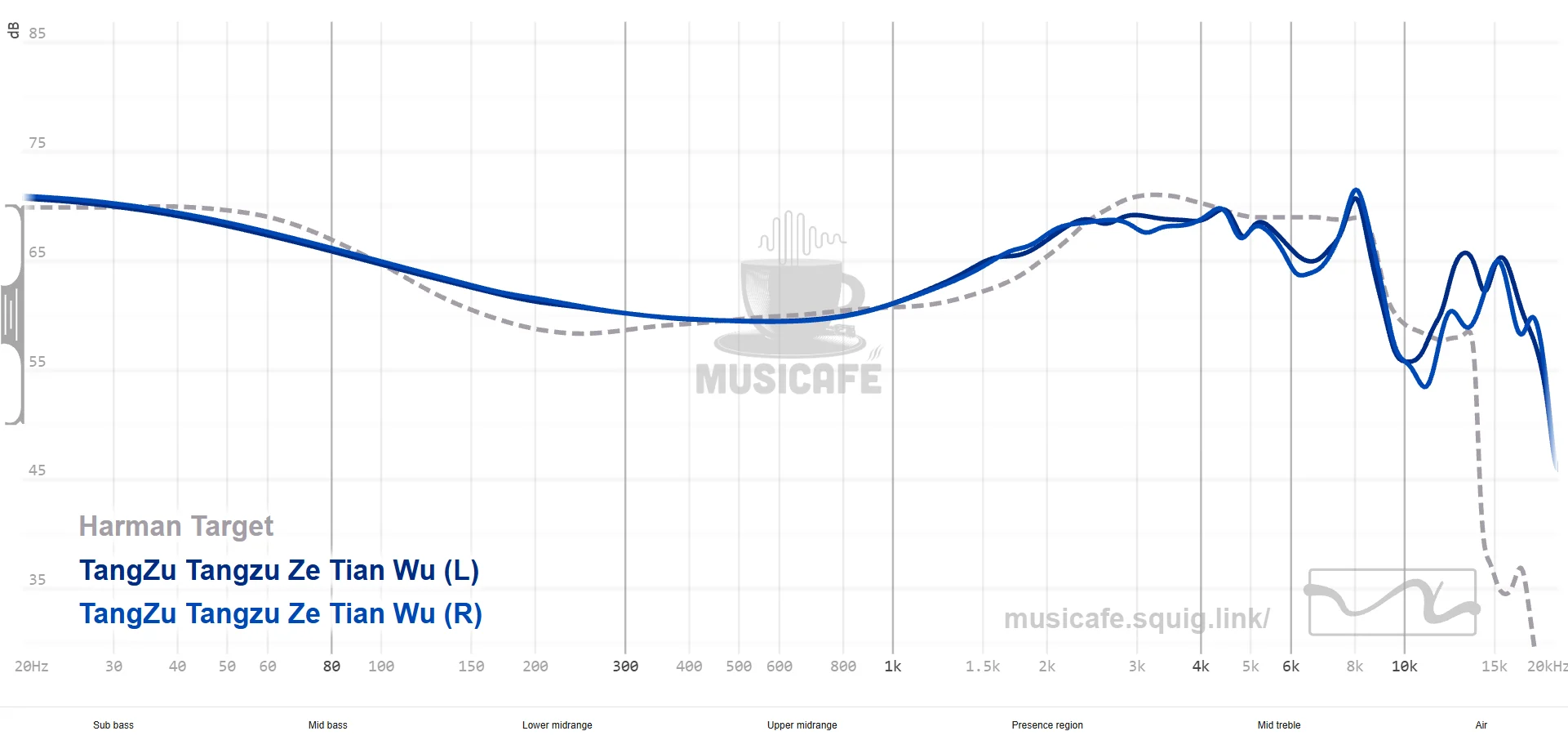
The MusicCafe frequency-response measurements offer a useful window into Ze Tian Wu’s original personality.
And they help explain why this planar sounds different from the aggressively technical presentations often associated with the category.
The bass starts with a noticeable sub-bass elevation, then gradually descends through the mid-bass toward the lower midrange.
No enormous mid-bass plateau overwhelms the center of the recording.
Instead, the transition is smooth and progressive.
This helps establish low-frequency weight while keeping a relatively clean relationship with the mid frequencies.
From approximately 300Hz through the lower midrange, the response remains comparatively restrained before rising toward the upper-midrange presence region around 2–3kHz.
This provides vocal articulation without sounding excessively forward.
And then we reach the treble.
There’s some energy around 4–5kHz, a reduction through portions of the 6–7kHz region, and a pronounced measured peak around 8kHz.
However, those higher-frequency features need careful interpretation.
Common IEM measurement couplers can display resonance-related peaks near 8kHz that change substantially with insertion depth and the measurement configuration.
Likewise, measurements above approximately 10kHz are especially sensitive to coupler limitations and positioning.
So I wouldn’t treat every peak and dip as a literal representation of what reaches my eardrum.
But the overall shape is revealing.
The Ze Tian Wu prioritizes a satisfying low-frequency foundation and a restrained upper-frequency presentation rather than maximum perceived treble brilliance.
That helps explain why I find it so pleasant.
It also helps explain why it doesn’t deliver the sparkling, highly incisive character I sometimes expect from planar magnetic designs.
And there’s another encouraging detail.
The left and right channels appear closely matched through much of the bass and midrange, suggesting good tonal consistency in the measured sample.
Of course, frequency response alone can’t establish driver speed, distortion behavior, or true resolving ability.
Nor can it tell us whether an IEM helps us connect emotionally with the music.
But it can help explain the tuning choices behind that connection.
The original Ze Tian Wu makes its priorities clear.
This Empress values musical balance over technical theatrics.
🥁 Bass: Authority Without Brutality
The original Ze Tian Wu has a satisfying low-frequency foundation.
The sub-bass carries noticeable weight, giving electronic bass lines and deeper instrumental notes a pleasing sense of substance.
But this isn’t an IEM that simply overwhelms everything with enormous low-frequency output.
The bass gradually declines through the mid-bass, helping it transition naturally into the lower midrange.
I appreciate that balance.
There’s enough low-frequency presence to keep the music grounded, and the overall tuning avoids sounding unnecessarily thin or sterile.
But here’s where some of the technical limitations become apparent.
The bass doesn’t always have the sharpest leading edges.
Individual low-frequency textures aren’t necessarily outlined with exceptional precision.
In complex passages, the separation between bass elements can feel slightly softer than with more technically ambitious planar IEMs.
Does that ruin the experience?
Not for me.
Because Ze Tian Wu’s bass does something I value tremendously.
It’s supporting the music.
It contributes warmth and rhythmic substance without constantly trying to become the main attraction.
This isn’t the bass of a precision demolition crew.
It’s the steady foundation beneath a performance.
And sometimes that’s exactly what I want.
🎤 Lower Midrange: Warmth Without the Weight
Moving into the lower midrange, the Ze Tian Wu maintains a relatively smooth transition from its elevated bass response.
This region shapes the perceived body of male vocals, acoustic instruments, piano, and a recording’s overall warmth.
Too much energy here can make an IEM sound overly thick.
Too little can leave music feeling hollow.
The Ze Tian Wu takes a pleasantly balanced approach.
There’s enough tonal substance to keep the presentation from feeling sterile, while the lower midrange avoids excessive emphasis.
And that contributes to the cohesive character I enjoy.
The instruments don’t sound artificially separated to create an exaggerated impression of clarity.
They exist together.
The result is a presentation that feels integrated rather than aggressively dissected.
Could I ask for greater texture and more precise instrumental definition?
Absolutely.
But I’m not particularly interested in sacrificing this natural musical relationship just to sharpen every edge.
The lower midrange gives the Ze Tian Wu its easygoing confidence.
And confidence doesn’t always need to be loud.
✨ Upper Midrange: The Empress Knows When to Speak
The Ze Tian Wu’s upper midrange rises gradually, adding presence and intelligibility without making voices unnecessarily aggressive.
And I appreciate that.
I love vocal clarity.
I love hearing articulation, breath, emotion, and the little imperfections that remind us there’s a human being behind the microphone.
But I don’t need every singer pushed directly into my face.
The Ze Tian Wu takes a more relaxed approach.
Vocals remain connected to the overall musical arrangement rather than constantly demanding center-stage attention.
For some listeners, that may mean the presentation feels less immediate.
And that’s fair.
If you’re accustomed to an energetic upper midrange that thrusts every vocal forward, the Ze Tian Wu may initially seem a little polite.
But over time, that politeness becomes part of its appeal.
It lets the performance unfold.
And that’s an important distinction.
The Ze Tian Wu doesn’t need to shout to make itself heard.
🌟 Treble & Air: Where the Empress Surrenders Her Sparkle
Now we’ve reached the original Ze Tian Wu’s most important limitation.
Its treble.
More specifically, it lacks that unmistakable upper-frequency sparkle and incisive brilliance that often makes planar magnetic IEMs feel technically exciting.
And I notice it.
The Ze Tian Wu isn’t devoid of treble.
Let’s be clear about that.
It provides enough upper-frequency information to preserve reasonable clarity and articulation.
But it doesn’t deliver the same shimmer, openness, or effortless microdetail as some of my favorite planar presentations.
Cymbals don’t always have that extended, airy decay.
The finest upper harmonics aren’t necessarily illuminated with tremendous precision.
And delicate background details don’t leap out of the recording with extraordinary immediacy.
For an IEM built around a planar magnetic driver, that’s a meaningful compromise.
But here’s where I smile.
The very quality that keeps the Ze Tian Wu from becoming technically spectacular also makes it wonderfully pleasant.
Its treble doesn’t constantly demand attention.
It doesn’t insist on sharpening every sound.
And it doesn’t rely on exaggerated brilliance to create excitement.
The result is a smoother, more forgiving listening experience.
Would I enjoy a little additional sparkle?
Absolutely.
I love airy treble, dimensional vocals, and the sensation of delicate details floating around the listener.
And I occasionally wish the Ze Tian Wu would lift that upper-frequency curtain just a little higher.
But I also recognize that changing the treble could alter this IEM’s entire personality.
And I’ve grown rather fond of that personality.
The Empress trades a little brilliance for a lot of musical comfort.
For me, that’s a trade worth making.
🎯 Instrument Separation & Placement: Cohesion Over Surgical Precision
One of the things I enjoy most about technically accomplished IEMs is their ability to establish clear relationships between individual instruments.
I love hearing a guitarist’s position.
The separation between percussion elements.
The way a backing vocal occupies its own recognizable place within the recording.
And Ze Tian Wucan provide a coherent sense of those relationships.
But it doesn’t approach separation with extreme precision.
Individual instruments aren’t always outlined with razor-sharp definition.
In complex arrangements, some boundaries between sounds can blur.
And if you’re accustomed to a highly analytical planar presentation, you may notice that softness.
But there’s an interesting upside.
The performance feels cohesive.
Rather than isolating every musical element as if it were a technical demonstration, Ze Tian Wu lets the arrangement function as a complete performance.
There’s a natural relationship between instruments.
And that helps explain why the overall experience feels so pleasant.
Of course, coherence doesn’t excuse every limitation.
I still want sufficient separation to follow individual musical elements, especially during dense recordings.
The Ze Tian Wu provides that competently, but not exceptionally.
This Empress understands the orchestra better than she understands the microscope.
And I can appreciate that.
🌌 Width & Depth: A Comfortable Throne Room
Anyone familiar with my listening preferences knows I love an expansive, immersive presentation.
Give me convincing width.
Give me front-to-back depth.
Give me instruments occupying recognizable positions with enough breathing room to create a believable musical environment.
And I’m usually a very happy audiophile.
But not every IEM needs to produce enormous holographic dimensions to earn my affection.
The Ze Tian Wu doesn’t overwhelm me with a spectacularly expansive presentation.
Instead, it offers a more relaxed and cohesive sense of musical space.
The arrangement feels organized, although the softer instrumental edges can reduce the sensation of sharply defined distances between performers.
There’s enough spatial information to enjoy the recording without constantly thinking about where every instrument has been placed.
And once again, that suits the overall tuning.
The Ze Tian Wu isn’t attempting to recreate a gigantic concert hall around my head.
It’s creating a comfortable place to enjoy the music.
Not the empire’s largest throne room. But definitely one I’d enjoy spending time in.
🔬 Detail & Resolution: Information Without the Interrogation
Let’s talk about resolving ability.
Because here’s where our expectations of planar magnetic technology can sometimes become a little unreasonable.
We’ve grown accustomed to associating planar drivers with tremendous detail retrieval, crisp transients, and highly revealing presentations.
And some planar IEMs absolutely deliver those characteristics.
But a planar driver doesn’t automatically guarantee superior resolution.
The overall acoustic design and tuning matter enormously.
With the original Ze Tian Wu, there’s enough information to keep the listening experience satisfying.
I don’t feel as though the recording has been stripped of important musical details.
But the finer textures don’t necessarily emerge with extraordinary precision.
Subtle background information may remain less conspicuous.
Instrumental attacks have softer definition.
And the upper-frequency restraint means the presentation lacks some of the apparent brilliance that can make other planar IEMs sound spectacular during an initial audition.
But I want to distinguish something important.
Not hearing a detail as prominently doesn’t necessarily mean the driver cannot reproduce it.
Frequency balance strongly influences perceived resolution.
An elevated treble region can make small musical elements seem more obvious without necessarily indicating superior underlying technical performance.
Likewise, a smoother tuning can make an IEM seem less resolving even when the information remains present.
The Ze Tian Wu sits firmly on the relaxed side of that relationship.
And here’s what I love.
The recording isn’t constantly interrogating me.
The IEM isn’t demanding that I acknowledge every tiny musical event.
I’m free to enjoy the performance.
That doesn’t make it a technical champion.
But it makes it a delightful companion for listening.
The Ze Tian Wu reminds me that revealing more isn’t always the same thing as enjoying more.
🦴 Slam & Dynamics: Power With a Softer Touch
The Ze Tian Wu’s bass emphasis delivers satisfying low-frequency weight.
But there’s a difference between weight and impact.
While the Ze Tian Wu has enough bass presence to keep the music engaging, its transients aren’t especially aggressive.
Kick drums don’t always explode with startling physical immediacy.
Bass notes aren’t consistently carved into sharp, individual events.
And dramatic dynamic changes don’t always deliver the explosive contrast some technically stronger IEMs can.
Instead, the Ze Tian Wu approaches rhythm with a softer, more relaxed personality.
The music has momentum.
The bass provides a foundation.
And the overall performance remains enjoyable.
But this isn’t a planar that constantly makes me jump out of my chair.
It’s more interested in keeping the music moving than knocking me off the throne.
And for extended listening, that approach has plenty of appeal.
⚡ Speed & Transients: Planar Technology, Relaxed Execution
Here’s another interesting part of Ze Tian Wu’s character.
It’s a planar magnetic IEM that doesn’t constantly sound obsessed with speed.
That doesn’t mean the driver is inherently slow.
Without controlled transient measurements, I wouldn’t make that claim.
But the overall frequency balance and note presentation feel softer than some aggressively tuned planar competitors.
Percussion doesn’t have especially sharp leading edges.
Plucked strings don’t always snap into focus with remarkable immediacy.
And instrumental attacks are presented with a little less emphasis than I sometimes expect from planar designs.
Could that reduce the initial wow factor?
Certainly.
But here’s what matters to me.
The Ze Tian Wu doesn’t sound like it’s struggling to keep up with ordinary musical arrangements.
It simply doesn’t exaggerate that sense of speed into a defining personality trait.
And once again, that restraint helps maintain the relaxed musical character I enjoy.
The Empress doesn’t sprint to prove she can run. She moves at her own pace.
🎵 Tonality & Timbre: The Soul of the Empress
If I had to describe the original Ze Tian Wu in four words, I’d choose:
Warm. Smooth. Cohesive. Musical.
And that last word is the key.
Musicality is an admittedly subjective concept.
Different listeners connect with different tunings, and there’s no single frequency-response curve that guarantees emotional satisfaction.
But I know what works for me.
I enjoy voices with convincing body.
I enjoy instruments that sound integrated, not artificially separated.
I appreciate warmth when it adds musical substance without becoming muddy.
And I love treble that reveals enough information to keep recordings engaging without constantly threatening to become fatiguing.
The Ze Tian Wu brings those qualities together in a way I find remarkably satisfying.
It doesn’t have the most expansive presentation.
It doesn’t deliver astonishing upper-frequency brilliance.
And it doesn’t present every detail with breathtaking immediacy.
But the complete experience feels natural.
There’s a sense of consistency to the tuning.
Nothing seems desperately determined to dominate the recording.
And as a result, I find myself simply enjoying what I’m hearing.
This is where the Ze Tian Wu earns my affection.
Not through technical conquest.
Through musical connection.
And I think that deserves a crown of its own.
🎛️ Amplification & Source Pairing: You Don’t Need to Conquer the Power Grid
With a published impedance of 16ω and a sensitivity of 100 dB at 1kHz, the Ze Tian Wu’s specifications suggest it should work well with a range of capable portable and desktop sources.
However, sensitivity figures can be quoted using different reference conventions, so I wouldn’t use that number alone to make precise power predictions.
Likewise, a planar magnetic driver doesn’t automatically demand enormous amplification.
What matters is whether the source can deliver clean output at your preferred listening level.
Given Ze Tian Wu’s relatively relaxed tuning, I’d prioritize a transparent, low-noise source with sufficient headroom rather than assume that adding warmth or power will necessarily improve the presentation.
While I’m always interested in how different DACs, amplifiers, and output configurations shape the experience, I wouldn’t expect a source change to fundamentally transform the IEM’s underlying frequency response.
The Ze Tian Wu has a particular identity.
I wouldn’t want to erase it.
A little EQ could add more upper-frequency energy for listeners who want more sparkle, but make changes in that region carefully and evaluate them by ear.
But personally?
I’m not convinced this Empress needs a makeover.
Sometimes the best pairing is simply a clean source, a comfortable volume, and a recording you love.

👹 The GearZilla KAIJU DNA Scan: Anatomy of a Rebellious Empress
Every Kaiju has a defining personality.
Some overwhelm with raw power.
Others rely on speed, precision, or spectacular technical abilities.
And then there are the ones that don’t need to prove anything.
The original Ze Tian Wu belongs to that last group.
Let’s examine her DNA.
🎯 K • Kill Shot: Musical Satisfaction
The Ze Tian Wu’s greatest strength isn’t resolution, treble extension, or extraordinary instrument separation.
It’s the wonderfully pleasant listening experience.
The tuning invites me to relax, settle into familiar recordings, and enjoy the complete performance rather than obsess over individual technical characteristics.
The Empress doesn’t aim for your ears. She aims for your heart.
🧬 A • Anatomy: One Planar, One Distinct Personality
A single 14.5mm planar magnetic driver sits inside lightweight resin shells decorated with elegant purple aluminum faceplates.
It’s a straightforward configuration, but the implementation has an unmistakable identity.
TANGZU didn’t simply chase every emerging planar trend.
It created something warmer, smoother, and more relaxed.
One driver. One crown. Her own rules.
🦴 I • Impact: Weight Without Aggression
The Ze Tian Wu offers satisfying low-frequency presence, particularly through its sub-bass emphasis.
But the presentation doesn’t prioritize explosive attacks or relentless physical slam.
The bass adds warmth and cohesion rather than constantly demanding attention.
Authority doesn’t always require brute force.
🎩 J • Joy: The Luxury of Simply Listening
This is where the Ze Tian Wu earns its place in my collection.
It’s not the most technically spectacular planar I own.
It’s not the sharpest.
And it certainly isn’t the sparkliest.
But I absolutely love listening to it.
The beautiful case, generous assortment of tips, and striking design make owning it even sweeter.
Sometimes the greatest luxury is forgetting about the equipment and enjoying the music.
🎤 U • Unleashed: A Rebel Who Refuses to Sparkle
Here’s the trade-off.
The Ze Tian Wu doesn’t deliver the upper-frequency air, razor-edged articulation, or exceptional perceived resolution that some listeners expect from planar magnetic IEMs.
It’s a softer, more forgiving performer.
And that limitation is precisely what gives the tuning its character.
The Empress refuses to chase somebody else’s definition of greatness.
🦖 The KAIJU Conclusion: A Monster With a Crown
The original Ze Tian Wu isn’t a technical tyrant.
It’s a musically satisfying planar with a distinctive personality, excellent accessories, beautiful historical inspiration, and enough technical competence to keep the experience enjoyable.
It doesn’t overwhelm me.
It wins me over.
And that’s why this little purple Kaiju deserves a place in the GearZilla kingdom.
💰 Value: A Royal Experience Beyond the Driver
At its original retail price of about $149, the Ze Tian Wu entered a fiercely competitive market.
The planar magnetic category already offered several technically impressive alternatives.
If your only concern was maximum resolution, speed, or higher-frequency extension, there were legitimate reasons to consider other options.
But value isn’t determined by technical performance alone.
Design, comfort, accessories, usability, and the complete listening experience also shape it.
And this is where TANGZU did something particularly smart.
It created a beautiful product with an accessory collection that feels genuinely generous.
The carrying case is exceptional for the category.
The ear tip selection is outstanding.
The detachable cable is attractive and useful.
And the overall presentation feels intentional.
Those qualities matter because they extend beyond the first listening session.
They contribute to the pleasure of actually owning and using the product.
Of course, the Ze Tian Wu’s technical limitations remain relevant.
If you’re searching for a planar that constantly dazzles with microdetail and brilliant treble, this probably isn’t your ideal investment.
But if you value relaxed musicality, a complete accessory package, and a distinctive historical aesthetic?
The original Ze Tian Wu makes a compelling argument.
The Empress doesn’t merely arrive with an IEM. She brings the entire royal entourage.
And I love that.

🦖 GearZilla Scorecard: The Empress Who Chose Musicality Over Conquest
The original Ze Tian Wu has earned my admiration not through spectacular technical performance, but through its wonderful musical personality and exceptionally thoughtful accessory package.
It’s a planar that prioritizes relaxation, cohesion, and emotional satisfaction over aggressive resolution and sparkling upper-frequency brilliance.
And that’s exactly why I enjoy it.
Here’s how the Empress performs across the GearZilla scorecard.
✨ Clarity: 4.2/5 ⭐
Clear and articulate enough to keep the musical presentation enjoyable, but without the extraordinary incisiveness of more analytical planar IEMs. The smooth tuning favors natural flow over sharply defined instrumental edges.
🎤 Midrange & Vocals: 4.4/5 ⭐
Pleasant, cohesive, and naturally integrated into the recording. Vocals have an inviting character without excessive forwardness or aggression. The presentation favors relaxed musical expression over microscopic articulation.
🥁 Bass: 4.4/5 ⭐
A satisfying sub-bass foundation adds welcome weight and warmth. The transition into the midrange is smooth, although bass texture and transient definition could be more precise. Musical substance takes priority over analytical control.
🎯 Separation & Placement: 4.1/5 ⭐
Competent instrumental organization, but not exceptional precision. Individual elements remain identifiable, although dense arrangements can lose some separation. The emphasis is on the complete performance rather than sharply isolated musical objects.
🌌 Width & Depth: 4.2/5 ⭐
A comfortable, coherent sense of space without extraordinary holographic dimensions. The presentation supports musical immersion, though softer instrumental definition limits precise front-to-back layering.
🔬 Detail & Resolution: 4.0/5 ⭐
Adequate detail retrieval for an enjoyable experience, but this isn’t a planar that dazzles with microdetail or analytical precision. The restrained upper-frequency presentation reduces perceived brilliance and fine instrumental definition.
🌟 Treble & Air: 4.0/5 ⭐
Smooth, forgiving, and pleasantly restrained. There’s sufficient treble presence to preserve musical articulation, but the upper registers lack some sparkle, shimmer, and openness. This is both a technical limitation and a major part of the Ze Tian Wu’s charm.
🦴 Slam & Dynamics: 4.2/5 ⭐
Satisfying low-frequency weight and rhythmic momentum, but with softer transient impact than more aggressive performers. The Ze Tian Wu prioritizes steady musical engagement over explosive dynamic contrast.
🎤 Vocal Lift: 4.3/5 ⭐
Vocals remain intelligible and naturally positioned within the arrangement without excessive upper-midrange emphasis. The presentation isn’t dramatically forward or elevated, but its restraint contributes to the relaxed experience.
⚡ Speed & Transients: 4.1/5 ⭐
A competent planar presentation that doesn’t emphasize razor-sharp attacks or extreme transient precision. Percussion and instrumental edges are softer, which adds to musical comfort, though some listeners may crave more immediacy.
🎵 Tonality & Timbre: 4.7/5 ⭐
This is where the Empress earns her crown. 👑
Warm, smooth, cohesive, and wonderfully musical. The Ze Tian Wu delivers a natural tonal balance that encourages long listening sessions and makes the entire performance feel integrated. It may not be the most revealing planar, but its personality is exceptionally appealing.
🎛️ Tuning & Pairing Flexibility: 4.4/5 ⭐
The detachable two-pin connection and available 3.5mm or 4.4mm stock cable options provide welcome flexibility. The generous ear-tip selection adds fit and tonal experimentation, though the core tuning remains deliberately relaxed.
☁️ Comfort & Fit: 4.5/5 ⭐
Lightweight resin construction and an ergonomic shell provide a strong foundation for extended listening. As always, insertion depth and ear-tip selection matter, but the physical design complements the relaxed musical personality.
🎨 Design & Build: 4.7/5 ⭐
Beautiful purple CNC aluminum faceplates, traditional engraved patterns, and lightweight resin shells give the Ze Tian Wu a distinctive and elegant identity. TANGZU successfully created an IEM that feels visually connected to its historical inspiration.
📦 Accessories & Presentation: 5.0/5 ⭐
Absolutely outstanding. A flagship-worthy experience. 🏆
The gorgeous, spacious red carrying case is a genuine highlight, and the silicone ear tip assortment is exceptional. Add the attractive copper cable and elegant presentation, and the Ze Tian Wu delivers an ownership experience that punches well above its original price category.
This is how you treat an Empress.
🎶 Listening Enjoyment: 4.8/5 ⭐
This is why I absolutely love the Ze Tian Wu. 🧡
It isn’t the most technically impressive planar in my collection.
It doesn’t overwhelm me with sparkle, resolution, or razor-sharp precision.
But it makes listening enjoyable.
The tuning is pleasant, cohesive, and emotionally satisfying. It’s the kind of IEM that lets me stop evaluating the equipment and start enjoying the recording.
And that matters tremendously.
💰 Value: 4.5/5 ⭐
At its original price of approximately $149, the Ze Tian Wu offered an appealing combination of musical tuning, distinctive styling, and unusually generous accessories. Its technical performance faces meaningful competition, but the overall ownership experience remains compelling.
🧡🦖 Overall GearZilla Score: 4.3/5 | The Musical Empress
The original TANGZU Ze Tian Wu earns a 4.3/5 because it delivers something I appreciate more than another technically impressive planar magnetic IEM.
A wonderfully pleasant musical experience.
Its greatest accomplishment isn’t its 14.5mm planar driver, beautiful purple faceplates, or even the exceptional accessory package.
It’s how the entire tuning comes together.
The bass provides satisfying substance.
The midrange feels cohesive and inviting.
The treble remains smooth and forgiving.
And the presentation never seems particularly interested in overwhelming me with exaggerated technical brilliance.
What keeps it from a higher score?
The Ze Tian Wu doesn’t quite deliver the sparkle, upper-frequency extension, or razor-sharp precision I sometimes crave from planar magnetic technology.
Its resolution is competent, not extraordinary.
Its separation is enjoyable, not spectacular.
And its softer transient character can make complicated recordings feel less distinctly organized.
But here’s the thing.
I don’t consider the Ze Tian Wu a disappointing planar. I consider it refreshingly different.
And when I pair that musical personality with the beautiful carrying case, excellent ear-tip selection, attractive cable, and distinctive historical design, the whole package becomes genuinely memorable.
🧡🦖 GearZilla Verdict: 4.3/5 | The Musical Empress
Four years later, she doesn’t need to conquer the planar kingdom. She’s already won my affection.

🦖 Final Roar: The Empress Never Needed to Follow the Rules
There’s something wonderfully appropriate about an IEM named after Wu Zetian refusing to follow the conventions of its own time. More than thirteen centuries ago, Wu Zetian challenged an imperial political system that had never formally recognized a woman as emperor. Her rise was complicated, her reign controversial, and her legacy remains fiercely debated. But one thing is undeniable: she forged an identity that refused to be confined by expectations. And while the stakes in the planar magnetic IEM market are far less dramatic than imperial Chinese politics, I can’t help but appreciate the connection. The original TANGZU Ze Tian Wu has its own rebellious streak, and I absolutely love it.
When the Ze Tian Wu arrived in 2022, planar magnetic IEMs were becoming increasingly associated with technical performance. Speed, separation, resolution, and brilliant high-frequency detail drove much of the conversation. Manufacturers were pushing the boundaries of affordable planar technology, delivering increasingly revealing presentations that gave enthusiasts plenty to celebrate. And understandably so. I love extraordinary clarity, precise instrument placement, and the exhilarating sensation of discovering new details in familiar recordings. But TANGZU approached the challenge differently, introducing a beautiful purple planar with a warm-leaning, cohesive, and wonderfully relaxed musical personality. Rather than competing to deliver the sharpest technical performance, the Ze Tian Wu seemed content to offer something less spectacular but, for me, considerably more inviting.
The Ze Tian Wu doesn’t need to sound impressive to make me happy. And that’s the lesson I keep returning to throughout this review. I’ve experienced IEMs with sharper separation, greater treble extension, more pronounced microdetail, and astonishing technical precision. I’ve admired their engineering and appreciated the remarkable information they reveal. But sometimes I find myself spending more time evaluating the equipment than enjoying the performance. The Ze Tian Wu changes that relationship. Its bass adds warmth and substance, its midrange lets instruments and vocals coexist naturally, and its restrained treble keeps the overall presentation smooth and forgiving. Nothing feels particularly exaggerated or desperate to grab my attention. Instead, the music unfolds with an easygoing confidence that makes listening feel wonderfully effortless.
Of course, that restraint comes at a cost, and I’m not about to pretend otherwise. The Ze Tian Wu doesn’t sparkle quite the way I sometimes want a planar magnetic IEM to sparkle. Its upper frequencies lack some brilliance and air, its finest instrumental details aren’t always sharply defined, and complicated arrangements can expose limitations in separation and transient precision. Those shortcomings are real, particularly for listeners who associate planar technology with razor-sharp technical performance. But here’s what makes this little Empress so fascinating. I recognize those limitations without allowing them to define the experience. I know there are technically stronger performers in my collection, yet I reach for the Ze Tian Wu because its particular combination of warmth, cohesion, and musical restraint is simply enjoyable. Before long, I’m no longer thinking about diaphragm technology, frequency-response measurements, or whether another IEM might retrieve a few more microscopic details. I’m enjoying the music. And honestly, isn’t that why we fell in love with this hobby in the first place?
Then there’s the ownership experience, and folks, TANGZU absolutely knocked the accessories out of the park. The gorgeous red carrying case feels like something I’d expect with a much more expensive IEM, offering a beautiful, practical home for the earphones and their accessories. The generous assortment of silicone ear tips provides meaningful opportunities to experiment with fit and tonal balance, while the attractive detachable copper cable completes a package that feels genuinely considered. In a market where manufacturers sometimes include little more than the essentials, TANGZU gave the original Ze Tian Wu the royal treatment. And I appreciate that tremendously. The accessories don’t magically improve resolution or add treble sparkle, but they absolutely elevate the overall ownership experience. This isn’t simply an IEM with a pretty faceplate. It’s a beautifully presented product that makes you feel like somebody cared about what happens after you open the box.
Four years after its original release, the Ze Tian Wu doesn’t need to dominate the latest planar competition to justify its place in my collection. It doesn’t need the sharpest resolution, the most spectacular treble, or the widest and deepest presentation. Its strengths lie in a different kind of accomplishment: making music feel natural, cohesive, and emotionally satisfying without constantly demanding admiration for its technical abilities. That’s not an excuse for its shortcomings, nor does it mean technical performance suddenly stops mattering. It means I can appreciate what the Ze Tian Wu does well without insisting that every IEM excel in every possible category. Some earphones impress me immediately and gradually lose their appeal. Others reveal their charm through the simple pleasure of listening. The Ze Tian Wu belongs firmly in that second group.
And that’s why this little purple Empress earns a 4.3/5 GearZilla rating and a place in my collection. It isn’t a technically spectacular planar, but it’s not disappointing either. It’s a wonderfully pleasant, musically satisfying IEM with a distinctive personality, beautiful historical inspiration, and an accessory package that still deserves applause. I love that TANGZU had the confidence to sound different, even if it meant sacrificing some of the sparkle and precision enthusiasts might expect. The result is an earphone that doesn’t overwhelm me with technical fireworks but consistently reminds me how enjoyable listening can be when the equipment stops demanding attention.
Perhaps that’s the most fitting tribute to the woman whose name it carries. Wu Zetian didn’t build her historical identity by quietly accepting the conventions around her, and the original Ze Tian Wu doesn’t need to follow every expectation of planar magnetic technology. Its legacy isn’t built around conquering every technical category. It’s built around offering a distinctive experience that remains enjoyable years after its introduction. Not every ruler needs to conquer the world, and not every planar needs to conquer the frequency spectrum. Sometimes the greatest victory is winning someone over without even trying.
The Empress who refused to follow the rules has earned my affection precisely because she doesn’t sound like everybody else.
Long live the Empress. 👑🦖🎧
✅ Buy If
- You value musical enjoyment over maximum technical performance.
- You appreciate warm-leaning, smooth, cohesive tuning.
- You enjoy a satisfying sub-bass foundation without overwhelming mid-bass.
- You prefer forgiving treble instead of aggressive upper-frequency energy.
- You love natural, relaxed vocal presentations.
- You want a planar magnetic IEM that doesn’t constantly sound analytical.
- You appreciate distinctive historical inspiration and beautiful design.
- You love premium accessories, especially substantial carrying cases and generous ear-tip collections.
- You’re interested in revisiting an original planar magnetic release from 2022.
- You want an IEM that encourages long, enjoyable listening sessions rather than constant technical evaluation.
⛔ Skip If
- You expect enormous treble sparkle and upper-frequency brilliance from planar magnetic drivers.
- You prioritize maximum microdetail and incisive resolution.
- You want exceptionally sharp instrument separation.
- You prefer explosive transient attacks and aggressive dynamics.
- You need enormous holographic width and depth.
- You enjoy highly forward, energetic upper-midrange tuning.
- You prefer lean, analytical presentations over warmth and cohesion.
- You want the smallest possible pocket-friendly carrying case.
- You primarily evaluate IEMs through technical superiority rather than overall musical enjoyment.
🛒 Ready to Meet the Empress?
The original TANGZU Ze Tian Wu is a wonderful reminder that great audio doesn’t have to follow one rigid definition of excellence.
With its 14.5mm planar magnetic driver, beautiful purple aluminum faceplates, relaxed musical tuning, and exceptional accessory package, this little Empress offers a distinctly different interpretation of what a planar IEM can be.
It’s not the most revealing.
It’s not the sharpest.
And it certainly doesn’t have the most spectacular treble.
But something about the way the entire presentation comes together is wonderfully satisfying.
For listeners who appreciate musical warmth, smooth treble, and a cohesive listening experience, the original Ze Tian Wu remains a compelling piece of planar history.
Since this is the original 2022 edition, be sure you’re selecting the correct model rather than the later Heyday or Legend.
If you find one in good condition with its original case, cable, and generous collection of tips, you’ll get much more than a pair of purple earphones.
You’ll be getting a little piece of personal-audio history.
A planar that refused to follow the rules.
An Empress with a personality entirely her own.
Because sometimes the best monsters aren’t the ones that roar the loudest. They’re the ones that make you want to keep listening. 🦖👑🎧
Listen Bigger!
Share This Story, Choose Your Platform!