



Some monsters conquer with brute force. Others win with precision, clarity, and a clear sense of what they’re built to do.
🎧 BQEYZ NI: When Gaming Precision Meets Affordable HiFi
Every once in a while, an IEM comes along that reminds me why I love exploring the affordable end of personal audio.
Not because it promises to destroy every flagship on the planet, rewrite the laws of acoustics, or make a $500 IEM tremble in its expensive little carrying case.
Sometimes, it’s because a manufacturer understands its audience, builds something thoughtfully, and delivers an experience that makes genuine sense for the price.
Enter the BQEYZ NI.
At an official listed price of $49.90, this little green-and-black monster comes with an 11mm ceramic-composite dynamic driver, a dual-chamber acoustic design, attractive translucent shells, and a surprisingly impressive interchangeable cable that supports both 3.5mm single-ended and 4.4mm balanced connections.
And then there’s the sound.
The NI is clear, articulate, nicely controlled, and remarkably capable of keeping individual elements of a recording organized. Its presentation occupies a comfortable middle ground, neither especially expansive nor claustrophobic, while its restrained low-frequency emphasis helps maintain the intelligibility that makes this tuning particularly interesting for gaming and everyday listening.
But here’s what I find most appealing.
BQEYZ hasn’t built another budget IEM that desperately wants to pretend it’s a flagship.
Instead, the NI has a specific identity. It’s a clarity-oriented, gaming-focused earphone that brings genuine HiFi qualities to an audience that might otherwise spend the same money on a flashy gaming headset with a questionable microphone and enough RGB lighting to guide aircraft into an airport.
And I appreciate that.
Now, anyone familiar with my listening preferences knows I enjoy big, immersive musical environments, rich vocals, and a generous helping of warmth. The NI takes a different approach, emphasizing clarity, definition, and a cleaner overall presentation.
That’s not a shortcoming.
That’s a tuning decision.
And it makes considerable sense when you consider the listeners BQEYZ is trying to reach.
Plenty of people don’t want enormous bass, romanticized vocals, or a concert hall unfolding around their heads. They want to hear their music clearly, follow individual instruments, enjoy clean dialogue, and distinguish subtle sonic information without spending a small fortune.
The NI makes a compelling case for those listeners.
And as it happens, the unusual name BQEYZ chose for this IEM gives us a beautiful way to understand its personality.
Because Ni isn’t simply a catchy collection of letters.
It has a place in Chinese cultural history.
And that place is written across the sky.
✅ Pros: Strong clarity and articulation; clean, controlled presentation; good perceived detail for the asking price; organized instrumental separation; moderate spatial dimensions that maintain a cohesive listening environment; useful tuning for listeners who prioritize intelligibility; attractive translucent shells with intricate green faceplate detailing; genuinely nice interchangeable 3.5mm and 4.4mm cable; practical detachable connections; and excellent overall value for budget-conscious gamers and music enthusiasts.
⛔ Considerations: Not tuned for listeners seeking enormous bass impact or particularly lush lower-midrange warmth; spatial presentation remains moderate rather than expansively holographic; vocal richness and romantic warmth are not its defining characteristics; and buyers should choose their cable configuration carefully because the analog package reviewed here does not provide USB-C microphone or digital-processing functionality.

🤝 Disclosure: The Truth Behind the Roar
Huge thanks to Elle and the BQEYZ Audio Team for generously providing the NI review sample and giving me the opportunity to explore this little green monster!
I genuinely appreciate that support, but as always, providing review gear doesn’t buy a positive verdict, guarantee a particular score, protect a product from criticism, or influence my conclusions. BQEYZ hasn’t paid for this review, and no manufacturer or retailer has editorial approval over my work. My observations, opinions, and ratings are entirely my own.
The NI I received features the interchangeable 3.5mm single-ended and 4.4mm balanced cable, rather than the USB-C configuration. That distinction matters because I can’t evaluate the USB-C version’s microphone performance, digital audio implementation, or potential DSP functionality. My assessment focuses on the analog listening experience, tuning, construction, accessories, and overall value.
I genuinely appreciate manufacturers who support independent reviewers and trust us to explore their products on our own terms. That freedom lets me celebrate what a product does well, recognize where its priorities differ from mine, and, most importantly, help readers decide whether it’s the right match for their listening preferences.
Listen first. Figure out the story later. 🦖🎧

🎧 Review Perspective & Listening Setup: Finding the Monster’s True Personality
Every GearZilla review starts with the same philosophy.
Listen first. Figure out the story later.
And every review eventually comes back to one question that matters more to me than driver counts, frequency-response targets, or impressive marketing promises:
Does this thing help me experience the music I already love in a new way?
That’s my guiding principle, whether I’m evaluating a budget gaming IEM, a flagship headphone, or a DAC that costs more than my first car. I’m not necessarily looking for better bass, greater clarity, or more treble. I’m looking for a different perspective on familiar recordings, something that makes me notice an instrument, appreciate a vocal performance, or connect with a song in a way I hadn’t before.
But finding that personality requires giving the manufacturer a fair opportunity to show me what it intended.
That’s why I begin my listening sessions with the stock tuning and a neutral, flat EQ. No bass boosts, no custom parametric EQ, no corrective filters, and no immediate attempts to reshape the sound to resemble my favorite IEMs. I want to hear the product as it arrives, understand its tonal balance, and discover what makes it different before deciding whether I’d change anything.
From there, I gradually explore different sources, musical genres, listening volumes, and, when appropriate, ear-tip combinations. Only after I become familiar with the original tuning do I start experimenting with EQ or PEQ to see how adaptable the driver might be. I treat those adjustments as a separate part of the experience, not as a replacement for my assessment of the manufacturer’s intended sound.
And this is especially important with the BQEYZ NI.
Anyone familiar with my reviews knows I enjoy expansive, immersive presentations, beautifully elevated vocals, musical warmth, and smooth treble that lets a recording breathe. But those preferences aren’t requirements for every IEM I review. I’ve spent years listening to reference-oriented headphones and monitoring equipment, so I understand the value of a cleaner, more restrained presentation when clarity and intelligibility are the priorities.
I don’t need every IEM to be a bass cannon. I don’t need exaggerated treble to feel impressed, and I certainly don’t need every vocalist floating somewhere above my forehead like a musical apparition.
I want to understand why someone would choose this IEM over the dozens of alternatives competing for their attention.
What does it do differently? What kind of music or listening environment brings out its strengths? What does its tuning tell us about the audience BQEYZ had in mind?
With the NI, those questions became especially interesting because this isn’t an IEM trying to deliver enormous bass, romantic vocal warmth, or spectacularly exaggerated spatial dimensions. Its appeal lies in clarity, articulation, control, and a moderate, organized presentation. Rather than judging it by how closely it resembles my personal favorites, I wanted to understand how those characteristics serve the listeners who would appreciate them most.
The listening setup also matters. My evaluation centers on the analog NI using its interchangeable 3.5mm and 4.4mm terminations with compatible audio equipment. I start source comparisons with EQ disabled, using familiar recordings and, where practical, carefully matched listening levels. The goal isn’t to declare that a balanced connection automatically sounds better or that an expensive DAC transforms a budget IEM into a flagship. It’s to determine whether the NI maintains its character across suitable sources and whether any meaningful differences emerge.
While the NI carries a gaming-oriented identity, I’m careful to distinguish its music-listening characteristics from its competitive-gaming performance. Clarity and controlled bass may help in gaming, but they don’t automatically prove superior positional accuracy. Likewise, because I received the analog configuration, I can’t assess the USB-C version’s microphone or potential digital tuning options.
Throughout the process, I also pay attention to the complete ownership experience. Comfort, ear-tip selection, cable ergonomics, connectivity, and everyday practicality all matter. A great driver in an uncomfortable shell isn’t much fun, and a beautifully tuned IEM becomes far less appealing if using it feels like untangling Christmas lights every morning.
With the NI, the interchangeable cable, attractive construction, and sensible tuning all contribute to the overall experience.
And that’s ultimately what this review is about.
Not whether the NI sounds exactly the way I would personally tune an IEM, but whether BQEYZ has created something genuinely worthwhile for the people it was designed to serve.
Because discovering a new way to enjoy familiar music doesn’t always require an enormous sonic transformation. Sometimes it’s hearing a familiar guitar part more clearly, following a subtle percussion line more easily, or appreciating the organization of a complicated recording without excessive bass competing for attention.
The NI brings that clarity-first perspective to the table, and at roughly fifty dollars, it’s a compelling one.
Different tuning. Different priorities. Another way to Listen Bigger! 🦖🎧
🌈 NI (霓): The Second Rainbow in Ancient China
Long before frequency-response graphs, ceramic diaphragms, or arguments about whether an IEM has enough bass to qualify as fun, Chinese observers looked to the heavens and found meaning in the sky’s changing colors.
And occasionally, after a storm, something extraordinary appeared.
Two rainbows.
The primary rainbow was brilliant and immediately recognizable, a colorful arc stretching across the sky. But beyond it, another rainbow sometimes emerged, fainter and more delicate, its colors arranged in reverse order.
In Chinese, these two phenomena acquired distinct identities.
The primary rainbow was called Hong (虹).
The secondary rainbow was called Ni (霓).
The distinction appears in traditional Chinese language and literature, including references preserved in classical poetry. The character 霓 describes the outer arc of a double rainbow, sometimes called the secondary rainbow.
Historical Chinese cosmological writings also connected the two rainbows with complementary natural forces and symbolic associations. Some traditions described the brighter primary arc and fainter secondary arc through masculine and feminine imagery, reflecting broader cultural attempts to understand the relationships between natural phenomena.
Today, we understand the science.
The secondary rainbow forms when sunlight undergoes two internal reflections inside raindrops rather than the single internal reflection that produces the primary rainbow. Its colors appear reversed, and the additional reflection contributes to its generally fainter appearance.
But what I love about this historical distinction isn’t which rainbow appears brighter.
It’s that the two rainbows are different manifestations of the same extraordinary natural phenomenon.
And Chinese writers found the imagery worthy of poetry.
The Tang dynasty poet Du Fu, for example, referred to Ni in his natural-world descriptions, using imagery of snow-covered peaks and a slender rainbow appearing among the clouds.
Other historical references use rainbow imagery to describe heavenly journeys, ceremonial banners, and imperial splendor.
The rainbow wasn’t simply a colorful object in the sky. It became part of a rich cultural vocabulary for beauty, transformation, celestial movement, and extraordinary experiences.
Now, am I suggesting that BQEYZ intended every one of these historical associations when naming its gaming IEM?
Of course not. That would require a statement from its designers.
But the name offers a wonderful metaphor for the product.
The NI doesn’t need to recreate the enormous musical environment of a much more expensive IEM. It doesn’t need thunderous bass, exaggerated vocal intimacy, or spectacularly theatrical spatial effects to establish its identity.
Instead, it offers a different interpretation of a satisfying listening experience.
One that prioritizes clarity, organization, precision, and practicality.
The second rainbow doesn’t need to become the first. It has its own place in the sky.
And the BQEYZ NI has found its own place in the increasingly competitive world of affordable personal audio.
🏯 BQEYZ: Bringing Boutique Engineering to the Budget Battlefield
BQEYZ has developed a reputation among personal-audio enthusiasts for experimenting with acoustic technologies and unusual driver implementations.
Its broader catalog includes models such as the Winter, Wind, Frost, and Cloud, with designs that range from traditional dynamic drivers to micro-planar transducers and bone-conduction-related technologies.
In other words, this isn’t a company whose entire engineering philosophy begins and ends with putting a big driver inside a plastic shell.
BQEYZ likes exploring acoustic possibilities.
And that’s what makes the NI interesting.
Rather than introducing an elaborate multi-driver configuration into the roughly $50 category, BQEYZ selected a single 11mm dynamic driver built around a ceramic-composite diaphragm and dual-chamber acoustic system.
The objective appears straightforward: maintain the coherence and simplicity of a single-driver design while using advanced diaphragm construction and acoustic engineering to achieve the clarity and responsiveness associated with more technically ambitious products.
That approach has an elegant practicality.
Multi-driver IEMs can be wonderful, but driver count doesn’t automatically determine performance. Additional drivers introduce crossover and integration considerations, and a well-implemented single dynamic driver can deliver excellent results without requiring a miniature engineering department inside each earpiece.
One driver. One cohesive presentation. One clear sense of purpose.
For000 a gaming-oriented IEM, that simplicity makes a lot of sense.
Players need intelligible information, consistent tonal balance, and convincing directional cues. Music listeners benefit from many of those same qualities, especially when listening to complex arrangements or recordings rich in subtle instrumental details.
The NI attempts to serve both audiences.
Not by becoming two different earphones, but by emphasizing the qualities those audiences share.
And that’s an intelligent place to begin.
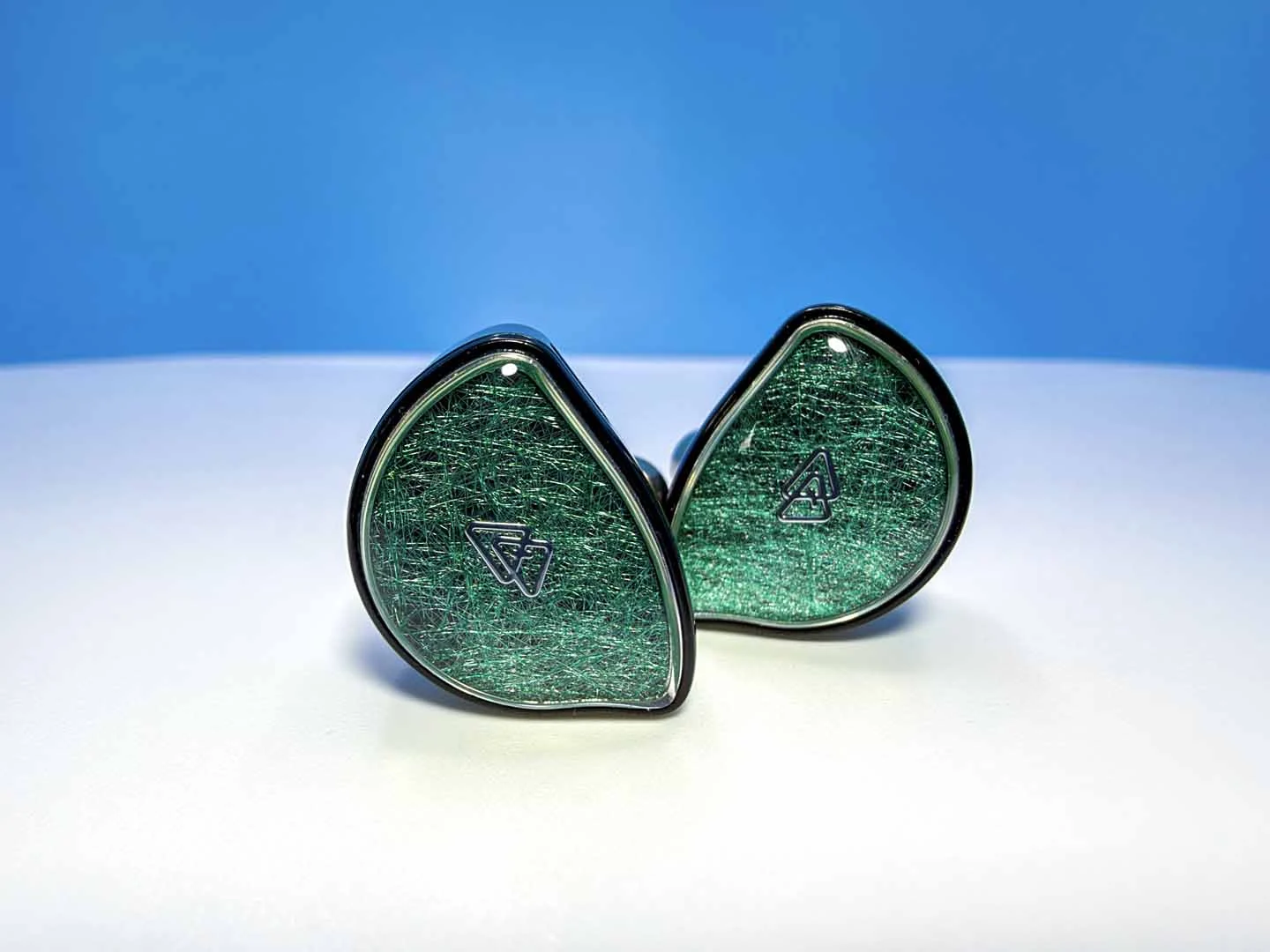
🎨 Design & Build: A Little Green Lightning in the Clouds
Let’s talk about the physical design, because BQEYZ gives the NI far more visual personality than its modest price suggests.
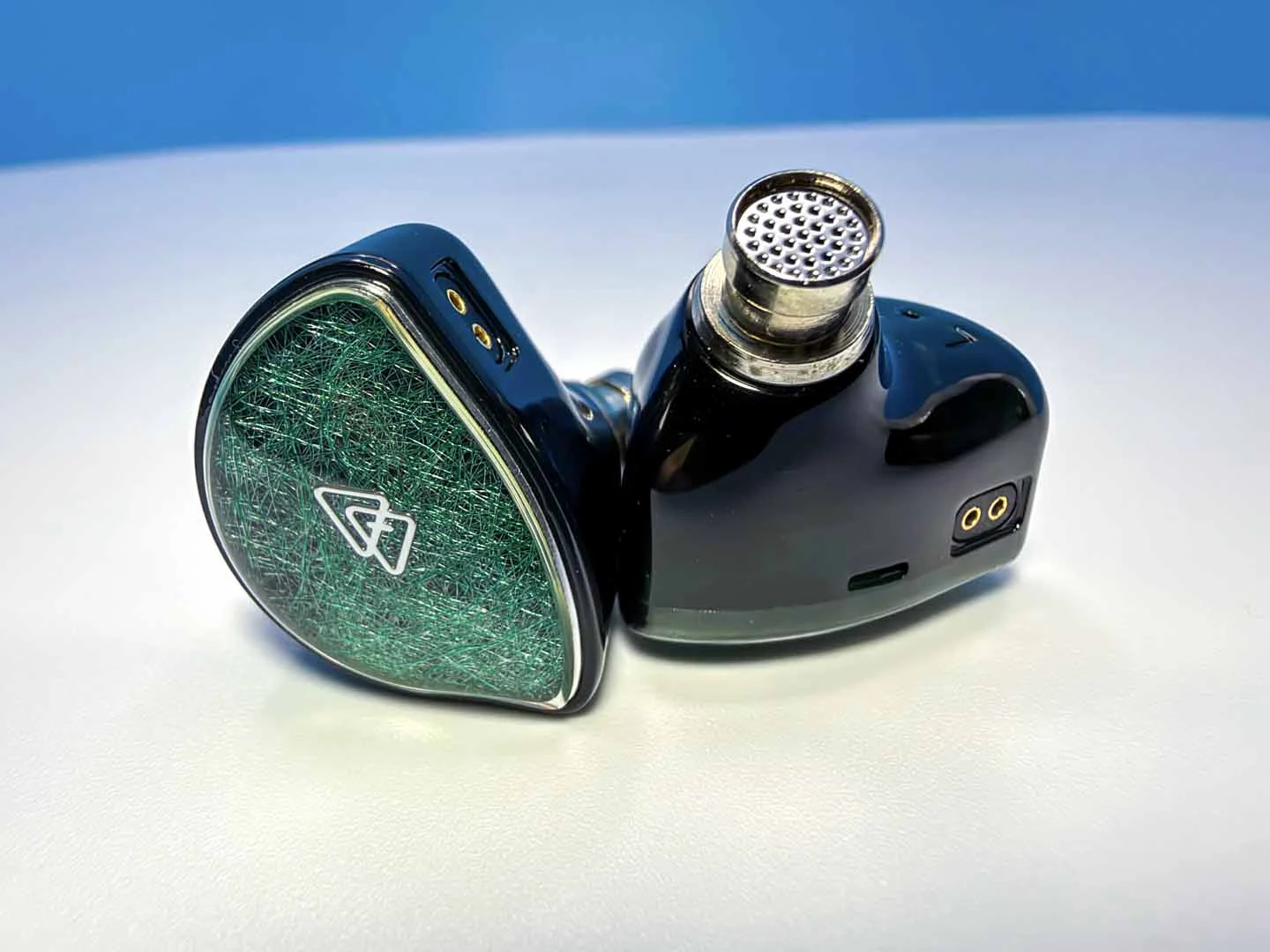
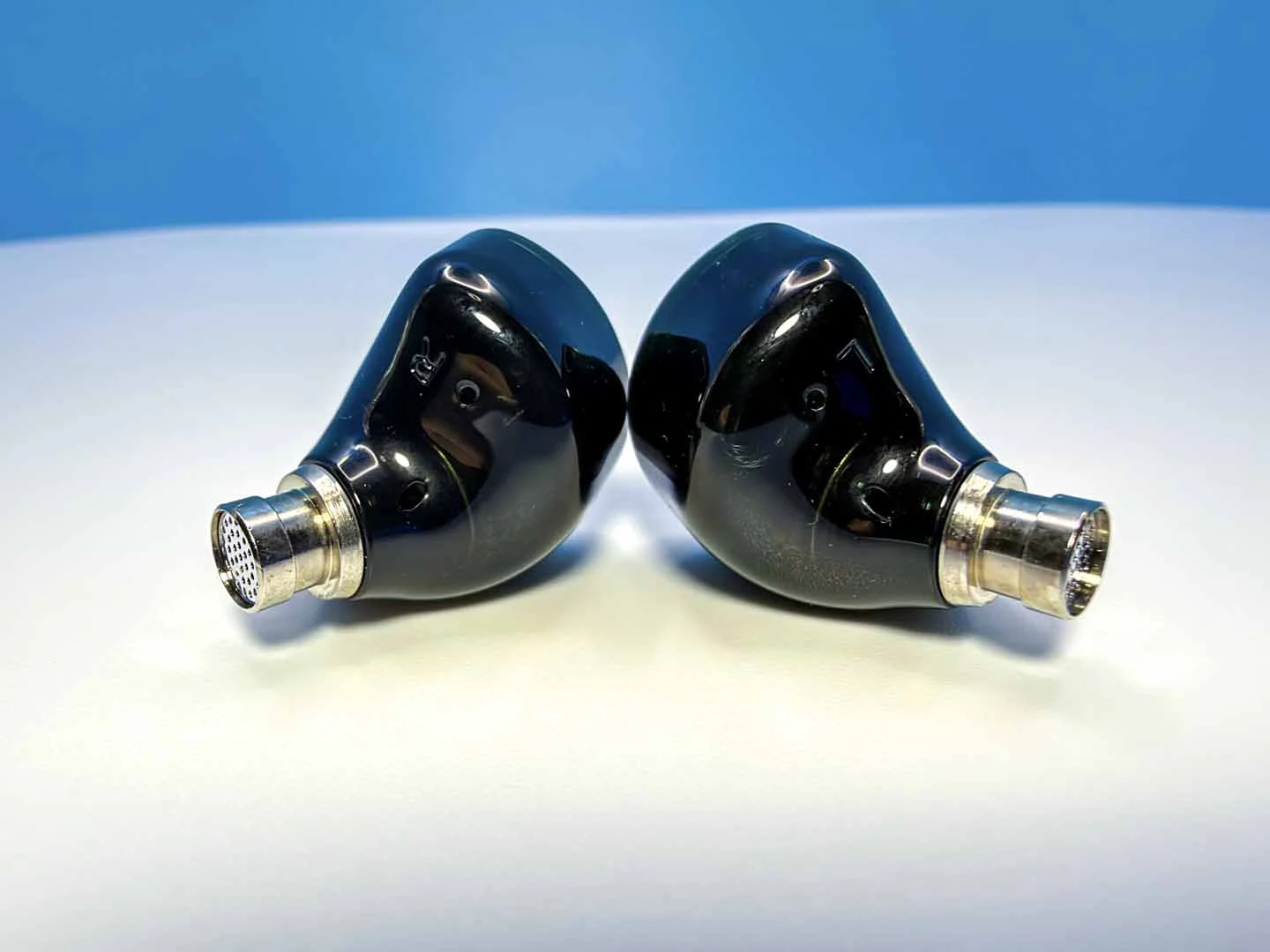
The earpieces combine dark, semi-transparent resin shells with aluminum-alloy elements and intricate decorative faceplates featuring green, silk-like patterns.
The effect is attractive without becoming ridiculous.
And thank goodness for that.
Gaming audio manufacturers occasionally seem convinced that everything associated with a video game must resemble a radioactive spaceship that just escaped a science-fiction convention.
BQEYZ took a more restrained approach.
The NI’s green detailing catches the light, creating an almost luminous appearance against the darker shell. Depending on how the light strikes the faceplates, the patterns can resemble strands of silk, wisps of colored cloud, or delicate flashes of green energy.
It’s a handsome design that feels connected to the product’s name without relying on oversized decorative elements.
The translucent construction also subtly reminds you there’s genuine acoustic engineering beneath the surface.
The aluminum-alloy components provide a welcome visual contrast, while the detachable two-pin connectors help make the design practical rather than merely decorative.
The overall result is an IEM that looks intentional.
It doesn’t look like an inexpensive shell with a gaming label slapped on the packaging at the last minute.
There’s a coherent design language here.
And for roughly fifty dollars, that’s worth appreciating.
Design & Build: Attractive, distinctive, and more refined than its price might suggest.
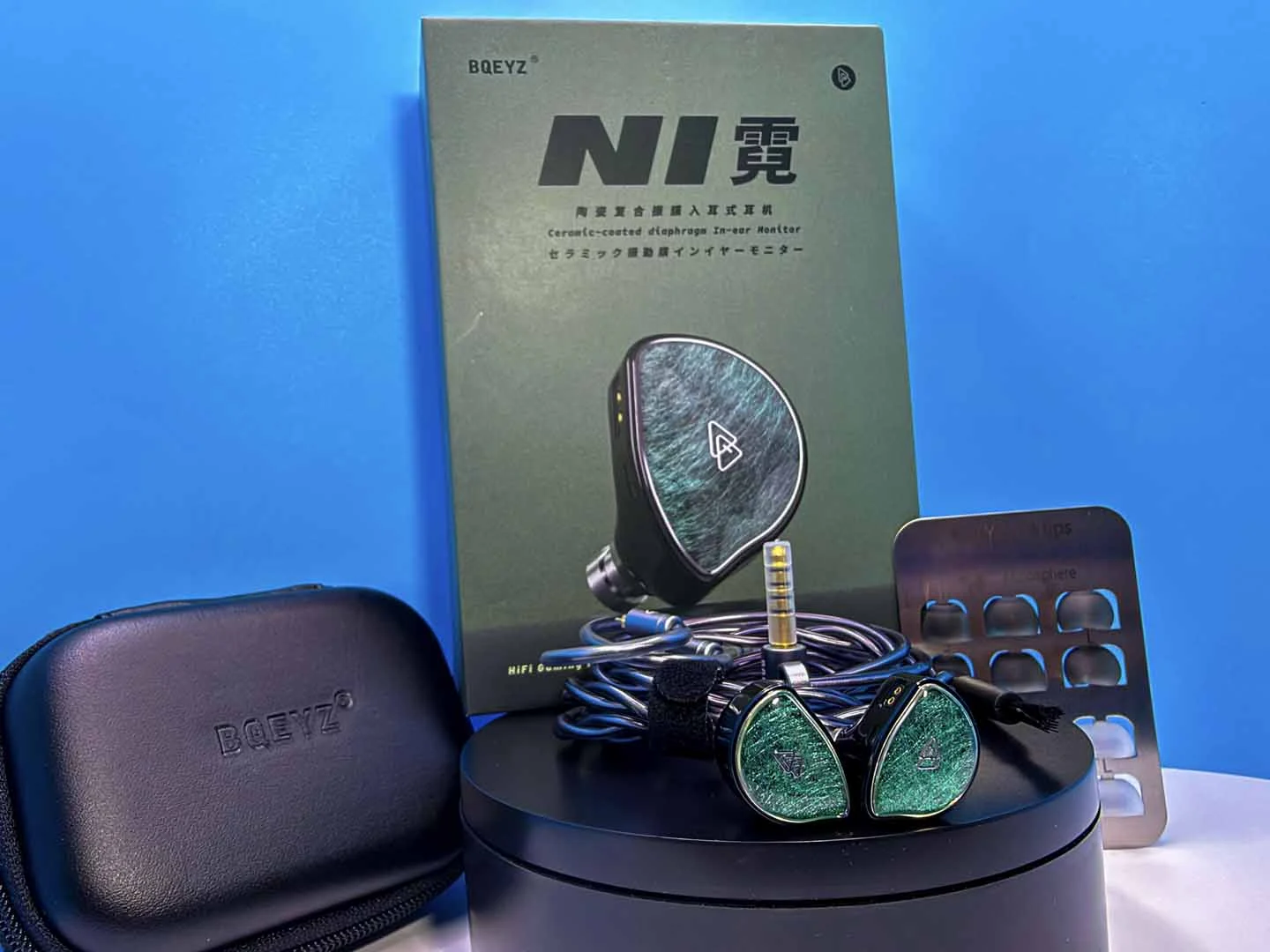
📦 Unboxing: The Cable Steals the Show
Let’s talk about what BQEYZ gets right before we even press play.
At roughly fifty dollars, I don’t expect extravagant packaging, elaborate presentation boxes, or accessories worthy of a royal procession. What I appreciate is when manufacturers invest in what makes a product genuinely enjoyable to own.
And with the NI, the cable is the star of the show.
Folks, I genuinely like this thing.
While some manufacturers still include thin, tangly cables that look like they were rescued from an abandoned electronics drawer, BQEYZ offers a well-built modular cable with interchangeable 3.5mm single-ended and 4.4mm balanced terminations.
It’s attractive, practical, and genuinely useful, particularly for listeners who move between portable DACs, digital audio players, and desktop equipment.
The protective carrying case is another welcome inclusion, while the translucent shells and distinctive green faceplates give the package a more refined look than its modest price suggests.
Nothing here is unnecessarily extravagant, and that’s perfectly fine.
BQEYZ focuses on what matters: a capable IEM, a genuinely useful cable, and a complete ownership experience that makes sense for the price.
And I appreciate that.
Accessories & Presentation: Practical, thoughtfully executed, and highlighted by an excellent modular cable.
⚙️ Technical Specifications: One Driver With a Mission
Beneath NI’s attractive exterior sits a single 11mm dynamic driver with a bio-ceramic composite diaphragm and PZT-related enhancement.
The driver operates inside a dual-chamber acoustic system designed to manage airflow and resonance.
Here are the published specifications.
Model: BQEYZ NI (霓)
Manufacturer: BQEYZ Audio
Type: Wired in-ear monitor
Market positioning: Gaming and music listening
Driver configuration: Single 11mm dynamic driver per earpiece
Diaphragm: Bio-ceramic composite with PZT-related technology
Acoustic architecture: Dual-chamber design
Published impedance: 28Ω
Published sensitivity: 112dB
Published frequency response: 5Hz–40kHz
Earphone connector: 0.78mm 2-pin
Cable length: Approximately 1.2 meters
Cable construction: High-purity Litz-style copper, approximately 196 conductors
Reviewed termination options: Interchangeable 3.5mm single-ended and 4.4mm balanced
Other available configuration: USB-C cable option with microphone controls
Shell construction: Semi-transparent resin with aluminum-alloy components
Included ear tips in my package: Six pairs
Official listed price: $49.90 USD for the selected analog configuration
One technical detail is worth clarifying.
The NI’s dual-chamber architecture doesn’t mean it contains two dynamic drivers. It is a single-dynamic-driver design, with acoustic chamber engineering intended to manage driver behavior.
Likewise, using PZT-related technology doesn’t automatically mean there’s a separate piezoelectric tweeter operating alongside the dynamic driver.
Those distinctions matter because engineering claims should be understood accurately, not turned into marketing mythology.
🧪 Ceramic-Composite Technology: What’s the Objective?
A dynamic driver’s diaphragm must move in response to an electrical signal, generating pressure changes that produce sound.
Ideally, the diaphragm should move in a controlled fashion across the frequencies it needs to reproduce.
Different materials and constructions affect stiffness, mass, damping, and resonance.
Ceramic-composite technology is interesting because it offers manufacturers another way to pursue diaphragm rigidity and control, potentially reducing unwanted movement and helping reproduce fine details.
But a material alone doesn’t guarantee superior sound.
The motor system, diaphragm geometry, acoustic chambers, damping, and final tuning all shape the final result.
And that’s where the NI becomes interesting.
Rather than using its technical specifications simply to promise enormous bass or spectacular treble, BQEYZ appears to have pursued a clean, articulate presentation that keeps sonic information easy to identify.
The engineering supports the mission.
For an affordable, gaming-oriented IEM, that’s exactly what I want.
🎧 Listening Impressions: Clarity Has Its Own Kind of Magic
Here’s where the NI begins making its strongest argument.
This is a genuinely clear-sounding little IEM.
And I don’t mean clarity in the sense that every instrument has been sharpened until it threatens to cut somebody.
I mean the NI presents musical information in an organized, articulate way that makes it easy to follow what’s happening in a recording.
Individual elements stay recognizable, vocals stay intelligible, and the overall tuning avoids the kind of excessive low-frequency emphasis that can make busy passages feel congested.
There’s a sense of control here.
And I appreciate it.
The NI doesn’t create the enormous musical environment that some of my favorite IEMs deliver, but it also doesn’t force everything into an artificially cramped space.
Instead, it occupies a moderate, comfortable middle ground.
Not especially wide. Not especially shallow. Just sensibly proportioned.
And that’s a perfectly legitimate spatial presentation.
We sometimes become so obsessed with enormous width, exaggerated depth, and spectacular imaging that we forget something important.
A recording doesn’t need to sound gigantic to sound organized.
For many listeners, particularly those interested in gaming, podcasts, vocals, acoustic music, and everyday listening, a coherent presentation with strong clarity can be far more useful than artificial spaciousness.
The NI understands that balance.
It doesn’t insist on transforming every recording into a stadium performance.
It presents the material cleanly and lets you follow what’s happening.
And there’s genuine value in that kind of restraint.
The NI is an IEM built to understand the sound, not exaggerate it.
🌸 Ear Tips & Fit: Finding the Right Seal
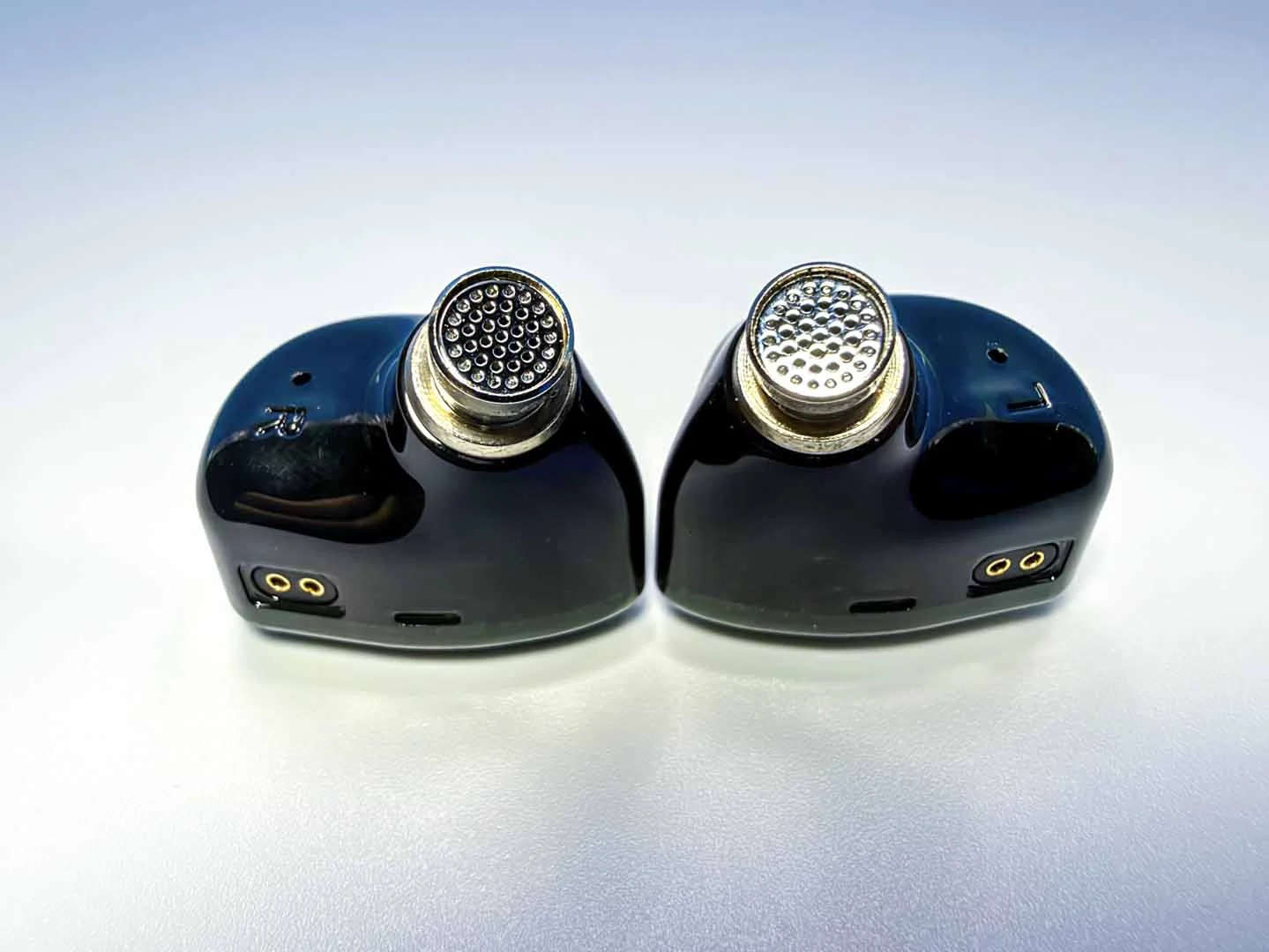
BQEYZ includes six pairs of silicone ear tips with the NI, giving listeners several chances to find the right fit.
That’s especially important because the NI’s clean, controlled tonal balance depends on establishing a consistent acoustic seal.
When that seal is compromised, low-frequency output can drop, shifting the balance between bass, midrange, and treble.
An IEM that sounds balanced with a good seal can become noticeably leaner when the tips don’t fit correctly.
Because the NI already emphasizes clarity, preserving its intended low-frequency foundation is especially important.
I recommend beginning with the included tips rather than immediately reaching for aftermarket replacements.
Try different sizes, pay attention to insertion comfort, and listen for consistent bass response before judging the tuning.
Tip bore and insertion depth can also affect perceived upper-frequency behavior, though those changes vary by earphone and individual anatomy.
For listeners with smaller ears, shell geometry and nozzle fit deserve particular attention. The NI’s conventional over-ear design provides a reasonable starting point, but comfort is personal and shouldn’t be assumed from product photographs.
The right fit helps the NI deliver the clean, balanced presentation it was designed to provide.
🔬 Frequency Response: The Anatomy of a Precision-Minded Rainbow
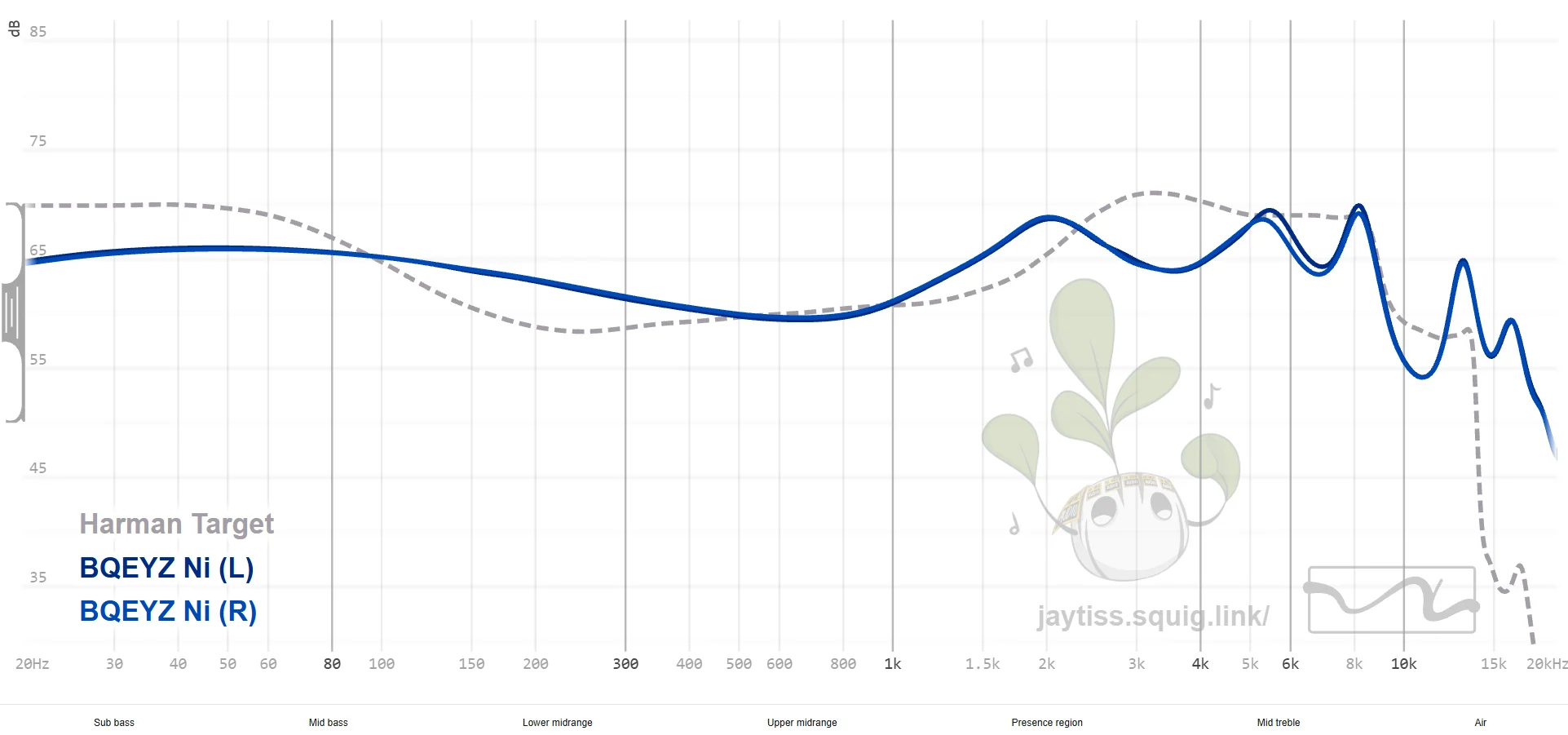
The BQEYZ NI frequency-response measurements, courtesy of Jaytiss (jaytiss.squig.link), provide a useful window into the tuning decisions behind this little green monster. A huge thanks to Jaytiss for making these measurements publicly available and helping enthusiasts better understand the gear we enjoy.
First, the NI’s tuning seems designed around clarity rather than exaggerated warmth or enormous low-frequency output.
The bass starts with a modest lift in the lowest frequencies before gradually transitioning into the lower midrange. No enormous mid-bass plateau dominates the center of the recording, which helps explain why the NI maintains a relatively clean relationship between low-frequency instruments and the rest of the musical arrangement. The lower midrange remains comparatively restrained, favoring articulation over a particularly thick or romantic vocal body.
Then we encounter the upper-midrange region, where things get particularly interesting. The response rises noticeably around 1–2kHz, providing energy in frequencies associated with vocal intelligibility and instrumental presence. Compared with the Harman target displayed in Jaytiss’s graph, the NI emphasizes this region somewhat differently, with its strongest rise occurring earlier. That doesn’t make the tuning incorrect. It simply illustrates BQEYZ’s particular approach to balancing vocal presence, instrumental clarity, and the overall presentation.
And for an IEM oriented toward clean sonic information, that decision makes considerable sense.
The treble region shows several measured peaks and dips, but they warrant careful interpretation. IEM measurements above approximately 5kHz are particularly sensitive to coupler behavior, insertion depth, and individual ear-canal acoustics. For example, an apparent peak around 8kHz shouldn’t automatically be interpreted as the same peak in every listener’s eardrum.
Likewise, a frequency-response graph doesn’t independently establish imaging precision, driver speed, distortion performance, or overall technical resolution. It shows tonal balance, not every characteristic of the listening experience.
But it certainly helps explain the NI’s priorities.
Controlled bass, articulate mids, and enough upper-frequency emphasis to make detail easy to recognize.
That’s a sensible foundation for an IEM intended to serve both gaming and music enthusiasts, and importantly, it aligns with the general character I’m hearing. The NI isn’t trying to overwhelm listeners with enormous low-frequency weight or an exaggerated sense of musical scale. It pursues a cleaner, more organized presentation that keeps individual elements of a recording intelligible.
Another encouraging detail in Jaytiss’s measurements: the left and right channels track closely across much of the frequency range, suggesting good tonal consistency in the measured sample. That’s particularly welcome in an IEM where clarity and organized presentation are important parts of the experience.
Ultimately, the measurements reinforce what makes the NI an interesting option in the affordable IEM market. BQEYZ has chosen a tuning with recognizable priorities rather than attempting to satisfy every conceivable preference.
The frequency response tells the story of an IEM that prioritizes clarity.
And the second rainbow shines comfortably in its own way.
Measurement credit: Jaytiss Squiglink – BQEYZ NI. Frequency-response measurements represent the tested sample and measurement setup; individual listening experiences may vary.
🥁 Bass: Control Before Conquest
The NI’s bass is best understood in relation to the rest of the tuning.
This isn’t an IEM designed primarily to deliver gigantic sub-bass explosions or thick, room-filling mid-bass.
Instead, the low frequencies provide a controlled foundation that supports the recording without constantly demanding attention.
And for the NI’s intended audience, that’s an intelligent choice.
Excessive bass can be tremendous fun, particularly with electronic music, hip-hop, and cinematic recordings. I certainly enjoy a healthy amount of low-frequency authority when an IEM is built to deliver it.
But not every listening situation benefits from that emphasis.
In gaming, too much low-frequency energy can make subtle information harder to distinguish. Explosions, environmental effects, and heavy musical accompaniment can compete with quieter cues that players want to identify.
For music listeners, controlled bass can preserve the clarity of vocals, guitars, percussion, and other instruments without adding unnecessary thickness.
The NI leans toward that cleaner interpretation.
Its bass provides structure without becoming the defining feature of the entire experience.
Listeners seeking enormous physical slam may prefer a bass-emphasized alternative, but that doesn’t diminish the NI’s approach.
This isn’t a monster trying to demolish the battlefield. It’s trying to make sure you can hear what’s happening on it.
And sometimes, that’s considerably more useful.
🎤 Lower Midrange: Clean Foundations, Clear Intentions
The lower midrange plays an important role in the perceived body of vocals, guitars, piano, and other instruments.
It’s also one of the regions that can dramatically influence whether an IEM sounds warm, neutral, lean, or particularly rich.
The NI takes a comparatively restrained approach.
Rather than building a thick cushion of warmth beneath the entire presentation, it keeps the transition from bass into the central midrange cleaner.
That helps preserve intelligibility.
Vocals aren’t unnecessarily obscured by low-frequency energy, and instrumental textures stay easy to distinguish without the added density warmer tunings bring.
Of course, different listeners appreciate different presentations.
Someone who wants exceptionally lush male vocals, rich cello resonance, or a particularly romantic acoustic character may gravitate toward an IEM with greater lower-midrange emphasis.
But the NI’s cleaner presentation makes sense for its own objectives.
It provides a foundation that supports articulation without adding excessive weight.
And that’s a useful quality for listeners who prioritize clarity across a variety of content.
The NI doesn’t attempt to turn every recording into a warm blanket. Sometimes a clean window is exactly what the listener wants.
✨ Upper Midrange: Bringing the Important Details Forward
The upper midrange is one of the most interesting parts of the NI’s tuning.
This region contributes significantly to vocal intelligibility, guitar articulation, and the presence of many instruments.
The NI’s frequency-response curve shows a noticeable rise through this area, particularly around the lower portion of the upper-midrange presence region.
That helps explain why clarity is such a prominent part of its character.
It emphasizes making important musical information easy to recognize without requiring excessive overall volume.
And this has obvious applications beyond music.
For dialogue, voice communication, and gaming environments where intelligibility matters, a well-managed upper midrange can be extremely valuable.
However, upper-midrange balance also shapes how naturally voices sound, and the ideal amount varies among listeners.
The NI’s approach isn’t specifically designed around the lush, elevated, floating vocal presentation I often gravitate toward.
It focuses more on articulation and clarity.
And that’s perfectly appropriate.
The NI gives voices a clear place in the arrangement without insisting that every singer become the center of the universe.
For its intended audience, that may be exactly the right balance.
🌟 Treble & Air: Detail Without the Fireworks
Treble can make or break an affordable IEM.
Too little upper-frequency energy can leave recordings feeling muted, closed-in, or lacking definition.
Too much can produce an initially impressive sense of detail that becomes tiring over time.
The NI approaches this region with a clarity-oriented presentation that brings out upper-frequency information without making enormous spatial effects its primary selling point.
The result is a sound that supports articulation and perceived detail.
Cymbals, guitar strings, and other higher-frequency elements benefit from an overall tuning that doesn’t bury them beneath excessive bass.
And for a modestly priced single-dynamic-driver IEM, that’s an appealing accomplishment.
The measured frequency response suggests some variation in the upper treble, though you should interpret exact peaks and dips cautiously because of the limitations of common IEM measurement systems.
What matters more is how the treble contributes to the complete presentation.
The NI uses upper-frequency energy as part of its clarity-first identity.
It’s not trying to recreate an enormous cathedral around every recording.
It’s providing enough information to make instruments and smaller sonic details recognizable.
And there’s a useful distinction here.
More apparent detail doesn’t automatically mean greater underlying resolution, but a clear tonal balance can make existing information easier to appreciate.
The NI understands the practical value of that relationship.
🎯 Instrument Separation & Placement: Organized, Not Exaggerated
This is an important category for a gaming-focused IEM.
And it deserves careful consideration.
The NI’s clear presentation keeps individual instruments recognizable within a recording, providing organization that suits both music and detail-focused listening.
Rather than creating an artificially enormous environment, the NI maintains a moderate spatial presentation.
The resulting arrangement feels sensibly proportioned.
And while some listeners may prefer dramatically expanded width or front-to-back depth, an expansive presentation isn’t automatically more accurate.
In fact, instrument separation and spatial size are two different characteristics.
An IEM can present sounds in a relatively moderate space while still letting listeners follow individual musical elements.
Likewise, an enormous sense of width doesn’t guarantee precise localization.
That distinction matters especially for gaming.
Competitive players often care less about recreating a gigantic concert hall than about distinguishing small details and identifying where sounds appear to originate.
The NI’s clarity-oriented tuning makes that a reasonable design objective.
However, I wouldn’t claim verified competitive positional accuracy without dedicated gameplay testing.
What I can say is that the NI’s musical presentation is organized, articulate, and sensibly scaled.
Not every battlefield needs to be enormous. Sometimes it’s more important to understand what’s happening within it.
🌌 Width & Depth: A Comfortable Middle Ground
Anyone who’s read my reviews knows I love expansive, immersive audio.
Give me beautiful width, convincing front-to-back depth, and the sensation of instruments existing in a three-dimensional musical environment, and I’m usually a very happy listener.
But I’m also realistic.
Not every IEM needs to deliver that experience.
And the NI is an excellent example of why.
Its spatial presentation is moderate.
Not especially wide. Not shallow. Not exaggerated.
It leaves enough room for musical elements to stay organized without relying on an enormous sense of scale to define its character.
And for many listeners, that’s a perfectly sensible approach.
A moderate presentation can make vocals, dialogue, and instrumental relationships feel direct and coherent.
It can also avoid the sometimes artificial quality of earphones that appear more interested in producing spectacular width than maintaining believable proportions.
The NI’s spatial character is practical rather than theatrical.
It doesn’t try to place the listener in the world’s largest concert hall, but it also doesn’t cram every instrument into a crowded corner.
There’s a comfortable sense of organization.
And that fits the product’s identity.
The second rainbow doesn’t need to stretch across the entire horizon to be worth seeing.
🔬 Detail & Resolution: A Clear View of the Recording
If there’s one sonic quality that immediately establishes the NI’s appeal, it’s clarity.
This is where the little BQEYZ makes a strong case.
The overall presentation keeps the musical information intelligible, letting the listener recognize individual elements without fighting through excessive bass or an overly dense tonal balance.
And that creates an enjoyable sense of definition.
Acoustic instruments benefit from the cleaner presentation, while layered recordings let you appreciate how different musical elements interact.
This doesn’t automatically mean the NI has extraordinary underlying resolution or superior driver technology compared with every competing IEM.
Frequency balance plays an important role in perceived detail, and controlled bass combined with elevated presence can make information easier to hear.
But the listening experience matters most.
And the NI succeeds in making clarity one of its most appealing characteristics.
For someone entering the IEM hobby from ordinary gaming earbuds or inexpensive consumer earphones, that articulation can be particularly rewarding.
It’s the kind of quality that encourages listeners to pay attention to individual instruments and discover details they may not have previously noticed.
The NI doesn’t need to overwhelm you with information. It simply makes the recording easier to explore.
And at roughly fifty dollars, that’s a meaningful accomplishment.
🦴 Slam & Dynamics: Discipline Over Destruction
I love a good bass monster.
There’s something wonderfully satisfying about an IEM that can deliver a convincing kick drum, powerful bass guitar, or deep electronic impact with enough authority to make the recording feel physically alive.
But there are many different ways to approach dynamics.
And the NI clearly isn’t designed around maximum low-frequency aggression.
Its relatively controlled bass tuning supports a cleaner presentation, letting other parts of the recording stay audible instead of being dominated by low-frequency energy.
That makes sense for its intended applications.
In music, this balance can help preserve the relationship between rhythm instruments and vocals.
In gaming, it may help prevent heavy effects from overwhelming quieter details, though you need to judge that practical advantage in actual gameplay.
The NI’s identity isn’t about explosive physical slam.
It’s about maintaining clarity and control.
And there’s absolutely a place for that.
Listeners who want a more visceral, bass-heavy experience have plenty of alternatives, but someone seeking a disciplined presentation may find the NI’s priorities particularly appealing.
Sometimes the smartest monster on the battlefield knows when not to stomp.
⚡ Speed & Transients: Keeping Up With the Action
The NI’s ceramic-composite dynamic driver and dual-chamber design are part of BQEYZ’s effort to deliver a responsive, controlled sound.
And the listening presentation certainly emphasizes articulation.
But I want to make an important technical distinction.
An IEM that sounds clean or sharply defined doesn’t automatically prove its driver has superior transient speed.
Frequency response, acoustic damping, and the character of instrumental attacks all contribute to how we perceive responsiveness.
Without controlled measurements, I wouldn’t claim the NI is objectively faster than a competing driver simply because its notes sound well defined.
What matters is that the NI presents musical information with clarity and organization that suit its intended purpose.
This approach benefits percussive details and instrumental articulation.
When the recording gets more complicated, that clean tonal balance helps preserve the intelligibility of individual elements.
It’s a sensible combination for listeners who enjoy energetic music, detailed recordings, or gaming-oriented audio.
The NI doesn’t need to win a laboratory drag race. It needs to make the action understandable.
And its overall tuning gives it a useful foundation for doing exactly that.
🎵 Tonality & Timbre: A Different Kind of Musical Personality
If I had to describe the NI’s overall sonic character in four words, I’d choose:
Clear. Controlled. Articulate. Practical.
And I mean every one of those words positively.
The NI doesn’t embrace the thick warmth of a particularly lush IEM, nor does it rely on enormous low-frequency emphasis to generate excitement.
Instead, its tuning provides a cleaner tonal balance that makes musical information easy to follow.
For listeners who enjoy that presentation, it has considerable appeal.
Vocals stay intelligible, instruments occupy recognizable positions, and the overall sound stays organized across a range of material.
That doesn’t mean the NI has to become everyone’s favorite tuning.
And frankly, I wouldn’t want it to.
The personal-audio hobby becomes far more interesting when manufacturers explore different approaches instead of treating one frequency-response target as the only acceptable definition of good sound.
Some listeners want warmth.
Others want bass.
Some crave silky vocals, extraordinary spatial depth, or a relaxed presentation that encourages hours of listening.
And some want clarity, control, and a straightforward relationship with the recording.
The NI serves that last group particularly well.
It isn’t trying to be another version of something I already own.
It has its own sonic priorities.
And I respect that.
This hobby has room for more than one kind of musical personality.
The second rainbow has its own colors.
🎮 Gaming Performance: Built for the Battlefield
Let’s address the obvious question.
Why is the NI marketed as a gaming IEM?
Because several core tuning priorities matter to how people experience competitive and immersive games.
Clarity can help distinguish subtle sonic information.
Controlled bass can prevent explosions and other low-frequency effects from dominating the entire mix.
An organized presentation can make overlapping sounds easier to follow.
A comfortable, practical wired configuration can also appeal to players who don’t want to rely on wireless batteries or extra connectivity complications.
These characteristics make the NI a plausible choice for gaming-oriented listeners.
But there’s an important distinction between an IEM with a tuning that sounds well suited to gaming and one that delivers superior competitive performance in direct testing.
🎯 Competitive Gaming: Information Matters
In games such as VALORANT and Rainbow Six Siege, players often rely on small audio cues to understand what’s happening around them.
Footsteps, reloading sounds, movement through different surfaces, and environmental effects can all contribute useful information.
Clear presentation can make those details easier to recognize, especially when the audio mix gets complicated.
The NI’s restrained bass and articulate overall character support that objective.
However, identifying a sound’s direction or elevation also depends on the game’s audio engine, headphones or IEMs, individual hearing, and how spatial information is encoded.
I wouldn’t promise that purchasing the NI will magically reveal an enemy hiding three floors above you.
If it did, the entire competitive gaming industry would have a rather serious problem.
But the NI offers several sonic qualities that make it worth considering for players who prioritize intelligibility.
🌆 Immersive Gaming: A Different Kind of Experience
For cinematic games, priorities can differ.
Deep bass, environmental scale, and expansive spatial effects can create a stronger sense of immersion.
The NI’s moderate presentation and clarity-oriented tuning may appeal to players who prefer clean dialogue and organized effects over enormous cinematic impact.
Others may want a warmer, bass-heavy alternative.
Neither preference is wrong.
They’re simply different ways of experiencing a game.
🎙️ The USB-C Question
BQEYZ also offers the NI with a USB-C cable configuration incorporating microphone functionality.
That’s an interesting option for gamers and mobile listeners.
However, the version I received uses interchangeable 3.5mm and 4.4mm analog terminations.
I cannot evaluate the USB-C microphone, its controls, or any potential DSP implementation.
And I won’t pretend otherwise.
The NI’s gaming proposition is promising, but this review’s conclusions are grounded in the analog listening experience rather than unperformed gaming benchmarks.
🎛️ Amplification & Source Pairing: Keep It Simple
With a published impedance of 28Ω and sensitivity of 112dB, the NI’s specifications suggest it should be compatible with a wide variety of capable audio sources.
Of course, sensitivity figures can be expressed using different reference standards, so don’t use those numbers alone to make precise power predictions.
Still, the NI doesn’t present itself as an IEM that requires an enormous desktop amplifier to function properly.
And that’s appropriate for its audience.
Someone buying a roughly $50 gaming-oriented earphone shouldn’t need to spend several hundred dollars on extra equipment just to enjoy it.
A capable, low-noise dongle DAC, portable player, or suitable audio output should provide a reasonable foundation.
The interchangeable 3.5mm and 4.4mm cable also provides useful flexibility for enthusiasts who already own different sources.
One important reminder: balanced operation doesn’t automatically improve sound quality.
The benefits depend on the equipment’s implementation, output characteristics, and compatibility.
For listeners who enjoy experimenting with EQ, the NI’s tuning also offers opportunities for adjustment.
A modest low-frequency boost can add warmth or impact for those who prefer more bass, while careful midrange adjustments can help personalize vocal presentation.
But I wouldn’t suggest the NI needs rescuing from its factory tuning.
Its existing sound serves a clear purpose, and it’s worth hearing that purpose before changing it.

👹 The GearZilla KAIJU DNA Scan: Anatomy of the Second Rainbow
Every Kaiju has a defining personality.
Some rely on overwhelming force, others on extraordinary speed, and a few win through intelligence, precision, and knowing exactly when to strike.
The BQEYZ NI belongs firmly in that last category.
Let’s examine its DNA.
🎯 K • Kill Shot: Clarity Is the Weapon
The NI’s strongest sonic quality is its clear, articulate presentation.
The music stays organized, key details are easy to spot, and the restrained bass tuning keeps things from getting congested.
For listeners who value intelligibility, that combination is appealing.
The NI doesn’t need to roar the loudest. It wants you to hear every detail before the roar begins.
🧬 A • Anatomy: One Driver, Thoughtful Engineering
A single 11mm ceramic-composite dynamic driver operates inside a dual-chamber acoustic system, housed in attractive translucent shells with distinctive green detailing.
It’s a relatively simple driver configuration supported by more ambitious material and acoustic choices.
And the result is a capable, clarity-oriented presentation.
One driver. One mission. No unnecessary monsters hiding in the crossover.
🦴 I • Impact: Precision Over Power
The NI doesn’t rely on oversized low-frequency emphasis to establish its identity.
Its controlled bass supports musical organization and helps preserve the clarity of other instruments.
Listeners who want enormous physical impact may prefer another tuning, but the NI’s restraint is deliberate and useful.
This monster isn’t trying to destroy the battlefield. It’s trying to understand it.
🎩 J • Joy: Great Value Is Worth Celebrating
The NI’s ownership experience is one of its strongest selling points.
A genuinely nice interchangeable cable, attractive construction, and practical connectivity make this feel thoughtfully assembled. The modular terminations are particularly welcome, providing useful flexibility without requiring an additional cable purchase.
At roughly $50, those details matter.
BQEYZ remembered that affordable doesn’t have to mean forgettable.
🎤 U • Unleashed: A Different Kind of Listener
The NI isn’t designed around enormous holographic dimensions, romantic vocal warmth, or overwhelming bass impact.
Its strengths lie in clarity, organization, and practical versatility.
That makes it particularly appealing to listeners whose priorities differ from mine.
The right monster for the right mission. That’s what makes this hobby interesting.
🦖 The KAIJU Conclusion: A Rainbow With Its Own Colors
The BQEYZ NI combines appealing engineering, articulate sound, thoughtful accessories, and excellent value in a package built for listeners who prioritize clarity.
It doesn’t attempt to imitate every other IEM on the market.
It understands its purpose.
And that confidence deserves recognition.
The second rainbow doesn’t compete with the first. It completes the sky.
💰 Value: This Is Where BQEYZ Makes Its Argument
At an official listed price of $49.90, the NI enters one of personal audio’s most competitive segments.
And it arrives prepared.
Let’s look at what the buyer gets.
It includes an 11mm ceramic-composite dynamic driver, a dual-chamber acoustic design, attractive translucent shells, a protective carrying case, detachable two-pin connections, and a genuinely nice modular cable with interchangeable 3.5mm and 4.4mm terminations.
That’s a compelling feature set at this price.
But what matters most is how those features improve the overall experience. The interchangeable cable makes switching between compatible sources easier, the clear tuning gives the NI a practical sonic identity, and the thoughtful construction makes the entire product feel more refined than its asking price suggests.

🦖 GearZilla Scorecard: The Second Rainbow Earns Its Place
The BQEYZ NI is a clarity-focused, well-equipped budget IEM that serves its intended audience with confidence.
Its strengths lie in articulation, practical tuning, an attractive physical design, and an especially good modular cable package.
Here’s how the little green monster performs across the GearZilla scorecard.
✨ Clarity: 4.5/5 ⭐
One of NI’s defining strengths. Its clean presentation makes musical information easy to recognize, helping vocals and instruments remain intelligible without excessive low-frequency congestion. This clarity is exactly what makes the NI appealing to detail-focused listeners.
🎤 Midrange & Vocals: 4.1/5 ⭐
Clear, articulate, and well-suited to listeners who prioritize vocal intelligibility. The NI doesn’t emphasize particularly lush lower-midrange warmth or dramatically elevated vocal intimacy; instead, it presents voices with a cleaner, more straightforward character.
🥁 Bass: 3.9/5 ⭐
Controlled and appropriately restrained for the tuning’s objectives. The NI provides a useful low-frequency foundation without making enormous bass impact its central attraction. Listeners seeking stronger physical slam may prefer a bass-emphasized alternative.
🎯 Separation & Placement: 4.2/5 ⭐
A well-organized presentation that keeps individual elements recognizable. The NI prioritizes clarity within a moderate listening environment rather than relying on exaggerated spatial dimensions.
🌌 Width & Depth: 3.9/5 ⭐
A comfortable middle-ground presentation that feels neither particularly wide nor shallow. The NI offers sensible musical proportions without trying for an extraordinary holographic scale.
🔬 Detail & Resolution: 4.3/5 ⭐
Strong perceived detail for the asking price. The tuning makes small instrumental elements easier to appreciate, delivering a clear, articulate listening experience. Its detail presentation is a meaningful strength, even though frequency balance also contributes to perceived resolution.
🌟 Treble & Air: 4.1/5 ⭐
Enough upper-frequency energy to support clarity, articulation, and a lively sense of definition. Treble-sensitive listeners should still evaluate fit and personal tolerance, but the overall presentation supports the NI’s precision-oriented identity.
🦴 Slam & Dynamics: 3.9/5 ⭐
A controlled presentation that emphasizes organization over overwhelming impact. The NI isn’t designed around enormous low-frequency force, making its approach particularly relevant to listeners who prefer a cleaner balance.
🎤 Vocal Lift: 4.0/5 ⭐
Vocals remain intelligible and clearly integrated into the recording. The NI doesn’t pursue the especially elevated, floating presentation that some vocal-focused IEMs provide, favoring directness and articulation instead.
⚡ Speed & Transients: 4.1/5 ⭐
Instrumental attacks are clean and articulate, matching the NI’s overall tuning. The perceived responsiveness is appealing, though listening impressions alone can’t establish objective transient superiority.
🎵 Tonality & Timbre: 4.0/5 ⭐
A focused tuning with a clear purpose. The NI prioritizes intelligibility, articulation, and tonal cleanliness rather than pronounced warmth or exaggerated bass. Its character suits listeners who prefer a more controlled presentation.
🎛️ Tuning & Pairing Flexibility: 4.4/5 ⭐
The interchangeable 3.5mm and 4.4mm terminations are a genuine advantage for listeners using different compatible sources. The detachable two-pin connections add flexibility, while the USB-C option offers another purchase choice not covered in this review.
☁️ Comfort & Fit: 4.0/5 ⭐
The NI’s conventional over-ear construction provides a reasonable foundation for everyday listening. As always, comfort depends on individual ear anatomy, nozzle geometry, insertion angle, and achieving a consistent acoustic seal.
🎨 Design & Build: 4.4/5 ⭐
Attractive green detailing, translucent resin shells, and aluminum-alloy components make the NI look more refined than its asking price suggests. The physical design feels cohesive and thoughtfully executed.
📦 Accessories & Presentation: 4.6/5 ⭐
The modular cable stands out here. Its interchangeable 3.5mm and 4.4mm terminations bring meaningful convenience, while the protective case and attractive overall presentation complete a package that feels thoughtfully executed for the price.
🎶 Listening Enjoyment: 4.0/5 ⭐
An enjoyable, capable presentation for listeners who appreciate clarity and control. The NI doesn’t chase lush warmth or massive immersion, but its coherent tuning serves a legitimate, appealing listening preference.
💰 Value: 4.7/5 ⭐
This is where BQEYZ deserves applause. At roughly $50, the NI delivers strong clarity, attractive construction, a genuinely useful interchangeable cable, and thoughtful accessories. It’s a well-rounded package with a clear sense of purpose.
🧡🦖 Overall GearZilla Score: 4.0/5 | The Second Rainbow
The BQEYZ NI earns a 4.0/5 GearZilla rating because it delivers a strong combination of clarity, practicality, attractive design, and excellent value.
Its greatest accomplishment isn’t creating an enormous listening environment or overwhelming the listener with bass.
It’s a coherent, articulate presentation supported by useful accessories and smart product design.
The clean tuning makes musical information easy to recognize, while the moderate spatial presentation keeps the experience organized without becoming exaggerated.
And that modular cable?
Absolutely one of my favorite parts of the package.
For listeners who regularly move between compatible 3.5mm and 4.4mm outputs, it’s a genuinely useful feature that elevates the complete ownership experience.
What makes the NI particularly interesting is how clearly it serves a particular audience.
It isn’t trying to become every listener’s favorite IEM.
It’s designed for people who value clarity, intelligibility, controlled bass, practical connectivity, and an affordable entry into better personal audio.
And those priorities deserve recognition.
The NI isn’t a compromise disguised as an accomplishment. It’s an accomplishment built around a different set of priorities.
The GearZilla score reflects the complete product experience, not a mathematical average of individual categories. Different strengths matter differently depending on the intended audience, and the NI’s strong value and practical design contribute meaningfully to the final verdict.
Clear, capable, thoughtfully equipped, and confident in its own identity.

🦖 Final Roar: The Second Rainbow Knows Exactly Where It Belongs
There’s something wonderfully appropriate about an IEM named after the secondary rainbow finding its identity through a different approach to sound. In Chinese tradition, Ni (霓) describes the outer arc of a double rainbow, a phenomenon that has inspired scholars, poets, and observers for centuries. Its colors appear in reverse order from the primary rainbow, and its softer appearance gives it a character entirely its own. The two rainbows are connected, but they aren’t identical. Each emerges from a different path light takes, and together they create something more interesting than either could produce alone. That feels like a beautiful metaphor for the BQEYZ NI.
In a hobby where we constantly compare products against our personal favorites, it’s easy to forget that different tuning philosophies serve different listeners. I love expansive musical presentations, lush vocals, and the sensation of instruments occupying a wonderfully dimensional environment. Those preferences shape my listening experiences, but they don’t establish a universal standard for great sound. BQEYZ has approached the NI with another set of priorities, emphasizing clarity, articulation, controlled bass, and practical versatility. Through that lens, I find a thoughtfully designed little IEM that accomplishes much of what it seems intended to do.
Clarity is the NI’s greatest sonic strength, and it deserves genuine appreciation at this price. The presentation keeps musical information organized, vocals remain intelligible, and individual instruments are easy to follow without excessive bass competing for attention. The spatial character is moderate, neither especially wide nor shallow, and that proportion makes sense for the tuning. Not every recording benefits from being stretched into an enormous imaginary concert hall. Sometimes the material needs a coherent, well-organized listening environment. For listeners who value intelligibility, clean instrumental relationships, and a more direct presentation, the NI offers an appealing experience without requiring a substantial investment.
And then there’s the physical package, where BQEYZ has made several decisions that deserve applause. The translucent shells and intricate green detailing give the NI an attractive identity without feeling unnecessarily extravagant. But the real highlight for me is the interchangeable cable. Having both 3.5mm single-ended and 4.4mm balanced terminations available without replacing the entire cable is genuinely convenient, particularly for enthusiasts who move between different audio devices. It’s a practical feature that makes the product feel more complete, and I appreciate manufacturers that pay attention to those details rather than expecting buyers to immediately spend more money on accessories.
Of course, the NI’s gaming-oriented positioning deserves consideration, too. Its clarity-focused tuning, restrained bass, and organized presentation could appeal to players who want to distinguish subtle audio information during gameplay. But those qualities don’t automatically translate into superior competitive performance, and I won’t make claims unsupported by direct testing. The same applies to the USB-C configuration. My review unit uses the interchangeable analog cable, so I can’t evaluate the digital version’s microphone or potential DSP implementation. What I can appreciate is that BQEYZ offers different connectivity options for different buyers, and the analog package I received makes an especially compelling case for listeners who already own compatible audio equipment.
What I enjoy most about NI’s place in the market is that it offers another meaningful choice. Someone who prefers warmer, fuller bass might gravitate toward the 7Hz Zero 2 or KEFINE Klean. A vocal enthusiast might find the TANCHJIM OLA II more aligned with their preferences, while a listener seeking a lively, clarity-oriented presentation might also consider the SIMGOT EW200. The NI enters that competitive landscape with its own combination of ceramic-composite driver technology, articulate tuning, attractive design, and a modular cable that’s particularly appealing for the price. That’s exactly what I want to see from manufacturers. Not another product trying to imitate everything else, but an IEM with a recognizable purpose and a clear audience.
And that’s why the NI earns a 4.0/5 GearZilla rating. It’s a genuinely good budget IEM, not because it attempts to satisfy every imaginable listening preference, but because it delivers a strong, practical experience for people who appreciate what it offers. Its clarity is impressive, its accessories are thoughtful, and its design provides a sense of ownership satisfaction that goes beyond the driver itself. Warmer, bassier, and more expansive IEMs exist, as do others that emphasize different technical characteristics. The beauty of this hobby is that listeners can choose the experience that suits them rather than chasing someone else’s definition of perfection.
And perhaps that’s the most fitting lesson from the NI’s historical namesake. The secondary rainbow doesn’t need to shine more brightly than the primary arc to justify its existence. It follows a different path, presents its colors in a different order, and adds another dimension to something already beautiful. The BQEYZ NI approaches personal audio in much the same spirit, offering a clarity-first interpretation of affordable HiFi that’s practical, accessible, and thoughtfully executed.
The second rainbow isn’t trying to steal the show. It’s reminding us there’s more than one way to appreciate the sky.
And at roughly fifty dollars, that’s a pretty wonderful little monster to have in the kingdom.
Listen Bigger! 🦖🎧
✅ Buy If
- You prioritize clarity, articulation, and intelligibility over enormous bass.
- You want an affordable, gaming-oriented IEM with a clean tonal balance.
- You enjoy hearing individual instruments and musical details clearly.
- You prefer a moderate, organized spatial presentation rather than exaggerated width.
- You want an attractive, thoughtfully designed IEM without spending heavily.
- You appreciate a genuinely nice modular cable with interchangeable 3.5mm and 4.4mm terminations.
- You’re exploring your first serious wired IEM and want a capable entry into personal HiFi.
- You enjoy acoustic music, dialogue-focused listening, or detail-rich recordings.
- You value practical accessories and good overall ownership value.
- You’re looking for an IEM with a specific sonic identity rather than another generic bass-heavy tuning.
⛔ Consider Another IEM If
- Your primary preference is enormous sub-bass rumble or powerful mid-bass slam.
- You want a particularly warm, lush, or romantic vocal presentation.
- You prioritize exceptionally expansive, holographic width and depth.
- You prefer a thick, relaxed tonal balance over clarity-oriented articulation.
- You require a built-in microphone and are considering the analog-only configuration.
- You expect verified competitive gaming performance data rather than a music-focused listening assessment.
- You want an especially bass-rich, cinematic presentation for immersive gaming.
- You’re buying an IEM for digital EQ or DSP and haven’t confirmed the USB-C version’s capabilities.
🛒 Ready to Discover the Second Rainbow?
The BQEYZ NI makes a compelling case for affordable personal audio built around clarity, practicality, and thoughtful design.
For roughly $50, you get an 11mm ceramic-composite dynamic driver, attractive translucent shells, a useful selection of silicone tips, and an interchangeable analog cable that makes switching between compatible 3.5mm and 4.4mm sources remarkably convenient.
Most importantly, you get an IEM with a clear sonic identity.
It’s articulate, controlled, and intelligently positioned for listeners who value recognizable details and a cleaner overall presentation.
And in a hobby where everyone seems to be chasing the next enormous technological breakthrough, it’s refreshing to find a product that understands its purpose.
Ready to meet the NI?
Explore the BQEYZ NI at the official BQEYZ store
Choose the connectivity package that fits your equipment, find the right ear tips, and discover what this little green monster has to offer.
Because the best IEM isn’t necessarily the one that sounds the biggest. It’s the one that fits the way you listen.
Pick your monster and Listen Bigger! 🦖🎧
Share This Story, Choose Your Platform!