



Five drivers, six mythical wings, and a beautifully controlled balance of power, precision, and musical enjoyment.
🎧 ZiiGaat × Jay Audio Seraphim: A Little Heaven, a Little Hell, and a Whole Lot of Music
In ancient Hebrew, seraphim are the “burning ones,” celestial beings associated with divine fire, extraordinary power, and a presence far removed from the gentle, halo-wearing angels decorating Christmas cards. In the Book of Isaiah, they’re described as having six wings: two covering their faces, two covering their feet, and two for flying. It’s an extraordinary image of power balanced by reverence and restraint, and a fascinating name to give a pair of in-ear monitors.
Because when you name something Seraphim, you’re setting some pretty lofty expectations.
Enter the ZiiGaat × Jay Audio Seraphim: a $259 hybrid IEM with two dynamic drivers in an isobaric bass configuration, three genuine Knowles balanced armatures, striking CNC-machined aluminum shells, and a modular cable with interchangeable 3.5mm and 4.4mm connections. It’s an ambitious collaboration designed to combine musical excitement with clarity, naturalness, and comfort for long listening.
And that balance wasn’t accidental. Jay wanted to address something he felt was missing from many otherwise well-tuned IEMs: the emotional connection that makes music worth listening to in the first place.
“We wanted to maintain this versatility and naturalness, but add the soul and passion back into the music.”
Jay, Jay’s Audio
I love that philosophy because an IEM can be beautifully balanced on paper and still leave me emotionally disconnected from the performance. Technical competence doesn’t automatically translate into musical enjoyment, and a tuning that avoids every potential offense can sometimes forget to deliver a little excitement along the way. Jay’s ambition was to preserve the versatility of a balanced presentation without sacrificing the texture, contrast, and energy that give music its personality.
And after spending time with the Seraphim, I’ve discovered something interesting. Its greatest strength isn’t how fiercely it burns. It’s how beautifully it controls the flame.
The bass has genuine authority, with an elevated mid-bass presence that I find particularly satisfying. There’s weight, impact, and energy without the overwhelming low-frequency excess that can turn every recording into a bass demonstration. Attack feels quick, the presentation is clean, and there’s plenty of life in the music without the exaggerated sharpness or relentless treble energy that makes some IEMs exhausting.
That last point deserves attention because I’ve heard impressions that the Seraphim can sound aggressive in the upper frequencies. That’s simply not what I’m hearing. To my ears, the treble is remarkably controlled, providing enough definition to keep instruments articulate without constantly demanding attention. This is the kind of IEM I can settle into for a long listening session without feeling like I need to negotiate a ceasefire with the cymbals.
Vocals are clear and well-centered, though they lack the elevated, almost floating intimacy I personally love. Instruments spread across a convincingly wide presentation, and there’s enough layering to appreciate how different musical elements interact. But wide doesn’t automatically mean holographic, and the Seraphim doesn’t transport me into the deeply three-dimensional musical environment that some of my favorite IEMs create.
That distinction matters, but it doesn’t diminish what this little monster does exceptionally well. The Seraphim is a genuinely excellent all-rounder, moving between musical styles without demanding I change my expectations, adjust the tuning, or hunt for one particular recording that makes everything fall into place. It’s energetic when the music calls for excitement, articulate when a recording demands clarity, and relaxed enough to remain enjoyable over extended sessions.
And then there’s the physical design, which is absolutely gorgeous. The sculpted aluminum shells, intricate detailing, and premium presentation make this an IEM that’s just as satisfying to admire as it is to listen to. At a time when manufacturers often try to stand out with increasingly elaborate driver configurations and aggressive tuning, ZiiGaat and Jay’s Audio have delivered something more complete.
Great inside. Great outside.
That’s why the Seraphim earns a 4.5/5 GearZilla rating, and why I believe its greatest accomplishment isn’t any one spectacular sonic characteristic. It’s the confidence to deliver a consistently enjoyable experience without asking the listener to sacrifice comfort, control, or versatility.
✅ Pros: Powerful, satisfying bass with enjoyable mid-bass elevation; quick, articulate perceived attack; clean and lively presentation; remarkably controlled, non-fatiguing treble; clear, centered vocals; convincing width and instrumental layering; strong versatility across musical genres; gorgeous CNC-machined aluminum construction; refined physical presentation; useful modular cable with interchangeable 3.5mm and 4.4mm connections; and a cohesive overall personality that makes extended listening a pleasure.
⛔ Considerations: Wide presentation doesn’t translate into especially holographic immersion; vocals remain centered rather than dramatically elevated or forward; listeners seeking particularly lush, romantic lower-midrange warmth may prefer another tuning; and those with smaller ears should pay careful attention to nozzle geometry and establishing a comfortable, consistent seal.

🤝 Disclosure: The Truth Behind the Roar
Huge thanks to Rosie and the wonderful Linsoul team for generously providing the ZiiGaat × Jay Audio Seraphim for review. I’m genuinely grateful for their continued trust and support, and after spending time with this beautiful little monster, I’m especially glad they sent it my way!
Every GearZilla review begins with the same philosophy: Listen first. Figure out the story later. My responsibility is to the reader, and receiving a review sample doesn’t buy a positive verdict, guarantee a particular score, or protect a product from criticism. Linsoul hasn’t paid for this review or exercised editorial control over my conclusions. The opinions, observations, and ratings throughout this Field Report are entirely my own.
The Seraphim’s 4.5/5 GearZilla rating reflects the complete experience, from its gorgeous craftsmanship and satisfying bass to its lively, controlled presentation and impressive versatility. I’ve also been clear about where it doesn’t quite match my personal preferences, particularly its more grounded vocal placement and lack of truly holographic spatial depth. Those distinctions matter because a great review should celebrate what a product does well without pretending it’s something it isn’t.
I appreciate partners like Rosie and the Linsoul team who give independent reviewers the freedom to explore products honestly, share their experiences, and help enthusiasts make informed decisions. I value that trust tremendously, and the Seraphim has been an absolute pleasure to discover.
Listen first. Figure out the story later. 🦖🎧
🎧 Review Perspective & Listening Setup: Finding the Monster’s True Personality
Every GearZilla review begins with the same philosophy: Listen first. Figure out the story later.
And every review eventually comes back to one question that matters more to me than driver counts, frequency-response targets, or impressive marketing promises:
Does this thing help me experience the music I already love in a new way?
That’s my guiding principle, whether I’m evaluating a budget IEM, a flagship headphone, or a DAC that costs more than my first car. I’m not necessarily looking for better bass, greater clarity, or more treble. I’m looking for a different perspective on familiar recordings, something that makes me notice an instrument, appreciate a vocal performance, or connect with a song in a way I hadn’t before.
Anyone familiar with GearZilla Reviews knows that my listening preferences lean toward the lush, musical, and immersive side of personal audio. I love expansive width, convincing front-to-back depth, rich vocals that seem to rise naturally from the performance, and enough low-frequency authority to make a recording feel alive. Smooth treble matters because I want to enjoy my music for hours, not spend the evening wondering which instrument is causing the headache behind my eyes.
But my personal preferences aren’t a universal definition of good sound, and I don’t want every manufacturer tuning IEMs to satisfy one particular interpretation of musical enjoyment. This hobby has room for warm, romantic presentations, clarity-oriented monitors, bass-heavy monsters, vocal specialists, and everything in between. The interesting question isn’t whether every new product sounds like my favorite equipment. It’s whether the product understands its own purpose and delivers something genuinely worthwhile.
That’s why I begin GearZilla evaluations by listening to the factory tuning with EQ disabled. No bass boosts, custom parametric EQ, corrective filters, or immediate attempts to reshape the sound to resemble my favorite IEMs. I want to understand the manufacturer’s acoustic decisions, discover the product’s personality, and give it a fair chance to show what it was designed to do.
From there, I explore different musical genres, listening volumes, suitable sources, and, when appropriate, eartip combinations. Only after I become familiar with the original tuning do I experiment with EQ or PEQ to see how adaptable the product is. I treat those adjustments separately from my assessment of the manufacturer’s intended sound, not as replacements for it.
My listening equipment includes desktop sources such as the FiiO K13 R2R and Topping DX5 II, alongside my portable HiBy R4. I’m also exploring additional audio configurations with the iFi GR2 and Astell & Kern equipment currently in for review and testing. This combination lets me evaluate different playback configurations, but I’m careful to distinguish equipment I own from temporary review units and never attribute sonic improvements to a particular source without establishing those differences through listening. I also don’t assume that balanced connections, expensive amplification, or particular DAC architectures automatically improve the sound. When practical, I compare sources at carefully matched listening levels, allowing the product’s actual performance to guide my conclusions rather than its price or technical reputation.
Throughout the evaluation, I consider the complete ownership experience. Comfort, shell design, eartip selection, cable ergonomics, connectivity, and long-listening enjoyment all contribute to whether a product deserves a recommendation. A beautifully tuned IEM that becomes uncomfortable after thirty minutes isn’t particularly useful, and a technically impressive product that constantly distracts me from the music has missed something important.
Ultimately, I’m not trying to determine whether every IEM sounds exactly how I’d tune it. I’m trying to understand what makes it special, who it’s designed for, and whether it delivers a genuinely rewarding listening experience.
Finding the Seraphim’s Personality
The ZiiGaat × Jay Audio Seraphim makes that philosophy particularly relevant because its greatest strength isn’t one extraordinary sonic characteristic. It’s how several desirable qualities work together with confidence, creating an IEM that’s lively, controlled, and remarkably versatile without sacrificing its musical personality.
Its factory tuning offers a satisfying combination of bass authority, clarity, and smooth upper-frequency behavior. The elevated mid-bass provides welcome punch without overwhelming the performance, while quick perceived attack and clean instrumental separation give the music an engaging sense of energy. Vocals remain centered rather than dramatically elevated, and the presentation offers convincing width and layering without creating the exceptionally holographic environment I often chase.
Those differences from my personal preferences don’t make the Seraphim less successful. They help define its identity. What impresses me most is how naturally it moves between musical styles without demanding special treatment or constant adjustments. The treble doesn’t need to get aggressive to deliver clarity, the bass doesn’t need to overwhelm the recording to add excitement, and the presentation doesn’t need enormous spatial effects to stay thoroughly enjoyable.
And then there’s the physical craftsmanship, which deserves recognition alongside the sound. The gorgeous aluminum shells, thoughtful detailing, and premium overall presentation make the Seraphim an IEM that’s as satisfying to admire as it is to listen to. It’s a wonderfully complete package that reminds me why I evaluate the entire ownership experience rather than focusing on one acoustic measurement or technical specification.
The Seraphim doesn’t need to become my favorite tuning to earn my respect. It needs to make music enjoyable on its own terms, and it does that remarkably well.
Different tuning. Different priorities. Another way to Listen Bigger! 🦖🎧

🔥 Seraphim: The Burning Ones and the Meaning of Six Wings
Long before balanced armatures, dynamic drivers, or frequency-response measurements, the word seraphim belonged to a very different world. Derived from the Hebrew seraph, commonly associated with burning, the plural seraphim appears most famously in Isaiah 6, where the prophet describes a vision of celestial beings surrounding the divine throne.
These aren’t ordinary winged messengers. Each has six wings, arranged in three pairs, each with a distinct purpose. Two cover the face, two cover the feet, and two are used for flight. Their proclamation of holiness is accompanied by trembling thresholds and a smoke-filled temple, while a seraph later approaches Isaiah with a burning coal, symbolizing purification.
It’s powerful imagery, but what fascinates me most isn’t simply the fire or spectacle. It’s the balance between extraordinary power and deliberate restraint. In later Christian interpretations, the seraphim came to occupy the highest rank of the angelic hierarchy, associated with divine love and spiritual intensity. Yet the six-winged imagery also conveys humility, reverence, and service rather than uncontrolled displays of force.
That creates an unexpectedly fitting metaphor for the ZiiGaat Seraphim.
Consider its bass. Genuine energy waits to be unleashed, but it never seems determined to consume the entire performance. Consider its treble, which provides definition and clarity without turning that brilliance into fatigue. And consider its spatial presentation, which offers convincing width and organized layers without attempting to manufacture an exaggerated illusion of infinite space.
The Seraphim can make an impression, but its restraint is what makes the experience last.
Now, I’m not suggesting ZiiGaat or Jay’s Audio intended every historical association behind the name. Confirming that would require input from its creators, and the six wings have specific meanings in the biblical account rather than representing frequency bands or driver categories. But the imagery gives us a wonderful way to understand the product’s personality.
The Seraphim carries fire in its bass, discipline in its treble, and enough freedom in its presentation to let the music breathe. It never quite transports me into the heavens, but it doesn’t need to. What makes it appealing is how confidently it balances its available qualities.
And for an IEM named after the burning ones, that’s a rather beautiful interpretation of controlled power.

🏯 ZiiGaat & Jay’s Audio: Engineering With a Sense of Purpose
ZiiGaat has become an increasingly interesting presence in personal audio, developing IEMs with distinctly different tuning philosophies rather than forcing every product into the same acoustic mold. I’ve experienced that variety through the Doscinco and the Z Reviews THUNDER, two models that show how differently a manufacturer can approach musical energy, bass authority, and overall engagement.
The Seraphim continues that willingness to explore different sound signatures through another collaboration with Jay’s Audio, following the earlier Estrella. According to the official Linsoul product description, the project aims to deliver a well-balanced, detailed, dynamically textured experience suitable for different musical genres and both audiophile and gaming applications. Its engineering combines dual isobaric dynamic subwoofers and three Knowles balanced armatures, with a particular emphasis on low-frequency impact, natural midrange reproduction, and articulate treble.
That’s an ambitious balancing act because the same qualities that make an IEM immediately exciting can also become its weaknesses. Too much bass can overwhelm the midrange, excessive presence can make vocals unnaturally aggressive, and an exaggerated treble response can create an impressive first impression that becomes exhausting during longer listening sessions. Multi-driver configurations add engineering considerations, especially when dynamic and balanced-armature technologies need to work as one musical system.
What interests me about the Seraphim isn’t simply that ZiiGaat selected five drivers or gave the bass system an interesting technical description. It’s that the finished tuning supports such a broad range of listening experiences without relying on one spectacular characteristic to justify its existence.
The bass is substantial without becoming overbearing, the midrange stays clear enough for the music to retain its organization, and the treble adds definition without turning analytical sharpness into the product’s defining personality. There’s excitement here, but it’s accompanied by enough discipline to keep the presentation approachable.
ZiiGaat and Jay’s Audio haven’t created a one-trick celestial pony. They’ve built an IEM that understands how the entire performance fits together.

🎨 Design & Build: Divine by Design
Let’s talk about the appearance because, folks, the Seraphim looks fantastic. And I don’t mean fantastic in the sense that somebody applied a particularly dramatic paint job to a familiar resin shell and called it a limited edition.
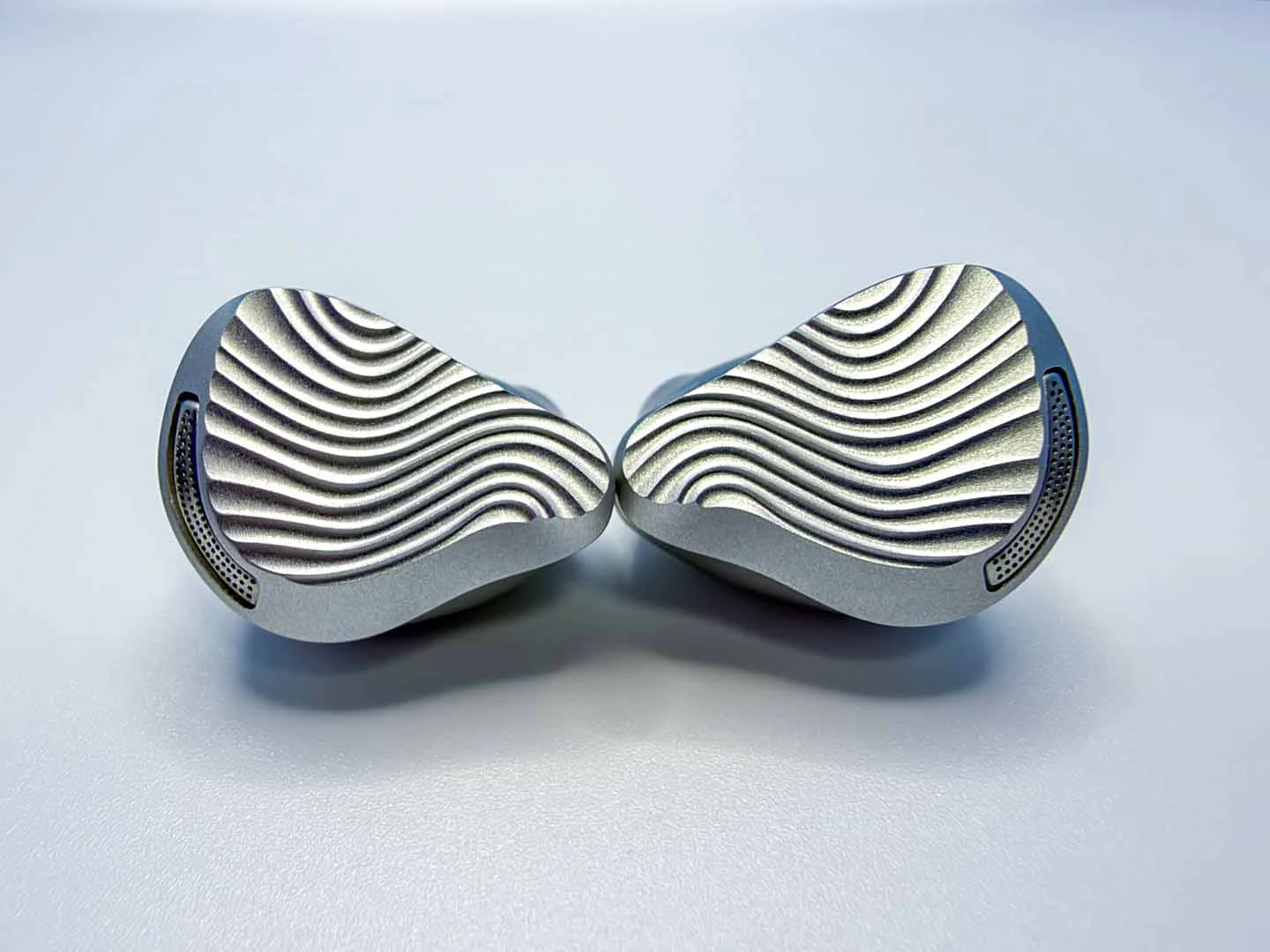
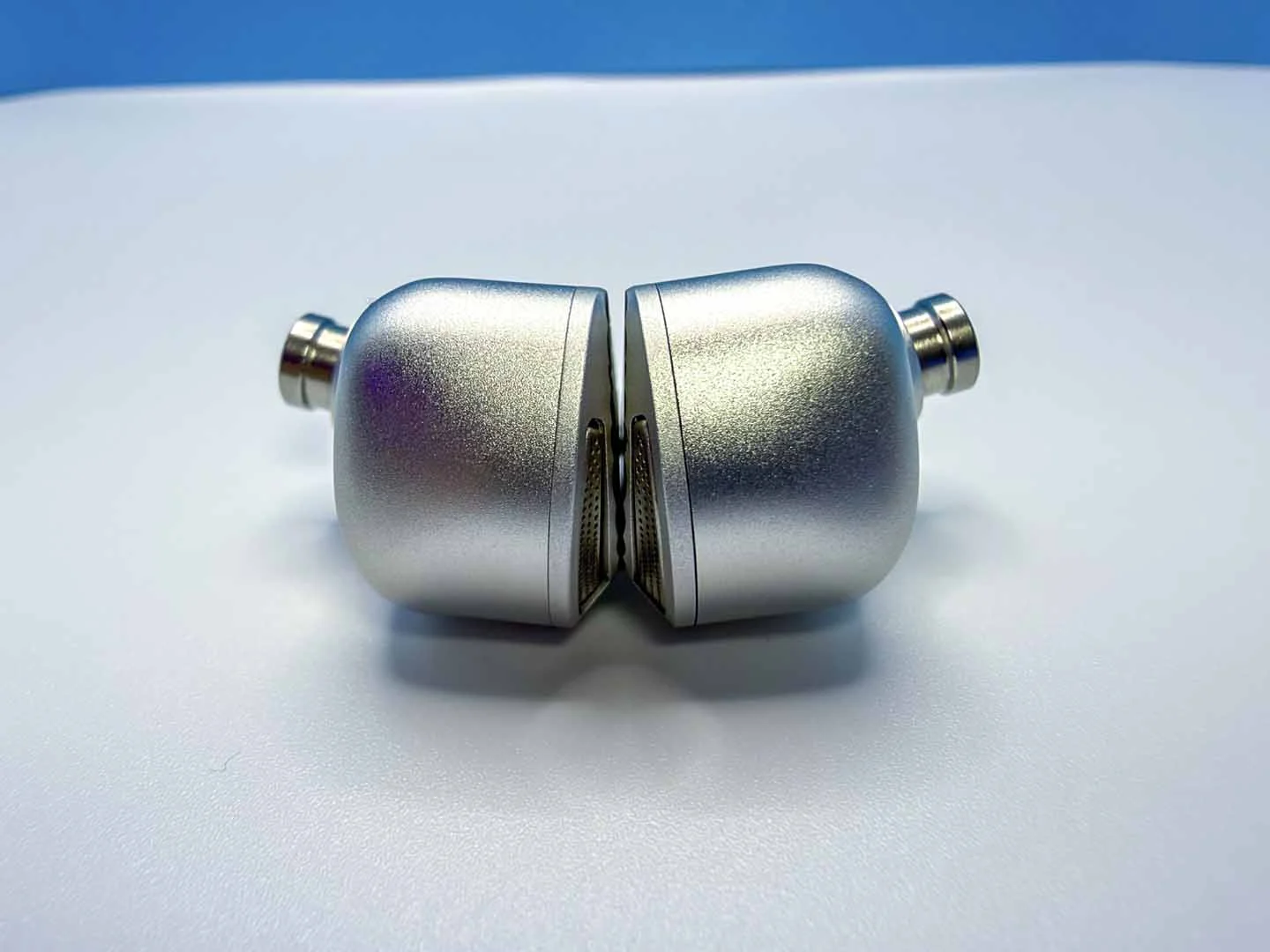
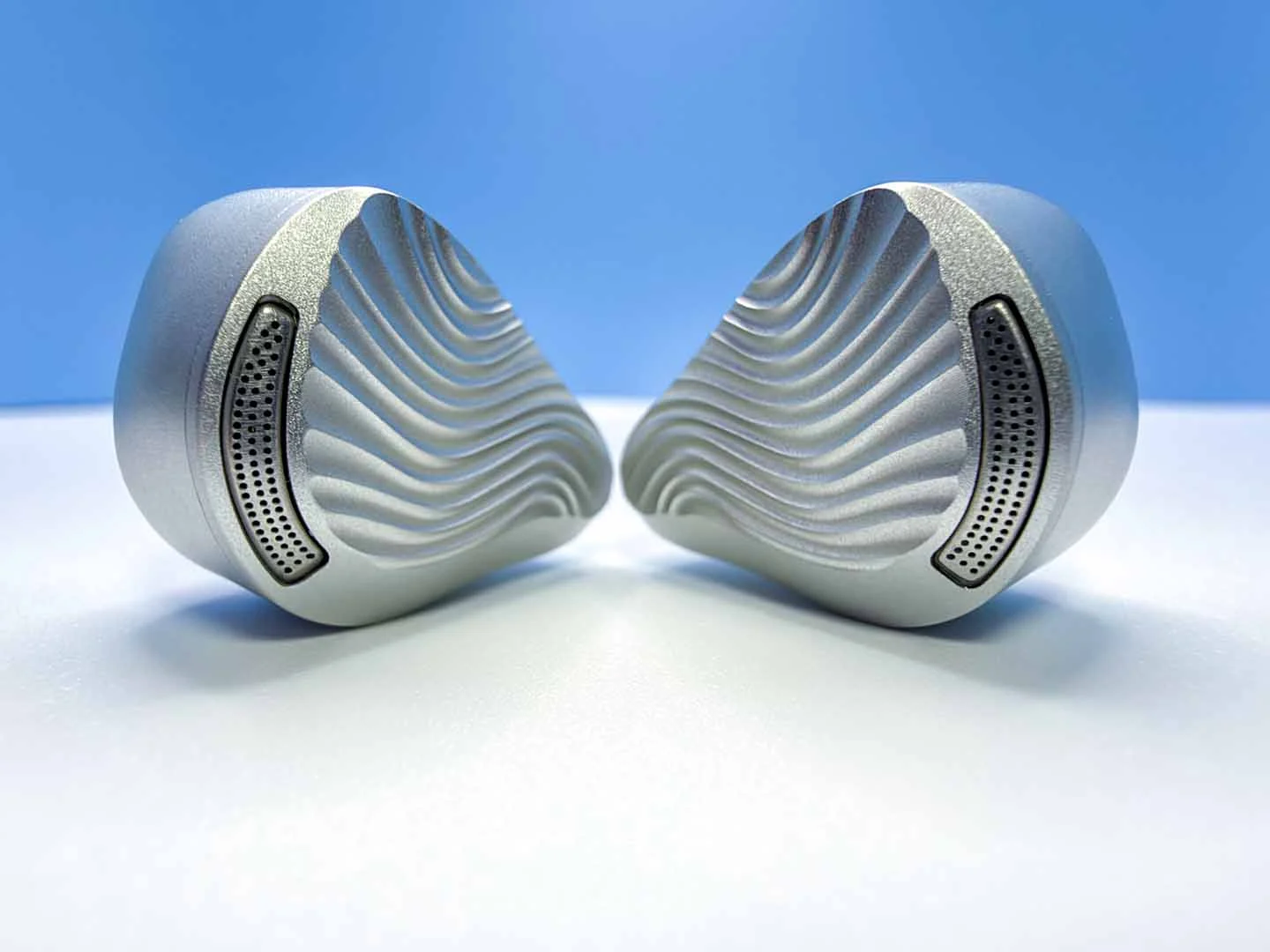
The Seraphim’s CNC-machined aluminum construction gives it a distinctive identity right away. Its metallic surfaces, sculpted geometry, and flowing faceplate details create a deliberate, refined design that feels appropriately sophisticated for its celestial namesake. The etched patterns interact beautifully with the housing’s contours, creating movement without excessive decoration.
The presentation shows wonderful restraint. ZiiGaat could’ve covered the faceplates in enormous wings, glowing halos, and enough religious iconography to decorate a Renaissance cathedral. Instead, the company has chosen a more contemporary design language that suggests elegance and craftsmanship without shouting for attention.
And I appreciate that enormously.
We’ve reached a point in the IEM hobby where impressive sound quality isn’t particularly unusual, even at accessible prices. Physical design, however, remains an important part of the complete ownership experience. An earphone can sound exceptional yet still feel uninspired in the hand, and an elaborate decorative shell can look great in promotional photography but feel less convincing in everyday use.
The Seraphim strikes a more appealing balance. Its metal construction gives the product a premium visual identity, while the clean integration of the faceplates, housings, and acoustic venting makes the design feel cohesive rather than assembled from unrelated ideas.
Of course, metal construction doesn’t automatically guarantee comfort, and I’d never suggest that appearance alone tells us anything about acoustic performance. But there’s something deeply satisfying about a product that shows the same attention to detail on the outside as its designers invested beneath the shell.
The Seraphim is genuinely beautiful, and its appearance is an important part of why I consider the overall package so successful.

📦 Unboxing & Accessories: A Thoughtfully Equipped Angel
At $259, I expect an IEM to offer more than attractive shells and impressive specs. Accessories should support how listeners actually use their equipment, especially when the product targets enthusiasts who may move between portable DACs, digital audio players, and desktop systems.
The Seraphim’s published package includes a detachable cable with interchangeable 3.5mm single-ended and 4.4mm balanced terminations, seven pairs of eartips, a carrying case, and four replacement nozzle filters. That’s a useful selection, especially because the modular cable lets you connect to different source outputs without needing a separate cable.
For someone who regularly moves between listening setups, that kind of convenience matters. I appreciate having the flexibility to use a standard single-ended connection when appropriate and a 4.4mm balanced output when a particular device requires or benefits from that configuration. But let’s avoid the familiar assumption that balanced automatically means better. The acoustic result depends on the equipment, its output characteristics, and the listening conditions, not simply the number of contacts on the plug.
The replacement filters are another thoughtful inclusion because they acknowledge that IEM ownership involves maintenance. Acoustic nozzles and filters are small components, but they’re important to keeping the product usable and performing consistently over time. A carrying case and multiple tip choices are equally practical because comfort, protection, and convenience are parts of the listening experience that don’t appear on a frequency-response chart.
I also like that the accessory selection complements the Seraphim’s premium physical identity without turning the package into an unnecessary exercise in extravagance. The emphasis seems to be on useful equipment rather than decorative items that will spend the rest of their lives in a drawer.
Accessories & Presentation: A complete, practical package that feels appropriate for the price and complements the excellent physical design.
⚙️ Technical Specifications: Five Drivers Beneath Six Wings
The Seraphim combines two 10mm dynamic drivers with three Knowles balanced armatures in each earpiece, creating a five-driver hybrid architecture that divides low-frequency, midrange, and treble reproduction among specialized transducers.
Model: ZiiGaat × Jay Audio Seraphim
Manufacturer: ZiiGaat
Collaboration: Jay’s Audio
Type: Wired hybrid in-ear monitor
Driver configuration: 2 dynamic drivers + 3 balanced armatures per earpiece
Low-frequency drivers: Dual 10mm dynamic drivers in an isobaric arrangement
Published diaphragm construction: PEEK+PU composite
Midrange drivers: 2 × Knowles RAF 32873 balanced armatures
High-frequency driver: 1 × Knowles RAD 33518 balanced armature
Published impedance: 9Ω at 1kHz
Published sensitivity: 105dB at 1kHz
Published frequency response: 20Hz–35kHz
Published total harmonic distortion: 0.75%
Shell construction: CNC-machined aluminum
Earphone connector: 0.78mm 2-pin
Cable terminations: Interchangeable 3.5mm single-ended and 4.4mm balanced
Published accessories: Seven pairs of eartips, carrying case, four replacement nozzle filters, and modular cable
Official listed price: $259 USD
🧪 Isobaric Bass: Two Drivers, One Foundation
The dual-dynamic bass system is one of the Seraphim’s more interesting engineering features. In an isobaric arrangement, two drivers operate as an acoustically coupled system, allowing designers to manage the interaction between the drivers, enclosed air volume, and resulting low-frequency behavior. This approach can be especially interesting in an IEM, where physical space is limited and the relationship between driver movement, acoustic loading, and tuning becomes critical.
But two dynamic drivers don’t automatically produce twice the bass, and an isobaric system doesn’t guarantee superior speed, control, or resolution. The overall acoustic design determines the outcome, and the best evidence comes from understanding what the finished product actually delivers.
In the Seraphim, the result is a strong, enjoyable low-frequency presentation with satisfying mid-bass authority and quick, articulate perceived attack. It’s powerful without becoming overwhelming, exactly the balance I want from an all-rounder.
🧬 Knowles Balanced Armatures: Bringing the Music Together
The remaining three drivers handle the mid and upper frequencies, with two Knowles RAF 32873 units for the midrange and a RAD 33518 for high-frequency reproduction. Balanced armatures let engineers assign specific frequency regions to compact transducers, but combining multiple drivers also requires careful attention to crossover behavior, acoustic damping, phase relationships, and final tuning.
An IEM can contain excellent individual drivers and still sound disjointed if those components aren’t integrated effectively. That’s why I value the resulting cohesion more than the number or reputation of the components themselves.
The Seraphim’s presentation has recognizable low-frequency energy, clean midrange organization, and restrained treble, yet those elements work together convincingly enough that I don’t find myself distracted by the driver configuration during ordinary listening.
Five drivers are an engineering description. The music they produce is what earns the rating.

🎧 Listening Impressions: Devilishly Good by Nature
Here’s where the Seraphim makes its strongest argument, and it’s far more interesting than simply promising impressive bass, exceptional detail, or flagship-inspired performance.
This is a genuinely enjoyable IEM that sounds good without needing a special occasion.
Some earphones make their reputation through one extraordinary characteristic. Perhaps it’s enormous bass that threatens to rearrange your dental work, treble so revealing you can practically hear the recording engineer checking their phone, or a spatial presentation that seems to place an entire orchestra somewhere beyond the physical boundaries of your head.
I love discovering those qualities, but specialization often introduces compromises. An IEM built around tremendous low-frequency energy can sacrifice midrange clarity, while one designed to emphasize detail may become fatiguing. A tuning focused on intimate vocals might make certain recordings sound magical but feel less suited to instrumental arrangements, where balance matters.
The Seraphim takes a different approach, combining enough of those desirable qualities to create a versatile, engaging experience without letting any one element dominate the rest.
Its bass is elevated and satisfying, the midrange stays clean, vocals sit clearly at the center, and the treble shows restraint that makes extended listening particularly appealing. The presentation has convincing width and enough layering to keep individual instruments recognizable, even though it doesn’t create the extraordinary holographic immersion I personally favor.
What makes that combination work is its consistency. I don’t feel that I need to select music specifically suited to the Seraphim’s strengths. It can deliver rhythmic excitement, preserve instrumental clarity, and settle comfortably into less demanding recordings without making its own tuning the center of attention.
And that, to me, is the definition of a successful all-rounder.
Not an IEM that does absolutely everything better than its competitors, but one that does so many things well that I can stop evaluating the equipment and simply enjoy the music.

🌸 Ear Tips & Fit: Finding the Right Seal
A beautiful IEM with a poor fit can become an expensive reminder that human ears don’t come in standardized sizes. With the Seraphim, a comfortable, consistent seal matters especially because much of its musical personality depends on the relationship between its elevated bass and controlled upper frequencies.
The included eartip selection offers several starting points, and I encourage listeners to experiment with them before deciding whether aftermarket tips are necessary. A compromised seal can substantially reduce low-frequency output, leaving an IEM sounding thinner and potentially brighter than its designers intended. Insertion depth and tip geometry can also affect upper-frequency behavior, though the exact result varies with each listener’s anatomy.
For people with smaller ears, shell geometry and nozzle dimensions deserve particular consideration. The Seraphim’s aluminum housings are attractive, but physical beauty doesn’t guarantee a universal fit, and you shouldn’t assume comfort from product photos or another reviewer’s experience.
I prefer a silicone tip that seals reliably without requiring excessive pressure or unusually deep insertion. Once that relationship is established, I can evaluate the intended tuning rather than unknowingly reviewing the effects of a poor fit.
And that’s especially important when judging bass performance, treble comfort, and spatial qualities. A change in seal can alter all three, making it easy to mistake a fit problem for an acoustic design decision.
The Seraphim deserves a proper seal before anyone judges the fire it can produce.
🔬 Frequency Response: The Anatomy of a Controlled Flame
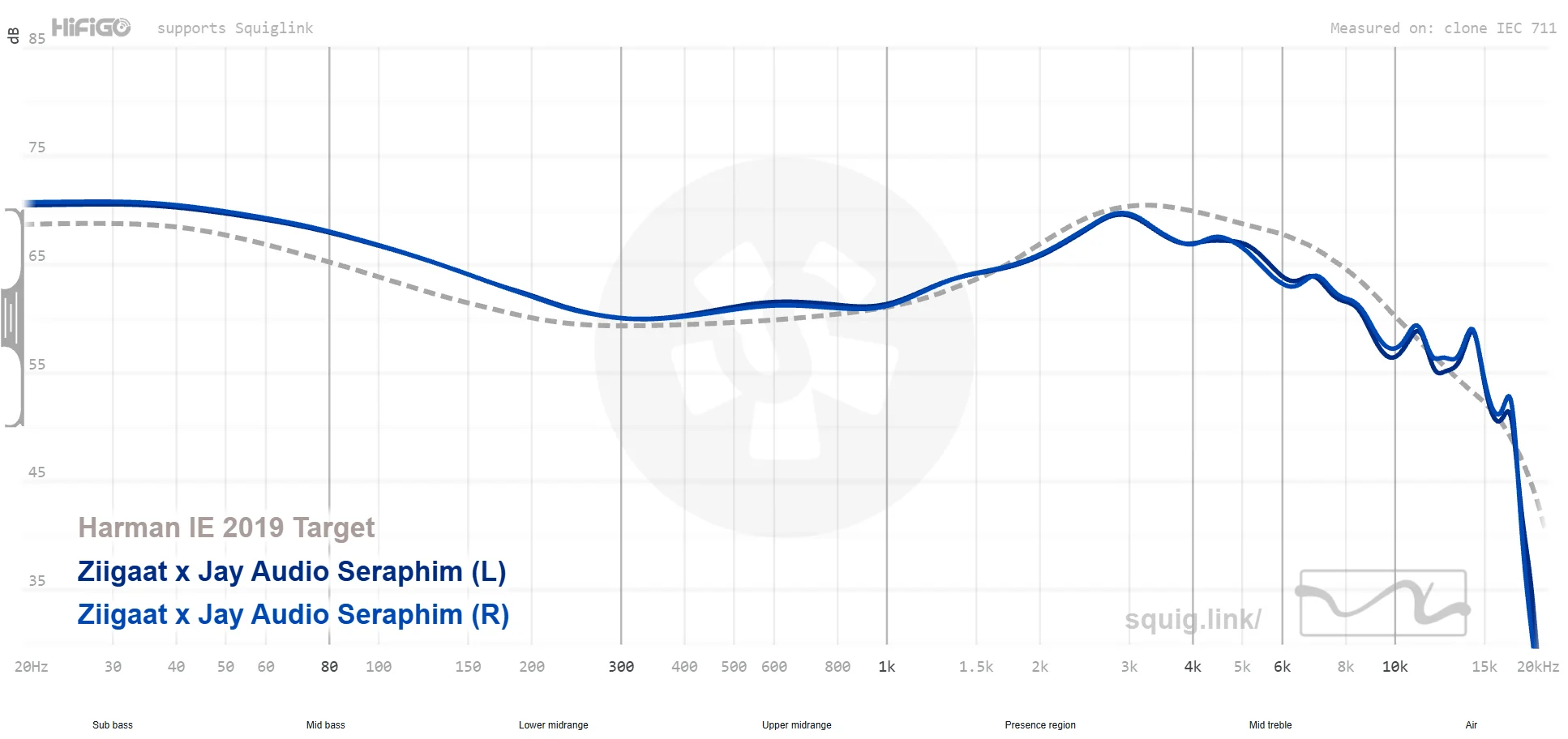
The Super* Review frequency-response measurement offers an interesting window into the Seraphim’s tuning decisions, particularly its generous low-frequency foundation, comparatively restrained lower midrange, and controlled rise through the vocal presence region. As always, I see measurements as useful evidence rather than substitutes for listening, because a frequency-response curve can explain tonal balance without independently establishing imaging, depth, transient performance, or a recording’s emotional character.
The most immediately recognizable feature is the elevated bass shelf, which begins with substantial sub-bass energy and gradually declines through the mid-bass before reaching the lower midrange. This tuning doesn’t try to create excitement through one isolated low-frequency peak. Instead, the broader elevation gives bass instruments and percussion a substantial foundation, which fits the powerful yet controlled presentation I’m hearing.
And importantly, I like that mid-bass elevation. It contributes to the Seraphim’s sense of life and rhythmic authority without making the entire recording feel heavy or congested. The lower-frequency response transitions smoothly into the midrange, helping maintain the cleanliness that keeps vocals and instruments recognizable.
The middle frequencies are comparatively restrained, while the upper midrange rises toward the presence region around 3kHz. That supports vocal intelligibility and instrumental articulation, but it doesn’t automatically make a vocalist sound like they’re floating above the arrangement. In my experience, the Seraphim’s singers remain centered rather than dramatically lifted, and the graph offers some useful context for understanding that tonal relationship.
The treble is where I’d encourage readers to resist drawing conclusions from the curve alone. Visible peaks and dips appear in the upper frequencies, but measurements from IEC 711-style couplers become particularly sensitive to insertion depth, acoustic resonances, and measurement conditions as frequency increases. A peak on a graph doesn’t necessarily correspond to an equally aggressive sensation in every listener’s ears.
And in my ears, the Seraphim’s treble is tame, controlled, and surprisingly comfortable over extended sessions. It supplies enough definition to preserve clarity without making upper-frequency energy the dominant characteristic of the presentation.
The measurement also shows reasonably close left-and-right channel tracking across much of the frequency range, which is encouraging for tonal consistency in the measured sample. That doesn’t prove superior imaging or holographic depth, but it does suggest the measured pair has broadly consistent frequency balance between channels.
Ultimately, the most useful lesson from the graph is how clearly it supports the Seraphim’s larger personality. It has substantial bass energy, clean midrange organization, and enough upper-frequency presence to maintain articulation without needing an aggressive treble presentation.
The measurements help explain the balance. The listening experience tells me why I enjoy it.
Measurement credit: Super* Review, ZiiGaat × Jay Audio Seraphim frequency-response graph, supplied for this review. Results reflect the measured sample and test setup; individual listening experiences may vary.
🥁 Bass: A Little Devil Beneath the Halo
Let’s talk about the bass, because this is one of my favorite things about the Seraphim.
I enjoy bass that gives a recording physical life, whether it’s the impact of a kick drum, the movement of an electric bass line, or the low-frequency foundation supporting a larger instrumental arrangement. But there’s a considerable difference between bass that contributes to the music and bass that insists on becoming the entire performance.
The Seraphim understands that difference beautifully.
Its dual-dynamic system delivers genuine low-frequency authority, and the elevated mid-bass adds satisfying punch and body that keep the overall presentation lively. It has enough presence to make rhythmic music exciting, but the drivers don’t feel like they’re constantly trying to outmuscle every other instrument in the recording.
What particularly appeals to me is the combination of impact and cleanliness. The bass arrives with a quick, articulate attack, giving the percussion satisfying immediacy without letting the low-frequency presentation get unnecessarily thick. It has energy, yet the surrounding musical elements stay easy to follow, making the Seraphim particularly versatile.
That balance also means I don’t feel compelled to reserve this IEM for electronic music, hip-hop, or recordings built around heavy bass. The low frequencies have enough personality to entertain without overwhelming acoustic instruments or making vocal material feel secondary.
There’s a little devil in the bass, certainly, but he’s surprisingly well behaved.
And perhaps that’s the best compliment I can give it. The Seraphim delivers the kind of bass I actively enjoy, not merely tolerate as part of a larger tuning compromise. It’s powerful, engaging, and appropriately controlled, giving music a firm foundation without setting the entire arrangement on fire.
🎤 Lower Midrange: Clean Foundations Without Excess Weight
The lower midrange plays an important role in the perceived body of vocals, guitars, piano, and other instruments, and it’s one of the regions that can make an IEM sound particularly warm, lush, romantic, or comparatively lean. With the Seraphim, ZiiGaat has chosen a cleaner transition from the elevated bass into the central midrange rather than maintaining a thick layer of warmth beneath everything.
That decision makes sense in the context of the overall tuning. The bass retains its authority, while vocals and instrumental textures have enough room to stay recognizable without getting buried under excessive low-frequency energy. The presentation feels organized and articulate, which supports the Seraphim’s ability to handle different styles of music.
Now, anyone familiar with my reviews knows that I have a particular appreciation for rich lower-midrange warmth. I enjoy the resonance of a cello, the body of a male voice, and the wonderfully natural weight of an acoustic guitar when an IEM captures those qualities convincingly. The Seraphim doesn’t make that romantic richness its defining characteristic, and listeners seeking exceptionally lush mids should understand the difference.
But I don’t hear the cleaner foundation as an obvious flaw. It’s part of what keeps the bass lively without dominating the rest of the presentation. The Seraphim makes room for musical energy while keeping the arrangement reasonably balanced.
Not every performance needs velvet. Sometimes a cleaner foundation gives the music exactly the freedom it needs.

✨ Upper Midrange: Vocals That Know Their Place
Here’s one aspect of the Seraphim I want to describe carefully because clarity and vocal lift are often treated as though they’re interchangeable, and they absolutely aren’t.
The Seraphim’s vocals are centered, not elevated.
I love an IEM that creates the sensation of a singer rising above the instrumental arrangement, with an intimacy that makes the voice feel beautifully separated from everything around it. When executed well, that effect can be extraordinary, turning familiar recordings into intensely personal experiences.
The Seraphim takes a more grounded approach. Vocals remain clear, intelligible, and naturally integrated into the musical arrangement rather than consistently projecting forward or floating above the instruments. There’s enough upper-midrange presence to preserve articulation, but the IEM doesn’t seem particularly interested in making every vocalist the star of an enormous imaginary stage.
And that’s an entirely legitimate tuning decision.
In fact, it contributes to the Seraphim’s versatility. When a recording shifts its emphasis from vocals to guitars, percussion, or other instruments, the presentation doesn’t feel constructed around one specific performer. The arrangement stays cohesive, letting the listener appreciate the relationship between musical elements rather than constantly focusing on vocal projection.
That doesn’t mean the Seraphim is a vocal specialist. It isn’t, at least not in the lush, intimate, elevated sense that I personally enjoy. But voices are clearly presented, and I don’t find myself frustrated by their placement.
Sometimes the most convincing angel isn’t the one singing above the choir. It’s the one that understands how beautifully the entire choir can work together.
🌟 Treble & Air: Heavenly Restraint Without the Burn
If there’s one thing I want readers to understand about the Seraphim’s upper frequencies, it’s that I’m not hearing the aggressive treble some impressions describe.
I hear restraint, and I consider that one of the product’s most appealing strengths.
Treble is a delicate balancing act: it adds clarity, articulation, and perceived detail, but too much energy in the wrong region can make an otherwise impressive IEM exhausting. A bright presentation can sound spectacular in a brief demo, especially when familiar recordings suddenly seem filled with tiny details and sharper instrumental outlines. But I don’t always want to live with that initial excitement for hours.
The Seraphim avoids that problem in my listening. Its treble stays energetic enough to keep the presentation clean and lively, but it doesn’t constantly announce itself or push cymbals, strings, and upper-frequency information into the foreground.
And I appreciate that enormously.
The upper frequencies don’t sound muted or lifeless to me, nor do they deprive the presentation of the definition needed to keep musical layers distinguishable. Instead, they operate with a level of discipline that lets the other frequency regions contribute equally to the performance.
This is particularly valuable because the Seraphim already has a substantial bass foundation. Pairing that low-frequency energy with overly aggressive treble could’ve created a more dramatically contrasted presentation, exciting at first but potentially less comfortable over time.
Instead, ZiiGaat and Jay’s Audio have delivered something I can genuinely enjoy during longer sessions.
For an IEM named after celestial beings associated with burning fire, the Seraphim’s greatest treble accomplishment is illuminating the music without scorching the listener.
🎯 Instrument Separation & Placement: Layers That Make Sense
One quality I appreciate about the Seraphim is its ability to preserve recognizable instrumental layers within a musical arrangement. This isn’t necessarily about producing an enormous imaginary space or positioning every musician at some extraordinary distance from the listener. It’s about keeping clarity and organization when multiple elements play together.
And the Seraphim does that well.
Its clean presentation keeps instruments distinct, while the elevated bass adds rhythmic authority without making the rest of the recording feel congested. The mix strikes a satisfying balance between impact and separation, giving the music energy while letting individual elements retain their identities.
The presentation also benefits from convincing left-to-right width, giving those layers room to develop without feeling crowded. Vocals stay centered, while other instruments sit around them in a way that’s easy to follow.
But there’s an important distinction between clearly hearing separate instruments and feeling as though those instruments surround you in a deeply dimensional environment. Separation doesn’t automatically guarantee extraordinary spatial depth, and a wide presentation isn’t necessarily holographic.
The Seraphim demonstrates that difference quite clearly. It keeps musical information organized, but it doesn’t consistently create the illusion of musicians occupying a vast three-dimensional space beyond my ears.
And I’m perfectly comfortable acknowledging both qualities.
Strong layering and clean separation are meaningful accomplishments, even when the presentation isn’t particularly holographic. The Seraphim understands how to organize a musical performance without resorting to exaggerated spatial theatrics.
🌌 Width & Depth: Six Wings Don’t Guarantee Flight
Anyone who’s spent time reading GearZilla Reviews knows that I have a particular weakness for holographic audio. I love when instruments seem to occupy a convincing three-dimensional space, with performers positioned not just from left to right but also at different distances from the listener.
Give me width, depth, and the sensation that the music exists in an environment rather than simply being reproduced between my ears, and I’m usually a very happy Kaiju.
But that’s not quite what the Seraphim delivers.
It’s wide, but it isn’t especially holographic.
The soundstage is wide, and individual instruments have room to establish themselves without crowding the center. The layering is enjoyable, and the presentation doesn’t feel cramped or confined. But I don’t hear the extraordinary front-to-back immersion that makes some IEMs feel as though they’ve opened an entirely new acoustic environment around me.
That’s a meaningful distinction, particularly for listeners who prioritize spatial performance above nearly everything else.
I wouldn’t recommend the Seraphim as a holography specialist, nor would I suggest that its width automatically translates into spectacular depth. If your primary goal is to feel completely surrounded by a recording, you may want to explore other sonic priorities.
But I also don’t believe every IEM needs that particular talent to be excellent. The Seraphim’s width supports its clarity and separation, while its overall proportions keep vocals and instruments in a coherent relationship.
That kind of organization has value, especially when paired with such enjoyable bass and controlled treble.
The Seraphim has six wings in mythology, but this one doesn’t need to fly beyond the heavens to make the music worth hearing. Sometimes, a beautifully organized performance is more satisfying than an exaggerated illusion of space.

🔬 Detail & Resolution: Clarity Without the Magnifying Glass
The Seraphim has a clean, articulate presentation that makes individual musical elements relatively easy to recognize, which is part of why I consider it such a capable all-rounder. Its controlled bass-to-midrange transition preserves clarity, while the upper frequencies provide enough definition to keep smaller instrumental details from disappearing beneath the overall arrangement.
But there’s an important difference between hearing detail clearly and proving that an IEM possesses extraordinary underlying resolution.
Frequency balance can influence how readily we notice particular sounds, and elevated upper-midrange energy can make some information more apparent without necessarily revealing anything that wasn’t already present in the recording. Likewise, strong bass can create a sensation of dynamic richness without establishing superior technical performance in every category.
What I appreciate about the Seraphim is that it doesn’t seem desperate to exaggerate its clarity.
The music remains organized, individual layers stay recognizable, and the presentation maintains enough articulation to feel lively without becoming unnaturally etched. I don’t feel like every recording has been put under a magnifying glass for forensic examination.
And for everyday enjoyment, that’s exactly the balance I want.
The Seraphim gives me enough information to appreciate the recording without making the pursuit of detail more important than the music itself.
🦴 Slam & Dynamics: Power Without Punishment
There’s something wonderfully satisfying about an IEM that can deliver genuine impact without losing control, and this is where the Seraphim’s elevated bass and lively personality come together particularly well.
The low frequencies have enough authority to give rhythm instruments a convincing sense of weight, while the clean overall presentation prevents that impact from overwhelming the rest of the music. It creates excitement without demanding enormous volume or exaggerated treble to feel energetic.
This distinction matters because perceived dynamics aren’t simply about how hard a kick drum hits. The contrast between quieter and louder musical elements, the articulation of percussion, and the ability to maintain clarity when an arrangement becomes busier all contribute to how lively a recording feels.
The Seraphim combines those qualities into an enjoyable, responsive presentation that suits a wide range of music. It doesn’t come across as a dedicated bass cannon, nor does it sound like a restrained monitor that’s afraid to have a little fun.
Instead, it occupies a compelling middle ground where impact supports musical engagement.
There’s a little devil in the low end, but he isn’t allowed to take over the whole performance.
⚡ Speed & Transients: Quick on Its Feet
The Seraphim gives me a clear impression of a quick, articulate attack, especially in the low frequencies. Percussive sounds arrive with satisfying definition, keeping the music responsive and lively without becoming unnecessarily sharp.
But perceived speed deserves careful interpretation. An IEM that sounds quick doesn’t automatically possess objectively faster drivers than another design, and the relationship between frequency response, acoustic damping, transient behavior, and our perception of articulation is more complicated than marketing descriptions sometimes suggest.
Without controlled measurements, I wouldn’t claim that the Seraphim’s dynamic drivers are inherently faster than competing technologies simply because their attacks sound clean.
What I can say is that the Seraphim’s presentation feels responsive, and that responsiveness works beautifully with its elevated mid-bass. Rhythmic passages have an enjoyable sense of immediacy, while the surrounding instruments stay clear enough to avoid turning that energy into congestion.
For a versatile IEM, that’s a meaningful strength. The Seraphim can sound lively and engaging without sharpening every note into something unnaturally aggressive.
That balance is increasingly the defining story of this review.
🎵 Tonality & Timbre: Musical Balance With a Personality
If I had to sum up the Seraphim’s overall character, I’d call it lively, clean, controlled, and confidently musical. It isn’t the warmest or most romantic IEM I’ve heard, nor is it particularly interested in floating vocals above an enormous three-dimensional performance. Instead, it maintains a satisfying relationship between bass authority, midrange clarity, and upper-frequency restraint.
That combination makes it easy to enjoy across different genres.
The elevated mid-bass contributes energy and physicality, while the comparatively clean midrange keeps voices and instruments recognizable. The treble supports articulation without becoming dominant, and the wide presentation offers enough space to maintain separation and layering.
There are trade-offs, certainly. Someone who prioritizes exceptionally rich male vocals, enormous spatial depth, or an especially intimate presentation may find another IEM more closely aligned with those preferences.
But the Seraphim’s appeal isn’t built around one extraordinary quality. It’s built around the complete relationship between its strengths.
And that’s why I keep returning to the word all-rounder.
Not because it sounds generic or lacks personality, but because its personality comes from balance rather than specialization. It’s an IEM that entertains without asking the listener to accept an obvious compromise every time the genre changes.
The Seraphim isn’t trying to become every kind of monster. It’s becoming a remarkably good version of itself.
🎮 Gaming Performance: A Capable Contender Beyond Music
Although my evaluation of the Seraphim centers on music, ZiiGaat and Jay’s Audio also position it as a gaming option. That’s an interesting proposition because several of its acoustic qualities, particularly clear instrumental separation, controlled bass, and articulate perceived attack, also matter for how listeners experience complex game audio.
In competitive games such as VALORANT and Rainbow Six Siege, players rely on subtle environmental information to interpret movement, direction, and activity around them. An IEM that reproduces overlapping sounds cleanly may make that information easier to distinguish, especially when the mix includes explosions, effects, dialogue, and quieter environmental cues. The Seraphim’s ability to maintain recognizable layers despite its elevated bass gives it some promising characteristics in that respect.
But I want to distinguish promising sonic qualities from verified competitive performance. I haven’t established how accurately the Seraphim reproduces positional cues through dedicated gameplay comparisons, and its broad left-to-right presentation doesn’t automatically guarantee superior front-to-back or vertical localization. Those qualities depend as much on the game’s audio implementation, the recording or rendering system, and the individual listener as on the earphone itself.
For cinematic gaming, the equation shifts slightly. Powerful bass, clean dialogue, and convincing separation can contribute to an enjoyable experience even when the sense of space isn’t exceptionally holographic. The Seraphim seems well suited to that balance, though listeners whose primary goal is extraordinary three-dimensional immersion should understand its spatial limitations.
The Seraphim has the ingredients for enjoyable gaming, but my 4.5/5 GearZilla verdict is based on my music-listening experience rather than unperformed competitive gaming benchmarks.
🎛️ Amplification & Source Pairing: Let the Angel Speak for Itself
With a published impedance of 9ω and sensitivity of 105dB at 1kHz, the Seraphim doesn’t demand enormous amplifier power. However, its low impedance deserves attention because the relationship between an IEM and its source can affect performance, especially when the source has relatively high output impedance.
That’s an important consideration for listeners using desktop amplifiers, hybrid tube designs, or older audio equipment. A low-impedance multi-driver IEM may show frequency-response changes when paired with an output that isn’t low enough in impedance, potentially altering the tonal balance in ways that have little to do with an amplifier’s advertised sonic character.
I wouldn’t automatically recommend a powerful desktop amplifier simply because the Seraphim has five drivers, nor would I suggest that switching from 3.5mm single-ended to 4.4mm balanced output guarantees an improvement. The most useful starting point is a clean, low-noise source with suitable output characteristics and enough volume control for comfortable listening.
The Seraphim’s stock tuning is already enjoyable, and I think that’s worth preserving before experimenting with EQ or different amplification paths. Its bass has satisfying authority, the midrange remains clear, and the treble is controlled enough that I don’t feel an immediate need to reshape the response.
Of course, listeners who enjoy EQ have room to experiment. Someone seeking greater vocal prominence might explore modest midrange adjustments, while a listener who prefers less mid-bass energy could reduce that emphasis. But those would be personal changes, not corrections to an inherently unsuccessful tuning.
The Seraphim doesn’t need an elaborate supporting cast to establish its identity. Give it a suitable source, a reliable seal, and some good music, and let the little angel do its thing.

👹 The GearZilla KAIJU DNA Scan: Anatomy of a Celestial Monster
Every Kaiju has a defining personality. Some thrive on brute force, others emphasize speed or technical precision, and a few become favorites because they balance several desirable qualities without turning any one into a liability.
The Seraphim belongs firmly in that last category. Its personality isn’t built around enormous holographic space, spectacular vocal lift, or bass that overwhelms everything in its path. Instead, it combines attractive engineering, convincing musical energy, and excellent physical design into a cohesive experience.
🎯 K • Kill Shot: Versatility Is the Superpower
The Seraphim’s defining strength is its ability to remain enjoyable across different musical styles without constantly reminding me of a particular tuning compromise. It has enough bass to satisfy, enough clarity to preserve instrumental relationships, and enough treble restraint to make longer listening sessions comfortable. That combination may not sound as dramatic as one extraordinary technical accomplishment, but it’s precisely what makes an IEM useful beyond the first few minutes of excitement.
The Seraphim doesn’t need one spectacular trick when so many good ones work together.
🧬 A • Anatomy: Five Drivers, Beautifully Dressed
Beneath those gorgeous CNC-machined aluminum shells sit two 10mm dynamic drivers and three Knowles balanced armatures, supported by an acoustic design that balances low-frequency impact with midrange clarity and treble extension. The engineering is interesting, but what makes the Seraphim memorable is how naturally those elements come together in a cohesive musical presentation.
And the exterior? Absolutely beautiful. This monster looks ready for its close-up.
🦴 I • Impact: Fire With a Firm Hand on the Controls
The bass is powerful, elevated, and genuinely enjoyable, especially in the mid-bass, where it adds rhythmic authority without overwhelming the rest of the arrangement. The attack is quick, the presentation stays clean, and the low frequencies add excitement without becoming the IEM’s entire personality.
A little devil in the bass is a wonderful thing when he knows when to behave.
🎩 J • Joy: The Pleasure of an Excellent All-Rounder
I don’t want to spend every listening session analyzing whether my equipment is technically outperforming something else. Sometimes I want to put on an album, enjoy familiar music, and forget that I’m evaluating a pair of tiny speakers sitting inside my ears.
The Seraphim makes that remarkably easy. Its musical energy, controlled treble, and broad versatility create a listening experience that stays enjoyable without constant adjustment.
🎤 U • Unleashed: An Angel That Knows Its Limits
The Seraphim isn’t particularly holographic, and its vocals don’t rise above the arrangement with the intimate, floating quality I often prefer. Those are meaningful considerations, especially for enthusiasts whose priorities mirror mine.
But those absences don’t erase everything the Seraphim gets right. It simply tells us what kind of IEM we’re listening to.
🦖 The KAIJU Conclusion: Divine by Design, Devilishly Good by Nature
The Seraphim combines excellent craftsmanship, enjoyable bass, clean articulation, centered vocals, and controlled treble into one beautifully balanced package. It doesn’t need to dominate every category to earn a place among the most enjoyable all-rounders I’ve experienced.
Five drivers. Six mythical wings. One beautifully controlled personality.
And that’s a monster worth celebrating.

💰 Value: A Complete Experience for $259
At its official $259 price, the Seraphim occupies a particularly competitive part of the personal-audio market. Numerous hybrid IEMs offer ambitious driver configurations, impressive frequency-response claims, and increasingly elaborate physical designs, so specifications alone aren’t enough to justify a purchase.
What makes the Seraphim compelling is how its engineering, sound, and overall ownership experience work together.
The dual-dynamic bass configuration provides satisfying low-frequency authority, while the Knowles balanced armatures support a clean, articulate presentation that remains enjoyable without excessive treble energy. The beautiful aluminum construction gives the product a premium identity, and the included modular cable adds useful flexibility for listeners moving between different sources.
These qualities don’t exist in isolation. They reinforce one another, creating the impression of a thoughtfully developed product rather than an ambitious driver configuration waiting for the listener to overlook its shortcomings.
Versatility also has meaningful value. A specialist IEM may offer an extraordinary experience with a narrow selection of recordings or musical styles, but an excellent all-rounder can become something you reach for far more frequently. The Seraphim delivers satisfying bass, controlled treble, and clean instrumental separation without demanding a particular genre, making it an appealing primary listening companion.
At $259, the Seraphim earns its price through the complete experience, not just the tech listed on the box.

🦖 GearZilla Scorecard: A Beautiful Balance of Heaven and Hell
The Seraphim’s strongest argument isn’t that it dominates every performance category. It’s that its strengths work together to create a remarkably complete listening experience, supported by physical craftsmanship that makes it feel special before the music even begins. It delivers impressive consistency, with particularly strong bass, controlled treble, and an exceptionally attractive design that elevates the overall ownership experience.
Here’s how this celestial little monster performs across the GearZilla scorecard.
✨ Clarity: 4.5/5 ⭐
The Seraphim delivers an articulate, well-organized presentation that makes each musical element easy to follow. Its bass has satisfying authority without burying the midrange, while the controlled upper frequencies provide enough definition to preserve detail without becoming overly sharp.
🎤 Midrange & Vocals: 4.3/5 ⭐
Vocals remain clearly integrated into the musical arrangement rather than projecting dramatically forward. The Seraphim isn’t designed around the especially lush, elevated vocal presentation I personally enjoy, but its clarity and balance contribute to its versatility.
🥁 Bass: 4.7/5 ⭐
One of my favorite parts of the listening experience. The elevated mid-bass provides enjoyable rhythmic weight, while quick perceived attack and clean separation keep the low frequencies from overwhelming the performance. It’s powerful, energetic, and satisfying without becoming excessive.
🎯 Separation & Placement: 4.5/5 ⭐
Individual instruments remain recognizable within complex arrangements, supported by a clean presentation and convincing lateral organization. The layering feels satisfying, even though the layers don’t necessarily occupy a vast three-dimensional space.
🌌 Width & Depth: 4.0/5 ⭐
The Seraphim spreads music convincingly from left to right, allowing instruments to breathe without making the presentation feel cramped. However, it doesn’t deliver the exceptional front-to-back immersion or holographic dimensionality I personally chase. The width is enjoyable, but the spatial depth doesn’t reach the same level.
🔬 Detail & Resolution: 4.4/5 ⭐
The tuning makes musical information easy to appreciate without sounding artificially etched. It has enough definition to preserve clarity and separation, though I wouldn’t confuse perceived detail with proof of extraordinary underlying resolution.
🌟 Treble & Air: 4.7/5 ⭐
A significant strength and one of the Seraphim’s most enjoyable qualities. Despite reports of a potentially aggressive character, I hear smooth, restrained upper frequencies that add clarity without becoming sharp or fatiguing. This contributes considerably to its long-listening appeal.
🦴 Slam & Dynamics: 4.6/5 ⭐
The bass delivers satisfying impact, while the overall presentation remains energetic and engaging. Its dynamic personality contributes excitement without sacrificing the cleanliness that makes the tuning versatile. The music has plenty of life without the sense that the Seraphim is trying too hard to impress.
🎤 Vocal Lift: 4.0/5 ⭐
Vocals remain centered and intelligible, but they don’t create the floating, intimate presentation that some vocal-focused IEMs deliver. This isn’t necessarily a flaw, although it’s an important distinction for listeners who prioritize vocal immersion.
⚡ Speed & Transients: 4.6/5 ⭐
Percussion and rhythmic elements have an enjoyable sense of immediacy, supported by an articulate, controlled presentation. The Seraphim feels quick and responsive without requiring exaggerated treble to generate excitement.
🎵 Tonality & Timbre: 4.5/5 ⭐
The Seraphim combines a generous bass foundation, clean midrange, and controlled treble into a lively yet approachable personality. It isn’t exceptionally lush or romantic, but the result works beautifully across musical styles. Its greatest tonal achievement is balancing excitement with restraint.
🎛️ Tuning & Pairing Flexibility: 4.5/5 ⭐
The modular cable supports both 3.5mm and 4.4mm connections, and the factory tuning is enjoyable right out of the box. Its broad musical versatility is a major advantage, though source output characteristics still matter given its low impedance.
☁️ Comfort & Fit: 4.2/5 ⭐
The aluminum construction and included eartip selection provide a strong starting point, but individual comfort depends on shell geometry, nozzle fit, and ear anatomy. Listeners with smaller ears should focus on establishing a reliable seal. This is a provisional score pending a more specific assessment of physical comfort during extended wear.
🎨 Design & Build: 4.9/5 ⭐
Absolutely gorgeous. The CNC-machined aluminum shells, elegant styling, and distinctive faceplate detailing give the Seraphim a genuinely premium appearance. ZiiGaat has created something that looks beautifully considered and feels visually worthy of its celestial namesake.
📦 Accessories & Presentation: 4.6/5 ⭐
The modular cable, interchangeable plugs, included eartips, carrying case, and replacement filters make for a practical package built for everyday use, not decorative extras. It’s a thoughtfully equipped offering that complements the premium design.
🎶 Listening Enjoyment: 4.7/5 ⭐
This is where the Seraphim makes its strongest case. Powerful bass, clean articulation, controlled treble, and excellent versatility create a listening experience that stays enjoyable without demanding a perfect recording or a specific genre. It’s an IEM that makes me want to keep listening rather than constantly evaluate what I’m hearing.
💰 Value: 4.6/5 ⭐
At $259, the Seraphim offers a compelling combination of attractive construction, interesting acoustic engineering, useful accessories, and versatile tuning. Its value comes from the complete experience rather than one exceptional specification, making it an appealing option for listeners who want a capable all-rounder.
🧡🦖 Overall GearZilla Score: 4.5/5 ⭐ | Divine by Design. Devilishly Good by Nature.
The ZiiGaat × Jay Audio Seraphim earns a 4.5/5 GearZilla rating by delivering something I value tremendously: a beautifully balanced combination of musical excitement, thoughtful engineering, and exceptional craftsmanship. Its bass has genuine authority, with satisfying mid-bass elevation and quick, clean attack that gives music plenty of life without overwhelming the performance. The treble stays controlled and non-fatiguing, while clear, centered vocals and convincing instrumental layering create an articulate, enjoyable presentation that handles energetic recordings and settles into a long evening of listening with equal ease.
Of course, the Seraphim doesn’t accomplish every sonic trick I personally love. Its presentation is convincingly wide but not especially holographic, and its vocals remain grounded rather than rising above the arrangement with the intimate, floating quality I often chase. Those are meaningful distinctions, but they don’t diminish what ZiiGaat and Jay’s Audio have accomplished. My preferences aren’t a universal standard for great sound, and the Seraphim’s strength lies in its ability to deliver an engaging, versatile experience without relying on one spectacular characteristic to justify its existence. It’s an excellent all-rounder precisely because so many of its qualities work beautifully together.
And then there’s the physical craftsmanship, which deserves just as much recognition as the sound. The gorgeous CNC-machined aluminum shells, elegant detailing, and thoughtful accessories make the Seraphim feel genuinely premium, inside and out. At $259, the complete experience is compelling, especially for listeners who want a capable IEM that moves comfortably between genres without demanding constant adjustments or special treatment.
The 4.5/5 rating reflects the complete GearZilla experience, not a mathematical average of individual performance categories. Sound quality, versatility, design, listening enjoyment, and overall value all contribute to the verdict, and the Seraphim earns its recommendation through the remarkable consistency of those strengths. It isn’t perfect at everything, and it doesn’t need to be. What makes it special is how confidently it balances power with restraint, excitement with comfort, and technical capability with genuine musical enjoyment.
Heavenly craftsmanship. A little devil in the bass. And enough musical soul to keep this Kaiju smiling.
Great inside. Great outside. Divine by Design. Devilishly Good by Nature. 🦖🎧

🦖 Final Roar: Divine by Design. Devilishly Good by Nature.
There’s something wonderfully appropriate about an IEM named after the burning ones finding its greatest strength in restraint. In biblical tradition, the seraphim are extraordinary celestial beings whose six wings represent more than flight. Their imagery combines immense power with reverence, humility, and purposeful action. Four wings serve a purpose beyond flight, and I find that balance particularly fascinating when I consider the ZiiGaat × Jay Audio Seraphim. After spending time with this little celestial creature, I’ve come to appreciate that its most impressive accomplishment isn’t how much it can unleash, but how confidently it knows when enough is enough.
The bass provides a perfect example. It has genuine low-frequency authority, with an elevated mid-bass presence that gives music satisfying punch, movement, and rhythmic energy. I enjoy that elevation, particularly because it contributes excitement without overwhelming the rest of the performance. The attack feels quick, the presentation stays clean, and instruments retain enough separation to keep the music organized even when the arrangement gets more demanding. This isn’t a bass specialist attempting to demolish everything in its path. It’s an IEM that understands how low-frequency energy can support musical enjoyment without becoming a distraction.
And then there’s the treble, which I consider one of the Seraphim’s most appealing qualities. I’ve seen descriptions suggesting its upper frequencies can get aggressive, but that hasn’t been my experience. To my ears, the treble is controlled, articulate, and surprisingly comfortable during extended listening. There’s enough definition to keep recordings lively, but the upper frequencies never seem determined to dominate every performance. That balance matters enormously because I want to enjoy my music without constantly wondering whether the next cymbal crash will make me reach for the volume control. The Seraphim gives me clarity without punishment, and I genuinely appreciate that.
Of course, it doesn’t pull off every sonic trick I love. Vocals remain centered rather than beautifully lifted above the arrangement, and while the presentation offers convincing width and enjoyable instrumental layering, it doesn’t create the deeply holographic environment that makes certain IEMs feel almost supernatural. I love those experiences, and I won’t pretend the Seraphim delivers them simply because I admire the rest of its performance. But I also don’t believe an IEM needs extraordinary spatial depth or exaggerated vocal intimacy to be genuinely excellent. The Seraphim’s strengths lie elsewhere, particularly in its ability to bring satisfying musical energy, clean separation, and controlled treble together without forcing the listener to compromise too much elsewhere.
That’s what makes it such an effective all-rounder. Some IEMs specialize in enormous bass, others emphasize spectacular detail, and a few build their identities around extraordinary spatial presentation. Those approaches can be wonderful, but they’re not always what I want when I’m simply looking to enjoy an evening of music. The Seraphim doesn’t demand a particular genre or recording to reveal its strengths. It stays lively, articulate, and engaging across styles, letting me appreciate the performance rather than constantly evaluate the equipment reproducing it. That kind of versatility carries a quiet confidence, and I think it deserves considerable recognition.
Then we have the physical package, where ZiiGaat has delivered something genuinely beautiful. The CNC-machined aluminum construction, sculpted details, and refined metallic appearance give the Seraphim a premium identity that feels appropriate for its celestial namesake. The modular cable and thoughtful accessories add practical value, making the ownership experience feel complete rather than merely decorative. I appreciate a product that demonstrates genuine attention to both its acoustic engineering and physical execution, and the Seraphim succeeds on both fronts. Great inside. Great outside. Sometimes, the most meaningful accomplishment is delivering a complete experience without an obvious weak link demanding forgiveness.
And that’s why the Seraphim earns its 4.5/5 GearZilla rating. It isn’t the most holographic IEM I’ve experienced, nor does it deliver the especially lush, elevated vocals I sometimes crave. But its powerful bass, quick attack, clean presentation, tame treble, and extraordinary versatility make it a wonderful companion for the music I enjoy. It’s an IEM that knows its strengths, understands its limitations, and doesn’t need to exaggerate either to make a convincing impression.
Perhaps the greatest compliment I can offer is that the Seraphim makes it easy to stop thinking about the technology. Five drivers, an isobaric bass system, and three Knowles balanced armatures are certainly interesting engineering accomplishments, but they’re not why I keep enjoying the experience. I enjoy it because the music sounds lively, controlled, and satisfying. The bass gives me something to smile about, the treble doesn’t wear me out, and the overall presentation stays engaging without making me overlook an obvious sonic problem.
In the end, the Seraphim’s name may invoke heavenly grandeur, but its personality has a wonderfully mischievous side. There’s a little devil in the bass, plenty of life in the music, and enough discipline throughout the presentation to keep everything beautifully under control. It doesn’t need to transport me into the heavens to earn my appreciation.
It simply needs to make the music worth staying for.
And the Seraphim does that beautifully.
✅ Buy If
- You want a genuinely versatile IEM that performs well across genres without relying on one specialized sonic characteristic.
- You enjoy powerful, elevated mid-bass with satisfying punch that doesn’t overwhelm the rest of the recording.
- You appreciate quick, articulate attack and a clean, lively presentation.
- You prefer controlled, non-fatiguing treble that supports long listening sessions.
- You value clear, centered vocals and recognizable instrumental layering.
- You enjoy convincing left-to-right width without requiring enormous holographic dimensions.
- You appreciate beautiful aluminum construction and a premium physical design.
- You want practical modular connectivity with interchangeable 3.5mm and 4.4mm plugs.
- You want a complete IEM package around $259 that balances sound quality, craftsmanship, and everyday enjoyment.
⛔ Consider Another IEM If
- Your highest priority is an exceptionally holographic presentation with expansive front-to-back depth.
- You want intimate, elevated vocals that consistently float above the instrumental arrangement.
- You prefer a particularly lush, warm, romantic midrange with substantial vocal body.
- You want a dedicated bass cannon rather than powerful, controlled low-frequency energy.
- You prefer an ultra-analytical presentation with a more aggressive emphasis on upper frequencies.
- You have smaller ears and need a particularly shallow or narrow nozzle fit, no experimentation required.
- You expect a specific specialist performance characteristic to dominate every listening session.
🛒 Ready to Meet the Seraphim?
There’s something wonderfully satisfying about an IEM that knows exactly what it wants to be, and the ZiiGaat × Jay Audio Seraphim makes a compelling case for getting the fundamentals right instead of chasing one extraordinary sonic achievement. Its powerful, elevated mid-bass brings genuine energy to the music, while its quick attack, clean presentation, and controlled treble create an enjoyable balance between excitement and long-term comfort. Vocals remain nicely centered, instruments have room to breathe, and the wide presentation offers satisfying layering without pretending to deliver an enormous holographic environment.
What makes the Seraphim particularly appealing is how naturally those qualities work together. It doesn’t demand a particular musical genre, an elaborate supporting system, or the perfect recording to reveal its personality. Instead, it offers a confident, versatile experience that feels equally comfortable delivering rhythmic energy, instrumental clarity, or an evening of relaxed listening. Gorgeous aluminum construction and practical modular accessories complete the package, making this an IEM that feels thoughtfully executed inside and out.
At $259, the Seraphim earns its 4.5/5 GearZilla rating by delivering an engaging, beautifully controlled experience that stays enjoyable long after the initial excitement of a new product fades.
Ready to feel a little heavenly fire?
Explore the ZiiGaat × Jay Audio Seraphim at Linsoul
Heavenly craftsmanship. A little devil in the bass. And enough musical soul to keep this Kaiju smiling.
Pick your monster and Listen Bigger! 🦖🎧
Share This Story, Choose Your Platform!