



Five Settings. One Simple Slide. Finally, an Impedance Adapter That Doesn’t Require a Toolbox.
🎧 TimeEar TEC-Ω: Sometimes Innovation Is Simply Eliminating the Annoying Stuff
I’ve spent years experimenting with impedance adapters, from individual connectors offering fixed resistance values to adjustable devices that require a miniature screwdriver to change their settings.
They all worked.
And every single one of them managed to frustrate me in some way.
Fixed-resistance adapters meant carrying multiple connectors and physically swapping them out whenever I wanted to experiment with different resistance levels. Adjustable alternatives consolidated those options into a single device but introduced another inconvenience: keeping track of a ridiculously small screwdriver.
Folks, I’m trying to enjoy my music, not repair a Swiss watch.
That’s what makes the TimeEar TEC-Ω Adjustable Audio Impedance Adapter such a refreshing discovery.
TimeEar hasn’t necessarily reinvented the science behind impedance adaptation. Instead, it’s addressed something that previous implementations consistently overlooked.
The user experience.
By integrating five selectable resistance settings into a single device with an intuitive sliding selector, TimeEar has eliminated much of the frustration associated with traditional impedance adapters. Simply move the slider to your desired resistance setting, adjust your listening volume accordingly, and get back to enjoying your music.
No swapping individual connectors. No hunting for miniature screwdrivers. No unnecessary interruptions to the listening experience.
And perhaps most importantly for someone like me who regularly uses balanced audio equipment, TimeEar offers 4.4mm balanced connectivity.
That alone deserves some serious appreciation.
I genuinely love this little accessory. It’s one of those rare products that immediately makes you wonder why everyone else hasn’t been doing it this way all along.
In fact, the only thing keeping it from earning a perfect GearZilla rating is that it lacks both 3.5mm and 4.4mm female output connections on the same device.
Give me that flexibility, TimeEar, and you’ve got yourself a 5.0.
Until then, this little monster will have to settle for an exceptionally well-deserved 4.8/5.

✅ Standout Strengths & Considerations
✅ Standout Strengths
Exceptionally convenient tool-free impedance adjustment; five clearly labeled resistance settings; intuitive five-position sliding selector; native 4.4mm balanced connectivity; passive operation requiring no batteries or software; eliminates the need to carry multiple fixed-resistance adapters; excellent utility for IEM reviewers and enthusiasts; potential to reduce audible background hiss and improve volume-control flexibility with sensitive IEMs; and a refreshingly practical approach to analog sound experimentation.
⛔ Considerations
The absence of both 3.5mm and 4.4mm female outputs on the same device limits its universal compatibility. Higher resistance settings reduce the signal level reaching the connected IEMs, potentially requiring additional amplification headroom. Changes in tonal balance depend on the electrical characteristics of the connected earphones, meaning results won’t be identical across different driver configurations. For me, however, the missing dual-output configuration is the only meaningful design shortcoming.

🤝 Disclosure: The Truth Behind the Roar
I bought the TimeEar TEC-Ω with my own money after trying my friend Dileep’s unit firsthand. Having used several different impedance adapters over the years, I was immediately impressed by TimeEar’s approach to convenience and functionality. Needless to say, Dileep sold me on this little accessory.
My evaluation focuses on functionality, design, connectivity, ease of adjustment, versatility, and how effectively the TEC-Ω addresses the practical shortcomings I’ve encountered with competing accessories.
Manufacturer specifications provide technical context where appropriate, but my observations and ratings reflect my independent, firsthand experience. TimeEar didn’t provide this product, compensate me, or have any editorial involvement in this review.
My responsibility is to the reader, not the manufacturer. Although in this particular instance, I might owe Dileep a little credit for encouraging another addition to my audio collection.
Listen first. Figure out the story later.
🎧 The GearZilla Review Perspective: Convenience Is an Underrated Audio Upgrade
Anyone who’s followed GearZilla Reviews knows how much I enjoy experimenting with personal audio equipment.
Whether it’s swapping ear tips, exploring different DAC architectures, comparing amplification options, or investigating how different accessories interact with my favorite IEMs, I’m fascinated by the relationships between the individual components of an audio system.
But one practical consideration doesn’t always get enough attention in audiophile discussions.
How much effort does it take to actually enjoy the technology?
An accessory can accomplish everything its manufacturer promises and still become frustrating enough that you eventually stop using it.
That’s particularly relevant with impedance adapters.
I’ve never questioned whether they serve a legitimate purpose. The electrical principles are well established, and adding resistance to an audio chain can produce meaningful changes depending on the connected equipment.
My frustration has always been with the implementation.
I want to explore different resistance settings without dismantling my listening setup, digging through accessory cases, or reaching for specialized tools.
For this evaluation, I approached the TEC-Ω less as a sound-enhancement accessory and more as a problem-solving tool.
Does it make impedance experimentation easier, more accessible, and more enjoyable?
Absolutely. That’s why it earns such a high score.
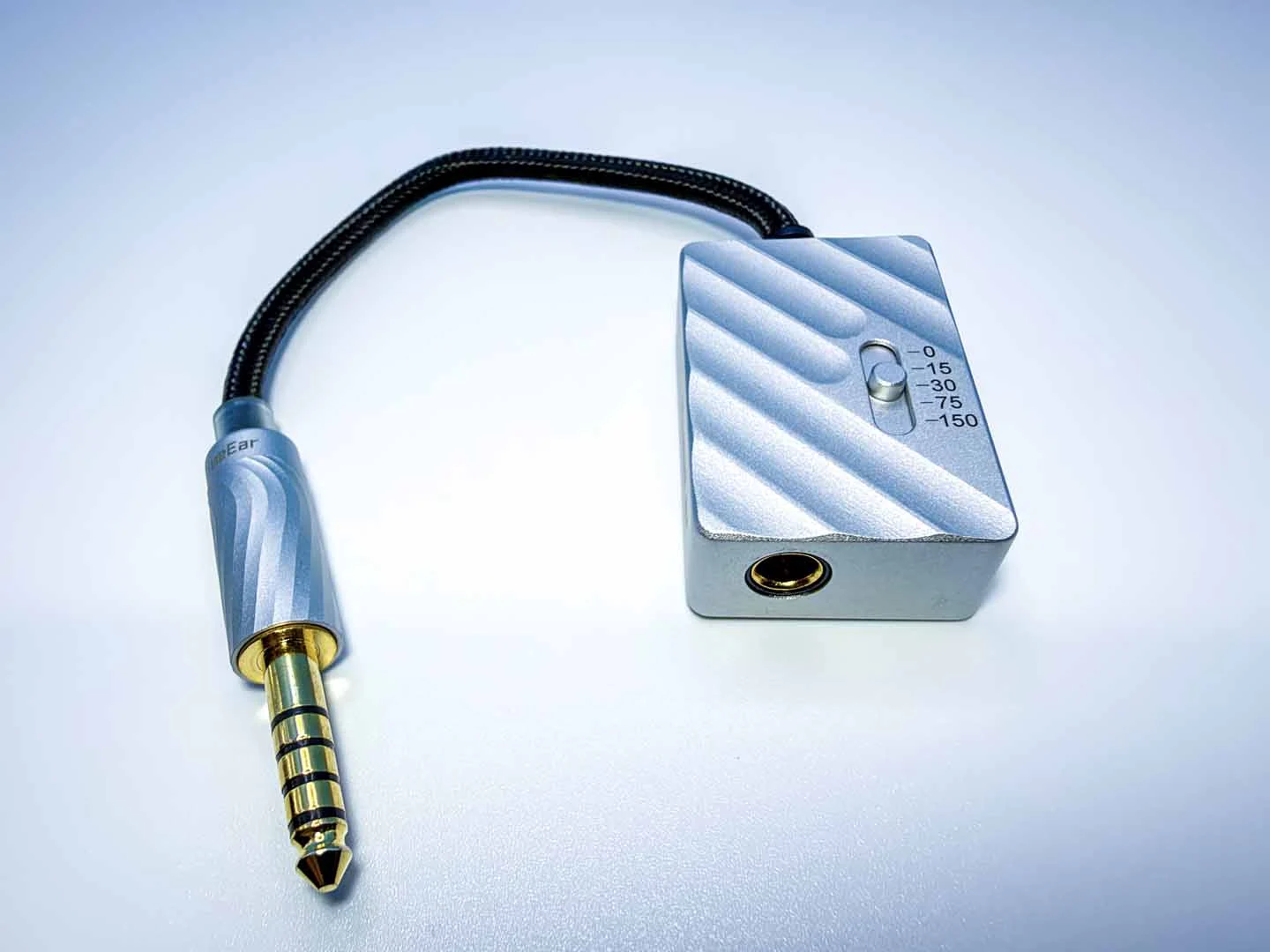
📖 The Story Behind the Find: My Growing Collection of Tiny Inconveniences
The traditional impedance adapter is a remarkably straightforward accessory.
You buy a connector with a specified resistance value, insert it between your audio source and earphones, and add resistance to the signal path.
Simple enough.
But what happens when you want to experiment with another resistance value?
You need another adapter.
Before long, you’re accumulating a collection of little connectors, each serving a slightly different purpose. They’re effective, but they introduce unnecessary friction into the listening experience.
Adjustable impedance adapters seemed like the obvious solution.
And electrically, they were.
Unfortunately, the adjustable versions I’ve used previously required a small screwdriver to manipulate their resistance controls.
Now, I appreciate precision engineering as much as the next audio enthusiast, but there’s something inherently ridiculous about reaching for a screwdriver while listening to Leon Bridges.
It also makes experimentation less spontaneous. Instead of simply exploring another setting, you’re managing an additional tool and interrupting the experience.
TimeEar approaches the same problem from an entirely different usability perspective.
Put the adjustment directly in the listener’s hands.
Make it accessible.
Make it intuitive.
And for the love of all things audiophile, leave the screwdriver in the garage.
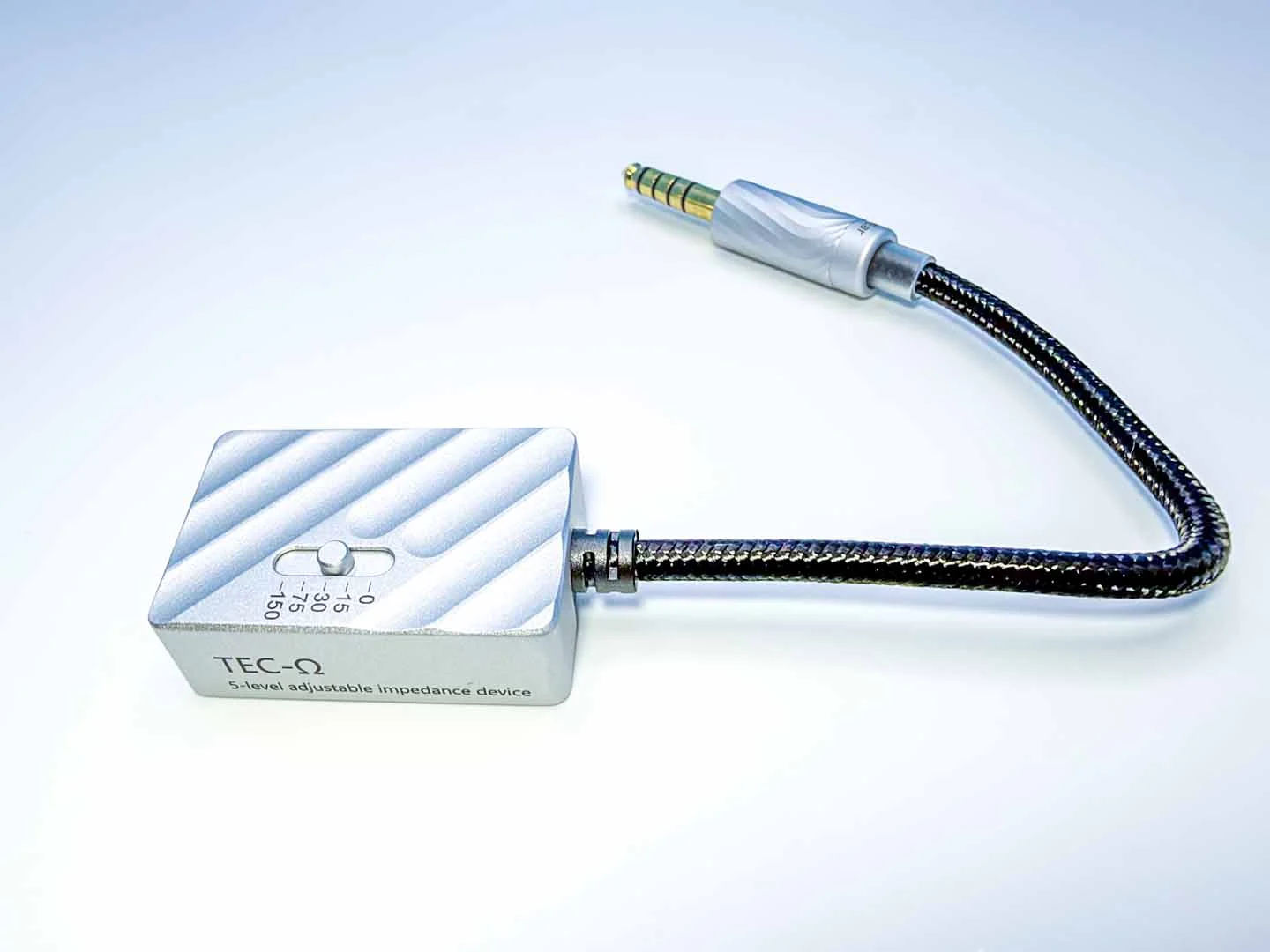
🎨 Design & Craftsmanship: Sliding Into Genius
The defining feature of the TEC-Ω isn’t an exotic material, a proprietary audio algorithm, or some revolutionary electrical discovery.
It’s that beautifully simple five-position resistance slider.
TimeEar has taken a function that previously required swapping connectors or manipulating recessed controls with a miniature screwdriver and made it accessible through a single, externally mounted sliding selector.
The five resistance positions are clearly marked on the housing: 0ω, 15ω, 30ω, 75ω, and 150ω. Simply move the small metal slider to the desired position to select the corresponding resistance.
There’s no guesswork, no screwdriver, and no collection of individual adapters to manage.
I also appreciate the industrial design. The metallic enclosure features an attractive diagonal sculpted pattern, complemented by a matching connector housing, black braided cable, and gold-colored connection points. It’s a surprisingly handsome little accessory for something designed around such a fundamentally utilitarian purpose.
Rather than burying the adjustment mechanism inside the housing, TimeEar has made it a defining visual and functional element.
That sounds almost embarrassingly simple.
But simple solutions are often the most satisfying.
I also appreciate that TimeEar hasn’t limited the concept to traditional 3.5mm single-ended connectivity. With a native 4.4mm balanced configuration available, the TEC-Ω fits naturally into the increasingly common balanced ecosystem of portable DAC/amps, digital audio players, and desktop listening equipment.
For enthusiasts who’ve invested in balanced IEM cables, that matters.
I don’t want to rebuild my cable configuration simply to experiment with impedance, and I certainly don’t want to abandon my preferred connection standard because an accessory manufacturer hasn’t accommodated it.
The TEC-Ω recognizes how contemporary audio enthusiasts actually use their equipment.
And that’s a significant part of its appeal.
⚙️ Technical Specifications: 5 Settings, One Accessory
Manufacturer: TimeEar
Model: TEC-Ω
Category: Adjustable audio impedance adapter
Resistance settings: 0Ω, 15Ω, 30Ω, 75Ω and 150Ω
Adjustment mechanism: Tool-free, five-position sliding resistance selector
Available connector configurations: 4.4mm male to 4.4mm female; 3.5mm male to 4.4mm female
Available cable lengths: 10cm and 40cm
Operation: Passive analog resistance adjustment
External power required: None
Official listed price: $39.90
Pricing and connector configurations are sourced from TimeEar’s official product listing, with resistance settings corroborated by published product coverage.
Instead of carrying five separate adapters, you’ve consolidated those options into one device.
🔬 Understanding Impedance: What Are We Actually Adjusting?
Before I explain why I enjoy the TEC-Ω so much, it’s worth explaining what an impedance adapter actually does.
Impedance describes the opposition an electrical circuit presents to an alternating current. It’s measured in ohms (Ω), and in headphones and IEMs, it influences how the transducer interacts with the amplifier supplying its signal.
An impedance adapter introduces additional electrical resistance between the source and the connected earphones.
That can have several practical consequences.
🔇 Managing Background Hiss
Highly sensitive IEMs can reveal background noise from certain amplifiers, particularly equipment designed to accommodate more demanding full-size headphones.
You might hear a faint hiss during quiet passages or when no music is playing.
Introducing additional resistance can attenuate that noise before it reaches the earphones, potentially creating a quieter perceived background.
However, this doesn’t mean the adapter is actively filtering noise or improving the amplifier’s underlying circuitry. It’s reducing the electrical signal reaching the IEM, including certain unwanted noise.
🎚️ Improving Volume-Control Flexibility
Some sensitive IEMs reach comfortable listening levels with very little amplifier output.
That can leave listeners operating within a frustratingly narrow portion of their volume control, particularly with powerful desktop equipment or analog amplifiers.
Additional resistance can provide more usable adjustment range by reducing the signal reaching the earphones.
For enthusiasts who regularly move between sensitive IEMs and demanding headphones, that’s a potentially valuable capability.
🎵 Exploring Changes in Tonal Balance
Here’s where things get particularly interesting.
An IEM’s impedance isn’t necessarily consistent across the entire frequency spectrum. Different drivers, crossover networks, and electrical configurations can produce varying impedance characteristics.
Adding resistance can affect how much signal reaches the earphones at different frequencies.
The result can be an audible change in frequency response.
Some IEMs may become warmer. Others may become brighter. Some may exhibit relatively little tonal change beyond reduced volume.
Multi-driver balanced armature and hybrid designs can be particularly interesting candidates for this kind of experimentation because of their potentially complex impedance curves.
The important distinction is that an impedance adapter doesn’t apply a predetermined EQ curve.
The resulting sound depends on the relationship between the adapter, the amplifier, and the connected earphones.
That’s part of what makes the TEC-Ω such an intriguing tool for enthusiasts.
You’re not simply selecting a bass boost or treble reduction. You’re exploring how different electrical relationships influence the equipment you already own.
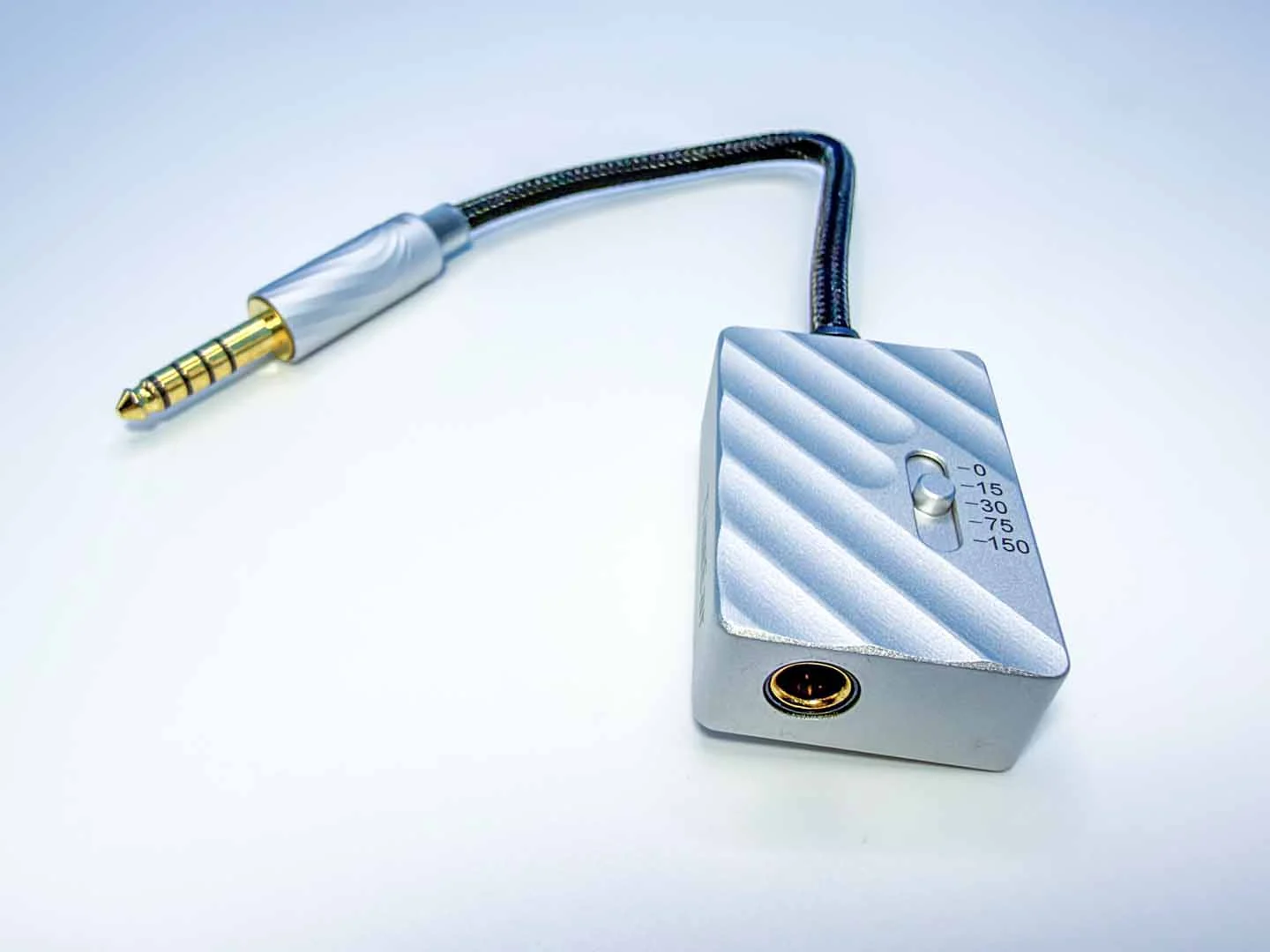
🎛️ 5 Resistance Settings: An Analog Playground for Audiophiles
TimeEar provides five clearly labeled resistance settings through a single, intuitive sliding selector, ranging from nominal passthrough at 0Ω to substantial attenuation at 150Ω.
Instead of carrying four individual fixed-resistance adapters, the TEC-Ω consolidates them into one compact device, with the added convenience of a 0ω reference position. Simply move the metal slider to the desired setting, and you’re ready to explore a different electrical relationship between your source and IEMs.
0Ω: Establishing Your Reference
With the slider in its uppermost position, the nominal 0Ω setting provides a listening reference with minimal intended additional resistance.
This is particularly useful because you can return to your IEM’s baseline presentation without physically removing the TEC-Ω from your audio chain. It’s essentially your starting point for experimentation.
15Ω: A Little Resistance Goes a Long Way
Slide down to 15ω, and you’re adding a relatively modest amount of resistance compared with the other available settings.
Depending on the IEM, this may provide useful attenuation, tame audible background hiss, or shift tonal balance without demanding as much additional amplifier output as the higher settings.
30Ω: Exploring the Middle Ground
Moving the slider to 30Ω introduces a more substantial electrical change, particularly when paired with low-impedance IEMs.
This is a good place to explore how different driver configurations and crossover networks respond to higher source resistance. Depending on the IEM’s impedance characteristics, changes in bass, midrange, or treble balance may become more apparent.
75Ω: Getting Serious About Attenuation
Moving further down to 75ω adds considerably more resistance, which may be particularly useful with highly sensitive IEMs or powerful amplification equipment.
Expect a more substantial reduction in signal level and potentially greater changes in tonal balance, depending on the connected IEM’s impedance curve. Adequate amplifier headroom becomes increasingly important at this setting.
150Ω: Maximum Resistance
At the bottom of the slider’s travel sits the maximum 150Ω setting, providing the most substantial attenuation and potentially the most pronounced interaction with frequency-dependent IEM impedance characteristics.
This isn’t necessarily a setting every listener will need, but I absolutely appreciate having it available. The beauty of the TEC-Ω is that curiosity doesn’t require purchasing another adapter.
🎚️ Slide, Adjust, Listen, Repeat
What makes these five settings so compelling isn’t simply their availability. It’s how effortlessly TimeEar lets you access them.
Each resistance value is clearly marked alongside the sliding selector, eliminating the guesswork associated with screwdriver-adjustable alternatives. You don’t need to disconnect cables, swap adapters, or keep track of miniature tools.
For meaningful listening comparisons, I recommend matching playback volumes between settings, since increased resistance reduces the signal level reaching your IEMs. Always lower your amplifier’s volume before moving the slider, especially when transitioning from higher-resistance settings back toward 0ω, to avoid unexpected loudness spikes.
Four resistance adapters, one passthrough position, and a single sliding control. TimeEar has transformed impedance experimentation from an inconvenience into something genuinely enjoyable.
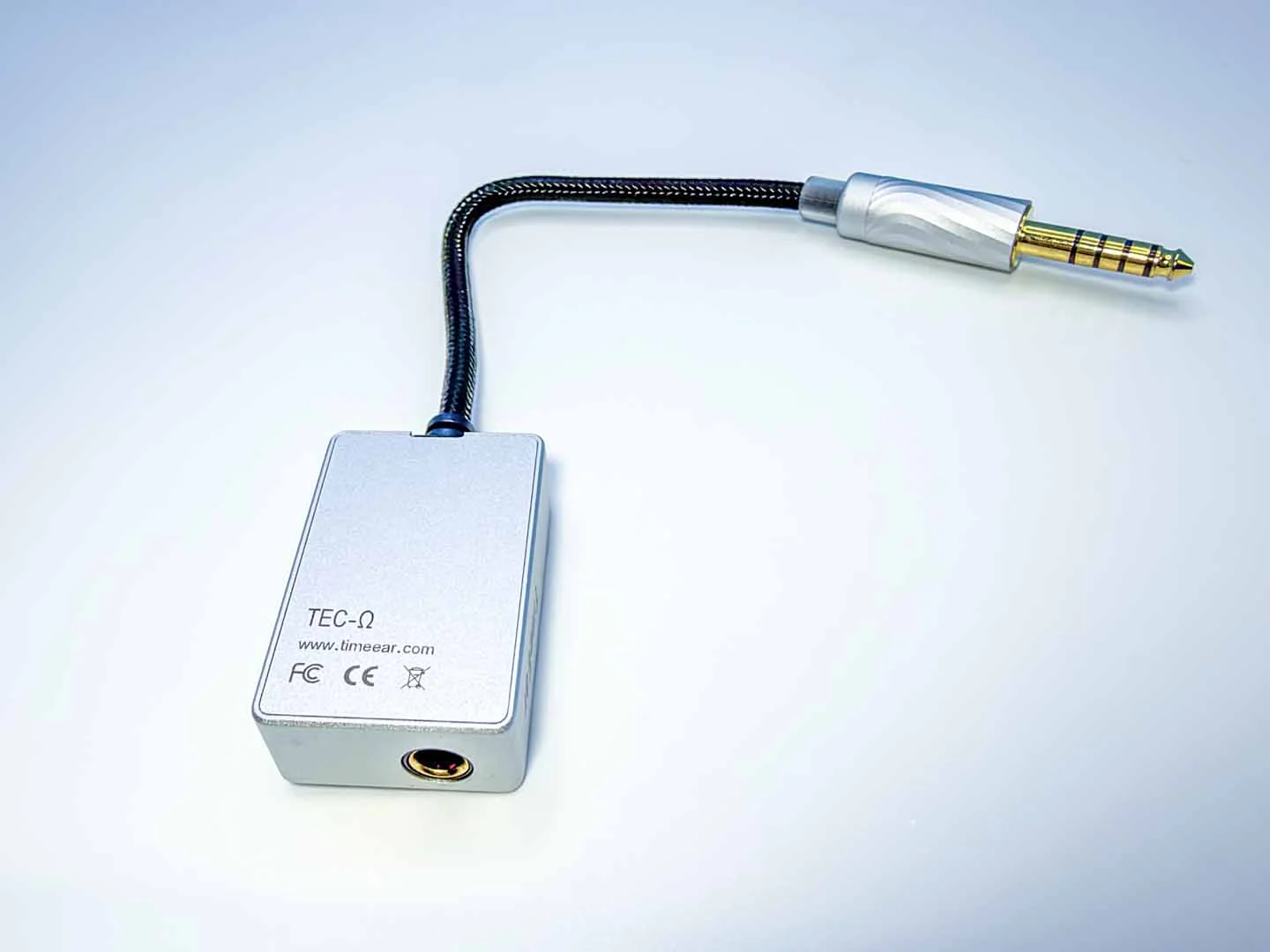
🎯 Real-World Performance: More Listening, Less Fiddling
The TEC-Ω’s greatest accomplishment becomes apparent when you consider how traditional impedance adapters interrupt the listening experience.
With fixed-resistance adapters, experimentation means disconnecting your equipment, locating another adapter, reconnecting everything, and adjusting the volume.
With screwdriver-adjustable devices, you’re introducing an entirely different set of inconveniences.
TimeEar eliminates much of that unnecessary interaction.
One slider. Five clearly marked positions. No additional tools.
Having the resistance adjustment readily accessible makes exploring different configurations feel like a natural extension of using your audio equipment. I can select a different resistance value without physically dismantling my listening chain or searching for another accessory.
And if I want to return to my nominal reference setting, I simply move the slider back to 0Ω after reducing the playback volume.
That’s the convenience I’ve been missing from every previous impedance adapter I’ve used.
🔌 Balanced Connectivity: TimeEar Understood the Assignment
One of my biggest frustrations with many impedance accessories has been their emphasis on traditional 3.5mm single-ended connections.
There’s nothing inherently wrong with 3.5mm connectivity, and balanced operation doesn’t automatically guarantee superior sound quality.
But much of my personal audio equipment utilizes 4.4mm balanced connections, and I appreciate accessories that accommodate my existing setup without requiring unnecessary cable changes.
TimeEar offers the TEC-Ω in two configurations:
| Source connection | IEM connection |
|---|---|
| 4.4mm balanced male | 4.4mm female |
| 3.5mm single-ended male | 4.4mm female |
The second configuration is particularly interesting because it allows earphones terminated in 4.4mm to connect to a conventional 3.5mm source.
Of course, connecting to a single-ended source doesn’t magically create balanced amplification. The source remains single-ended regardless of the connector used on the earphone side.
Still, that flexibility is welcome.
For me, the native 4.4mm balanced configuration is one of the strongest reasons to recommend the TEC-Ω.
It’s also what brings this accessory tantalizingly close to a perfect GearZilla score.
🛠️ One Missing Connection: So Close to Perfection
TimeEar, if you’re reading this, I’ve got one request.
Give us both 3.5mm and 4.4mm female output connections on the same device.
That’s it.
That’s my biggest criticism.
The current design works beautifully for enthusiasts using 4.4mm-terminated cables, but anyone regularly moving between balanced and single-ended IEM cables would benefit from having both output options available.
A properly engineered dual-output configuration would make the TEC-Ω an even more universal accessory, particularly for reviewers and collectors who frequently rotate between different earphones.
Obviously, incorporating both connections would require appropriate electrical isolation or switching to protect balanced source equipment. This isn’t something that should be accomplished by simply tying the outputs together.
But as a future design refinement, I’d absolutely love to see TimeEar explore it.
The company has already solved my biggest frustrations with previous impedance adapters.
One more thoughtful improvement, and I’d have virtually nothing left to complain about.
And where’s the fun in that?
💰 Value: Nearly $40 to Eliminate an Entire Category of Annoyance
At its official listed price of $39.90, the TEC-Ω occupies an interesting position within the personal audio accessory market.
But that comparison becomes less compelling when you want access to multiple resistance values, particularly if you’re looking for balanced connectivity.
The TEC-Ω consolidates five selectable settings into one accessory, eliminating the need to purchase, organize, transport, and exchange multiple connectors.
Unlike some audiophile accessories whose value depends on hard-to-substantiate promises of sonic improvements, the TEC-Ω offers clearly identifiable functionality.
You know what it’s designed to accomplish.
You can explore its effects yourself.
And you can decide whether a particular setting benefits your listening experience without committing to another purchase.
For me, that’s a compelling proposition.
The value isn’t simply in the resistance settings themselves.
It’s in how easily TimeEar lets me access them.
For an enthusiast who enjoys experimenting with IEMs, that’s money well spent.

👹 The GearZilla KAIJU DNA Scan: The Resistance Rebel
Every audio monster has its own personality, and the TEC-Ω’s DNA reveals something I particularly appreciate: thoughtful engineering that solves real-world frustrations without introducing unnecessary complexity.
🦴 K • Kill Shot: Look, Ma, No Screwdriver
The TEC-Ω’s defining achievement is making adjustable impedance genuinely convenient. Its intuitive five-position sliding selector eliminates the need to swap fixed-resistance adapters or use miniature screwdrivers to manipulate recessed controls. It’s a remarkably simple improvement that fundamentally transforms the accessory’s usability.
🧬 A • Anatomy: Five Positions, One Clever Little Monster
The selectable 0Ω, 15Ω, 30Ω, 75Ω, and 150Ω settings offer substantial flexibility within one passive analog device. The sculpted metallic enclosure, braided cable, clearly labeled sliding selector, and native 4.4mm balanced connectivity combine purposeful design with everyday practicality.
🥁 I • Impact: Rediscover the Equipment You Already Own
From potentially reducing audible background hiss and improving volume-control flexibility to exploring changes in tonal balance, the TEC-Ω opens another avenue for musical discovery. It’s an affordable way to experiment with your existing IEM collection rather than immediately reaching for your wallet to purchase something new.
✨ J • Joy: Slide, Adjust, Listen, Repeat
The TEC-Ω removes the unnecessary frustrations that accompanied my previous impedance adapters. There’s something genuinely satisfying about moving a simple slider and exploring another resistance setting without dismantling your listening setup. TimeEar has made experimentation feel like entertainment rather than a maintenance project.
🛡️ U • Unleashed: One Connection Away From Perfection
The only significant improvement I’d request is incorporating both 3.5mm and 4.4mm female output connections into a single, properly engineered device. That additional flexibility would make an already outstanding accessory even more universally useful and elevate it from an impressive 4.8/5 to a perfect 5.0.
KAIJU DNA Verdict: A brilliantly practical little analog monster that proves meaningful innovation doesn’t always require reinventing technology. Sometimes, it simply takes a manufacturer recognizing what frustrates enthusiasts and designing those frustrations out of existence.
Resistance isn’t futile. Inconvenience is extinct.

🦖 GearZilla Scorecard: Almost Zero Resistance to Recommending This One
The TimeEar TEC-Ω is one of those accessories that earns my appreciation not through extravagant marketing promises, but through thoughtful execution. It addresses a longstanding frustration with impedance adapters and makes a useful technology considerably more approachable.
Here’s how this little monster earns its 4.8/5 GearZilla rating.
🎨 Design & Aesthetics: 4.8/5 ⭐
The sculpted metallic enclosure, matching connector housing, braided cable, and clearly labeled five-position resistance slider create an attractive, purposeful design. The externally accessible sliding mechanism is the centerpiece of the experience, giving users immediate control without additional tools. It’s a handsome little accessory that successfully balances aesthetics with practicality.
🛠️ Build & Craftsmanship: 4.8/5 ⭐
The integration of selectable resistance and balanced connectivity demonstrates a thoughtful approach to designing a specialized audio accessory. TimeEar has prioritized practical functionality over unnecessary complexity, and I appreciate the execution.
🎯 Functionality: 5.0/5 ⭐
This is where the TEC-Ω absolutely shines. Consolidating four fixed-resistance values and a nominal 0Ω passthrough setting into one intuitive, tool-free sliding mechanism directly addresses my biggest frustrations with traditional impedance adapters. TimeEar took something that already worked and made it considerably more enjoyable to use.
🧩 Practicality & Versatility: 4.5/5 ⭐
Exceptional everyday convenience, with particularly welcome support for 4.4mm balanced connectivity. However, the absence of both 3.5mm and 4.4mm female outputs on the same device is the only thing standing between this accessory and perfection. Give me both connections, and this category earns a perfect score.
💰 Value & Long-Term Appeal: 4.9/5 ⭐
At $39.90, the TEC-Ω provides tremendous utility for enthusiasts who regularly experiment with IEMs and source equipment. It replaces multiple fixed-resistance adapters and eliminates the need for adjustment tools, making it an exceptionally worthwhile addition to an audio accessory collection.
🧡🦖 Overall GearZilla Score: 4.8/5 ⭐ | Resistance Without the Resistance
I’ve used enough impedance adapters over the years to appreciate just how refreshing the TimeEar TEC-Ω is.
The traditional fixed-resistance adapters worked. The screwdriver-adjustable alternatives worked, too. But neither approach delivered the combination of functionality and convenience I wanted.
TimeEar finally got it right.
Five selectable resistance settings, tool-free adjustment, passive operation, and native 4.4mm balanced connectivity make the TEC-Ω an exceptionally appealing accessory for anyone who enjoys experimenting with personal audio equipment.
It doesn’t promise to magically transform every IEM into something better. Instead, it provides a practical tool for exploring how different electrical relationships influence the listening experience.
And it makes that exploration considerably more enjoyable.
The only thing standing between this accessory and a perfect GearZilla score is the absence of both 3.5mm and 4.4mm female outputs on the same device.
Give me that additional flexibility, and this thing earns a 5.0 without hesitation.
For now, 4.8/5 reflects how thoroughly TimeEar has impressed me with such a seemingly simple accessory.
The overall score reflects my complete user experience rather than a mechanical average of the individual evaluation categories.
🔥 The Final Roar: Finally, an Impedance Adapter That Doesn’t Impede My Enjoyment
There’s something particularly satisfying about a manufacturer recognizing that a product category doesn’t necessarily need new technology. It just needs someone to rethink how people interact with it.
That’s what TimeEar has accomplished with the TEC-Ω.
Impedance adapters aren’t new. Adjustable impedance adapters aren’t new. Even balanced impedance adapters aren’t new.
But consolidating four fixed-resistance values and a nominal 0Ω passthrough setting into a single device with an intuitive, tool-free sliding selector?
That’s the kind of thoughtful innovation I appreciate.
No more rummaging through a collection of individual adapters. No more miniature screwdrivers. Just slide to your desired resistance setting, make a quick volume adjustment, and explore your favorite IEMs again.
The TEC-Ω also represents something I love about this hobby. You don’t always need to spend hundreds or thousands of dollars on new equipment to find another avenue for musical exploration. Sometimes, a clever little $39.90 accessory can give you an entirely different perspective on the equipment you’ve already invested in.
Whether you’re investigating background hiss, looking for more manageable volume adjustment, or simply curious about how your favorite IEMs respond to additional resistance, the TEC-Ω makes that experimentation remarkably accessible.
The native 4.4mm balanced connectivity makes it even more appealing, and the only thing keeping it from earning a perfect GearZilla score is the lack of a dedicated 3.5mm female output.
At 4.8/5, the TEC-Ω earns an enthusiastic recommendation and a permanent place in my audio accessory collection. TimeEar didn’t reinvent impedance adjustment. It simply removed the inconveniences that made me reluctant to use it.
And for someone who genuinely enjoys experimenting with personal audio, it’s a wonderfully practical addition to my audio toolbox.
Metaphorically speaking, of course.
Because thanks to TimeEar, I can finally leave the actual toolbox alone.
Resistance isn’t futile. Inconvenience is extinct.
👥 Who Should Buy It, and Who Shouldn’t?
👍 Buy It If: You’re an IEM enthusiast who enjoys experimenting with source impedance, regularly evaluates different driver configurations, uses sensitive IEMs with powerful amplifiers, or wants to consolidate multiple fixed-resistance adapters into one convenient accessory. It’s particularly attractive if your existing equipment utilizes 4.4mm balanced connections.
⛔ Skip It If: You’re perfectly satisfied with the electrical relationship between your current source and earphones, primarily use 3.5mm-terminated IEM cables without a suitable adapter, or expect guaranteed improvements in sound quality regardless of the equipment connected. If precise, frequency-specific adjustments are your primary objective, parametric EQ may be a better tool.
🦖 Ohm Sweet Ohm: A Little Resistance Goes a Long Way
The TimeEar TEC-Ω doesn’t reinvent impedance adjustment.
It reinvents the experience.
Five resistance settings, one intuitive sliding selector, and native 4.4mm balanced connectivity make this one of my favorite practical audio accessories.
TimeEar, add that second output connection and we’ll talk about perfection.
Until then, this little monster has earned a formidable 4.8/5.
Resistance isn’t futile. Inconvenience is extinct.
🎧 Listen Bigger!
🛒 Product Link: TimeEar TEC-Ω Adjustable Audio Impedance Adapter
Share This Story, Choose Your Platform!