


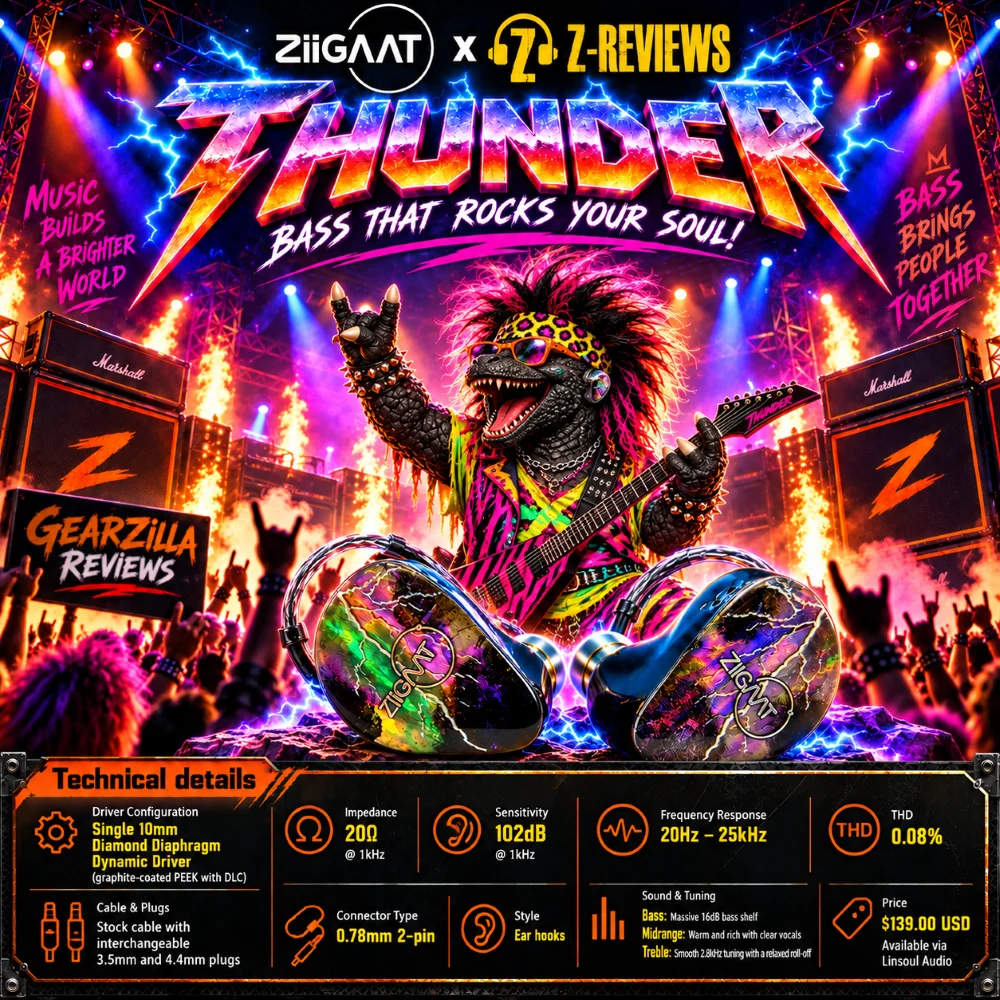
Is the ZiiGaat × Z Reviews THUNDER Worth Buying?
Absolutely! The ZiiGaat × Z Reviews THUNDER is a gloriously unapologetic $139 basshead IEM that combines enormous low-frequency impact, impressive speed, rich male vocals, and the kind of single-dynamic-driver cohesion that makes music feel alive. Built around a 10mm diamond-like carbon (DLC) composite dynamic driver and an aggressive 16dB bass shelf, this collaboration delivers a muscular, energetic tuning designed for listeners who believe music should be experienced, not merely analyzed.
What impressed me most wasn’t the amount of bass. With THUNDER and Zeos involved in the tuning, I expected plenty of low-frequency fireworks. What surprised me was how well the driver handles speed, how naturally the frequency ranges work together, and how beautifully this set reproduces male vocals. There’s plenty of slam, but the presentation never feels like an exercise in low-frequency excess for its own sake. The treble has enough lift to balance the bass without getting unnecessarily aggressive, while the midrange adds the warmth and body that make rock, blues, soul, and hip-hop especially enjoyable.
And then there’s the design. Those gorgeous iridescent faceplates look like they belong beneath the neon lights of the Sunset Strip in 1986, surrounded by leather pants, teased hair, screaming guitars, and enough hairspray to create its own environmental emergency. The visual personality is pure ’80s excess, but the sound travels well beyond glam metal. From David Lee Roth wailing over Eddie Van Halen’s guitar work to Metallica’s relentless thrash and the booming rhythmic foundations of classic Beastie Boys and Run-D.M.C., the THUNDER seems built for music with attitude.
✅ Pros: Enormous bass impact, excellent speed and rhythmic control, cohesive single-dynamic-driver presentation, outstanding male vocal richness, satisfying guitar and drum reproduction, beautiful iridescent faceplates, exceptional comfort for smaller ears, modular 3.5mm and 4.4mm cable, generous accessories, and excellent value at $139.
⛔ Cons: Treble lacks crystalline clarity and exceptional upper-frequency air, the substantial bass shelf won’t appeal to neutral listeners, analytical detail retrieval and spatial layering aren’t its primary strengths, and the familiar resin construction may leave enthusiasts wishing for more adventurous acoustic materials.
🎸 Welcome to the Sunset Strip, Circa 1986
Close your eyes and imagine walking down the Sunset Strip in 1986. Neon signs blaze over legendary clubs, leather jackets and teased hair fill the sidewalks, and someone wears zebra-print spandex that probably violates several local ordinances. The air is thick with hairspray, cigarette smoke, and the unmistakable promise of rock-and-roll excess. Outside the Whisky a Go Go, a crowd is forming, and inside, guitars scream, kick drums pound, and a vocalist prepares to launch himself across the stage.
The Sunset Strip was home to bands like Mötley Crüe, Ratt, Poison, Dokken, W.A.S.P., and L.A. Guns, all helping define a scene where bigger was better, and subtlety rarely made the guest list. Van Halen helped establish the California hard-rock blueprint years earlier, and David Lee Roth’s flamboyant vocals and outrageous stage presence remain inseparable from that larger-than-life era.
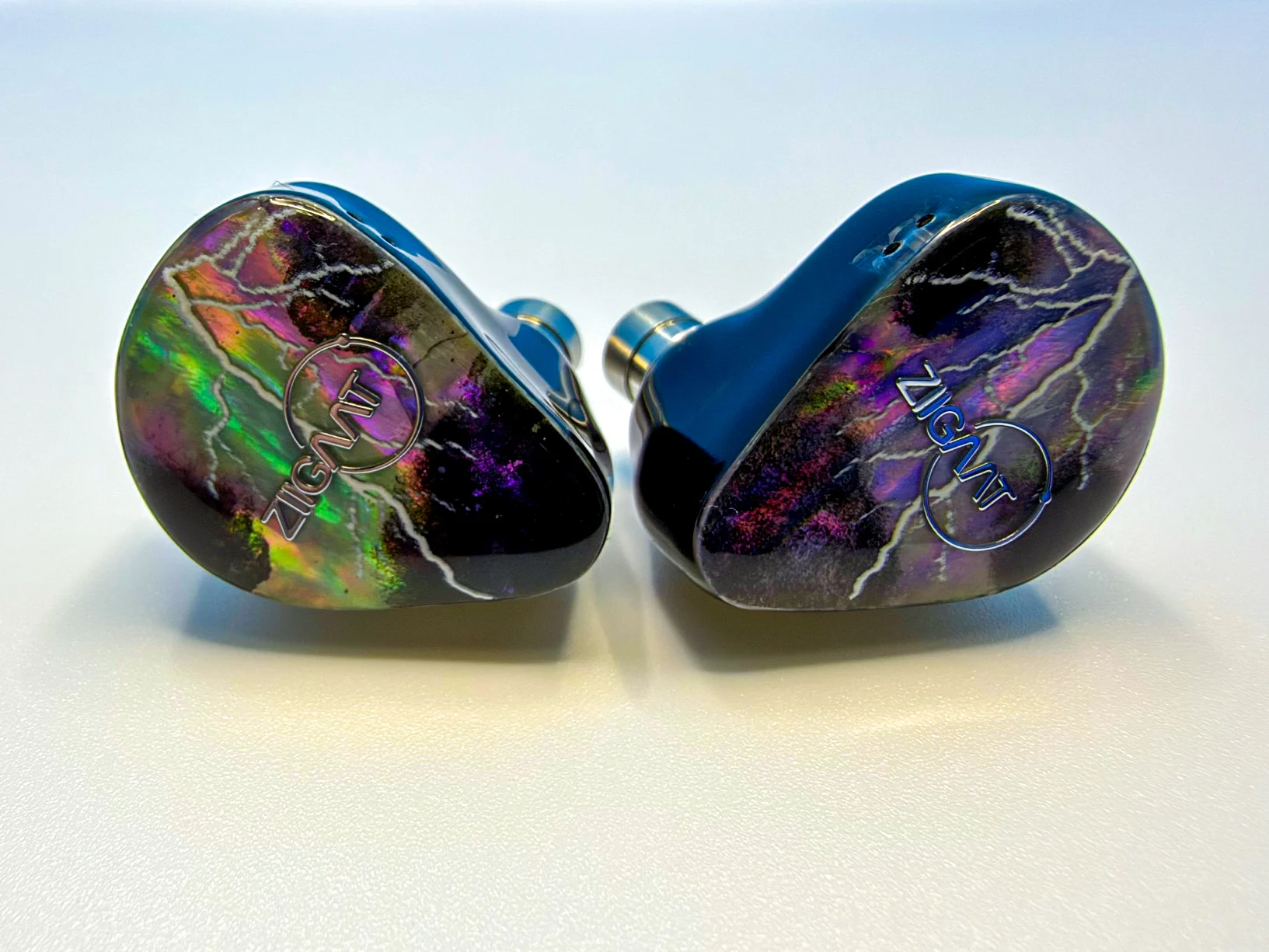
That’s the world I immediately thought of when I saw the ZiiGaat × Z Reviews THUNDER. Its faceplates shimmer with electric greens, purples, pinks, and golds, interrupted by lightning-like streaks that look lifted from an extravagant 1980s album cover. Then I started listening, and the connection became even stronger. The enormous bass foundation, explosive rhythmic energy, thick guitars, and rich male vocals give the THUNDER the same larger-than-life personality as the music that defined that era.
But the longer I listened, the more I realized the THUNDER’s musical identity extends well beyond the Sunset Strip. This tuning also feels at home with Metallica’s aggressive precision and the rhythmic swagger of classic 1980s hip-hop. The Beastie Boys combined rock attitude with booming beats, Run-D.M.C. redefined the relationship between rap and rock, and artists like LL Cool J, Eric B. & Rakim, and Public Enemy built an entirely different kind of musical revolution.
Different genres, different musical cultures, but a common thread: energy, attitude, rhythm, and impact.
The THUNDER isn’t wearing a tuxedo to an audiophile listening session. It shows up in spandex, plugs into a wall of Marshall amplifiers, and asks who’s ready to rock. Then somebody drops a Beastie Boys record, and the party gets even better.
🦖 Disclosure
Huge thanks to James, Rosie, and the team at Linsoul for letting us review the ZiiGaat × Z Reviews THUNDER!
I genuinely appreciate the opportunity to explore a collaboration that brings such a distinctive, bass-forward listening experience to enthusiasts at an accessible price. Linsoul’s continued support for independent audio reviewers makes these kinds of detailed listening evaluations possible.
As always, complimentary review equipment doesn’t purchase a positive review. Neither Linsoul nor ZiiGaat has controlled my conclusions, influenced my final rating, or determined what I choose to share about the product.
My listening impressions, comparisons, and evaluations are entirely my own.
My approach remains simple: Listen first. Figure out the story later.
And the THUNDER gave me quite a story to tell.
🏭 The Story Behind the THUNDER: ZiiGaat Meets Zeos
I’ve developed a genuine appreciation for ZiiGaat’s house sound and approach to IEM design. My experience with the Doscinco helped establish that relationship, and the THUNDER reinforces many of the qualities I enjoy about the brand. ZiiGaat understands how to create an appealing musical personality without making every product feel like a laboratory exercise in precision. It emphasizes engaging sound, attractive shells, and tuning choices that give its products recognizable identities.
The collaboration with Zeos of Z Reviews is particularly interesting because his enthusiasm for energetic, entertaining audio is well established. The THUNDER reflects a deliberately bass-forward philosophy, with a published 16dB bass shelf and upper-midrange tuning intended to preserve vocal and instrumental presence. Rather than trying to please every listener, the design embraces the preferences of people who want substantial low-frequency impact without completely surrendering clarity or musical coherence.
After listening to the THUNDER, I understand what Zeos was aiming for. This tuning loves fast bass slam, rock-level aggression, and the rhythmic authority that makes hip-hop so enjoyable. It doesn’t sound like a conventional neutral monitor with a little extra bass sprinkled on top. Its entire personality is built around musical weight and excitement, but the execution is sophisticated enough to make it far more interesting than a simple bass cannon.
And that’s the beauty of collaborations when they’re done well. The goal shouldn’t simply be to put a familiar reviewer’s name on an existing product. It should be to create something that expresses a recognizable listening philosophy.
With the THUNDER, that philosophy comes through loud and clear.
⚙️ What’s Inside the THUNDER? One Driver, One Mission
In an industry increasingly fascinated with complicated driver arrangements, the THUNDER takes a refreshingly straightforward approach. ZiiGaat uses a single 10mm DLC composite dynamic driver to reproduce the entire frequency range, rather than relying on a collection of balanced armatures, electrostatic drivers, or bone-conduction components. The manufacturer describes a graphite-rich coating applied to a thinner PEEK substrate, an engineering approach intended to combine diaphragm rigidity with responsive movement and controlled distortion.
Of course, driver count alone tells us very little about actual sound quality. I’ve heard extraordinary multi-driver IEMs and disappointing single-driver designs, just as I’ve experienced the reverse. An IEM’s performance depends on the complete acoustic system, including the driver motor, diaphragm, enclosure, damping, nozzle geometry, and tuning. But there’s something particularly appealing about how a well-executed single dynamic driver can present music as one cohesive performance, without needing to integrate multiple driver technologies.
That quality is especially evident with the THUNDER. Despite its aggressive low-frequency tuning, the bass, midrange, and upper frequencies feel like parts of the same musical personality. The presentation is consistently satisfying, especially with bass-heavy music. That’s one reason single DDs still appeal to me, and this set shows why an elaborate driver configuration isn’t a prerequisite for an enjoyable listening experience.
🥁 The 16dB Bass Shelf
The THUNDER’s defining engineering feature is its published 16dB bass shelf, intended to create a substantial low-frequency elevation relative to the rest of the response. That’s an ambitious tuning choice, particularly for a single-driver design, because so much bass energy can influence the perceived balance of vocals, instruments, and higher-frequency details. ZiiGaat complements that foundation with a presence-region contour around 2.8kHz, aiming to preserve enough vocal and instrumental articulation to keep the presentation engaging.
The specifications describe the intended design, but listening reveals the more interesting result. The THUNDER doesn’t merely produce enormous bass. It delivers that bass with speed and rhythmic drive that makes energetic recordings feel exciting, not lethargic. I can’t independently verify the manufacturer’s diaphragm-response claims through mechanical measurements, but the audible result is an IEM that handles rapid musical passages remarkably well for its intended tuning.
📋 Technical Specifications
| Feature | Specification |
|---|---|
| Model | ZiiGaat × Z Reviews THUNDER |
| Collaboration | Z Reviews / Zeos |
| Driver configuration | Single dynamic driver |
| Driver diameter | 10mm |
| Diaphragm | Diamond-like carbon composite |
| Diaphragm construction | Graphite-rich coating over PEEK substrate |
| Impedance | 20Ω at 1kHz |
| Sensitivity | 102dB at 1kHz, published rating |
| Frequency response | 20Hz-25kHz |
| Published THD | 0.08% |
| Bass tuning | 16dB bass shelf |
| Presence tuning | 2.8kHz curvature |
| Cable | Detachable with interchangeable plugs |
| Included connections | 3.5mm single-ended and 4.4mm balanced |
| Included ear tips | 7 pairs |
| Replacement filters | 4 |
| Carrying case | Leatherette |
| Warranty | 1 year on IEMs, 3 months on cable |
| Reference price | $139 USD |
These are manufacturer-published specifications, not independent GearZilla laboratory measurements. The quoted distortion and sensitivity figures don’t provide complete measurement conditions, so they shouldn’t be interpreted as directly comparable performance benchmarks without additional context.
📦 First Impressions: A Beautiful Little Storm
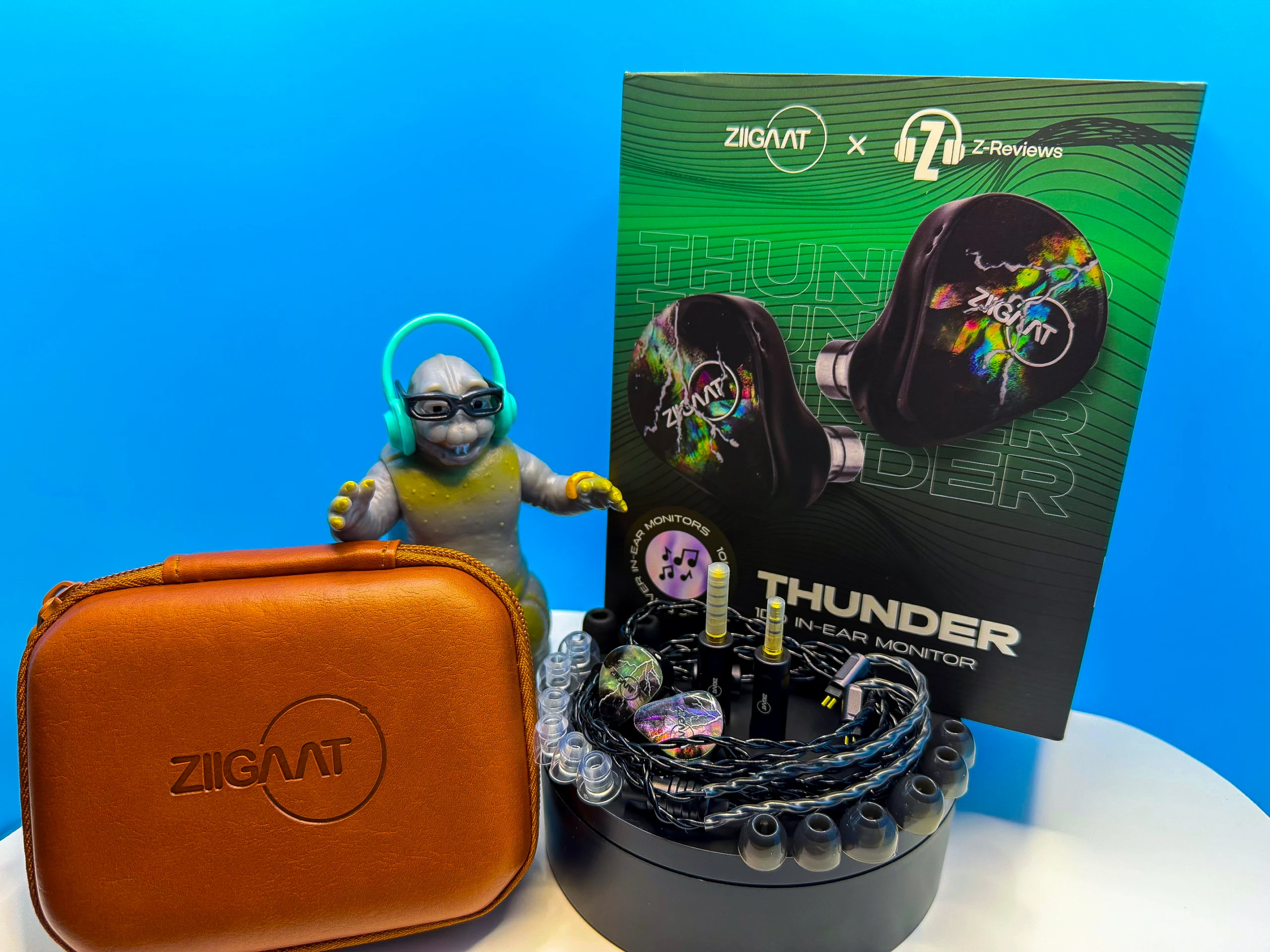
The THUNDER comes with a practical accessory package for $139, including the IEMs, detachable cable, interchangeable 3.5mm and 4.4mm plugs, seven pairs of ear tips, a leatherette case, four replacement filters, and documentation. I appreciate the modular termination system because it allows the same cable to work with conventional single-ended outputs and compatible balanced headphone connections without requiring a separate purchase. That’s a welcome convenience, although balanced operation shouldn’t be mistaken for an automatic improvement in sound quality.
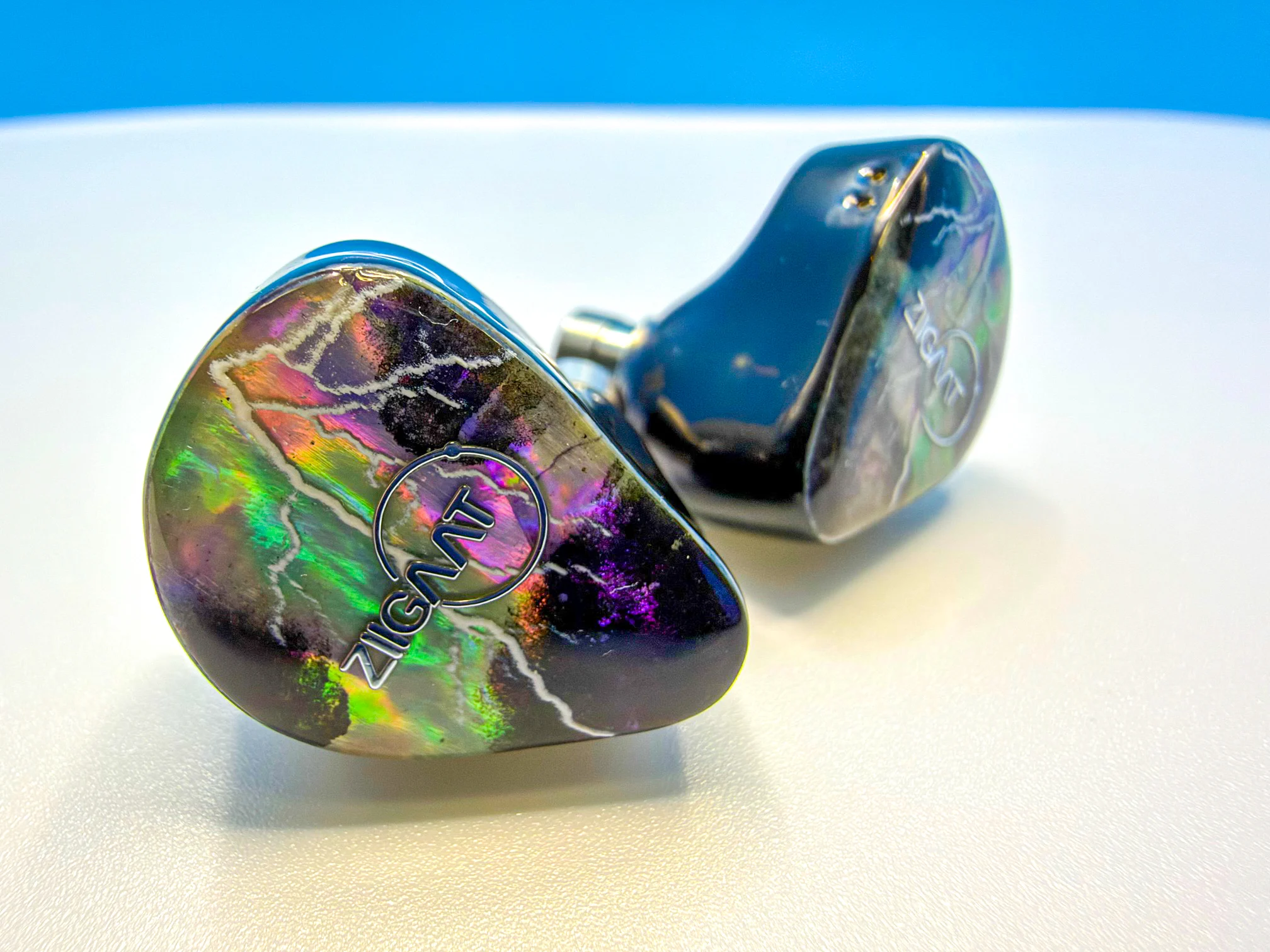
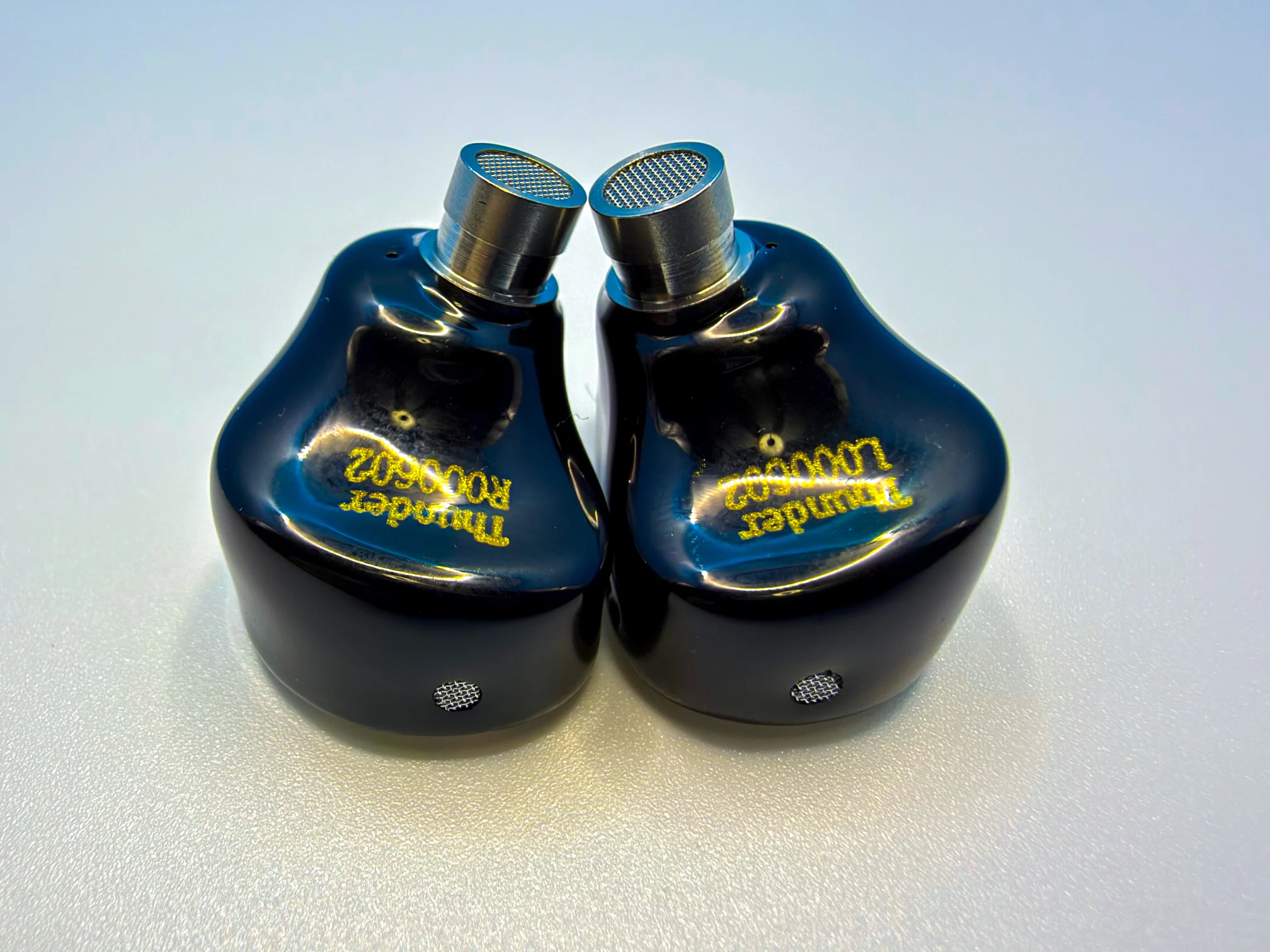
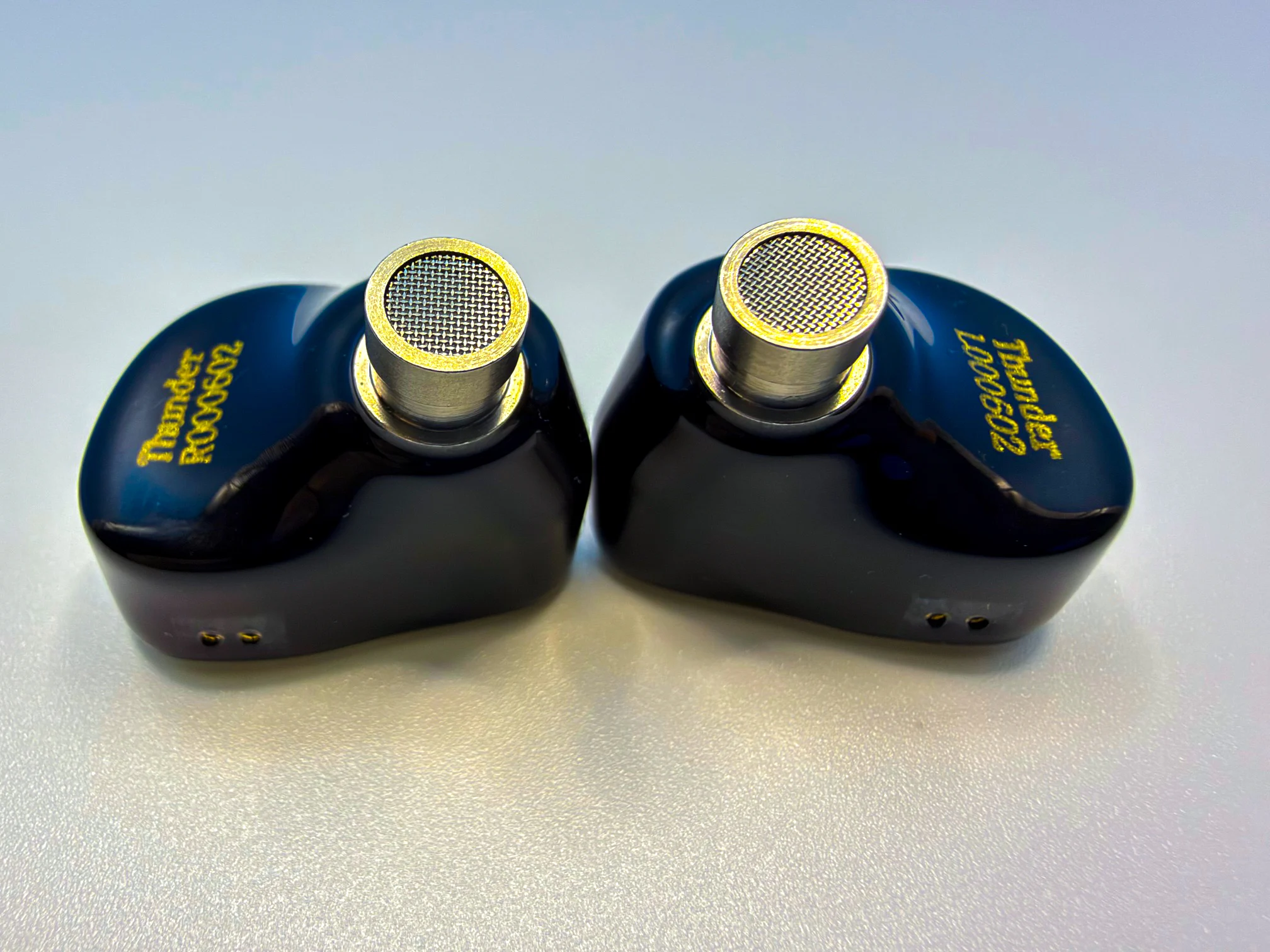
But accessories aren’t what make the THUNDER memorable. The shells immediately command attention, and I have to give ZiiGaat credit for creating something that looks this striking. The faceplates combine dark, stormy backgrounds with shifting iridescent greens, purples, magentas, and flashes of gold. Lightning-like veins cut through the finish, while the reflective ZiiGaat logo adds another visual layer. As the light changes, different colors emerge, giving the shells a wonderful sense of movement.
My photographs capture some of that effect, but you really need to see these in person. Rotate them slightly and the greens seem to glow; change the angle and the purples and pinks take over. The result feels perfectly suited to the THUNDER name, and I can’t help thinking about neon-lit album artwork every time I pick them up.
🎨 Resin Again? Sure, but Look at These Things!
I’ll admit resin construction is starting to feel familiar after reviewing so many IEMs. Part of me wonders what this tuning might have achieved with a more adventurous enclosure concept, perhaps something inspired by the engineered metal construction of the CrinEar Monolith. It’s an interesting possibility, though alternative materials and shell resonance don’t automatically improve acoustics. Uncontrolled resonance can be detrimental, and there’s no evidence that simply changing the THUNDER’s shell material would improve its performance.
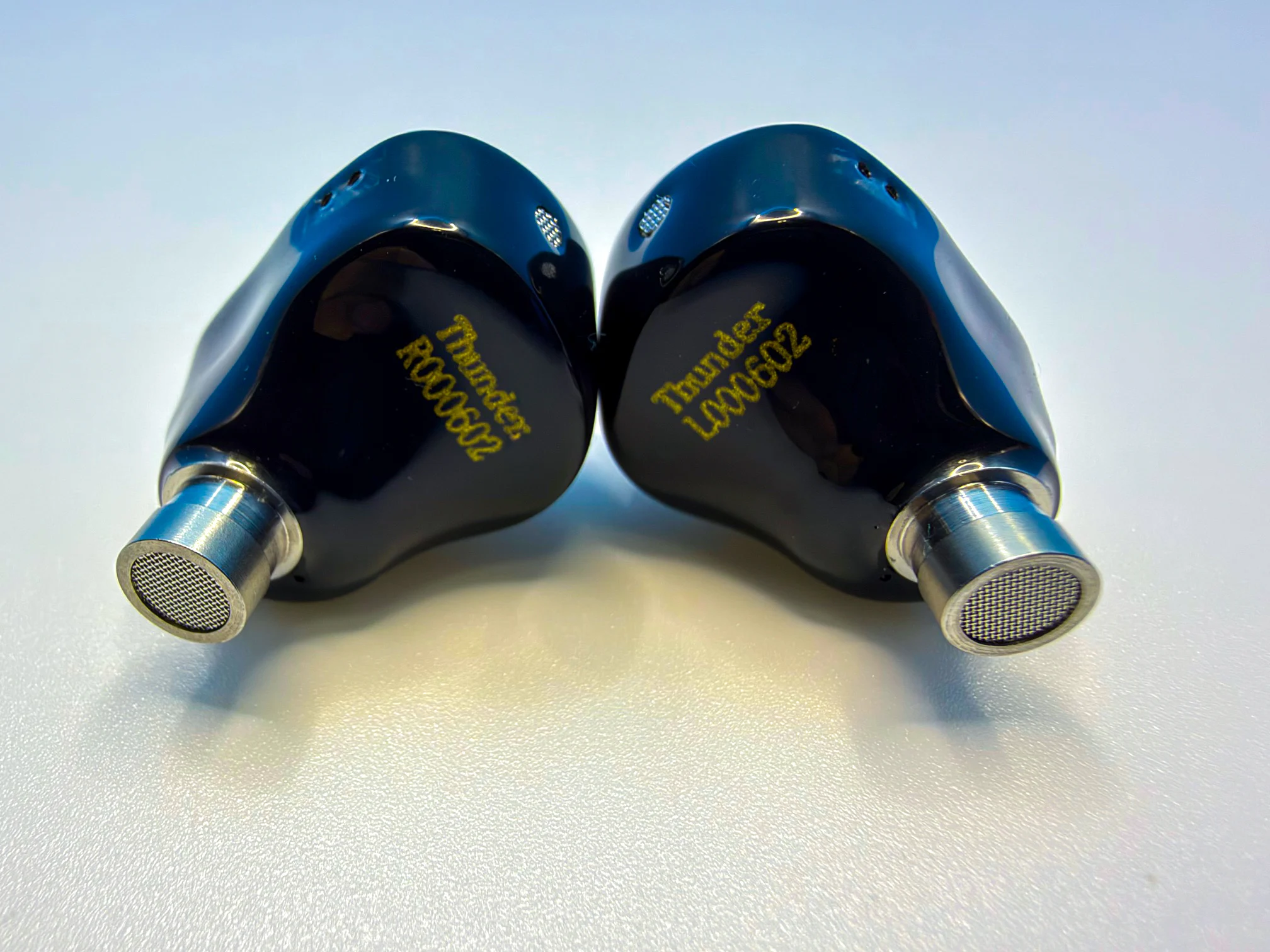
What I can say is that ZiiGaat executed this design beautifully, and the shell size is absolutely ideal for my ears. I have relatively small ears, and some modern multidriver IEMs can feel enormous during extended listening sessions. The THUNDER avoids that problem. Its shape and dimensions provide a comfortable, secure fit that allows me to settle into long listening sessions without constantly adjusting the earpieces.
That comfort matters more than exotic construction materials. An IEM can sound extraordinary, but if I can’t wear it comfortably for an extended period, the experience suffers. The THUNDER looks fantastic, feels excellent, and reminds me that thoughtful ergonomics are every bit as valuable as adventurous industrial design.
🎧 Review Setup: Listen First, Analyze Later
I start my listening evaluations with familiar music rather than frequency-response graphs. I want to understand how a product handles recordings I know, what it brings forward, what it leaves behind, and whether its personality encourages me to keep listening. My primary streaming source is Apple Music Lossless, supported by a broader collection of desktop and portable equipment, including the Topping DX5 II, FiiO K11, Loxjie P20, HiBy R4 Evangelion, iBasso DC-Tonfa, and iFi iDSD GR2.
These components represent my available listening equipment, not a claim that I used each in a dedicated, controlled THUNDER comparison. My documented impressions for this review center on musical performance, fit, design, and comparisons with familiar bass-oriented IEMs, particularly the FATfreq Deuce and FlipEars Legion. I also used the ZiiGaat Doscinco as a familiar point of reference for the company’s tuning identity.
The listening selections range from Alabama Shakes, Frank Ocean, Michael Kiwanuka, Giveon, Gary Clark Jr., Khruangbin, and Black Pumas to the Van Halen classics I love and some of the most aggressive rock and hip-hop recordings of the 1980s. The latter additions fit especially well because the THUNDER’s speed, bass authority, and vocal weight seem tailor-made for that energy.
📈 Understanding the THUNDER: What the Measurements Reveal
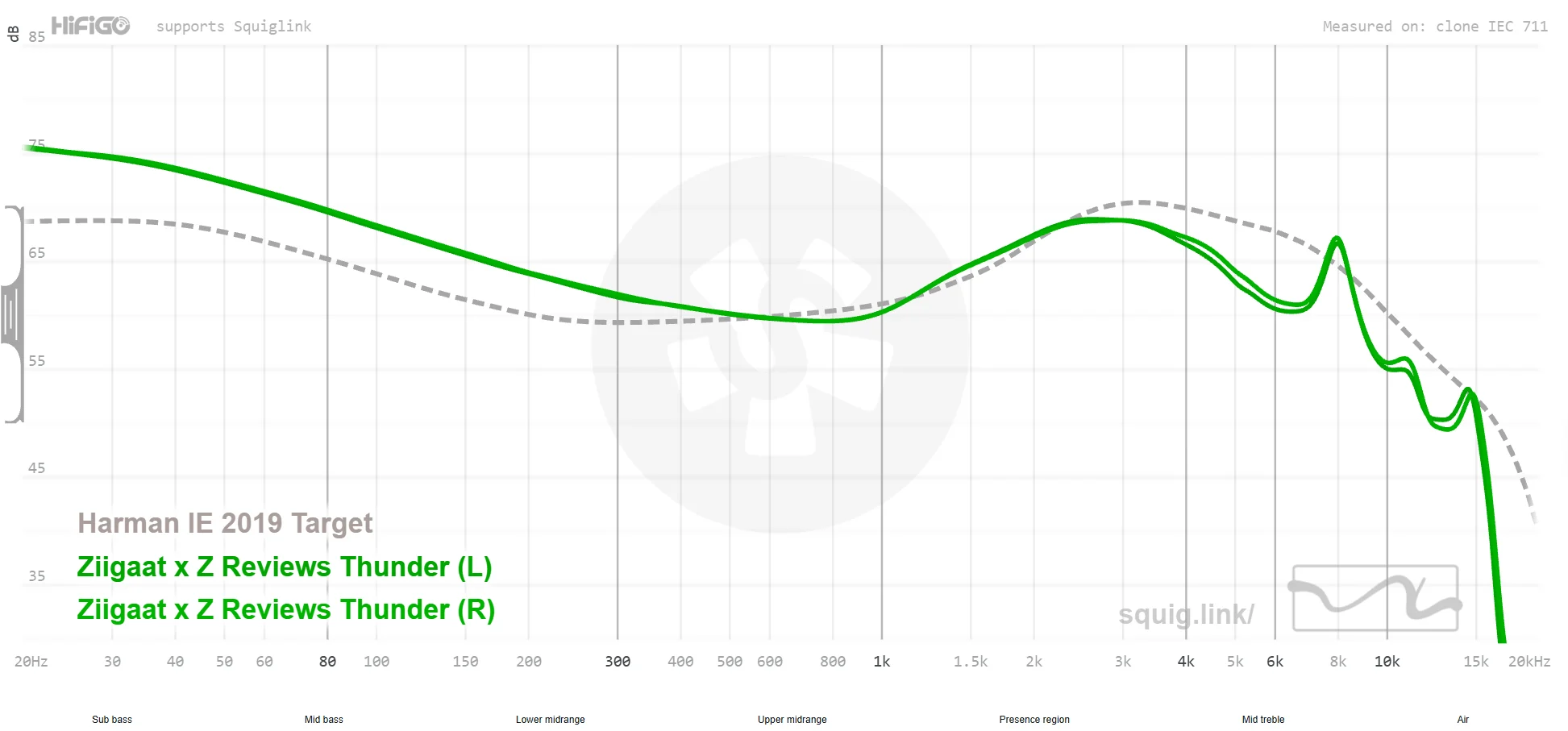
One of my favorite parts of reviewing audio equipment is comparing what I hear with what the measurements reveal. I don’t use frequency-response graphs to tell me whether I should enjoy an IEM. I use them to understand why a particular tuning produces the experience I’m hearing. The THUNDER’s graph is especially interesting because it clearly explains its enormous bass foundation, smooth midrange transition, and deliberately shaped upper-frequency response.
The Squiglink graph Mark provided at Super* Review makes it clear that Zeos and ZiiGaat weren’t interested in creating another conventionally balanced IEM. The THUNDER begins with substantial sub-bass elevation, transitions gradually through the mid-bass and lower midrange, and rises again through the upper mids before introducing a more complicated treble response.
🥁 Bass: More Than an Isolated Sub-Bass Boost
The most obvious characteristic is the enormous bass shelf. At the lowest measured frequencies, the THUNDER sits substantially above its central midrange response, consistent with the manufacturer’s advertised 16dB bass emphasis. What makes the curve particularly interesting is its gradual downward slope through the mid-bass, rather than an abrupt drop after the deepest sub-bass frequencies.
That distinction helps explain why the THUNDER sounds so satisfying with kick drums and bass guitars. Its low-frequency energy isn’t confined to the deepest electronic rumble. It extends into the range that gives conventional bass instruments much of their body and weight, creating the substantial foundation I hear on Michael Kiwanuka’s “The Rest of Me” and Gary Clark Jr.’s “When My Train Pulls In.”
It also helps explain why classic hip-hop feels like such a natural fit. The bass foundation beneath tracks like Beastie Boys’ “Paul Revere” or LL Cool J’s “Rock the Bells” is central to the musical experience. These recordings put rhythm and low-frequency impact front and center, exactly where the THUNDER seems happiest.
A frequency-response graph can’t tell us how quickly a driver responds or how accurately it reproduces fast bass transients, but it does illustrate the considerable low-frequency demands of this tuning. The THUNDER’s perceived speed makes that combination particularly enjoyable.
🎤 Midrange: The Secret Behind Those Male Vocals
The smooth transition from the elevated bass region into the lower mids is another important characteristic. Rather than dropping off abruptly, the response gradually descends into a shallow midrange trough before rising into the upper-midrange presence region. The result is a tuning that maintains substantial low-frequency warmth while adding enough high-frequency energy to support vocal articulation.
That general shape aligns closely with what I’ve been hearing, particularly with male vocals. The warmth adds body and substance, while the presence-region rise keeps singers from sounding completely buried beneath the bass. Giveon’s “Like I Want You,” Frank Ocean’s “Thinkin Bout You,” and Black Pumas’ “Colors” demonstrate why I find this combination so enjoyable.
Interestingly, the same quality helps explain why David Lee Roth’s vocals on Van Halen’s “Runnin’ with the Devil” sound so satisfying. His performance carries the swagger and personality that define the song, supported by a strong rhythmic foundation.
The graph can’t establish vocal timbre or emotional engagement on its own, but it provides useful context for how ZiiGaat has balanced such an enormous bass shelf against the midrange.
✨ Treble: Energy Without Excessive Brightness
The upper-frequency response helps explain another consistent observation from my listening sessions. The THUNDER has enough treble energy to keep guitars, percussion, and vocals articulate, but the highs aren’t exceptionally crystalline or airy.
The graph rises through the upper mids toward a broad presence region around 2–3kHz before gradually declining through the lower treble. A narrow peak appears near 8kHz, followed by a substantial reduction in measured energy through much of the upper-treble region. Another smaller feature appears farther up the spectrum.
This shape suggests a tuning that provides perceptible high-frequency definition without emphasizing delicate upper-treble sparkle and air. Electric guitars have enough bite to remain engaging, and percussion doesn’t disappear beneath the bass, but I don’t experience the extraordinary shimmer or transparency associated with more analytically focused IEMs.
The 8kHz peak deserves caution because IEC 711-style coupler measurements can be particularly sensitive to insertion depth and acoustic resonance in this region. I wouldn’t assume every listener will hear a distinct 8kHz emphasis simply because it appears on the graph, and measurements farther into the upper treble should also be interpreted carefully.
🎯 Channel Matching: Encouraging Consistency
Another detail worth noting is how closely the measured left and right channels track each other. Across most of the frequency range, the two green traces are nearly identical, suggesting good frequency-response consistency in the measured sample.
That doesn’t guarantee identical performance across every production unit, nor does it independently establish imaging accuracy or overall technical refinement. But it’s an encouraging observation, particularly for an IEM built around a single dynamic driver and such an ambitious tuning.
🦖 The Graph Explains the Storm
The THUNDER’s measurements illustrate a coherent tuning philosophy: enormous bass elevation, a gradual transition through the lower mids, an upper-midrange rise to support articulation, and enough treble energy to prevent the presentation from becoming overwhelmingly dark.
What they don’t establish is driver speed, bass texture, spatial imaging, or emotional engagement. Those judgments require listening and, where appropriate, other forms of measurement.
The graph helps explain the sonic foundation. My listening sessions tell me whether that foundation works.
The graph explains the storm. My ears tell me why I enjoy standing in it.
🥁 Bass: Thunder Without the Bloat
The THUNDER delivers enormous low-frequency energy, with the weight and impact that make bass-driven music immediately satisfying. But what surprised me wasn’t the quantity. It was how well the single dynamic driver maintains its rhythmic character. Fast kick drums strike with authority, bass guitars have wonderful substance, and aggressive passages retain the momentum that makes rock and hip-hop so enjoyable.
The frequency-response graph confirms just how deliberately bass-forward this tuning is. Its low-frequency elevation extends beyond the deepest sub-bass region, giving the mid-bass additional authority and contributing to the warmth and substance I hear throughout the performance. The THUNDER doesn’t simply rely on the deepest frequencies to create an impression of power. It delivers genuine rhythmic weight across a broader part of the bass spectrum.
This tuning absolutely loves fast bass slam. With aggressively boosted IEMs, the sheer low-frequency energy can make complicated arrangements feel sluggish or overly thick. The THUNDER handles speed far better than I expected, keeping quick rhythmic passages exciting rather than collapsing into an indistinct wall of warmth.
🦴 FATfreq Deuce and FlipEars Legion: Familiar Basshead Territory
My FATfreq Deuce offers a useful comparison because I’m familiar with its substantial low-frequency personality. The THUNDER reminds me of the Deuce without its impedance adapter, delivering a comparably satisfying amount of bass energy even though the exact tonal character isn’t identical. That’s impressive for a $139 single-dynamic-driver IEM, especially since the THUNDER maintains the speed and cohesion I’ve been enjoying.
My FlipEars Legion remains another benchmark, especially for the upper limits of physical bass impact. The THUNDER doesn’t quite reach that level of extreme low-frequency intensity, but it doesn’t need to. It delivers enough slam and rumble to satisfy my basshead tendencies without needing extra driver technology or an elaborate acoustic system.
And then there’s Metallica.
Throw on “Master of Puppets” or “Battery,” and the THUNDER’s ability to keep up with aggressive, rapidly changing musical passages becomes part of the fun. Fast kick drums, relentless rhythm guitars, and powerful bass demand a driver who doesn’t fall asleep when the music starts moving. The THUNDER has the muscle and rhythmic urgency to make this material sound wonderfully aggressive.
The same applies to hip-hop, though the musical demands differ. Beastie Boys’ “Paul Revere” and Run-D.M.C.’s “It’s Tricky” rely on rhythmic precision, vocal attitude, and punchy beats rather than extended instrumental complexity. The THUNDER’s bass authority gives those recordings a satisfying physical foundation while preserving the playful aggression that makes them so enjoyable.
The THUNDER doesn’t simply make bass louder. It makes bass-driven music more fun, whether the source is a screaming guitar or a drum machine.
🎤 Midrange & Male Vocals: The Unexpected Star of the Storm
For all the attention the THUNDER’s enormous bass shelf deserves, I think one of its greatest achievements is how beautifully it handles male vocals. This set absolutely nails them, and I can’t say the same about many IEM tunings. Too often, bass-heavy presentations sacrifice vocal substance or push male voices too far back, leaving singers sounding thin, distant, or disconnected from the rest of the arrangement. The THUNDER preserves a wonderfully satisfying sense of warmth, body, and emotional weight.
The measurements help explain part of that experience. The gradual transition from the bass through the lower midrange avoids an abrupt tonal discontinuity, while the rise toward the presence region around 2–3kHz gives vocals enough articulation to maintain their character. The graph can’t establish vocal quality on its own, but it provides useful context for why the THUNDER’s substantial low-frequency foundation doesn’t automatically overwhelm male singers.
Giveon’s “Like I Want You” is a terrific example. His rich baritone has the substance I want from a male vocal performance, complemented by the THUNDER’s generous low-frequency foundation. Frank Ocean’s “Thinkin Bout You” offers another side of that presentation, letting his expressive delivery retain warmth without demanding aggressive upper-frequency brightness. Michael Kiwanuka’s “The Rest of Me” and Eric Burton’s performance on Black Pumas’ “Colors” further reinforce how naturally this tuning complements soulful male voices.
But this ability isn’t limited to soul and R&B. David Lee Roth’s charismatic delivery on Van Halen’s “Runnin’ with the Devil” shows how vocal personality can stay engaging against a powerful rhythm section. The THUNDER’s warmth complements the performance without making it sound unnecessarily thin or brittle.
The same characteristic makes vintage hip-hop surprisingly satisfying. LL Cool J’s forceful delivery on “Rock the Bells” and the unmistakable vocal chemistry of Run-D.M.C. benefit from a presentation that gives voices substance while maintaining rhythmic excitement.
What I particularly appreciate is that the THUNDER doesn’t make these performers feel detached from the music. Their voices remain part of the overall performance, supported by the bass rather than overwhelmed by it. This isn’t necessarily the lifted, floating, holographic vocal presentation I often pursue with more spatially ambitious IEMs. Instead, it’s a rich, grounded, emotionally engaging approach.
Come for the bass. Stay for the vocals.

🎯 Instrument Separation & Placement: Cohesion Over Clinical Precision
The THUNDER isn’t designed to dissect every recording into perfectly isolated instrumental layers, and I don’t think it needs to. Its strength is the way the complete performance comes together. The bass, guitars, vocals, and percussion feel like one unified musical event, and the consistent presentation reminds me why I love well-executed single dynamic drivers.
That doesn’t mean the THUNDER delivers exceptional instrument separation. With such a substantial bass shelf, fine background details can become less prominent, and I wouldn’t recommend this tuning to someone whose primary objective is hearing every instrument occupy a precisely defined location. There’s a difference between a cohesive presentation and an exceptionally resolving one, and the THUNDER emphasizes the former.
This becomes especially interesting in more demanding metal arrangements. Metallica’s “Master of Puppets” is filled with aggressive guitar work, rapid rhythmic changes, and substantial instrumental energy. The THUNDER handles the speed enthusiastically, though its bass-heavy personality keeps the emphasis on the performance’s force and momentum rather than the most delicate separation between individual instrumental layers.
And I’m perfectly comfortable with that distinction. Sometimes I want to hear a band as one unified force rather than a collection of individual instruments arranged across an imaginary stage. The THUNDER delivers that sensation convincingly, making energetic music immensely enjoyable.
🏟️ Soundstage & Imaging: More Arena Energy Than Audiophile Holography
Soundstage is one of my favorite areas to evaluate because I love music that seems to expand beyond an IEM’s physical boundaries. Give me width, depth, air, and believable instrument placement, with vocals floating independently in a holographic environment, and I’m usually a happy listener. The THUNDER approaches immersion from a different direction.
Its enormous bass foundation gives recordings a substantial, energetic character that can make the music feel powerful and involving. But low-frequency impact shouldn’t be confused with genuine spatial dimensionality. An IEM can create an impressively physical experience without reproducing the expansive depth and independent instrumental layering of more spatially accomplished designs.
I wouldn’t describe the THUNDER as a holographic specialist. Its appeal lies in its muscular, cohesive presentation rather than exceptionally airy staging or three-dimensional precision. That’s a trade-off worth understanding before buying, particularly for listeners who prioritize soundstage above bass impact.
For me, however, the THUNDER’s energy creates its own sense of musical immersion. It reminds me less of sitting in a carefully arranged concert hall and more of standing near the stage at a loud rock performance, where the bass drum hits your chest and the guitars seem to occupy the entire room. It’s a different experience, but one that feels entirely appropriate for this tuning.
🔬 Detail & Resolution: Clarity Isn’t the Same as Technical Wizardry
The THUNDER provides enough upper-frequency definition to make familiar recordings enjoyable, but I wouldn’t describe it as a microdetail champion or an exceptionally transparent technical performer. There’s an important difference between making selected frequencies more prominent and reproducing subtle musical information with extraordinary refinement.
The measurements help here because they show a clear rise into the presence region, followed by a more uneven treble response. That upper-midrange energy can help vocals and instruments sound articulate, but it shouldn’t be confused with proof of exceptional resolving power. Likewise, the reduced measured upper-treble energy is consistent with my impression that the THUNDER doesn’t emphasize delicate air and shimmer as strongly as some reference-oriented designs.
And frankly, I don’t consider that a failure. The THUNDER was clearly designed around a particular listening experience, and its technical priorities reflect that intention. It may not uncover every microscopic detail in a recording, but it delivers the rhythmic impact, vocal body, and musical excitement that define its personality.
Not every IEM needs to be a precision instrument to be worth owning.
✨ Treble & Air: Enough Bite to Balance the Bass
The THUNDER’s treble is an interesting balancing act. With an advertised 16dB bass shelf, the upper frequencies have serious competition, and leaving them too restrained could have made the presentation overwhelmingly dark. ZiiGaat has added enough elevation to maintain presence and definition, especially in electric guitars, percussion, and vocal articulation.
The graph’s broad rise around 2–3kHz and narrow feature near 8kHz help illustrate how the tuning preserves upper-frequency energy, while the reduced response through much of the upper treble is consistent with my impression of limited crystalline sparkle and air. Those measurements don’t tell us precisely how every listener will perceive the highs, especially given the sensitivity of IEC 711-style couplers in this region, but they provide useful context.
I can clearly hear upper-frequency energy, but it isn’t excessive. There’s enough bite to prevent aggressive rock arrangements from losing their edge, and enough definition to keep instruments recognizable against the substantial low-frequency foundation. At the same time, the highs aren’t crystalline or exceptionally airy. They lack the delicate shimmer, refined extension, or extraordinary transparency I enjoy in more technically ambitious IEMs.
The treble also plays an important role with the THUNDER’s more aggressive musical selections. Thrash metal demands enough upper-frequency energy to preserve the bite of distorted guitars and the attack of cymbals, while classic hip-hop depends on percussion and vocal articulation remaining recognizable above the bass. The THUNDER strikes a satisfying balance between those competing priorities without becoming unnecessarily sharp.
The highs have enough energy to join the party without trying to steal the microphone.
⚡ Speed & Transients: The THUNDER’s Secret Weapon
Speed is one of the THUNDER’s most impressive qualities, especially given how aggressively it elevates its bass. A tuning with this much low-frequency energy could easily become slow, thick, or overly rounded, yet the single dynamic driver responds with an appealing sense of rhythmic urgency. Fast percussion maintains its momentum, electric guitars retain their aggression, and bass-heavy hip-hop feels lively rather than sluggish.
This gets even more entertaining with Van Halen’s “Hot for Teacher.” Alex Van Halen’s explosive drum intro is a great workout for any driver, and the THUNDER’s mix of low-frequency authority and perceived speed makes the performance an absolute blast. When Eddie Van Halen’s guitar work enters the arrangement, the experience becomes even more exciting. The track has plenty of muscular energy, but it never loses the rhythmic drive that makes the song so infectious.
The same goes for Metallica’s “Battery,” where the aggressive pace and relentless rhythmic changes highlight why I appreciate the THUNDER’s responsive character. The frequency-response graph can’t prove transient speed or mechanical control, but the listening experience demonstrates why this quality matters so much to me.
And the fun doesn’t stop with guitars. The punchy rhythmic foundation of classic Beastie Boys, the tight beats of Run-D.M.C., and the aggressive production associated with Public Enemy all benefit from an IEM that can reproduce substantial bass without making the music feel sluggish.
The THUNDER has serious muscle, but it hasn’t forgotten how to dance.
🎵 Tonality & Timbre: One Driver, One Musical Personality
I keep coming back to the word cohesion because it captures so much of what I enjoy about the THUNDER. The low end is enormous, the midrange carries satisfying warmth, and the treble provides just enough energy to preserve definition. None of these elements operates in isolation. They contribute to a unified presentation that feels intentionally designed around musical enjoyment.
The frequency-response graph reinforces how deliberately this balance has been constructed. The bass region transitions gradually into the lower mids, while the upper-midrange presence rise gives vocals and instruments enough energy to remain recognizable. The treble response adds definition without making the overall presentation excessively bright. None of that guarantees superior sound quality, but it does help explain the tonal relationships I hear.
The THUNDER isn’t neutral, and it doesn’t pretend to be. Its substantial bass shelf adds a recognizable warmth that shapes how recordings sound, and listeners who prioritize strict tonal accuracy may find that coloration excessive. But for rock, metal, blues, soul, R&B, and hip-hop, I find the personality immensely satisfying. Bass guitars have body, male voices have wonderful richness, and the rhythmic foundation gives the music excitement.
A single dynamic driver doesn’t guarantee a cohesive sound, but the THUNDER shows how effective the approach can be when tuning and acoustic design work together. No elaborate driver count to celebrate, no crossover complexity to admire, and no bone-conduction system adding physical effects.
Just one driver delivering a whole lot of musical personality.
🔥 The THUNDER Experience: From Sunset Strip to Thrash Metal and Old-School Hip-Hop
What makes the THUNDER so entertaining is that its personality isn’t confined to one musical genre. The visual design might scream Sunset Strip glam metal, but the sound has enough rhythmic energy and low-frequency authority to celebrate a much broader range of music.
Classic Van Halen is a great place to start. “Runnin’ with the Devil” has that unmistakable swagger, with Michael Anthony’s bass providing a solid foundation beneath Eddie Van Halen’s guitar and David Lee Roth’s charismatic vocals. The THUNDER captures the attitude beautifully. But “Hot for Teacher” might be even more entertaining, with its explosive drum intro, aggressive guitar work, and relentless momentum. Both tracks sound AMAZING on this set, and they remind me why I love rock music.
Then there’s Metallica, which absolutely destroys on the THUNDER. The aggressive speed of “Battery,” the muscular rhythm guitars of “Master of Puppets,” and the dramatic dynamic shifts of “One” all let you appreciate the driver’s ability to combine low-frequency authority with rhythmic urgency. Metallica doesn’t need an exaggeratedly polite or delicate tuning. It needs impact, speed, and enough control to keep the intensity moving forward, and the THUNDER embraces that challenge enthusiastically.
But overlooking 1980s hip-hop would be a serious mistake. This was also the era when the Beastie Boys created their own outrageous musical identity, Run-D.M.C. brought hip-hop to a broader audience, LL Cool J delivered powerful rhythmic performances, and Eric B. & Rakim helped reshape the genre through innovative production and lyrical technique. Public Enemy would add even more intensity to the decade’s musical landscape.
The THUNDER feels particularly comfortable with that era’s bass-forward production and rhythmic confidence. Tracks like “Paul Revere,” “It’s Tricky,” “Rock the Bells,” and “Paid in Full” give the driver plenty of opportunities to show off its low-frequency authority while keeping the music energetic and engaging.
The influences are interesting, but the common thread is obvious. Whether we’re talking about Eddie Van Halen’s guitar work, Metallica’s relentless aggression, or the booming beats of classic hip-hop, the THUNDER celebrates rhythm, energy, and attitude.
The shells may look like the Sunset Strip in 1986, but the soundtrack stretches from Hollywood’s rock clubs to the birth of hip-hop’s golden age.
🔌 Source Pairing & Practical Listening
The THUNDER’s published 20Ω impedance and 102dB sensitivity suggest an IEM intended for conventional headphone outputs rather than unusually demanding amplification requirements, although the published sensitivity reference isn’t sufficiently detailed for a precise power calculation. The included interchangeable 3.5mm and 4.4mm plugs make it convenient to connect the THUNDER to a range of compatible devices.
I wouldn’t recommend purchasing a powerful balanced amplifier simply because the THUNDER includes a 4.4mm termination. Balanced operation doesn’t automatically produce better sound, and perceived differences between sources can involve output impedance, gain, equalization, noise floor, and playback-level differences. With an already warm, bass-forward tuning, some listeners may prefer a relatively transparent source over added warmth.
The THUNDER’s defining personality comes from its acoustic tuning, and I don’t hear a product that needs an elaborate equipment chain to justify its existence. This isn’t an IEM I’d buy to fix through extensive adjustments. I’d buy it because I enjoy what it already does.

👹 The GearZilla KAIJU DNA Scan: Anatomy of a Thunderstorm
Every monster has its own genetic signature, and the ZiiGaat × Z Reviews THUNDER has one of the most unapologetically entertaining personalities I’ve encountered in a while. Its DNA isn’t built around pristine neutrality, microscopic detail retrieval, or the pursuit of some elusive audiophile ideal. Instead, Zeos and ZiiGaat have created something that celebrates musical impact, rhythmic speed, vocal richness, and the wonderful cohesion of a single dynamic driver.
Looking at the THUNDER’s frequency-response measurements, you can easily spot the enormous bass shelf that defines its personality. But measurements alone don’t explain why this IEM is so enjoyable. Something special happens when the individual elements come together, especially when the music gets loud, fast, and wonderfully aggressive.
And the best way to understand this monster’s DNA? Give it a soundtrack worthy of its personality. We’re going deep into the 1980s, when rock was loud, hip-hop was changing the world, and nobody seemed particularly interested in turning down the volume.
🎯 K • Kill Shot: Bass That Means Business
The THUNDER’s signature weapon is unmistakable: enormous, unapologetic bass delivered with the kind of speed that makes me forget I’m listening to a single 10mm dynamic driver. The advertised 16dB bass shelf isn’t just a specification designed to attract bassheads. It’s the foundation of the entire listening experience, giving kick drums serious authority, bass guitars satisfying weight, and electronic beats the kind of physical impact that makes music feel alive.
What impresses me most is how effectively the THUNDER handles fast, aggressive passages. I’ve heard plenty of bass-heavy IEMs that produce extraordinary amounts of low-frequency energy but struggle to maintain rhythmic definition when the music gets complicated. The THUNDER doesn’t have that problem to the same degree. It keeps pace with driving rock, heavy metal, and hip-hop without losing the momentum that makes those genres exciting.
For a fitting ’80s bass workout, I’d reach for Rob Base & DJ E-Z Rock’s “It Takes Two” (1988) or EPMD’s “You Gots to Chill” (1988). Those hard-hitting rhythmic foundations highlight the THUNDER’s basshead personality. The substantial low-frequency emphasis gives beats real weight, while the driver’s perceived speed helps preserve the energy that makes these recordings so infectious.
Compared with my FATfreq Deuce without its impedance adapter, the THUNDER delivers surprisingly comparable bass authority. My FlipEars Legion still delivers another level of physical impact, but that’s an ambitious benchmark for a $139 single-DD IEM. The THUNDER gets close enough to make the comparison meaningful, and that’s impressive.
The kill shot isn’t simply how much bass the THUNDER delivers. It’s how much fun that bass becomes when the music starts moving.
🧬 A • Anatomy: One Driver, Total Cohesion
I’ve developed a genuine appreciation for single dynamic drivers, especially when manufacturers use them to create bold, bass-forward sound signatures. There’s something wonderfully satisfying about hearing the entire frequency range reproduced through one well-integrated acoustic system, without the complexity of coordinating multiple driver technologies.
The THUNDER uses a single 10mm DLC composite dynamic driver, and I think that simplicity plays beautifully to its strengths. The substantial bass foundation flows naturally into the warm midrange, while the elevated upper frequencies provide enough presence to keep vocals, guitars, and percussion articulate. Nothing feels like it’s fighting for control of the presentation. The sound has a unified character that makes music feel cohesive rather than artificially dissected.
That cohesive personality makes me think of Def Leppard’s “Photograph” (1983) and Scorpions’ “Rock You Like a Hurricane” (1984). Both feature substantial guitar arrangements, powerful rhythms, and vocal performances that depend on the entire band working together. The THUNDER’s unified presentation seems particularly well suited to preserving that sense of musical momentum rather than breaking every element into isolated pieces.
Of course, using one driver doesn’t automatically guarantee superior coherence. Driver materials, acoustic chambers, damping, and tuning all contribute to the final result. But ZiiGaat has demonstrated how effectively a single DD can deliver a satisfying musical experience when those elements work together.
And I love that it has no bone-conduction system or elaborate multi-driver configuration. The THUNDER achieves its personality through a relatively straightforward acoustic approach, and the results speak for themselves.
Sometimes the most impressive engineering decision isn’t adding another driver. It’s knowing how much one good driver can accomplish.
🦴 I • Impact: Fast, Physical, and Full of Attitude
If bass quantity is the THUNDER’s signature weapon, its rhythmic impact is what gives that weapon personality. This IEM doesn’t merely rumble beneath the music. It punches, drives, and propels the performance forward, bringing an infectious energy to everything from classic hard rock to aggressive heavy metal.
For a proper speed workout, I’d put on Iron Maiden’s “The Trooper” (1983). Steve Harris’ galloping bass lines and the band’s relentless rhythmic drive make it a natural challenge for any bass-forward IEM. The THUNDER’s combination of low-frequency authority and perceived speed is exactly what I want from this style of music. It delivers the muscular energy needed to make those galloping rhythms feel exciting without turning the entire experience into an indistinct wall of low frequencies.
Another fitting selection is Slayer’s “Raining Blood” (1986), which takes the aggression considerably further. The rapid percussion and furious guitar work are exactly the kind of demands that reveal whether an IEM’s bass-heavy tuning can maintain musical momentum. The THUNDER isn’t a surgical instrument-separation champion, but its energetic personality makes this relentless metal style particularly appealing.
The same principle applies to classic hip-hop. Salt-N-Pepa’s “Push It” (1987) uses a completely different musical vocabulary, but the emphasis on hard-hitting rhythm and confident delivery makes it another perfect candidate for the THUNDER’s bass-forward presentation.
The THUNDER doesn’t just reproduce impact. It celebrates it, whether that impact comes from a galloping bass guitar, a double-kick drum, or an old-school hip-hop beat.
🎸 J • Joy: A Soundtrack Built for Excess
Some audio equipment impresses me because of its technical accomplishments. Other products make me smile every time I put them on. The THUNDER falls firmly into that second category, and I think that’s one of its greatest achievements.
Everything about this IEM feels designed around enjoyment, beginning with those absolutely gorgeous faceplates. The iridescent greens, purples, pinks, and golds practically explode under the light, while lightning-like streaks cut through the dark resin. They remind me of the neon-soaked Sunset Strip in the mid-1980s, when every album cover seemed to demand bigger hair, tighter spandex, and more outrageous stage lighting.
The look brings to mind Bon Jovi’s “You Give Love a Bad Name” (1986), Whitesnake’s “Still of the Night” (1987), and Europe’s “The Final Countdown” (1986). Those larger-than-life productions feature soaring vocals, powerful drums, and enough theatrical energy to fill an arena. They’re perfect examples of the musical excess THUNDER seems designed to celebrate.
But the joy isn’t limited to rock. Young MC’s “Bust a Move” (1989) captures a completely different side of the decade, combining an infectious bass groove with playful vocal energy. It’s another reminder that an entertaining IEM shouldn’t be confined to one genre, especially when its strengths are rhythm, warmth, and musical engagement.
There’s also something refreshing about an IEM that doesn’t demand constant experimentation to become enjoyable. I don’t feel an overwhelming need to reshape its sound through EQ or chase some elaborate amplification combination. The stock tuning already delivers the personality I want, and the exceptionally comfortable shells make it easy to keep listening for extended sessions.
The THUNDER reminds me that not every listening experience needs to be an exercise in critical analysis. Sometimes the greatest accomplishment is making me forget about the equipment and enjoy another album.
🎤 U • Unleashed: Male Vocals Take Center Stage
For all the attention the THUNDER’s enormous bass shelf will get, I think one of its most impressive accomplishments is how it handles male vocals. This set absolutely nails them, delivering the warmth, substance, and emotional weight that I find missing from far too many IEM tunings.
That’s particularly impressive because bass-heavy presentations can easily overwhelm the midrange or leave singers sounding recessed beneath the rhythmic foundation. The THUNDER maintains a satisfying relationship between those regions, giving male voices enough body to sound substantial without losing the articulation needed to stay engaging.
For some classic ’80s vocal personality, think Billy Idol’s “Rebel Yell” (1983). Idol’s distinctive delivery has the grit and attitude that make a warm, energetic tone so appealing, while the driving instrumentation provides plenty of low-frequency excitement. INXS’s “Need You Tonight” (1987) offers a different perspective, with Michael Hutchence’s smooth, charismatic vocal delivery and the track’s tight, funky rhythmic foundation creating a wonderful blend of warmth and groove.
I’d also bring Grandmaster Flash & The Furious Five’s “The Message” (1982) into the conversation. Melle Mel’s commanding vocal delivery and the track’s distinctive bass-driven arrangement demonstrate how important midrange body and vocal intelligibility are to classic hip-hop. The THUNDER’s ability to pair substantial bass with a satisfying male vocal presence is especially relevant in music where the voice carries so much of the performance.
What’s interesting is that the THUNDER doesn’t create the exceptionally lifted, floating vocal presentation I sometimes chase in more holographic IEMs. Instead, it gives male singers a grounded, substantial presence that feels naturally connected to the rest of the music. That’s a different approach, but one that works beautifully with the genres I enjoy.
For an IEM marketed around enormous bass, the THUNDER’s ability to make male vocals sound this satisfying might be its most impressive surprise.
🦖 The KAIJU Conclusion: One Driver, One Magnificent Storm
Looking at the THUNDER’s complete DNA, I see an IEM that knows exactly what it wants to be. Its enormous bass shelf provides the foundation, the single dynamic driver brings the music together, and its impressive speed keeps energetic recordings moving. Rich male vocals add substance, while the carefully balanced treble adds definition without sacrificing the warmth that makes the tuning so appealing.
The THUNDER isn’t perfect. I’d welcome more crystalline treble, greater holographic depth, and stronger microdetail retrieval. But those limitations don’t diminish what Zeos and ZiiGaat accomplished with this particular design. They’ve created an IEM with a distinctive personality, beautiful ergonomics, remarkable bass authority, and a sound signature that celebrates musical enjoyment rather than technical perfection.
At $139, that’s a tremendously appealing combination.
The THUNDER doesn’t need a dozen drivers to make a big impression. It just needs one driver, plenty of bass, and the right attitude.
And if that attitude includes Iron Maiden galloping through a metal anthem, Billy Idol commanding the microphone, and Salt-N-Pepa turning the entire listening session into a dance party?
Even better.
💰 Value: $139 for a Backstage Pass?
At $139, the THUNDER makes an exceptionally compelling argument for itself. You’re getting enormous bass, surprisingly good speed, rich male vocals, beautiful shells, comfortable ergonomics, and a practical modular cable, all built around a cohesive single-dynamic-driver presentation.
My comparison with the FATfreq Deuce is particularly meaningful because I’ve spent time enjoying that IEM’s basshead personality. The THUNDER delivers a comparably satisfying amount of bass to the Deuce without its impedance adapter, while the FlipEars Legion remains my benchmark for more extreme physical impact. Those comparisons aren’t meant to suggest the products are technically identical. They illustrate the territory in which the THUNDER competes from the perspective of sheer listening enjoyment.
The trade-offs are also worth acknowledging. Listeners seeking a neutral tonal balance, exceptionally airy treble, analytical microdetail, or a large holographic soundstage may find that the THUNDER emphasizes different qualities. But for someone who wants fast, powerful bass and a thoroughly musical presentation, those compromises may be entirely reasonable.
At $139, this isn’t simply an inexpensive basshead novelty. It’s a genuinely enjoyable IEM that delivers tremendous personality for the money.

| Category | Score |
|---|---|
| ✨ Clarity | 4.2/5 |
| 🎤 Midrange & Vocals | 4.7/5 |
| 🥁 Bass | 4.9/5 |
| 🎯 Separation & Placement | 4.2/5 |
| 🏟️ Width & Depth | 4.1/5 |
| 🔬 Detail & Resolution | 4.0/5 |
| ✨ Treble & Air | 4.1/5 |
| 🦴 Slam & Dynamics | 4.8/5 |
| 🎤 Vocal Lift | 4.5/5 |
| ⚡ Speed & Transients | 4.7/5 |
| 🎵 Tonality & Timbre | 4.6/5 |
| 🎛️ Tuning & Pairing Flexibility | 4.3/5 |
| ☁️ Comfort & Fit | 4.9/5 |
| 🎨 Design & Build | 4.9/5 |
| 📦 Accessories & Presentation | 4.6/5 |
| 💰 Value | 4.8/5 |
🦖 Overall GearZilla Score: 4.5/5 | S-Class Kaiju
The THUNDER scores especially well in bass performance, speed, male vocal richness, comfort, aesthetics, and value. Its lower marks reflect limited upper-frequency refinement and a less analytical spatial presentation. The overall score is an editorial assessment of the complete experience rather than an arithmetic average of individual categories.
🦖 Final Roar: Big Hair, Bigger Bass!
Every once in a while, an IEM comes along that reminds me why I love this hobby. Not because it reinvents audio engineering or arrives with a complicated collection of exotic drivers, but because it understands something simple about music: sometimes the experience matters more than technical perfection.
The ZiiGaat × Z Reviews THUNDER is exactly that kind of IEM. I can hear what Zeos was aiming for, and I appreciate the confidence behind the tuning. This isn’t polite bass or a conventional reference signature with a little extra warmth. It’s an enormous, energetic, unapologetically bass-forward presentation designed to make music feel substantial and exciting.
Yet what makes the THUNDER so enjoyable isn’t just the bass shelf. The speed is impressive, especially with driving rock, aggressive metal, and classic hip-hop. Male vocals have a richness and natural body I rarely hear in aggressively bass-tuned IEMs. The treble has enough lift to give guitars and percussion energy without getting overly aggressive, even if it lacks the crystalline transparency and delicate air of more analytical designs.
Most importantly, the single dynamic driver ties it all together. I love that cohesion, especially in music that relies on rhythmic drive and the interplay between bass, drums, guitars, and vocals. The THUNDER makes those performances feel unified and alive, and it doesn’t need bone conduction or a collection of specialized drivers to accomplish it.
Then there’s the design. Those iridescent, lightning-streaked faceplates are absolutely gorgeous, especially when the light catches them. The colors practically dance across the shells, and the visual personality couldn’t be a better match for the sound. They remind me of the outrageous energy of 1980s rock, when bigger was better and subtlety was somebody else’s problem.
But the sound isn’t limited to that musical era. From Van Halen’s “Runnin’ with the Devil” and “Hot for Teacher” to Metallica’s aggression and the Beastie Boys’ rhythmic attitude, the THUNDER shows how well its personality translates across different styles of high-energy music.
I also appreciate that ZiiGaat has made this experience genuinely comfortable. The THUNDER’s shells fit my smaller ears beautifully, letting me enjoy long listening sessions without the physical distraction of oversized IEM designs. As much as I’d love to explore a more adventurous metal or resonant enclosure, I wouldn’t sacrifice this level of comfort for an acoustic experiment.
Would I appreciate more holographic depth, finer instrumental separation, and more refined treble? Of course. Those qualities remain important to me, and the THUNDER doesn’t pretend to compete with the most technically ambitious IEMs in those categories. But I’m also not going to criticize a wonderfully entertaining $139 basshead design for refusing to become something it was never intended to be.
The ZiiGaat × Z Reviews THUNDER earns a 4.5/5 and my S-Class Kaiju rating. It’s a tremendous value for listeners who want serious bass, impressive speed, rich male vocals, beautiful design, and the unmistakable cohesion of a well-executed single dynamic driver.
The THUNDER doesn’t need to be the most technically sophisticated IEM at the party. It just needs to be the one that makes everybody want to turn the music up.
And with those neon colors, thunderous drums, thick guitars, and David Lee Roth practically wailing in my ears, I think it accomplishes that mission beautifully.
Big hair. Bigger bass. One driver. A whole lot of attitude.

🎶 GearZilla Listening Playlist: Soundtrack to the Storm
Every GearZilla Field Report deserves a soundtrack, and the THUNDER practically demanded one. My listening sessions began with soul, blues, alternative rock, and contemporary R&B, but this IEM also inspired a return to some of my favorite hard-rock recordings and the unmistakable energy of classic 1980s hip-hop.
The playlist below combines my original THUNDER listening selections with the music that best captures its larger-than-life character. These tracks highlight bass impact, rhythmic speed, vocal richness, guitar weight, and the cohesive presentation that makes this single dynamic driver such an entertaining listen.
🎤 Soul, Blues & Modern R&B
1. Alabama Shakes – Sound & Color
Testing: Dynamics, atmosphere, low-frequency foundation, and vocal expression.
The atmospheric opening, layered instrumentation, and Brittany Howard’s powerful vocals make this an excellent introduction to the THUNDER’s musical character. I particularly enjoy how the substantial low-frequency foundation adds weight to the arrangement while maintaining the energy that makes the performance so compelling.
2. Frank Ocean – Thinkin Bout You
Testing: Male vocal tonality, upper-midrange smoothness, and subtle production details.
Frank Ocean’s expressive delivery offers a great opportunity to evaluate vocal warmth and articulation against THUNDER’s generous bass foundation. The tuning’s substantial tonal body benefits his voice, while the restrained treble keeps the recording from becoming overly analytical.
3. Michael Kiwanuka – The Rest of Me
Testing: Bass-guitar weight, rhythmic articulation, and midrange richness.
This is one of my favorite tracks for the THUNDER, particularly because of that wonderful bass guitar. The groove has substance and rhythmic authority, highlighting exactly what I appreciate about this single dynamic driver. It’s a fantastic example of how bass quantity and musical engagement can work together.
Testing: Baritone richness, vocal body, and low-midrange warmth.
Giveon’s deep, expressive voice demonstrates why male vocals are one of the THUNDER’s strongest qualities. The tuning adds warmth and substance without letting the low frequencies swallow his performance, resulting in a wonderfully satisfying vocal presentation.
5. Gary Clark Jr. – When My Train Pulls In
Testing: Heavy guitar texture, bass slam, and rhythmic speed.
Now we’re talking! Thick electric guitars, a powerful rhythm section, and Austin’s own Gary Clark Jr.’s unmistakable blues-rock character create a performance that celebrates the THUNDER’s strengths. There’s plenty of aggression, but the driver maintains the rhythmic energy needed to keep the arrangement engaging.
Testing: Bass groove, instrumental cohesion, and rhythmic timing.
I absolutely love the way this track sounds on the THUNDER. Khruangbin’s relaxed instrumental groove lets the low frequencies shine without needing overwhelming aggression, while the single dynamic driver gives the performance a wonderfully unified character.
Testing: Male vocal presence, soulful instrumentation, and bass foundation.
And because I’m from Austin, you know the Black Pumas had to make the playlist! Eric Burton’s powerful vocals match the THUNDER’s warm midrange, while the rich instrumentation and rhythmic foundation create the kind of musical experience this tuning was designed to celebrate.
🎸 Big Hair, Screaming Guitars & Heavy Metal
8. Van Halen – Runnin’ with the Devil
Testing: Bass-guitar foundation, classic rock dynamics, and male vocal swagger.
One of my all-time favorite Van Halen tracks, and it sounds AMAZING on the THUNDER. Michael Anthony’s bass provides a substantial foundation beneath Eddie Van Halen’s guitar work, while David Lee Roth’s charismatic vocals deliver the attitude that makes the song unforgettable. This is exactly the kind of performance that makes me appreciate THUNDER’s combination of low-frequency authority and rich male vocals.
9. Van Halen – Hot for Teacher
Testing: Explosive drum transients, guitar speed, and rhythmic control.
Alex Van Halen’s legendary drum introduction is a fantastic workout for the THUNDER. The rapid percussion, powerful bass foundation, and Eddie Van Halen’s guitar work create an absolutely exhilarating listening experience. This track really demonstrates why I keep talking about the driver’s speed. There’s enormous bass energy, but the music retains the momentum that makes it so exciting.
10. Mötley Crüe – Looks That Kill
Testing: Kick-drum authority, guitar aggression, and low-frequency impact.
Here’s where the Sunset Strip party officially begins. The muscular rhythm section, aggressive guitars, and larger-than-life personality of “Looks That Kill” capture everything I associate with the THUNDER’s visual design. This is music built around attitude and impact, and the tuning feels perfectly matched to its energy.
Testing: Fast rock transients, guitar articulation, and male vocal presence.
Ratt’s signature combination of energetic guitars, driving percussion, and melodic vocals provides an ideal workout for the THUNDER’s speed. The driver maintains rhythmic momentum while giving the guitars enough bite to remain engaging against that enormous bass foundation.
Testing: Melodic male vocals, electric-guitar harmonics, and treble balance.
Dokken’s combination of expressive vocals and aggressive guitar work makes this a natural addition to the playlist. The band’s melodic approach provides a useful opportunity to explore vocal richness, while the guitars reveal how the tuning balances upper-frequency bite against its substantial low-end energy.
13. Metallica – Master of Puppets
Testing: Thrash-metal speed, rhythm-guitar definition, and low-frequency control.
Metallica absolutely destroys on the THUNDER. The relentless rhythmic energy and aggressive guitar work make this a fantastic demonstration of how well the single dynamic driver handles fast, demanding music. The low end adds authority without removing the intensity that makes the recording so powerful.
Testing: Rapid percussion, transient response, and musical aggression.
The dramatic opening gives way to relentless thrash-metal intensity, providing one of the most demanding rhythmic workouts in this playlist. The THUNDER’s sense of speed shines here, keeping the performance energetic and muscular.
15. Metallica – One
Testing: Dynamic contrasts, percussion, and aggressive instrumental layering.
From its atmospheric opening to its explosive later passages, “One” offers a terrific opportunity to explore how the THUNDER handles changing musical intensity. The aggressive percussion and guitar work give the driver plenty of opportunities to demonstrate its impact and rhythmic authority.
🎤 Old-School Hip-Hop: When the Beats Were Bigger Than Life
16. Beastie Boys – Paul Revere
Testing: Bass impact, rhythmic control, and vocal articulation.
The stripped-down, beat-driven production makes this a perfect track for appreciating the THUNDER’s bass authority. The rhythmic foundation carries plenty of weight, while the distinctive vocal delivery keeps the attitude that makes the song a classic.
17. Beastie Boys – No Sleep Till Brooklyn
Testing: Rock-rap fusion, guitar aggression, and rhythmic slam.
This track feels practically tailor-made for the THUNDER. Distorted guitar riffs, booming beats, and the Beastie Boys’ unmistakable energy combine everything I enjoy about this tuning. It’s a glorious collision of rock attitude and hip-hop swagger.
Testing: Punchy beats, vocal rhythm, and low-frequency momentum.
The driving beat and rapid vocal interplay make “It’s Tricky” an excellent workout for the THUNDER’s rhythmic character. Its energetic presentation complements the track’s infectious personality without requiring unnecessary sonic complexity.
19. LL Cool J – Rock the Bells
Testing: Percussive attack, bass weight, and forceful male vocal delivery.
LL Cool J’s commanding vocals and hard-hitting production offer a great example of how the THUNDER handles classic hip-hop. The bass has authority, while the midrange gives his delivery the substance needed to maintain the song’s intensity.
20. Eric B. & Rakim – Paid in Full
Testing: Bass groove, rhythmic timing, and vocal articulation.
The relaxed but confident rhythmic foundation offers a different kind of listening challenge. Rather than relying on sheer aggression, the track emphasizes groove and vocal control, letting THUNDER’s warmth and cohesive bass response shine.
21. Public Enemy – Bring the Noise
Testing: Dense production, rhythmic aggression, and vocal intelligibility.
Public Enemy’s intense production style challenges any bass-forward IEM. Hard-hitting beats, layered samples, and forceful vocals test whether the THUNDER can maintain rhythmic excitement while keeping the arrangement engaging.
🎧 What I’m Listening For
Twenty-one tracks, several genres, and one consistent story. The THUNDER excels when recordings demand rhythmic energy, rich male vocals, substantial bass, and enough upper-frequency presence to keep guitars and percussion exciting. Its limitations in crystalline treble, fine detail retrieval, and holographic spatial depth don’t disappear, but they rarely distract me from what makes this tuning so enjoyable.
What fascinates me most is how naturally the THUNDER moves between musical worlds. Van Halen’s guitar-driven swagger, Metallica’s relentless aggression, Michael Kiwanuka’s soulful grooves, and the unmistakable beats of classic hip-hop all reveal different sides of the same tuning.
The more I listen, the more I appreciate what Zeos and ZiiGaat accomplished. They didn’t build an IEM intended to satisfy every technical preference. They created one with a recognizable identity, a sound signature that embraces its strengths, and a physical design that matches its personality beautifully.
Listen Bigger. And don’t forget the hairspray.
✅ Buy If
- You love enormous, fast, physical bass with satisfying rhythmic control.
- You enjoy classic rock, hard rock, metal, hip-hop, soul, blues, and bass-driven R&B.
- You prefer rich, full-bodied male vocals over thin or recessed presentations.
- You prefer cohesive single-dynamic-driver tuning over complicated driver configurations.
- You want energetic music without excessively aggressive treble.
- You have smaller ears and value comfortable extended listening sessions.
- You appreciate beautiful, colorful IEM designs with personality.
- You want serious basshead performance without spending several hundred dollars.
- You believe listening to music should be fun.
⛔ Skip If
- You prefer neutral, reference-oriented tuning with restrained bass.
- You prioritize crystalline treble, delicate upper-frequency air, and exceptional transparency.
- You want maximum microdetail, analytical separation, and holographic imaging.
- You prefer leaner midrange warmth and more prominent upper-frequency information.
- You want premium metal construction rather than resin shells.
- You primarily listen to material where such enormous bass elevation would interfere with your preferred tonal balance.
- You expect every IEM to match a reference monitor’s technical priorities.
🧡🦖 GearZilla Verdict: 4.5/5 | S-Class Kaiju
The ZiiGaat × Z Reviews THUNDER is a wonderfully entertaining IEM that delivers exactly the kind of energetic, bass-forward musical experience its name promises. Its enormous low-frequency impact, impressive speed, rich male vocals, and cohesive single-dynamic-driver presentation make it an especially appealing choice for listeners who enjoy powerful, rhythmic music.
The THUNDER isn’t a technical-reference champion, and it doesn’t offer the crystalline treble, exceptional instrument separation, or holographic staging that define some of my favorite higher-end listening experiences. But that’s not the point. Its strengths are deliberate, and the overall result is an IEM that makes familiar music feel substantial, exciting, and alive.
Add the gorgeous iridescent faceplates, comfortable fit for smaller ears, modular cable, and approachable $139 price, and ZiiGaat has created something remarkably easy to recommend to the right audience.
This IEM has a clear identity, a sound that embraces its personality, and enough musical excitement to make me forgive some technical compromises.
For $139, the THUNDER is a tremendous buy for anyone who wants serious bass, fast rhythms, rich vocals, and a healthy dose of rock-and-roll attitude.
🦖 Ready to bring the THUNDER?
Explore the ZiiGaat × Z Reviews THUNDER at Linsoul
Hear the GearZilla Roar.
Listen Bigger! 🦖
Share This Story, Choose Your Platform!