


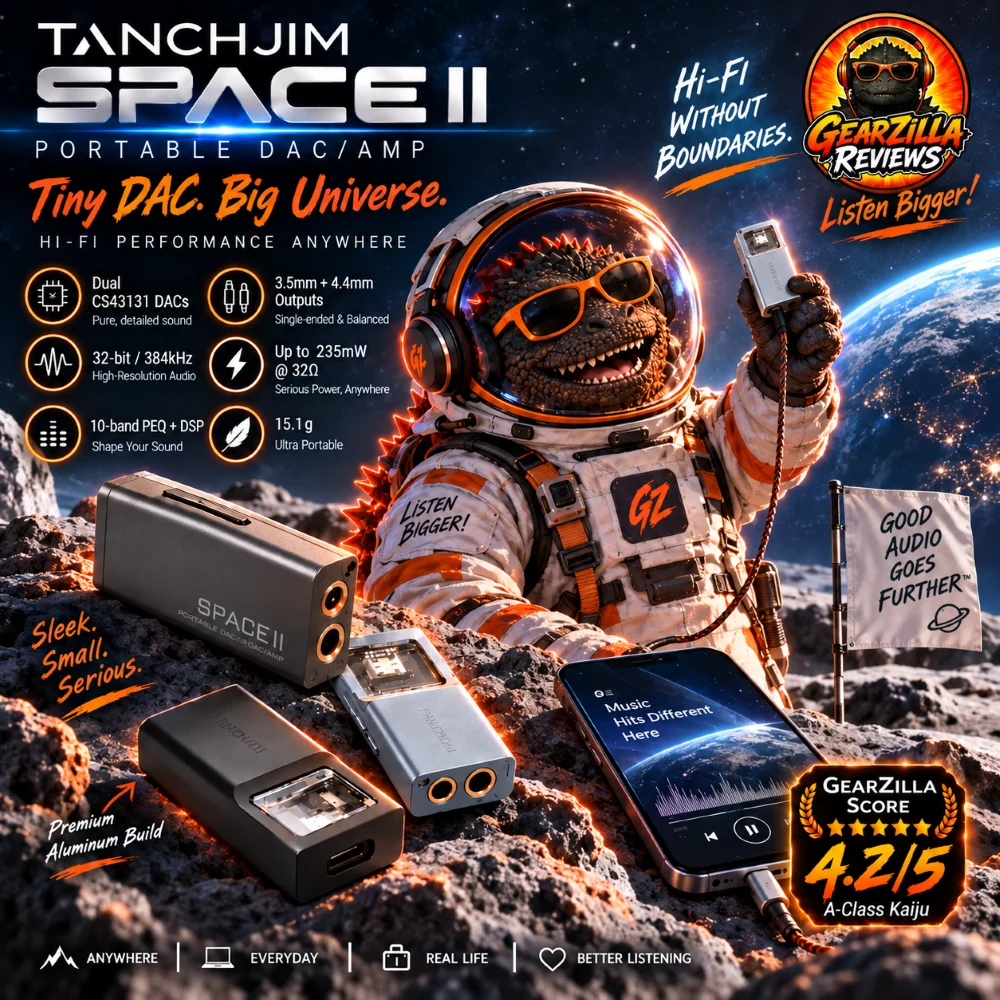
✅ Pros: Ridiculously small and lightweight, dual CS43131 DAC architecture, 3.5mm single-ended and 4.4mm balanced outputs, excellent tuning flexibility, genuinely useful 10-band PEQ, excellent presets, physical volume controls, up to 32-bit/384kHz PCM support, UAC 1.0/2.0 support, low power consumption, clean, transparent presentation, and one of the most feature-packed portable DAC/amps I’ve encountered at this size.
⛔Cons: No iOS app configuration support, which is a real pain if you use an iPhone, since so much of the SPACE II’s appeal comes from its DSP, presets, and PEQ functionality. It also isn’t designed to win a raw-power arms race against larger dongles; the 4.4mm balanced output can get warm during extended use, and much of the exterior design will look familiar to owners of the original SPACE. The real upgrade is happening inside.

🦖 Micro Beast. Massive Bite.
Sometimes the most interesting audio gear arrives looking like it has absolutely no intention of being interesting. No giant screen, no brick hanging off your phone, and no desktop-sized chassis pretending to be portable just because you can technically pick it up.
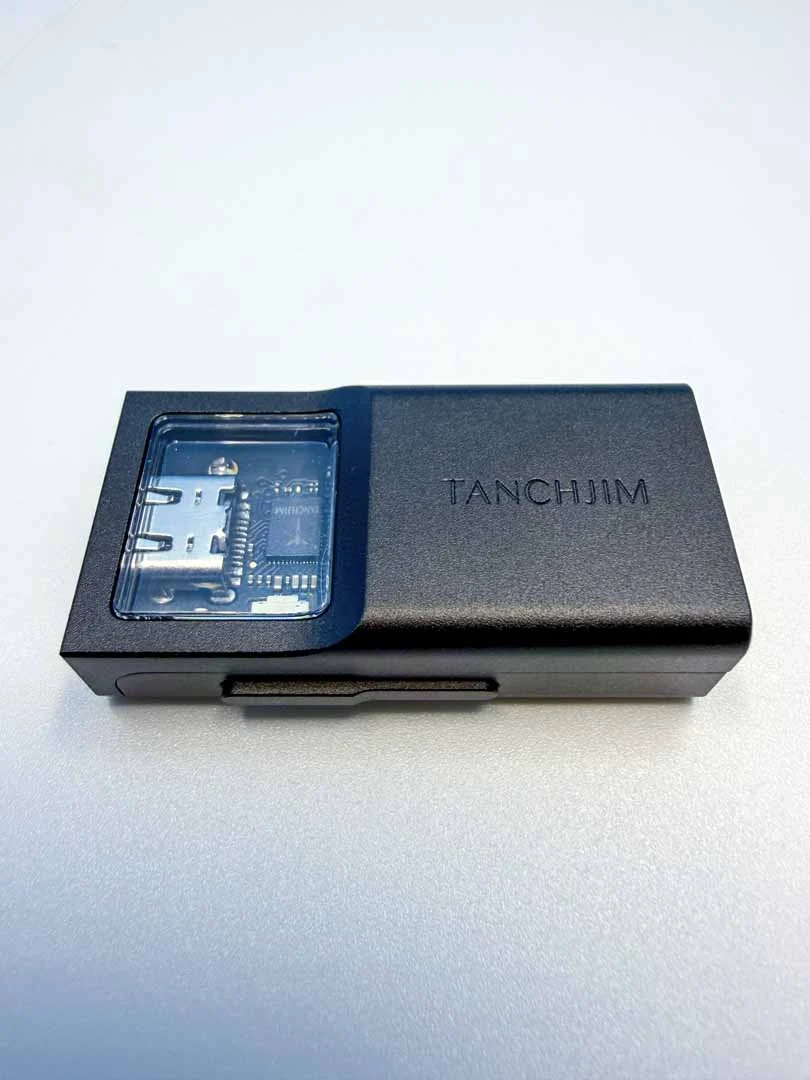
The TANCHJIM SPACE II is tiny. At just 15.1 grams, it practically disappears next to the phone powering it. Measuring a mere 1.65 × 0.83 × 0.47 inches, this tiny audio monster takes up no more pocket space than a standard USB flash drive and feels about as compact as two Lego bricks snapped together.
Yet somehow TANCHJIM looked at that little aluminum body and apparently decided there was still room for more.
Inside, you get dual CS43131 DACs, 3.5mm single-ended and 4.4mm balanced outputs, up to 235mW at 32Ω, 32-bit/384kHz PCM support, TANCHJIM’s PureBridge USB architecture, UAC 1.0 and 2.0, physical volume controls, DSP, presets, and a custom 10-band parametric EQ.
That’s an impressive feature list for any portable DAC. In something this small, it borders on ridiculous.
Better still, these aren’t just features piled onto a spec sheet. The DSP and tuning options give you meaningful control over how the SPACE II behaves, turning what could have been a simple dongle into something far more flexible.
There is one catch, and it’s a frustrating one for iPhone users. The lack of convenient iOS configuration makes accessing some of the SPACE II’s best tuning features more difficult than it should be. Considering how important DSP and PEQ are to the experience, that limitation matters.
Even with that annoyance, the SPACE II is much more than another tiny DAC/amp.
It’s basically a pocket-sized audio laboratory, and I’m having way too much fun with it.
🦖 Disclosure
-
- Understand what the product was designed to do.
- Hear it before I start trying to change it.
- Live with it long enough that the specifications stop being the story.
- Push a few buttons I probably shouldn’t, change things, and change them back.
🤏 First Impression: Wait… That’s It?
My first reaction was basically: Where’s the rest of it?
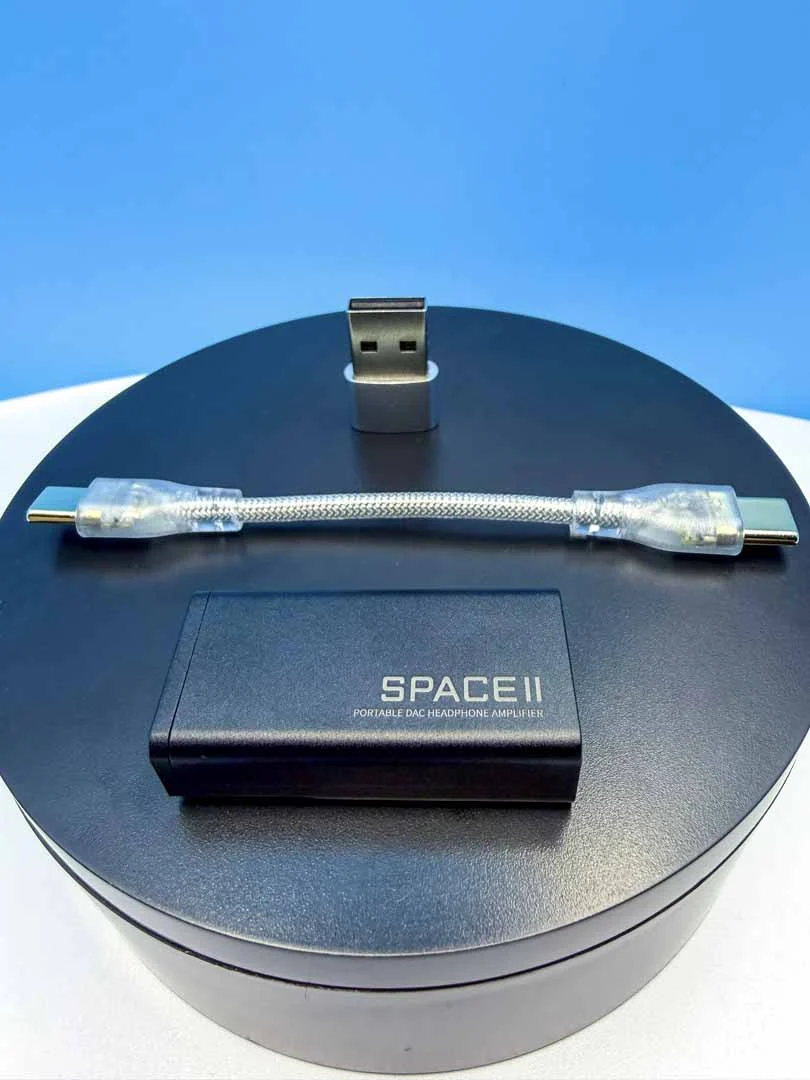
The SPACE II is almost comically small. At approximately 4.2 × 2.1 × 1.2 cm, it’s the kind of DAC that practically disappears next to the phone powering it, and that matters more than it might sound.
Portable DAC/amps usually start with a very reasonable mission: make your phone sound better. Somewhere along the way, though, some of them seem to evolve into, “What if we made the phone carry a small cinder block?”
Not here.
The SPACE II feels like a dongle should feel. It’s small, light, easy to carry, and simple enough that you can plug it in, connect your IEMs, and start listening without turning your portable setup into a project.
That simplicity is part of the appeal.
But underneath it, TANCHJIM hid a surprising amount of flexibility and control. Once you start digging into the DSP, presets, and PEQ, this tiny little DAC opens into a much deeper rabbit hole.
And that’s where the fun begins.
🎧 Review Philosophy
Every GearZilla review starts the same way:
Listen first. Figure out the story later.
And the story of the SPACE II isn’t simply that it has two CS43131 DAC chips.
Lots of audio products have impressive components.
The story is what TANCHJIM lets you do with them.
The SPACE II can function as a clean, straightforward portable DAC/amp.
If that’s all you want?
Great.
But start digging into the DSP and PEQ capabilities, and suddenly this tiny aluminum rectangle starts behaving more like a configurable audio platform.
That’s when I started smiling.
And that’s also why the lack of convenient iOS configuration bugs me so much.
The software features are too good to make Apple users jump through hoops to access them.
🧬 KAIJU DNA SCAN
Every monster leaves behind a genetic signature. Here’s what this tiny beast looks like.
K • Kill Shot
The SPACE II’s greatest weapon is serious sound control without sacrificing portability.
It isn’t trying to win with oversized power numbers, a giant display, or enough RGB lighting to announce to everyone within 30 feet that an audiophile has entered the building. Its strength is control.
You start with a clean, transparent source and then decide where you want to go. Want more warmth? You can get there. Want something a little more nostalgic? There are presets for that. Want to build your own profile using a proper parametric EQ? Go nuts.
That’s the SPACE II kill shot. It doesn’t simply give you a sound and tell you to live with it.
It gives you tools.
A • Anatomy
Inside this tiny chassis, TANCHJIM packs an impressive amount of hardware and functionality:
- Dual Cirrus Logic CS43131 DAC chips
- TANCHJIM PureBridge USB digital transmission architecture
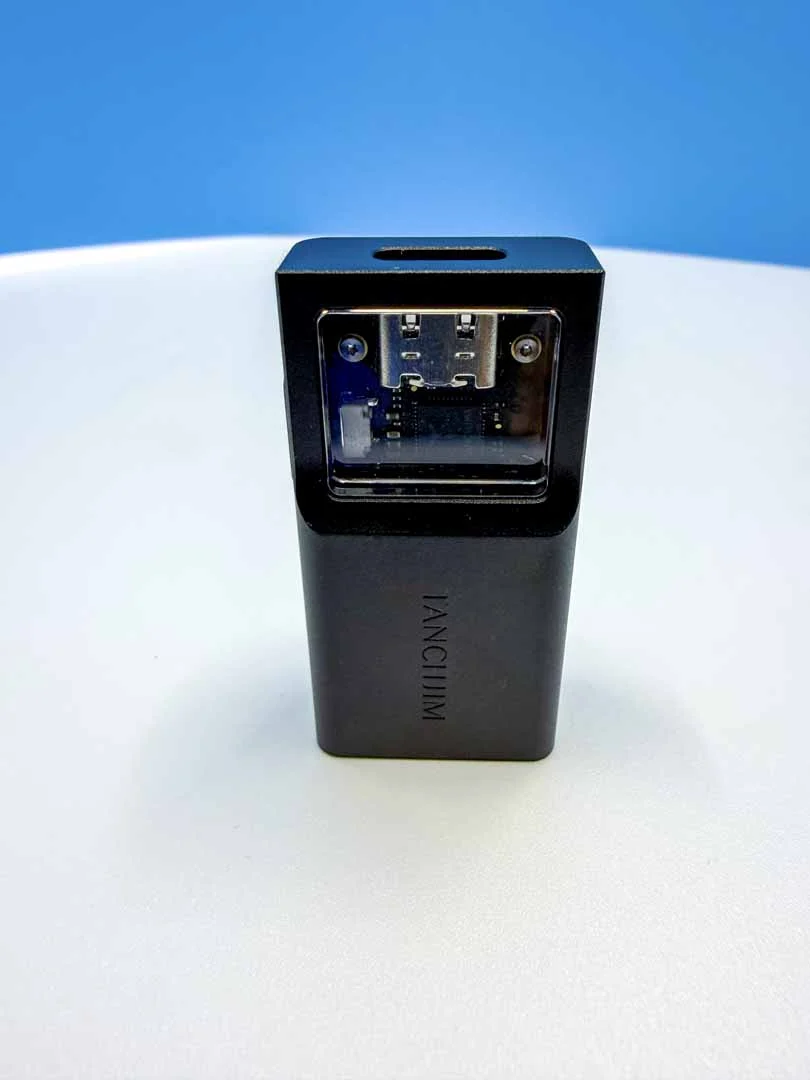
- USB-C input
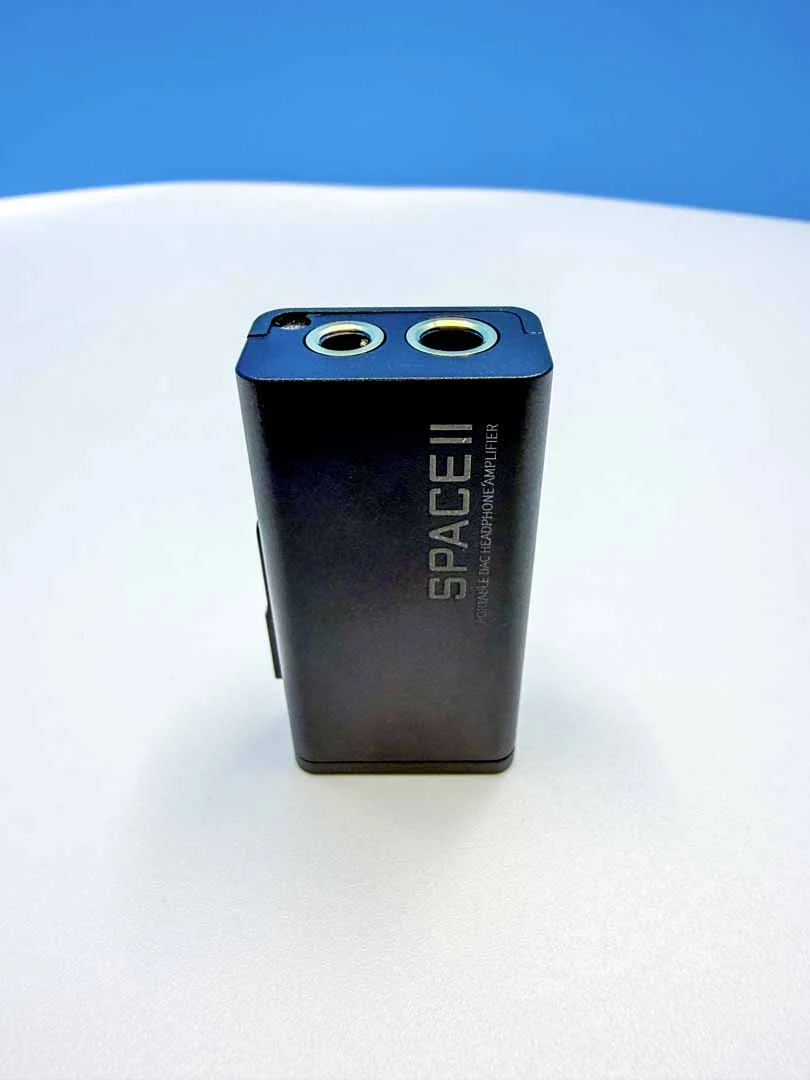
- 3.5mm single-ended output
- 4.4mm balanced output
- Up to 2Vrms through 3.5mm
- Up to 4Vrms through 4.4mm
- Up to 235mW at 32Ω
- PCM support up to 32-bit/384kHz
- UAC 1.0 and UAC 2.0 modes
- DSP functionality
- HiFi and gaming presets
- Virtual soundstage processing
- Parametric EQ
- Physical volume buttons
And somehow the whole thing weighs approximately 15.1 grams.
That specification still makes me laugh.
I have cables that feel heavier.
I • Impact
The SPACE II makes its biggest impact by knowing when to stay out of the way.
Its baseline presentation leans toward clarity and transparency rather than forcing a heavy sonic personality onto everything you connect. That approach makes perfect sense for a product with this much DSP and tuning flexibility.
Start clean, then let me decide.
If TANCHJIM had locked the SPACE II into an exaggerated house sound, it would have undermined half the reason for including PEQ and presets in the first place. Instead, you get a neutral foundation that preserves the character of your IEMs or headphones, then gives you the option to reshape things when you want to.
The SPACE II gives you the foundation.
Then it hands you the keys.
J • Joy
This is where the little monster really gets me: the tweaking.
Most normal people probably connect a DAC and start listening to music. Audiophiles connect one and immediately start wondering what happens if they change a filter, try a preset, add a little warmth, or build an entirely new PEQ profile just because the option is sitting there.
That sense of experimentation is a big part of the fun with the SPACE II. Tube Mode, CD Sound, custom PEQ, different profiles… you can keep exploring without the process ever feeling like work.
And every once in a while you make a change, start listening, and think:
Wait. Go back. That sounded awesome.
That’s joy.
You can absolutely plug the SPACE II in and forget about all of this, but I suspect a lot of GearZilla readers won’t want to.
U • Unleashed
The SPACE II really gets unleashed once you start digging into its DSP capabilities, and the centerpiece is a real 10-band parametric EQ.
This isn’t a couple of vague Bass+ and Treble+ buttons. You gain meaningful control over the sound, turning the SPACE II from a simple portable DAC/amp into an active part of the tuning chain.
Then TANCHJIM adds presets like Tube Mode and CD Sound, giving you quick ways to move away from the clean baseline without swapping gear. Want a little more warmth and body? Change the profile. Want to experiment with a different character for a particular IEM? Do it there.
You don’t need another DAC. You don’t need to change IEMs. And you don’t need to start digging through the cable drawer while convincing yourself copper sounds approximately 7.3 percent more emotional today.
That flexibility is insanely useful.
It also makes the lack of convenient iOS configuration even more frustrating. DSP isn’t some throwaway bonus feature buried in the spec sheet. It’s one of the SPACE II’s strongest features, and Apple users should have the same easy access to it.
🎼 Sound: Start Clean, Then Choose Your Adventure
The SPACE II’s smartest move is that it doesn’t try too hard to impose a personality of its own. Its baseline character is clean, neutral, detailed, and transparent, which is exactly what I want from a DAC this configurable.
This isn’t an IEM, so I don’t necessarily want the source deciding what my music should sound like. I want it to preserve what my gear is already doing well, give me a clear view into the recording, and stay out of the way unless I ask it to do something different.
I want it revealing what my gear can do.
And when I do want to change the presentation, that’s where the SPACE II gets fun. The DSP, presets, and PEQ give me plenty of room to shape the sound without sacrificing the clean foundation underneath it.
🔬 Clarity & Resolution
The dual CS43131 implementation gives the SPACE II the kind of clarity I want from a good portable source. Edges stay clean, separation is strong, and there’s plenty of information coming through without the DAC trying to fake detail by pushing everything into an obnoxiously bright presentation.
That distinction matters.
Clarity should reveal the music, not interrogate it.
The SPACE II stays controlled and transparent enough that the IEM or headphone you connect remains the star of the show. It adds definition and structure without forcing its own personality over everything else in the chain.
That’s exactly how I like a DAC to behave.
🌌 Separation & Space
A good source shouldn’t turn every recording into some giant artificial soundstage. What it should do is preserve the spatial information that’s already there and give the music enough room to breathe.
That’s where the SPACE II works well. Layers remain easy to follow, placement stays clear, and more complex passages don’t collapse into one crowded image. Because the underlying tonal balance is relatively neutral, the presentation also avoids that exaggerated sense of width some gear uses to create an instant “WOW, LISTEN HOW WIDE THIS IS!” effect.
Instead, the SPACE II feels controlled, organized, and clean. The space is there when the recording has it, but it doesn’t feel artificially stretched just to impress you.
And if you do want to start messing with the presentation, TANCHJIM gives you additional DSP and virtual soundstage options to experiment with.
Apparently restraint lasted about five minutes.
📱 DSP: The Secret Weapon With an Apple-Sized Asterisk
The SPACE II’s DSP functionality deserves its own section because it’s one of the biggest reasons this little DAC is so interesting.
Companion software can sometimes feel like homework. You install an app, create an account, accept a bunch of permissions, poke around for five minutes, and eventually wonder why you bothered. The SPACE II is different because the software actually adds meaningful functionality to the hardware.
You can adjust EQ, build parametric EQ profiles, experiment with sound presets and filters, change output behavior, explore gaming options, and play with virtual soundstage processing. More importantly, these aren’t just settings added so TANCHJIM can put “APP CONTROL” on a marketing graphic. The changes are audible and genuinely expand what you can do with the DAC.
That makes the software feel like part of the SPACE II experience rather than an accessory to it.
Unfortunately, that’s also what makes the iOS limitation so frustrating. iPhone users don’t get the same convenient path to configuring these features, and we’re not talking about some obscure setting buried six menus deep. DSP and PEQ are among the strongest reasons to buy the SPACE II in the first place.
If TANCHJIM is going to make these tuning tools this capable and this useful, iOS users should have equally easy access to them.
The hardware feels wonderfully modern. The iPhone experience needs to catch up.
🎚️ 10-Band PEQ: Now We’re Talking
This may be my favorite feature on the SPACE II: a real 10-band parametric EQ.
If you know GearZilla, you know I love being able to shape gear around my own preferences. Sometimes an IEM is already 90 percent of the way there, but I want a little more vocal lift, a touch more bass, or I need to tame one energetic region that keeps pulling my attention away from the music.
And sometimes I just want to see how ridiculous I can make something sound before immediately hitting reset.
For science.
PEQ gives you that control, and because the tuning happens at the source level, the SPACE II becomes incredibly versatile across different IEMs and headphones. You can create different profiles for different gear, genres, or moods without having to change anything else in the chain.
That turns one tiny dongle into a much more adaptable piece of your setup.
And for someone who enjoys experimenting with sound, that’s powerful.
🔥 Tube Mode: Digital Heresy Has Never Been So Much Fun
Let’s clarify something: there are no tiny vacuum tubes hiding inside the SPACE II. Although, considering how much TANCHJIM managed to cram into this thing, I wouldn’t completely rule it out.
Tube Mode is DSP, and that’s perfectly fine with me. The whole point is to give you a warmer, richer alternative to the cleaner stock presentation without forcing you to swap hardware or rebuild your setup every time your mood changes.
Maybe you want the neutral presentation today. Maybe tomorrow you want a little more body, warmth, or smoothness. That flexibility is exactly why DSP is useful. You can change the character of the experience in seconds and then go right back when you’re done.
Audiophiles occasionally act like changing the sound electronically is some kind of moral failure. I’ve never understood that.
If the technology is there, it works, and it helps you enjoy the music more, use it.
GearZilla’s position is simple: turn the damn knob.
💿 CD Sound: Hello, Old Friend
Then there’s CD Sound.
And this one tickles the nostalgia centers.
For those of us who remember when carrying a binder full of CDs was considered portable audio, there’s something wonderfully ridiculous about recreating that flavor of the experience with a 15-gram dongle connected to a modern smartphone.
Technology is weird.
I love it.
Again, the importance isn’t whether one preset becomes your permanent setting.
It’s that the SPACE II invites you to explore.
And exploration is half the fun of this hobby.

⚡ Power: Enough Is a Specification Too
The balanced output is rated for up to 235mW at 32Ω. Are there competing dongles with bigger power numbers? Absolutely. This is audio, so somewhere on the internet someone is already furiously typing, “BUT THIS OTHER ONE HAS MORE MILLIWATTS.”
And that’s fine. If your main goal is maximizing raw output, there are other dongles built specifically to win that numbers game.
The SPACE II is balancing something different. It gives you enough power for the kind of portable listening it’s designed around while also keeping size, efficiency, heat, features, and everyday usability in check. For IEMs, which are exactly the kind of gear I expect many people to pair with a DAC this small, that balance makes far more sense to me than chasing a giant output figure just because it looks impressive on a spec sheet.
That’s really the point. The SPACE II isn’t trying to replace a powerful desktop amplifier or drive every headphone ever created.
It’s a pocket DAC, not a nuclear reactor.
And for what it’s designed to do, I think TANCHJIM made the smarter tradeoff.
🔌 3.5mm AND 4.4mm
Having 3.5mm single-ended and 4.4mm balanced outputs in something this small gives the SPACE II a lot more flexibility than its size suggests. It means I can move between different IEMs and cables without reaching for an adapter or wishing I’d brought a different version of the DAC.
That sounds like a small thing until you’re actually living with portable gear every day. The fewer extra pieces I need to think about, the better.
And there’s something satisfying about grabbing the SPACE II, plugging in whatever cable I’m using that day, and just getting on with the music.
No adapter hunt. No compatibility drama. No staring at a 4.4mm cable while your dongle quietly judges your life choices.
Just plug in and go.
🎮 UAC 1.0 & 2.0: The Nerdy Feature That’s Actually Useful
The SPACE II supports both UAC 1.0 and UAC 2.0.
This isn’t the sexiest bullet point on the box.
But it expands compatibility, particularly with devices where UAC 1.0 support matters.
That’s the theme here again.
Flexibility.
The SPACE II keeps finding ways to be more useful than something this small has any right to be.
🤏 Portability: This Might Be the Whole Point
Let’s go back to 15.1 grams, because that number genuinely changes the experience.
A portable DAC stops feeling portable the moment it starts turning your phone into a two-piece carry-on luggage system. The SPACE II avoids that completely. It’s small and light enough that I can actually imagine leaving it connected rather than treating it like another accessory I have to constantly attach, detach, and manage.
Phone, short USB cable, SPACE II, IEMs. That’s the whole setup.
And yes, that sounds obvious, but portable audio should actually feel portable. The SPACE II gets that part right, and somehow that’s still worth celebrating.
🌡️ Heat
There is a tradeoff.
Push the SPACE II harder, particularly through the 4.4mm balanced output, and the chassis can get warm.
That isn’t particularly surprising given the amount of processing and amplification happening inside such a small aluminum enclosure.
But it’s worth knowing.
Tiny devices don’t have much real estate for shedding heat.
Physics remains undefeated.
🏋️ What the SPACE II Isn’t
The SPACE II isn’t the dongle I’d buy if my main goal were powering every absurdly demanding full-size headphone I could find. That’s simply not what it’s built to do.
There are larger portable DAC/amps with more output, and there are transportable units that blur the line between dongle and desktop gear. The SPACE II takes a different approach.
It gives you enough power for the role it’s designed to fill, then focuses on everything else that makes a portable source enjoyable to use: both 3.5mm and 4.4mm outputs, excellent conversion, PEQ, presets, physical controls, low power consumption, and a form factor small enough to disappear into your pocket.
That balance is what makes it interesting.
Rather than chasing the biggest power number on the spec sheet, TANCHJIM built something compact, capable, and flexible enough to become an everyday carry.
For me, that’s a much more useful kind of performance.
💰 Value: You’re Buying Flexibility
The SPACE II’s value isn’t really about being able to say it has two CS43131 DAC chips. That’s the kind of thing that looks good on a spec sheet, but it doesn’t tell you what living with the product is actually like.
What matters is how many jobs this tiny thing can perform without ever feeling like it’s trying to be too much. It can serve as a clean, transparent everyday dongle, provide both 3.5mm and 4.4mm outputs, handle PEQ and presets, support gaming, and still stay small enough that you barely notice it hanging off your phone.
That combination is what makes the SPACE II so appealing.
It isn’t chasing one spectacular trick. It’s trying to be the little DAC you keep reaching for because it works across so many different situations without adding bulk or complication to your setup.
That flexibility is genuinely valuable, especially if you rotate through different IEMs, cables, and listening profiles.
The one thing holding it back from feeling completely universal is the iOS configuration limitation. For Apple users, that’s a real blemish because some of the SPACE II’s best features live inside its DSP and tuning tools. The hardware is wonderfully flexible. The software experience should be too.
The SPACE II typically retails for $87 to $115 USD.
👹 Who Is This For?
The TANCHJIM SPACE II makes the most sense for someone who wants a genuinely portable source without giving up control. It’s especially well suited to IEM listeners, people who enjoy experimenting with PEQ and presets, and anyone who regularly switches between 3.5mm and 4.4mm gear.
It’s also a great fit for listeners who want their portable setup to stay portable. The SPACE II gives you plenty of flexibility without turning your phone into a two-piece audio brick or making the DAC itself the center of the entire setup.
That’s really the appeal. It gives you room to experiment when you want to, but it stays small and simple enough to disappear into everyday use.
This little monster gets it.
The biggest caveat is for iPhone users. You still get an excellent DAC/amp, but the lack of convenient iOS configuration means you don’t get the easiest access to some of the SPACE II’s best DSP and tuning features. If those features are a major reason you’re buying it, that limitation is absolutely worth considering.
🦖 GearZilla Score
🤏 Portability: 5.0/5
At approximately 15.1 grams, this is exactly how portable audio should feel. Tiny, lightweight, and easy to live with.
🎚️ Tuning Flexibility: 4.0/5
The 10-band PEQ and DSP tools are a huge part of what makes the SPACE II special, but that flexibility is not equally available across platforms. Android users get the full tuning experience. On iOS, I can’t configure PEQ, which significantly limits one of the product’s strongest selling points.
🔬 Transparency & Clarity: 5.0/5
The underlying sound remains excellent. The SPACE II gives you a clean, transparent foundation that lets the connected IEM or headphone keep its own personality without adding unnecessary coloration.
🔌 Connectivity: 5.0/5
Having both 3.5mm single-ended and 4.4mm balanced outputs in something this small is fantastic and makes the SPACE II easy to use across a wide range of portable gear.
⚡ Power: 4.5/5
Up to 235mW at 32Ω through balanced is plenty for the role the SPACE II is designed to fill. There are more powerful dongles if raw output is your priority, but this one is clearly built around balance rather than brute force.
📱 Features & DSP: 4.0/5
This is where the iOS limitation hurts most. The PEQ, presets, filters, and DSP functionality are among the SPACE II’s defining features, but iPhone users cannot take full advantage of them. When a headline feature is unavailable on one major mobile platform, it has to materially affect the score.
☁️ Everyday Usability: 4.3/5
The size, physical volume controls, dual outputs, and detachable USB connection make the SPACE II incredibly easy to carry and use. But if your daily source is an iPhone, the lack of PEQ configuration becomes a recurring limitation rather than a minor inconvenience.
💰 Value: 4.6/5
The hardware value is still excellent. Dual CS43131 DACs, both major headphone outputs, strong sound quality, and serious portability make this a compelling little DAC. Android users get even more for their money because they can access the full tuning experience.
🦖 Overall GearZilla Rating: 4.2/5 • A-Class Kaiju
The SPACE II is still an excellent portable DAC/amp and one of the most interesting little dongles I’ve used. But PEQ is too important to this product’s identity to ignore the fact that iPhone users can’t fully access it.
On Android, this feels closer to a 4.5 product. On iOS, that missing functionality pulls the overall GearZilla score down to 4.2.
🦖 Final Roar
The TANCHJIM SPACE II is kind of absurd, not because it’s the most powerful dongle in existence or because it tries to overwhelm you with flashy hardware, but because of how much TANCHJIM managed to hide inside something that weighs just 15.1 grams.
You’re getting dual CS43131 DACs, 3.5mm and 4.4mm outputs, physical volume controls, UAC flexibility, DSP, presets, and a genuinely useful parametric EQ, all packed into a tiny aluminum chassis that practically disappears next to your phone. More importantly, underneath all those features is a clean, transparent foundation that lets your IEMs and headphones retain their own character.
That’s what makes the SPACE II special.
You can plug it in, hit play, and treat it like a wonderfully simple portable DAC/amp. Or you can open things up and start experimenting. Try Tube Mode. Jump into CD Sound. Build a PEQ for a favorite IEM. Add a little warmth, pull something back, or completely change the presentation just because you can.
And that sense of exploration is what I keep coming back to.
The SPACE II takes something that could have been another anonymous USB dongle and turns it into a genuinely fun audio tool. It gives you enough control to tailor the experience without making you carry around a brick or build your portable setup around the DAC itself.
My biggest complaint is directly connected to one of its greatest strengths. The DSP and PEQ capabilities are fantastic, which makes the lack of an easy iOS configuration even more frustrating. If you’re an iPhone user like me, you can still enjoy the SPACE II as a terrific DAC/amp, but you don’t get convenient access to one of the features that makes it stand apart. That needs fixing.
Beyond that frustration, TANCHJIM absolutely nailed the assignment. The audiophile world has plenty of products that seem determined to prove their seriousness by getting bigger, heavier, hotter, and more complicated. The SPACE II goes the opposite direction.
Make it tiny. Give it plenty of capability. Add meaningful tuning tools. Make it easy to carry. Then get out of the way and let me listen.
Apparently TANCHJIM found room for almost everything.
Now just make a little room for iOS.
✅ Buy If
- 🤏 You want an extremely small and lightweight portable DAC/amp.
- 🎧 IEMs make up a significant part of your listening.
- 🎚️ A proper 10-band PEQ sounds like something you’ll actually use.
- 🔬 You want a clean, transparent foundation rather than a heavily colored source.
- 🔥 You like the idea of switching between cleaner and warmer sound profiles.
- 🔌 You regularly use both 3.5mm and 4.4mm cables.
- 🎮 UAC 1.0/2.0 flexibility matters for your devices.
- 📱 You want DSP functionality that goes beyond a couple of gimmicky presets.
- 🪶 You’re tired of supposedly portable DAC/amps that feel like they’re trying to pull the USB port out of your phone.
- 🦖 You believe half the fun of audio is experimenting with it.
⛔ Skip If
- 🍎 You rely exclusively on iOS and want easy app-based access to the SPACE II’s PEQ, presets, and configuration features.
- ⚡ Your number-one priority is getting the highest possible output-power figure for the money.
- 🎧 You’re primarily driving extremely demanding full-size headphones.
- 🧊 You expect a tiny balanced DAC/amp to remain completely cool under every operating condition.
- 📺 You need a display showing sample rate, volume, and other status information.
- 🎚️ You have absolutely no interest in PEQ, presets, or DSP and simply want maximum amplification per dollar.
- 🧱 You prefer your portable DAC to possess enough mass to double as emergency home-defense equipment.
The TANCHJIM SPACE II doesn’t need much space.
It just gives you a ridiculous amount of room to play.
Listen. Explore. Review. Repeat.
Explore the TANCHJIM SPACE II: https://tanchjim.com/en/products/dac/space-ii/
Hear the GearZilla Roar. 🦖
Share This Story, Choose Your Platform!