



From the legendary xDSD Gryphon’s engineering heritage comes a new breed of portable audio monster, armed with remarkable musicality, formidable power, exceptional craftsmanship, and innovations that make rediscovering your favorite music an absolute pleasure.
Overall GearZilla Rating: 4.7/5 ⭐
🎧 iFi iDSD GR 2: The Monster That Wouldn’t Let Me Walk Away
I’ve attended enough audio shows to recognize when a piece of equipment makes a powerful first impression. You sit down, connect your favorite headphones, listen to a few familiar recordings, trade enthusiastic observations with the manufacturer, and move on to whatever fascinating contraption is waiting at the next table. Sometimes you discover something genuinely special; other times, the excitement disappears somewhere between the convention floor and the parking garage.
But every once in a while, something happens that disrupts the entire routine.
At CanJam SoCal, that something was the iFi iDSD GR 2.
Over two days, I returned to the iFi booth five separate times. Not because I’d forgotten something, needed another demonstration for completeness, or wanted to make polite conversation with the team. I kept returning because every time I sat down with this remarkable little machine, it revealed another reason to be impressed.
My first encounter focused on the music. The presentation was immediately engaging, with the kind of richness, clarity, and immersive character that makes me forget I’m supposed to be evaluating equipment. But the longer I explored, the more I realized that iFi had created something considerably more ambitious than another excellent portable DAC/headphone amplifier.
I discovered K2HD processing and found myself revisiting familiar recordings to explore what harmonic enhancement and upsampling could contribute. Then came XBass+ and XSpace, two different ways to experiment with musical weight and spatial presentation without rebuilding an entire listening setup. The gorgeous color touchscreen made everything wonderfully accessible, while the amplification options, digital filters, and extensive connectivity kept giving me new reasons to stay.
Then I noticed the dedicated USB-C charging connection, separate from the digital audio input, and I practically wanted to applaud the engineering team.
Seriously, someone had been paying attention.
By my fifth visit, I wasn’t trying to decide whether the GR 2 was impressive. I was trying to figure out how I could spend considerably more time with it.
Thankfully, Ricardo and the wonderful team at iFi Audio made that possible by sending over a review sample.
I’ve now spent about a month using the GR 2 every day, often for extended listening sessions. That means I’ve moved beyond the convention-floor spectacle and explored what happens when an exciting product becomes part of an ordinary listening routine.
And folks, I’m even more impressed today.
The GR 2 has become one of those rare pieces of equipment that makes me want to listen longer, explore more music, and revisit recordings I thought I knew inside and out. Its underlying performance is wonderfully satisfying, but it’s the combination of sound quality, thoughtful engineering, intuitive controls, and seemingly endless flexibility that makes the overall experience so compelling.
I particularly appreciate that iFi hasn’t created a device that demands technical expertise simply to enjoy its more advanced features. There’s a surprising amount happening inside this chassis, yet the GR 2 makes experimentation feel natural rather than intimidating. I can adjust a setting, explore a different presentation, or switch between headphones and IEMs without feeling like I need an engineering degree and a weekend seminar.
This is exactly what I want from a serious enthusiast’s portable audio tool.
Of course, there are compromises. The GR 2 is larger and heavier than I’d prefer for something meant to travel, and its approximately seven-hour rated battery life doesn’t quite match the rest of the package’s remarkable versatility. Those shortcomings matter, especially when smaller, lighter portable audio solutions have become increasingly capable.
But here’s the most important part of this entire review.
I’m buying one!
Not because iFi sent me a loaner sample, and certainly not because I feel obligated to reward the company for its generosity. I’m buying one because, after a month of daily listening, I’ve concluded that the GR 2 offers almost everything I want from a portable enthusiast DAC/amp, and I can genuinely see myself enjoying it for a long time.
That enthusiasm earns the iFi iDSD GR 2 a 4.7/5 GearZilla rating, one of my strongest endorsements for a product that combines sophisticated engineering with a wonderfully approachable listening experience.
And perhaps the most fitting part of this story is its heritage.
The GR 2 descends from one of iFi’s most celebrated portable designs, the xDSD Gryphon, but the company has deliberately given its successor a new identity rather than simply calling it the Gryphon 2.
I think that distinction deserves respect because it really does feel different.
The Gryphon established the legend. The GR 2 is the monster born from everything iFi learned along the way.
And this particular monster has one hell of a roar.
✅ Pros: Wonderfully musical, engaging, and immersive listening experience; excellent underlying DAC and amplification performance; impressive power for a portable device; exceptional flexibility across headphones and sensitive IEMs; outstanding color touchscreen and intuitive control system; fascinating K2 and K2HD harmonic processing; highly enjoyable XBass+ and XSpace analog sound shaping; useful digital filters; Bluetooth 5.4 with LDAC and aptX Lossless support; extensive wired and wireless connectivity; dedicated USB-C charging and data connections; intelligent Hybrid Battery Mode; thoughtful battery-health management; excellent craftsmanship; and an overall ownership experience that consistently encourages musical exploration.
⛔ Considerations: Substantial size and 268g weight make it more transportable than effortlessly pocketable; approximately seven hours of rated battery life is disappointing relative to its otherwise exceptional capabilities; no full onboard parametric EQ; and listeners who simply want an ultra-compact, plug-and-play dongle may find its extensive functionality unnecessary.

🤝 Disclosure: The Truth Behind the Roar
Huge thanks to Ricardo and the entire iFi Audio team for generously providing the iDSD GR 2 review sample. I genuinely appreciate the opportunity, especially since this collaboration began with my own enthusiasm after I kept returning to the GR 2 at CanJam SoCal.
Over the past month, I’ve used the GR 2 every single day, often for extended periods, exploring its features and discovering how naturally it fits into my listening routine. I’ve enjoyed the experience enough that I’ve decided to purchase one for my personal collection. At the time of writing, the unit used for this evaluation was provided for review, and my decision to purchase my own reflects my personal enthusiasm rather than any obligation to the manufacturer.
Every GearZilla review begins with the same philosophy: Listen first. Figure out the story later. My responsibility is to the reader, and receiving a review sample doesn’t buy a favorable verdict, guarantee a particular score, or protect a product from criticism. iFi hasn’t paid for this review or exercised editorial control over my conclusions. The observations and GearZilla rating are entirely my own.
That independence matters as much when I’m enthusiastic as when I’m disappointed. The GR 2 deserves recognition for its remarkable engineering and musical performance, but its considerable physical size, weight, and battery limitations deserve acknowledgment too. A great product doesn’t become more credible when a reviewer pretends its compromises don’t exist.
I’m grateful to partners like Ricardo and the iFi team who make meaningful, extended evaluations possible. It’s a pleasure to see a manufacturer invest so much thought in the details that matter to enthusiasts, and I appreciate the chance to experience those innovations firsthand.
Listen first. Figure out the story later. 🦖🎧
🎧 Review Perspective & Listening Setup: Finding the Monster’s True Personality
Every GearZilla review begins with the same philosophy: Listen first. Figure out the story later.
And behind every evaluation is one deceptively simple question:
Does this thing help me experience the music I already love in a new way?
I’m drawn to lush, musical, immersive presentations with expansive width, convincing depth, beautifully expressive vocals, controlled bass, and smooth, non-fatiguing treble. But personal preferences aren’t universal standards, and I have no interest in judging every product against a single sonic ideal. Great audio comes in countless personalities, and understanding what a manufacturer intended matters as much as deciding whether that approach suits my tastes.
That’s why I resist the temptation to immediately reshape what I’m hearing. I start with factory settings, EQ disabled, and optional sound enhancements bypassed wherever practical. I want to understand the foundation before exploring which adjustments might improve the experience.
I listen across genres, recording qualities, and playback volumes, focusing on tonal balance, dynamics, instrumental separation, vocal presentation, spatial relationships, and long-session comfort. When comparing sources, I use carefully matched listening levels whenever practical, recognizing that louder doesn’t automatically mean better and that expensive circuitry doesn’t guarantee a more compelling performance.
For perspective, I evaluated the GR 2 alongside familiar desktop and portable sources, including my FiiO K13 R2R and Topping DX5 II desktop DAC/amps, HiBy R4 digital audio player, and portable DAC/amps such as the iBasso DC-Tonfa and HiBy W4. These reference points span different DAC architectures, amplification approaches, and portability levels, providing useful context for assessing the GR 2’s performance and versatility. Using familiar headphones, IEMs, and recordings, I focused on meaningful audible differences rather than assumptions about price, specifications, or design philosophy. My goal wasn’t to declare one device universally superior, but to understand where the GR 2 distinguishes itself, what it offers beyond smaller portable alternatives, and whether its additional size and complexity translate into a more rewarding listening experience.
How I Evaluated the GR 2
For this evaluation, I treated the iFi iDSD GR 2 as two complementary experiences: a DAC/amplifier in its fundamental operating configuration and a versatile audio platform with optional processing capabilities.
I began with its sound enhancements disengaged, establishing a baseline before introducing K2HD, XBass+, or XSpace individually. This let me separate the underlying playback performance from the subjective changes each feature introduced.
Rather than assuming those enhancements were universally beneficial, I considered how they interacted with different recordings, headphones, IEMs, and listening preferences. A setting that complements one recording may be unnecessary or less convincing with another, and that’s an important distinction when evaluating a device designed to offer considerable flexibility.
I also examined the practical experience of switching between configurations, using different connections, navigating the interface, and integrating the GR 2 into everyday listening. Those observations matter because a feature’s usefulness depends not only on what it accomplishes sonically, but also on how easily and reliably someone can incorporate it into their routine.
Throughout the process, I avoided treating subjective preferences as objective improvements. When describing changes in tonal weight, perceived space, or harmonic character, I’m reporting what I heard rather than claiming that processing restores information absent from the original recording.
My objective wasn’t to discover one ideal GR 2 configuration. It was to understand its baseline performance, identify what its optional features actually contribute, and determine how those choices influence the listening experience.
With that foundation established, let’s get into what I heard.

🦅 The Gryphon’s Legacy: Born of Legend, Not Bound by It
Long before it lent its name to one of iFi’s most celebrated portable audio devices, the gryphon, more commonly known today as the griffin, held a commanding place in ancient mythology.
With the powerful body of a lion and the majestic head and wings of an eagle, this legendary creature united two of nature’s most formidable predators. Across ancient civilizations and centuries of artistic interpretation, it came to symbolize strength, vigilance, nobility, and the guardianship of extraordinary treasures.
It’s a wonderfully appropriate creature to inspire an audio product that combines capabilities that might otherwise require separate equipment.
The original iFi xDSD Gryphon embodied that idea beautifully, bringing digital conversion, headphone amplification, wireless audio, analog processing, and extensive connectivity into one portable component. It was an ambitious fusion of technologies, and its reputation helped establish expectations for what a serious enthusiast could reasonably carry outside a dedicated listening room.
But here’s what makes the mythology especially interesting.
In nature, evolution doesn’t create a larger copy of the previous generation. It’s about adaptation, refinement, and developing capabilities that allow a creature to thrive under different conditions.
That’s how I think about the GR 2.
iFi could have released a straightforward Gryphon 2 with modest improvements and a familiar identity. Instead, the company chose to distinguish the new product through the iDSD GR 2 name, emphasizing a substantially reworked architecture and a broader vision for what portable audio equipment could become.
I appreciate that decision because the new product deserves to establish its own character.
Its predecessor supplied the heritage, but the GR 2 brings a different collection of capabilities, including a newly selected Burr-Brown DAC, redesigned analog circuitry, greater amplification power, sophisticated harmonic processing, updated wireless connectivity, and a genuinely transformative touchscreen.
In the GearZilla universe, that’s the moment an ancient legend inspires a new Kaiju.
Not simply a familiar creature in fresh armor, but something that inherits its ancestors’ strengths and emerges with abilities of its own.
The Gryphon was the legend. The GR 2 is the evolution. And when done thoughtfully, evolution can be a magnificent thing to witness.
🏯 iFi Audio: Engineering That Understands the Enthusiast
I’ve always been interested in manufacturers willing to explore technologies that give listeners meaningful choices rather than simply chasing the most fashionable specifications.
The personal-audio industry has become remarkably competitive, with increasingly affordable products delivering extraordinary technical performance. High-resolution decoding, balanced outputs, powerful amplification, and sophisticated DAC chipsets are no longer exclusive to expensive flagship equipment.
That’s fantastic for enthusiasts, but it creates an interesting challenge for manufacturers operating at higher price points.
How do you justify a more ambitious product when comparatively inexpensive equipment can already deliver excellent sound?
In my view, the answer isn’t necessarily more bits, greater output power, or another dramatic claim about microscopic detail retrieval. It’s creating a more complete experience through thoughtful engineering, useful innovation, and attention to how people actually interact with their equipment.
The GR 2 demonstrates that philosophy exceptionally well.
iFi has invested in a redesigned conversion architecture, sophisticated amplification, multiple approaches to sound shaping, extensive connectivity, modern wireless capabilities, and intelligent battery management. But the real accomplishment is how naturally those technologies work together.
The touchscreen provides an excellent example. Advertising advanced processing isn’t especially meaningful if accessing it requires constant menu diving or deciphering obscure commands. iFi has addressed that problem by making the features approachable, letting listeners explore without interrupting the music.
The separate USB-C charging connection demonstrates the same thinking from a different direction. It’s not glamorous engineering, and it won’t dominate an advertising campaign, but it’s exactly the kind of detail that makes extended daily listening easier.
Even the adjustable amplification modes reflect an understanding that enthusiasts may alternate between sensitive IEMs and considerably more demanding headphones.
Those decisions tell me what the product prioritizes.
The GR 2 feels like a device designed by people who understand that audio enthusiasts don’t merely listen to equipment. We experiment with it, learn from it, and build our musical routines around the experiences it creates.
That’s the kind of innovation worth celebrating.
🎨 Design & Build: A Beautifully Engineered Unit
Let’s talk about the physical design because the GR 2 makes a strong impression before it plays a single note.
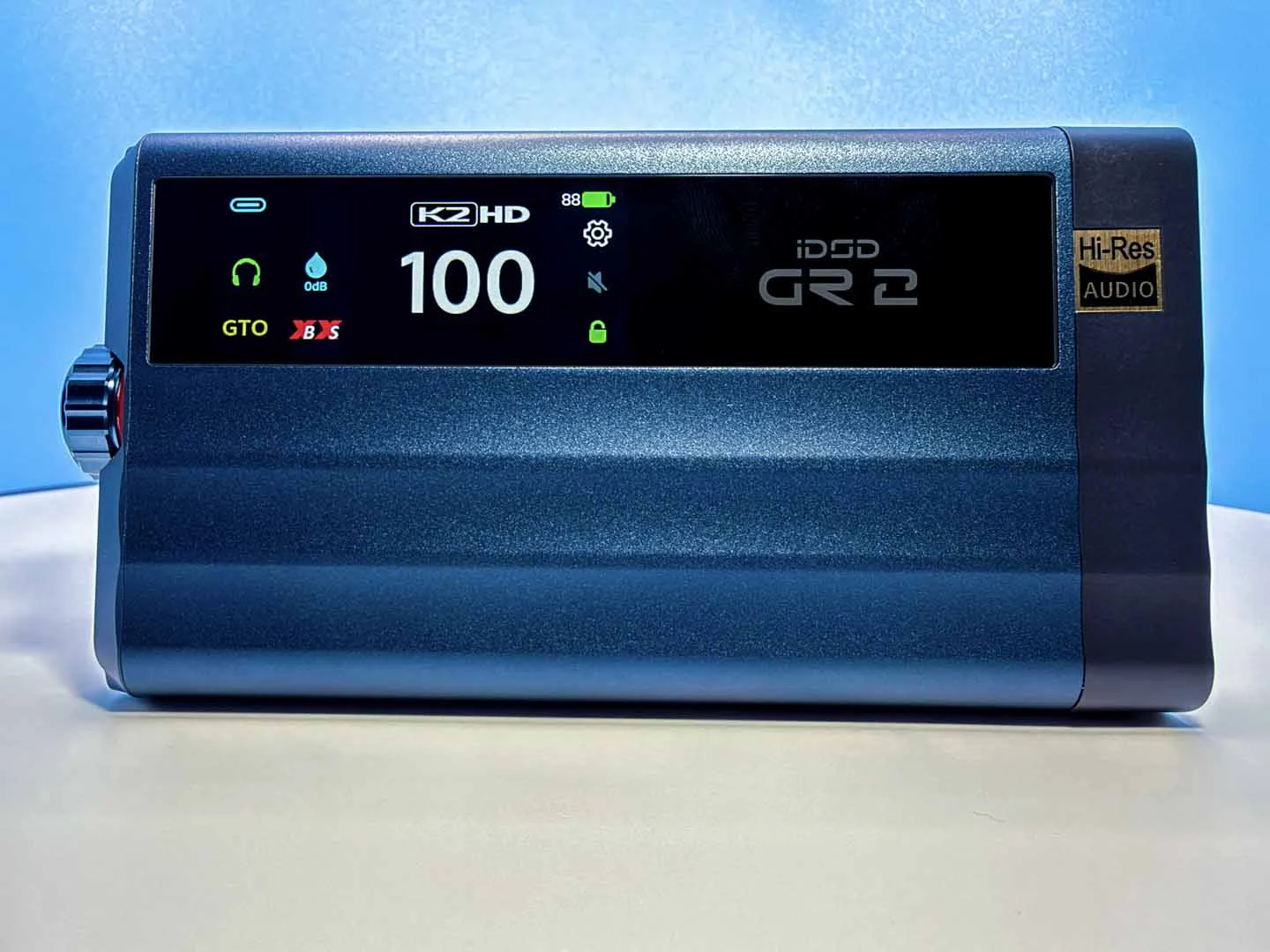
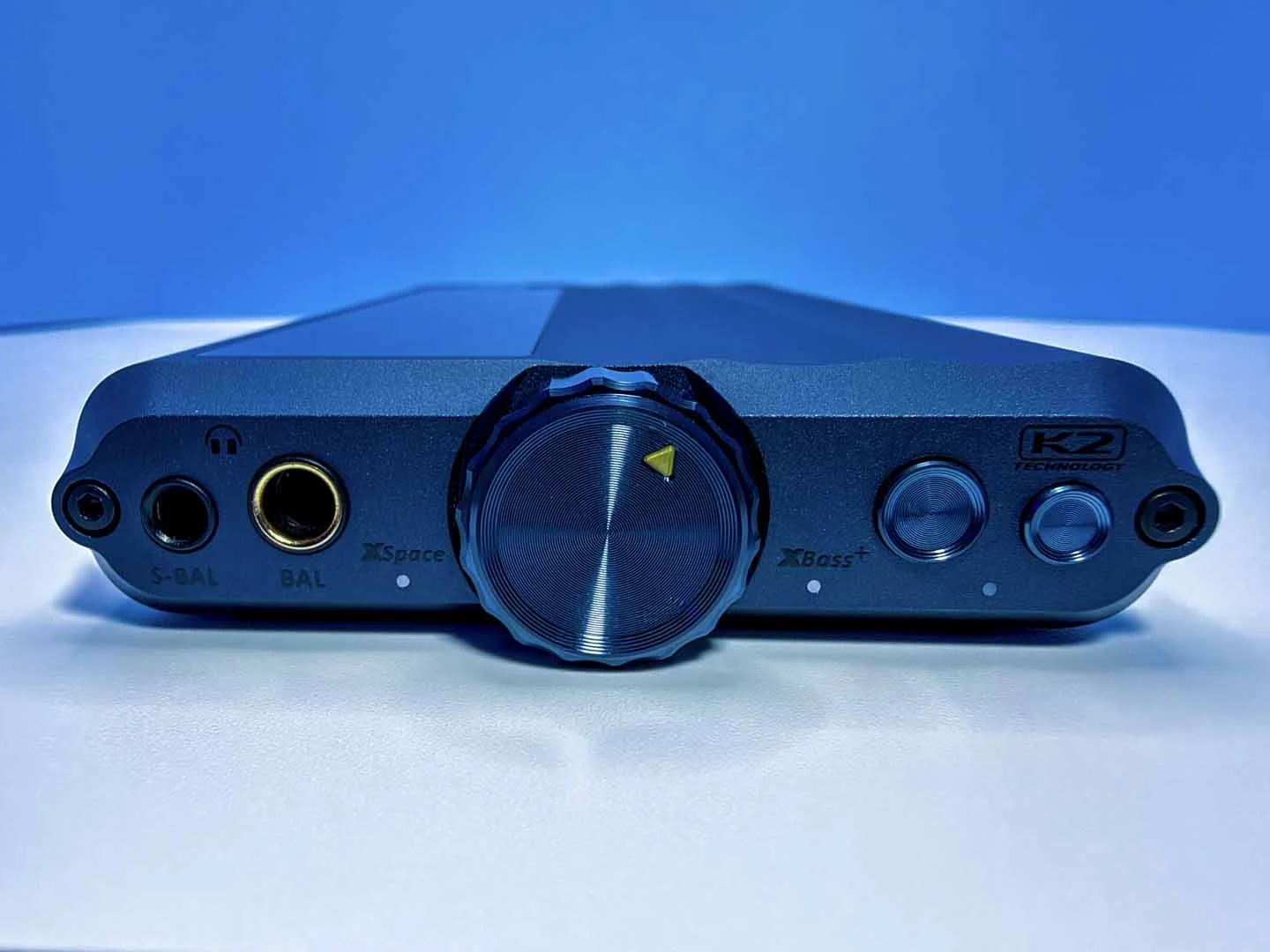
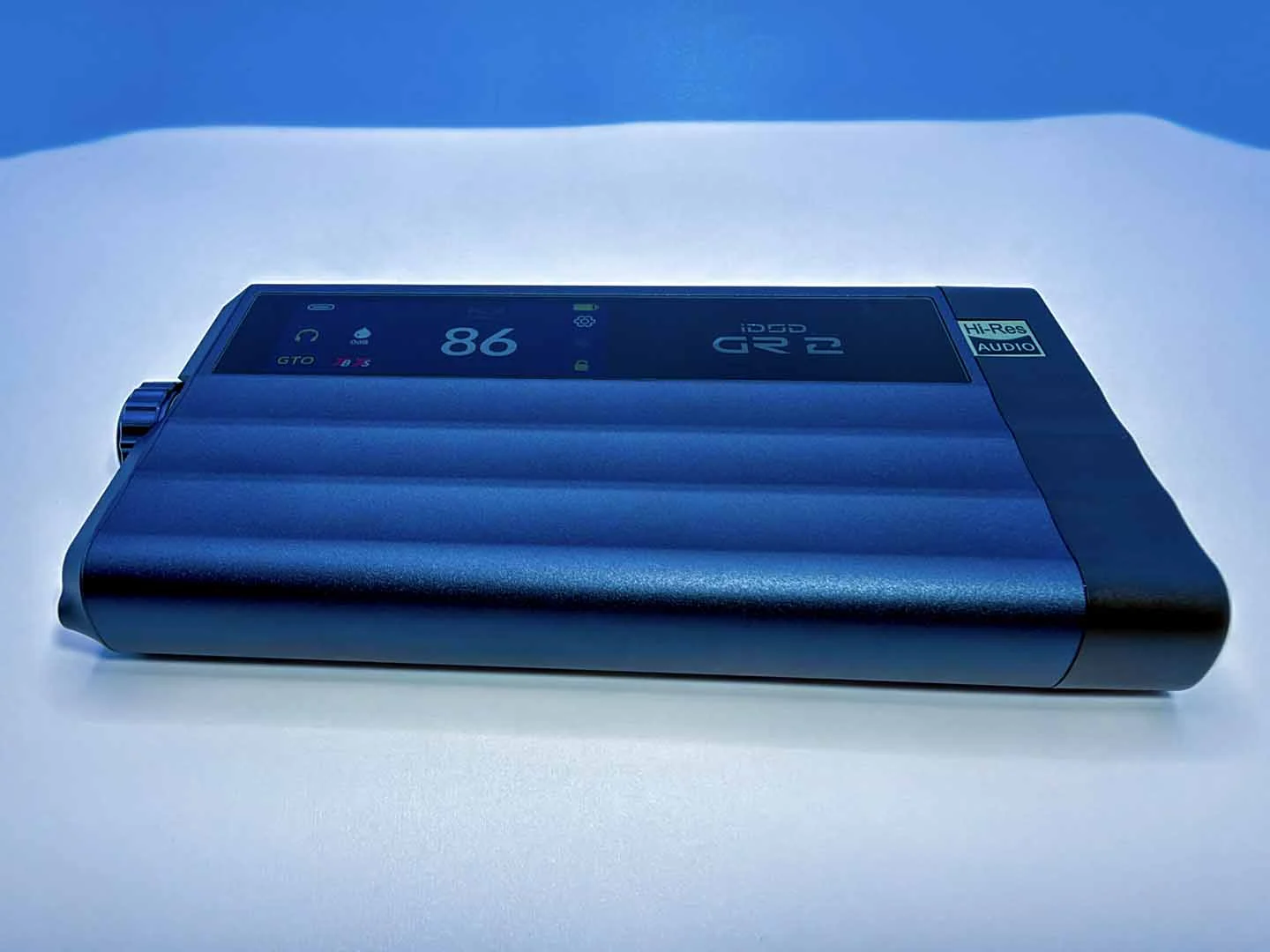
There’s something deeply satisfying about picking up equipment that feels like an instrument rather than a disposable electronics accessory. The substantial chassis, carefully integrated controls, crisp display, and purposeful connection layout show that iFi approached the GR 2 as serious enthusiast hardware.
And I absolutely love that.
The overall presentation is clean, sophisticated, and unmistakably functional. Rather than relying on elaborate decorative elements, the design allows its technological personality to speak for itself. The color display adds visual interest, the physical controls offer reassuring tactile interaction, and the surrounding enclosure maintains a cohesive look.
The construction feels appropriately premium for a long-term audio companion, and the overall execution reinforces my enthusiasm for iFi’s craftsmanship.
There’s also a wonderful sense of density to the GR 2. You can practically imagine how much engineering is packed inside, from the balanced amplification circuitry and Burr-Brown converter to the battery, wireless platform, digital processing, and multiple connection interfaces.
But that substantial construction introduces its most obvious drawback.
At 141 × 75 × 19mm and 268g, the GR 2 is not a tiny companion you casually forget is attached to your smartphone. It’s a dedicated portable audio component, and its physical presence reflects that ambition.
For me, that distinction matters because I appreciate equipment that travels easily, especially when I’m in cafés, moving between workspaces, or on a longer journey.
The GR 2 certainly qualifies as portable, but I see it more as a comfortable, transportable listening system than something I want dangling from a phone in my pocket.
Still, I can understand the engineering compromise. There’s a considerable amount of hardware here, and iFi has prioritized capability, power, and accessible controls over squeezing everything into an impossibly small enclosure.
I wish it were lighter, but I wouldn’t sacrifice the features that make it special just to shave a few millimeters.
The GR 2 looks and feels like a serious audio tool because it is.
And folks, this thing is a UNIT.
🖥️ Touchscreen & User Experience: The Interface That Changes Everything
I’ve reviewed plenty of sophisticated audio equipment, and one recurring frustration is how often manufacturers confuse a feature list with a great user experience.
An amplifier might offer multiple gain settings, digital filters, configurable outputs, wireless codecs, and firmware adjustments, but if accessing those features means deciphering flashing lights or memorizing complex button combinations, the excitement wears off fast.
The GR 2 takes a refreshingly different approach.
Its 2.3-inch color capacitive touchscreen puts key settings within reach, letting listeners access an unusually extensive feature set without treating every adjustment as a technical exercise.
And I think iFi absolutely nailed it.
The display feels like a natural extension of the equipment rather than a decorative addition. It communicates useful information and makes configuration accessible, while the physical controls preserve the tactile familiarity I still enjoy when adjusting audio equipment.
That combination matters because I don’t want to rely on a touchscreen for every interaction. Sometimes a physical control is faster and more convenient, particularly when I’m concentrating on the music. Other times, a clearly organized screen makes exploring a more sophisticated setting considerably easier.
The GR 2 gives me both.
This was one of the most significant reasons I kept returning to the iFi booth at CanJam SoCal. Every time I discovered another processing mode or configuration option, the interface made it easy to explore rather than forcing me to ask someone to demonstrate an obscure procedure.
There’s a psychological difference between a feature buried in a menu and one that feels immediately available.
When experimentation is easy, I actually experiment.
And when experimentation reveals another enjoyable way to experience familiar music, I become more interested in the device itself.
The GR 2 creates that relationship beautifully.
I also appreciate the practical interface details, including accessible power settings, display controls, operational information, and compatibility with iFi Nexis for additional configuration and firmware support.
The company has clearly considered how enthusiasts will interact with the device after the initial excitement of opening the box, and that’s where this interface becomes especially valuable.
The best technology doesn’t force you to admire its complexity. It lets you enjoy what that complexity makes possible.
The GR 2’s touchscreen is a wonderful example of that philosophy.
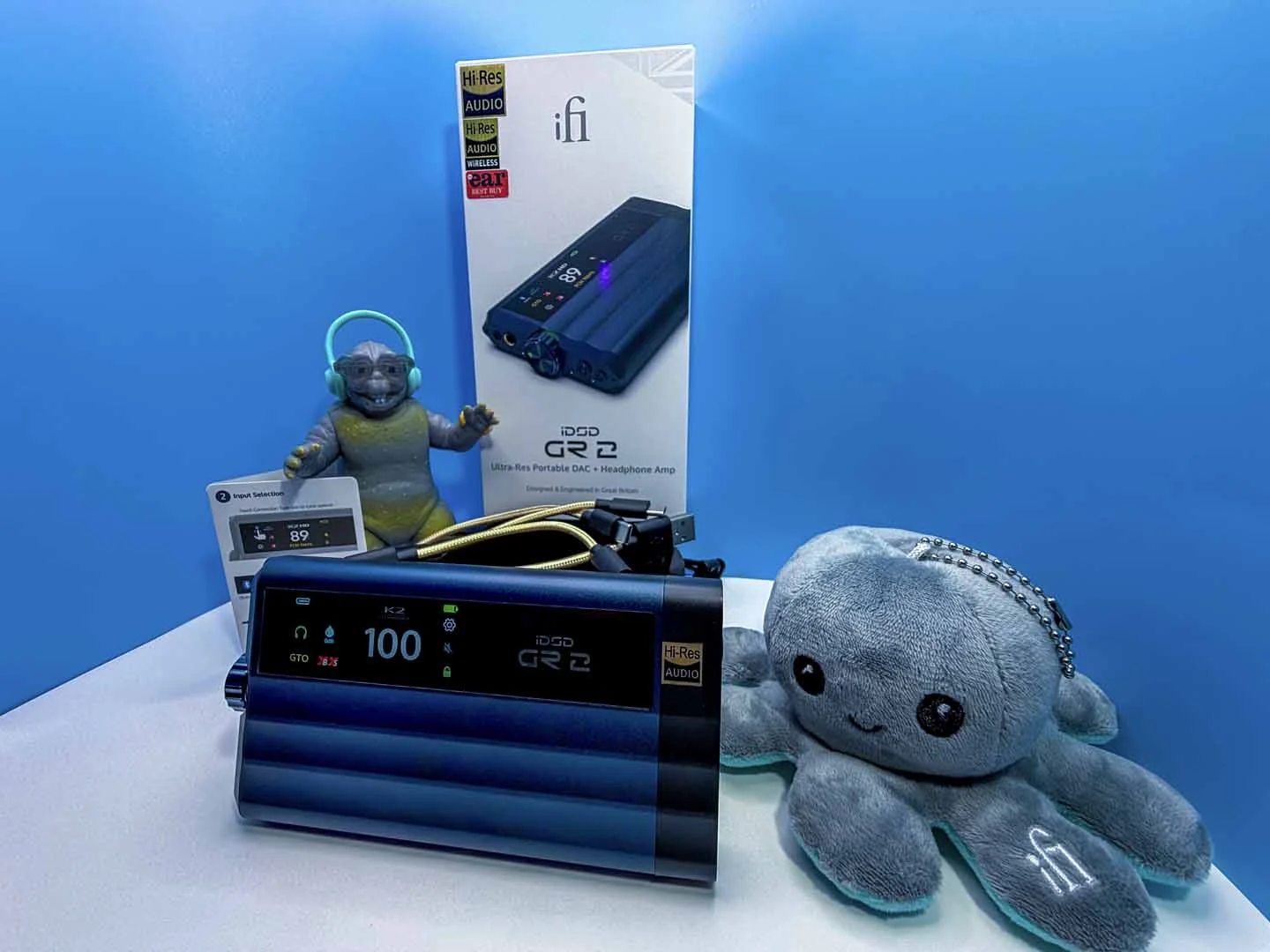
📦 Unboxing & Accessories: Everything You Need to Get Started
At its $529 reference price, I expect the GR 2 to arrive with the practical essentials to start enjoying its capabilities without immediately buying extra cables or accessories.
The published package includes the GR 2 itself, a USB-A to USB-C cable, a USB-C to USB-C cable, a microfiber protective bag, and documentation.
It’s a sensible selection that supports common computer and mobile connections while acknowledging the device will likely move between listening environments.
I particularly appreciate having both USB cable configurations available because flexibility is such an important part of the GR 2’s identity. A portable DAC/amp designed around multiple sources should accommodate different connection requirements without making every listener begin with an accessory-shopping expedition.
The microfiber bag offers basic scratch protection during normal handling, though I’d personally welcome a more substantial carrying case. With a device this capable and substantial, I want something that offers reassuring protection when it shares space with the various cables, adapters, and other audio equipment that inevitably accumulate in my bag.
iFi also offers a dedicated GR 2 case separately, which is useful for enthusiasts who prefer a more tailored protective solution.
Ultimately, however, the accessory package isn’t the reason to purchase this device.
The real value comes from the remarkable amount of functionality built directly into the hardware.
Accessories & Presentation: A practical, thoughtfully selected package that supports immediate use, although a more protective included case would have made the experience even more complete.
⚙️ Technical Specifications: The Anatomy of a Modern Audio Kaiju
The GR 2’s specifications illustrate just how ambitious iFi’s engineering approach has become. Rather than a simple USB converter with a headphone socket, this is a complete portable audio platform that handles digital and analog sources, wired and wireless playback, multiple headphone types, and several approaches to sound processing.
Model: iFi iDSD GR 2
Manufacturer: iFi Audio
Product category: Portable DAC, headphone amplifier, wireless receiver, and analog audio component
DAC chipset: Burr-Brown PCM1795
DAC architecture: Current-output converter with bespoke I/V and analog output design
Digital processing: PCM up to 768kHz and native DSD up to DSD512
Digital processing platform: XMOS XU316
Amplifier chipset: TPA6120
Amplification architecture: Fully balanced analog signal path with Class A operational amplifiers
Balanced headphone output: 4.4mm
S-Balanced headphone output: 3.5mm
Maximum published balanced output: 1,513mW RMS into 32Ω
Maximum published S-Balanced output: 567mW RMS into 32Ω
Digital inputs: USB-C, optical/coaxial S/PDIF, Bluetooth 5.4
Analog inputs: 4.4mm balanced and 3.5mm single-ended
Analog line outputs: 4.4mm balanced and 3.5mm single-ended
Bluetooth codecs: aptX Lossless, aptX Adaptive, aptX, LDAC, LHDC/HWA, AAC, SBC
Sound processing: JVCKENWOOD K2 and K2HD, XBass+, XSpace
Digital filter options: Bit-Perfect, GTO, Minimum Phase, Standard
Headphone power modes: iEMatch -12dB, Normal 0dB, Turbo +6dB
Display: 2.3-inch color capacitive touchscreen
Companion software: iFi Nexis
Battery capacity: 4,900mAh lithium-polymer
Published battery endurance: Approximately seven hours
Published charging time: Approximately 3.5 hours
Charging: Dedicated USB-C charging connection with additional configurable charging options
Power management: Hybrid Battery Mode and battery-health features
Dimensions: 141 × 75 × 19mm
Weight: 268g
Published reference price: $529 USD
That’s an extraordinary collection of capabilities in one rechargeable component, especially given the diversity of equipment the GR 2 is designed to support.
But specifications are only the beginning.
What makes the GR 2 genuinely impressive is how successfully iFi has turned that engineering into an enjoyable, approachable, and remarkably versatile listening experience.
🧬 Burr-Brown PCM1795: A New Heart for the Beast
The GR 2 introduces the Burr-Brown PCM1795, making it the first iFi product to incorporate this particular converter.
That decision represents an important architectural shift from the original xDSD Gryphon, which used the Burr-Brown DSD1793 with its internal current-to-voltage conversion stage.
The PCM1795 is a current-output DAC, giving iFi more freedom to design the surrounding analog circuitry rather than relying entirely on an internal conversion implementation. The company has used that flexibility to create a bespoke I/V stage and refined output architecture intended to deliver lower distortion, greater transparency, and a naturally engaging presentation.
I find that approach particularly interesting because I don’t think choosing a particular DAC chip automatically determines the sound of an entire product.
Much more happens between the digital signal and our ears.
The analog output stage, amplification circuitry, power supply, gain structure, and connected headphones all contribute to the final listening experience. Two products using the same converter can behave differently, just as two products using different converters can perform remarkably similarly under carefully controlled conditions.
What matters is the complete implementation.
With the GR 2, iFi has created a foundation that supports the musical richness and clarity I’ve enjoyed throughout my evaluation, while preserving enough technical discipline to make the device useful across a wide variety of listening equipment.
The company’s emphasis on a warm, analog character also aligns with my own preferences, although I wouldn’t attribute every perceived sonic quality exclusively to the PCM1795.
The result matters more than the marketing mythology surrounding any particular chipset.
And in this case, the result has kept me listening every day for a month.
A great DAC chip is an ingredient. The GR 2 demonstrates what happens when a manufacturer understands how to build the entire recipe.
⚡ Amplification: Serious Power Without Forgetting Sensitive IEMs
The GR 2’s amplification system is another major part of its engineering story, particularly because iFi has increased available output power while refining the overall analog architecture.
The published figures are substantial for a portable component, with up to 1,513mW RMS available through the balanced headphone output at 32 ohms and 567mW through the S-Balanced connection at the same impedance.
That’s considerably more power than many listeners need for sensitive IEMs, but it’s valuable for enthusiasts who enjoy alternating between easy-to-drive earphones and more demanding full-size headphones.
I appreciate that flexibility because I don’t want my source equipment to become an unnecessary limitation when exploring a different transducer.
However, raw output power isn’t the entire equation.
A powerful amplifier that introduces audible hiss with sensitive IEMs or makes fine volume adjustment difficult isn’t necessarily a good universal solution. Likewise, an exceptionally quiet output that lacks sufficient voltage or current for demanding headphones can limit otherwise excellent equipment.
The GR 2 addresses these different requirements with adjustable amplification modes and upgraded iEMatch circuitry.
The -12dB iEMatch mode is particularly welcome for sensitive IEMs, helping provide a more practical volume-adjustment range while reducing the audibility of amplifier noise. Normal mode offers a sensible starting point for everyday listening, while Turbo provides additional gain when suitable headphones need it.
That doesn’t mean everyone should engage Turbo simply because it’s available. More gain isn’t automatically better sound, and selecting an unnecessarily high setting can create volume-control problems or increase the risk of listening too loudly.
The engineering achievement lies in offering the appropriate range of options.
I also appreciate iFi’s fully balanced analog architecture, supported by Class A operational amplifiers, although balanced connections shouldn’t automatically be assumed to improve every listening situation.
The GR 2’s real strength is that it offers substantial capability while letting listeners adapt the output to their equipment.
The monster has serious muscle, but it also knows when to use a lighter touch.
✨ K2HD & K2 Processing: When Familiar Music Finds Another Voice
Of all the technologies built into the GR 2, JVCKENWOOD’s K2HD processing might best capture why I enjoy this hobby.
I love discovering new ways to experience familiar recordings.
Sometimes that happens through a different headphone tuning, a particularly engaging amplifier, or an IEM that reveals an unexpected relationship between instruments. Other times, a subtle change makes me pay closer attention to a vocalist’s texture, an acoustic instrument’s resonance, or the sense of space surrounding a performance.
K2HD offers another way to explore those experiences, and it has become one of my favorite reasons to revisit the GR 2.
The technology uses digital processing intended to enhance harmonic information and the perceived naturalness of recordings. iFi describes it as a way to restore some of the richness and nuance that digital recording and compression can diminish.
The GR 2 provides two related operating modes.
K2 applies harmonic processing without upsampling, while K2HD combines harmonic enhancement with upsampling for supported PCM signals.
That distinction matters because increasing a recording’s sample rate and changing its harmonic characteristics are separate processes, even when one mode combines them.
And here’s where I want to be particularly careful about the claims we make as enthusiasts.
Upsampling doesn’t magically transform a lower-resolution recording into an original high-resolution master. Likewise, processing cannot reconstruct the exact information a lossy codec removed just because the resulting signal contains additional harmonic content.
Those limitations don’t diminish the technology’s value.
They simply clarify what we’re actually enjoying.
K2HD is an enhancement intended to create a potentially more natural or musically satisfying presentation, not a time machine that retrieves an inaccessible original recording.
From a listening perspective, that distinction is exciting because the experience can be rewarding without requiring exaggerated claims about technical restoration.
I especially enjoy how accessible the GR 2’s processing is. Rather than forcing me to configure a computer application, choose complicated software plugins, or commit to one permanent sound profile, iFi places the options within easy reach.
That means I can explore the effect with familiar music, compare it against the unprocessed presentation, and decide whether it contributes something I value.
And after a month of experimentation, I remain genuinely enthusiastic about what it brings to the experience.
I don’t often encounter this sense of discovery with conventional portable DACs.
K2HD doesn’t excite me because it makes the display numbers bigger. It excites me because it gives me another reason to fall in love with recordings I already know by heart.
For GearZilla, that’s the entire point.
🥁 XBass+: The Art of Adding Authority Without Losing Control
If you know my reviews, you know I enjoy bass with genuine authority.
I want kick drums to hit hard, bass guitars to add texture and movement, and orchestral recordings to keep the low-frequency foundation that gives the music scale.
But there’s an important distinction between bass that engages you and bass that overwhelms everything else.
The GR 2’s XBass+ processing offers a remarkably convenient way to add low-frequency reinforcement through analog circuitry, letting listeners adjust the presentation without relying on a conventional software equalizer.
I absolutely appreciate that.
One frustration of constantly experimenting with headphones and IEMs is that their tuning philosophies can vary enormously. One set might deliver beautiful vocals and exceptional clarity but leave me wanting a little more low-frequency authority, while another might already provide enough bass to satisfy my inner Kaiju without any additional help.
I don’t want to force both products into the same sound signature.
XBass+ gives me another option.
When additional weight complements a recording, it’s available without requiring extensive configuration. When the existing tuning already provides the balance I’m looking for, I can leave it alone.
That flexibility appeals to me because it respects the character of the connected headphones rather than assuming every listener wants the same enhancement.
It’s also worth recognizing that analog bass processing still changes the signal. Operating outside a conventional digital EQ application doesn’t make it inherently transparent or universally beneficial.
The goal isn’t simply to add more bass.
The goal is to make the music more enjoyable when that additional bass serves a purpose.
And that’s where I find XBass+ so appealing.
Sometimes a recording needs more authority, not an entirely different pair of headphones. The GR 2 makes exploring that possibility wonderfully easy.
🌌 XSpace: An Invitation to Listen Bigger
If one characteristic consistently captures my attention when I evaluate personal audio, it’s spatial immersion.
I love recordings that make me feel like an actual performance is unfolding around me, with convincing width, believable front-to-back depth, and instruments occupying distinct positions rather than collapsing into an indistinct collection of sounds between my ears.
That fascination is why I’ve spent so much time exploring different headphones, IEMs, DACs, and amplifiers.
It’s also why XSpace immediately captured my interest.
iFi’s analog spatial processing is designed to change stereo headphone presentation, creating a more speaker-like listening perspective.
That’s an interesting challenge because conventional headphone playback differs from listening to loudspeakers in a room. Each ear normally receives a more isolated signal from its respective headphone channel, while loudspeaker listening involves acoustic interaction between both channels, room reflections, and the listener’s position.
XSpace tries to influence that relationship through signal processing.
Now, I’m not suggesting that engaging XSpace magically recreates the original recording space or turns every pair of headphones into a perfectly calibrated loudspeaker system. Spatial perception is considerably more complicated than that, and the result depends on the recording, headphone characteristics, and the individual listener.
But I love having another way to explore the presentation.
Sometimes the original stereo signal provides exactly the intimacy and organization I want. Other times, experimenting with a different spatial perspective can make a recording feel more expansive or engaging.
The GR 2 lets me explore those differences without extra hardware or complex software setup.
And because the controls are so accessible, I actually want to experiment rather than leaving the feature untouched.
That might be the most important quality of all.
The GR 2 doesn’t promise that every setting will appeal to every listener. Instead, it lets enthusiasts discover what works for their music and equipment.
XSpace isn’t about making every recording enormous. It’s about giving spatial explorers another perspective on the music they love.
And for a reviewer whose motto is Listen Bigger, that’s a wonderful thing.
🎛️ Combining the Technologies: An Enthusiast’s Playground
The GR 2 becomes even more interesting when you stop treating its sound-processing features as isolated novelties and begin exploring how the available options might complement one another.
XBass+ can add low-frequency authority, XSpace can change the perceived spatial presentation, and K2 or K2HD can introduce harmonic processing for supported digital signals. Selectable digital filters offer another set of configuration choices, letting listeners explore different approaches to digital reconstruction.
It’s a remarkable collection of tools for one portable device.
And this is where my repeated CanJam visits start to make perfect sense.
Every newly discovered capability encouraged me to revisit something I’d already heard. A familiar recording became another opportunity to explore, a different headphone suggested another configuration, and the GR 2’s approachable interface made the process enjoyable rather than frustrating.
I love that kind of experience because it reminds me why I became so enthusiastic about personal audio in the first place.
We’re not always searching for the single most technically accurate equipment combination. Sometimes we’re exploring how different technologies can influence our emotional connection to music, and the most rewarding discoveries come from experimentation rather than predetermined expectations.
But I also believe restraint has value.
Enabling every enhancement simultaneously doesn’t guarantee a better result. A recording with substantial bass may not benefit from additional reinforcement, and spatial processing that complements one arrangement could feel less convincing with another.
Likewise, harmonic enhancement isn’t necessarily preferable to the unprocessed signal just because it presents things differently.
The beauty lies in having the choice.
And the GR 2 provides that freedom in a way that feels unusually complete.
This isn’t a DAC/amp that simply lets me listen to music. It’s a tool that makes exploring music part of the entertainment.
🔬 Digital Filters: Fine-Tuning the Details
Alongside its more dramatic sound-shaping technologies, the GR 2 includes four selectable digital filter options: Bit-Perfect, GTO, Minimum Phase, and Standard.
These filters affect how the digital-to-analog conversion process reconstructs the signal, and their different mathematical approaches can influence impulse response, ringing behavior, and frequency-domain characteristics.
For listeners unfamiliar with digital filtering, this can sound considerably more complicated than it needs to be.
The practical point is that iFi offers several reconstruction approaches rather than forcing every listener to accept a single fixed implementation.
I appreciate that versatility, although I’d caution against assuming every filter produces an immediately dramatic audible difference.
Digital filter behavior can be subtle, and identifying meaningful differences requires careful comparisons that account for playback levels, recording characteristics, and listener expectations.
Still, the GR 2 makes exploring these options wonderfully approachable.
The Standard setting offers a conventional filtering approach, while Minimum Phase changes how ringing is distributed around transients. GTO, or Gibbs Transient Optimized, reflects iFi’s proprietary filtering philosophy, and Bit-Perfect provides another approach intended to minimize certain conventional filtering operations.
The names matter less than understanding that they represent different processing choices.
What matters to me is that iFi provides the options and makes them accessible without transforming the listening experience into an engineering project.
A thoughtful audio tool doesn’t need every adjustment to produce a dramatic transformation. Sometimes exploring a subtle difference is part of the pleasure.
📡 Bluetooth 5.4: Wireless Without Abandoning Ambition
I’ve never believed that serious audio enjoyment must be restricted to wired connections.
There are certainly technical reasons to appreciate lossless USB playback, and I frequently prefer it when evaluating equipment. But wireless convenience has a meaningful place in everyday listening, particularly when I want to move around without remaining physically attached to a phone or computer.
The GR 2 embraces that flexibility through Bluetooth 5.4 and a broad collection of supported codecs, including LDAC, aptX Lossless, aptX Adaptive, aptX, LHDC/HWA, AAC, and SBC.
That’s an impressive collection because modern listeners rarely operate within one perfectly standardized device ecosystem.
LDAC offers a high-bitrate option for compatible Android devices, supporting up to 990kbps under good connection conditions. aptX Lossless can deliver lossless CD-quality transmission when both the transmitting and receiving devices support the codec and the wireless environment allows it.
For Apple users, AAC remains relevant because iPhones typically use that codec with third-party Bluetooth audio devices.
The key distinction is that the GR 2’s codec support doesn’t automatically mean every connected phone can transmit using it.
A Samsung phone with compatible LDAC support can use that option, while an iPhone won’t suddenly transmit aptX Lossless just because the receiver understands the format.
And that’s perfectly fine.
The key achievement is the GR 2’s flexibility, which lets the wireless connection accommodate a variety of source devices and listening preferences.
I particularly enjoy having that convenience available alongside its extensive wired connectivity.
Sometimes I want to sit down with lossless playback and concentrate entirely on the recording. Other times, I want to enjoy music without another cable becoming part of the experience.
The GR 2 supports both approaches without making either feel like an afterthought.
Wireless convenience and enthusiast-level ambition aren’t mutually exclusive, and iFi has built a remarkably capable bridge between them.
🔌 Connectivity: Almost Every Connection an Enthusiast Could Want
The more I look at the GR 2’s connection options, the more impressed I am by how carefully iFi has considered the ways enthusiasts actually use their equipment.
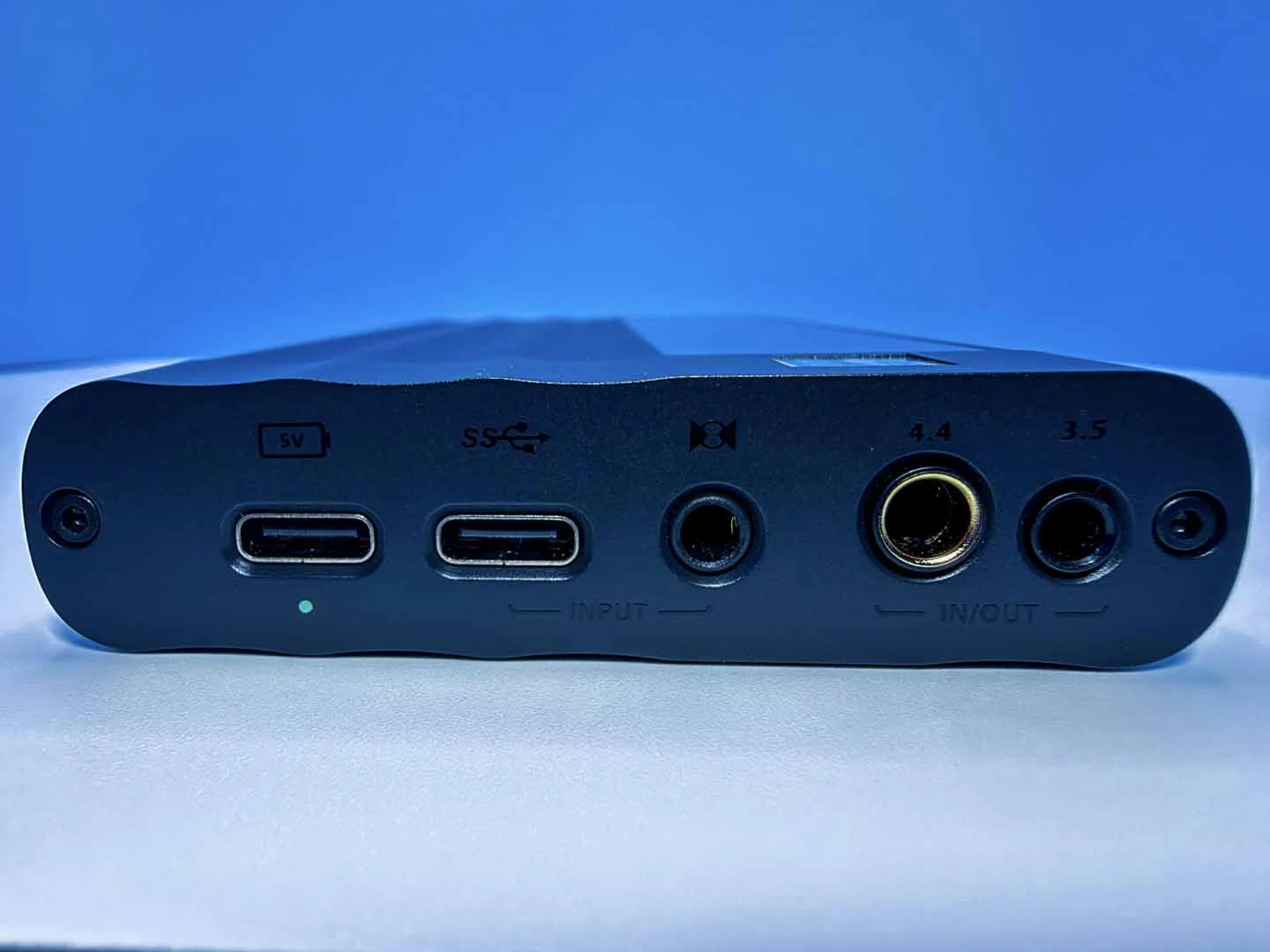
For digital audio, there’s USB-C, optical/coaxial S/PDIF, and Bluetooth. Analog inputs include 3.5mm single-ended and 4.4mm balanced connections, while analog line outputs provide additional flexibility for integrating the device with external equipment.
Headphone users get a 3.5mm S-Balanced output alongside the 4.4mm balanced connection.
That’s a remarkably complete selection for a device meant to travel.
I especially appreciate the analog connectivity because it expands the GR 2’s usefulness beyond simply converting a digital signal from a smartphone or computer.
Depending on the configuration, it can become part of a broader audio system, supporting external sources and amplifiers without requiring a separate component for every scenario.
That versatility makes the GR 2 especially appealing to enthusiasts who already own several headphones, portable players, and desktop audio devices.
Rather than forcing every source to conform to one connection standard, iFi offers multiple options to accommodate different equipment.
Of course, using the GR 2 within a larger system requires attention to the selected operating mode, output level, and equipment compatibility. Balanced connections aren’t universally preferable, and you should never confuse a line output with a headphone output just because the connector looks familiar.
But those are considerations inherent to a flexible audio component, not evidence of poor design.
What impresses me is the sheer range of listening configurations the GR 2 makes possible.
The best equipment doesn’t ask me to abandon the gear I already enjoy. It gives me new ways to bring everything together.
🔋 Separate USB-C Charging: Proof That Someone Was Paying Attention
Of all the clever engineering decisions built into the GR 2, one of my favorites is also one of the simplest.
iFi provided a dedicated USB-C charging connection separate from the USB-C digital audio input.
I realize that doesn’t sound particularly glamorous when compared with a sophisticated Burr-Brown DAC, powerful balanced amplification, or JVCKENWOOD’s K2HD processing.
But folks, I absolutely love this decision.
Anyone who’s used portable DAC/amps knows how frustrating power management can get when a device relies on one connection for several competing tasks. You want to maintain a digital audio connection, but you also need to charge the battery. Your smartphone may already be supplying power, or your computer connection may add another complication.
Suddenly, something as simple as enjoying music for several hours turns into a discussion about splitters, hubs, battery packs, and cable arrangements.
The GR 2 avoids much of that frustration by giving charging its own dedicated connection.
It maintains a USB digital audio path while independently supplying external power, making extended listening sessions much easier to manage.
And iFi didn’t stop there.
The GR 2 also adds power-management features, including configurable charging behavior, Hybrid Battery Mode, and Battery Health Mode.
These features show an understanding that modern portable audio equipment increasingly sits between traditional mobile and desktop use. A device might spend hours connected to a computer, travel with its owner in the afternoon, and return to a stationary setup later that evening.
The GR 2 has been engineered with those changing environments in mind.
Hybrid Battery Mode prioritizes external power when available, draws from the battery when necessary, and reduces unnecessary battery cycling during extended connected operation.
Battery Health Mode adds long-term charging management, reflecting that rechargeable equipment is often used for years rather than treated as a disposable accessory.
I particularly appreciate this focus on longevity because I’m increasingly interested in equipment that stays valuable long after the initial excitement of a purchase fades.
The GR 2 feels designed for that kind of relationship.
And while its rated battery endurance remains one of my criticisms, iFi deserves considerable credit for addressing the everyday challenges of using a powerful portable device over extended periods.
The separate USB-C charging port might not sell the GR 2 in a showroom, but it’s exactly the kind of thoughtful decision that makes me appreciate owning it.
📱 iFi Nexis: Software That Supports the Hardware
Companion applications have become increasingly common in personal audio, and I’ve developed a fairly simple preference regarding their role.
I want an app to expand a device’s capabilities, not become an unnecessary requirement for enjoying basic functionality.
The GR 2 strikes a welcome balance by providing a sophisticated built-in interface while supporting additional configuration and firmware-management capabilities through iFi Nexis.
That relationship makes sense.
The touchscreen gives me direct access to key listening controls, letting me experiment with processing and operating modes without constantly reaching for my phone. Nexis provides another layer of control and software support for users who want to explore the device more deeply.
iFi also supports firmware updates through the Nexis ecosystem, creating opportunities for future refinements and improvements.
I appreciate that capability because modern digital audio products are increasingly sophisticated, and the ability to address software issues or refine functionality over time can meaningfully support long-term ownership.
Of course, future updates shouldn’t be treated as a guarantee that every requested feature will eventually appear.
The GR 2 should earn its recommendation based on what it delivers today, with update support as a welcome bonus.
There’s also an important platform distinction: iFi identifies certain USB-based Nexis functions as Android-exclusive, so users relying entirely on Apple devices should understand that limitation.
But the central achievement remains the same.
The GR 2 doesn’t need its companion app to feel complete.
Nexis extends the experience. The touchscreen makes the hardware a pleasure to use on its own.
🦻 iEMatch: Because Not Every Monster Needs Maximum Power
One of the GR 2’s most thoughtful design choices is acknowledging that a listener doesn’t always need more amplification power.
A sensitive IEM may require very little energy to reach satisfying volume levels, and excessive gain can make fine adjustment difficult or reveal background noise that wouldn’t otherwise be noticeable.
A demanding full-size headphone presents a different challenge, potentially requiring more voltage or current capability to reproduce dynamic passages without distortion.
The GR 2 addresses both situations through its selectable output modes.
iEMatch at -12dB attenuates the output to better accommodate sensitive earphones, while Normal and Turbo provide different gain options for other listening requirements.
I appreciate this flexibility because my enjoyment of personal audio isn’t limited to one headphone design or impedance category.
I want to explore different equipment without worrying that my source is either unnecessarily powerful for a sensitive IEM or inadequate for a more demanding headphone.
The upgraded iEMatch implementation is particularly interesting because iFi has incorporated low-impedance MOSFET circuitry into the design.
There are still practical considerations. The published output impedance rises when iEMatch is engaged, which can affect the frequency response of certain low-impedance multi-driver IEMs. That means you should treat the setting as a useful tool rather than an automatic improvement for every earphone.
Likewise, I wouldn’t recommend engaging Turbo mode indiscriminately. More gain won’t clean up an IEM that already reaches sufficient volume.
What matters is having appropriate choices.
The GR 2 has enough muscle for serious headphones, but it also understands the finesse sensitive IEMs need.
That versatility separates a genuinely complete enthusiast device from a simple amplifier with impressive output specs.
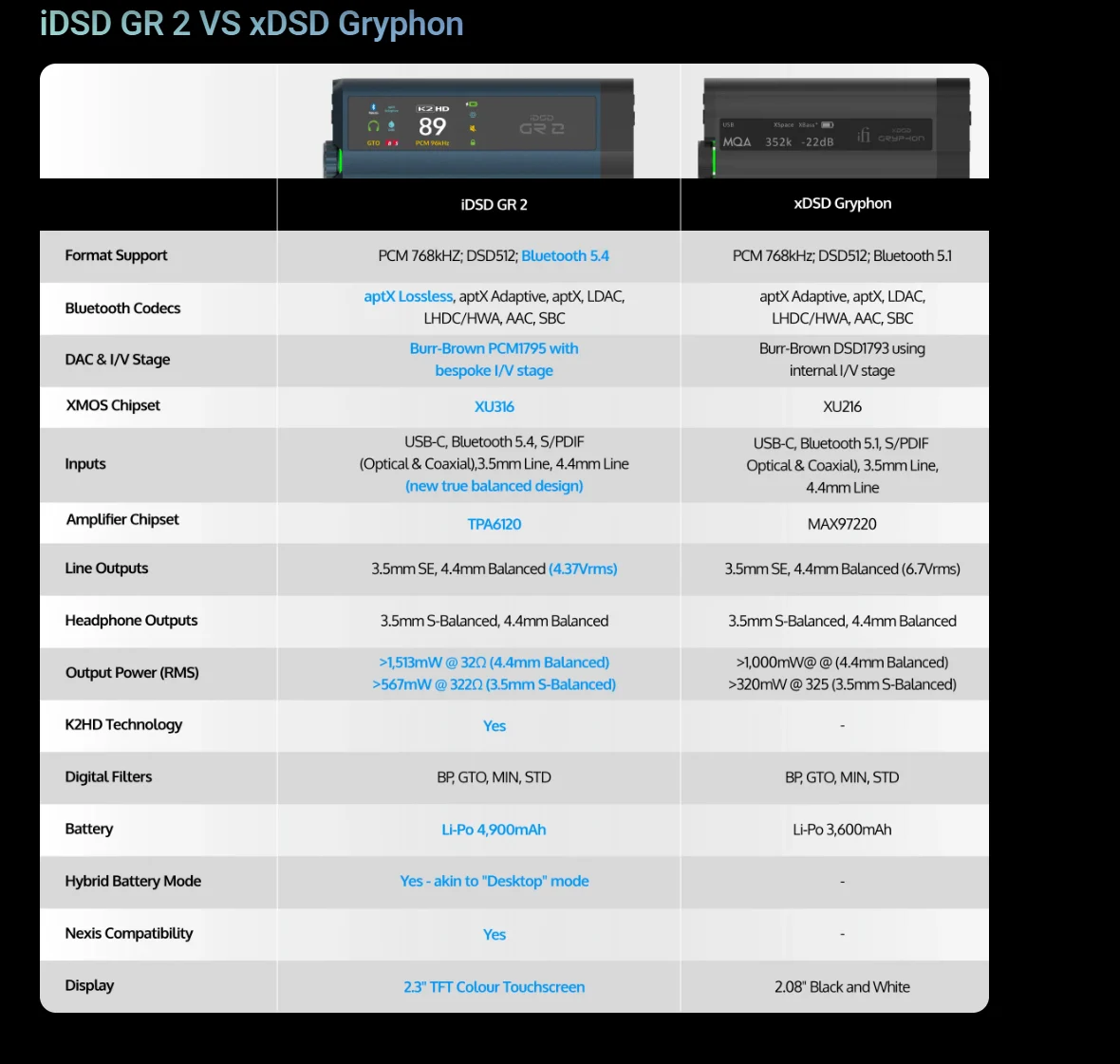
🧬 iDSD GR 2 vs. xDSD Gryphon: When a Legend Evolves Into Something Greater
There’s a considerable difference between releasing a successor to a beloved product and creating something that deserves its own identity.
The original xDSD Griffin became one of iFi’s most celebrated portable designs by combining sophisticated digital conversion, powerful amplification, extensive connectivity, and analog sound processing in a remarkably versatile enclosure.
It was an ambitious product that challenged the idea that serious audio enthusiasts needed an elaborate desktop system to enjoy advanced playback functionality.
But when iFi began developing its successor, the company clearly had more ambitious goals than a cosmetic refresh and a few internal updates.
The GR 2 is the result of a substantial architectural redesign that touches nearly every important aspect of the original concept.
And I think that’s worth celebrating because this industry sometimes treats incremental changes as extraordinary technological revolutions.
The GR 2’s evolution is considerably more meaningful.
🧠 A New Digital Brain and Analog Architecture
The original Gryphon used the Burr-Brown DSD1793 converter, while the GR 2 introduces the PCM1795 with a bespoke current-to-voltage stage.
That distinction matters because iFi gains more control over the surrounding circuitry, letting engineers develop a different analog architecture instead of relying on the previous converter implementation.
The digital processing platform also evolves from the XMOS XU216 to the XU316, reflecting a more modern approach to handling digital audio signals.
Meanwhile, the amplifier chipset shifts from the MAX97220 to a TPA6120-based implementation, along with a refined fully balanced signal path and Class A operational amplifiers.
These are meaningful architectural decisions, not cosmetic upgrades.
Of course, changing components doesn’t automatically guarantee better audible performance under every condition, and I wouldn’t claim that it does without appropriate measurements and controlled listening comparisons.
But it demonstrates how extensively iFi reconsidered the engineering behind its portable flagship concept.
The GR 2 doesn’t simply borrow the Gryphon’s internal architecture. It establishes a substantially new foundation.
⚡ More Power, Greater Flexibility
One of the most measurable improvements involves headphone output power.
The original Gryphon’s published balanced output exceeded 1,000mW into 32 ohms, while the GR 2 raises that figure to more than 1,513mW into the same load.
That’s about 50% more available output power compared with the manufacturer’s published reference figures.
The 3.5mm S-Balanced output also receives a substantial increase, rising from more than 320mW to more than 567mW at 32 ohms.
These improvements expand the GR 2’s usefulness with headphones that need more substantial amplification, especially when paired with its configurable power modes.
But what appeals to me isn’t just the higher maximum output.
It’s how iFi has balanced that capability with an upgraded iEMatch implementation, designed to make the same device work well with much more sensitive earphones.
A portable amplifier that delivers serious power while acknowledging IEM enthusiasts’ needs shows a thoughtful approach to versatility.
More power makes for an impressive specification. More appropriate power across different listening situations makes it a better tool for enthusiasts.
🖥️ The Interface Undergoes a Transformation
The original Gryphon featured a 2.08-inch monochrome display that communicated essential operating information.
The GR 2 replaces that with a 2.3-inch color capacitive touchscreen, fundamentally changing how listeners interact with the equipment.
For me, this is one of the most important improvements in the entire redesign.
The new interface makes sound-processing options, operating modes, and device settings easier to understand and access, encouraging experimentation without forcing users to memorize elaborate control sequences.
And that matters enormously when the equipment offers as many capabilities as the GR 2.
Innovative features offer little benefit if accessing them becomes so frustrating that listeners eventually stop using them.
The GR 2 avoids that trap beautifully.
Its touchscreen doesn’t feel like a novelty introduced merely to modernize the appearance. It feels like a deliberate response to the growing complexity of serious portable audio equipment.
The GR 2’s greatest interface accomplishment isn’t adding touch controls. It’s making sophisticated audio technology feel wonderfully approachable.
✨ K2HD Changes the Musical Conversation
The original Gryphon already offered valuable sound-shaping features through its XBass and XSpace processing.
The GR 2 retains those ideas while introducing K2 and K2HD, opening another avenue for harmonic enhancement and digital signal processing.
That addition is especially exciting because it expands the device’s appeal beyond conventional tone adjustment.
XBass+ reinforces low frequencies, XSpace explores spatial presentation, and K2HD offers another way to experiment with the perceived texture and naturalness of recordings.
For an enthusiast who enjoys discovering different sonic personalities, those capabilities complement one another beautifully.
I don’t need every setting enabled, and I don’t want every recording processed the same way.
What I want is the freedom to explore.
The Gryphon provided an excellent collection of audio tools. The GR 2 expands the workshop and makes the controls easier to reach.
📡 Bluetooth Evolves Without Abandoning Compatibility
The original Gryphon supported Bluetooth 5.1 and several high-quality wireless codecs, including LDAC and aptX Adaptive.
The GR 2 upgrades to Bluetooth 5.4 and adds aptX Lossless support, giving compatible devices another chance to deliver CD-quality audio wirelessly under suitable conditions.
LDAC remains available, supporting high-bitrate wireless playback from compatible Android sources.
I appreciate this evolution because excellent portable audio shouldn’t require enthusiasts to choose between serious listening and ordinary convenience.
Sometimes lossless USB playback makes the most sense, but modern wireless audio can also deliver genuinely satisfying experiences.
The GR 2 supports both approaches, making it more adaptable to the different devices and listening environments enthusiasts encounter every day.
🔋 A Larger Battery, With Smarter Management
The original Gryphon contained a 3,600mAh battery, while the GR 2 increases capacity to 4,900mAh.
That’s approximately a 36% increase in nominal battery capacity, which is particularly noteworthy given the additional processing, updated electronics, touchscreen, and greater amplification capability.
But the most interesting advancement isn’t simply the larger battery.
It’s the GR 2’s approach to power management.
Hybrid Battery Mode prioritizes external power when available, helping reduce unnecessary battery cycling during stationary use. Additional charging controls and battery-health functionality make the GR 2 more adaptable to extended listening sessions and long-term ownership.
I particularly appreciate the dedicated USB-C charging connection because it lets you manage digital audio and external power independently.
That’s precisely the kind of thoughtful engineering detail that makes equipment easier to live with.
Unfortunately, the GR 2’s approximately seven-hour rated battery endurance remains one of its weaknesses, particularly for travelers who want to enjoy long listening sessions without carrying additional power equipment.
The larger battery doesn’t automatically translate into extraordinary endurance because the complete system has its own operating demands.
Still, the additional power-management features represent a meaningful evolution in usability.
The GR 2’s battery may not last as long as I’d like, but iFi has given considerable thought to how you’ll use it.
🔌 More Refined Connectivity, With One Important Trade-Off
Both the Gryphon and GR 2 provide extensive digital and analog connectivity, including USB, optical/coaxial input, Bluetooth, line connections, and headphone outputs.
The GR 2 introduces a new truly balanced 4.4mm line-input design, complementing the fully balanced architecture developed for the new generation.
Its support for iFi Nexis also extends the user experience beyond the physical hardware, adding configuration and firmware-management capabilities unavailable on the original Gryphon in the same form.
Not every published specification has increased, however.
The original Gryphon’s balanced line output was specified at 6.7Vrms, while the GR 2 is rated at 4.37Vrms.
That’s worth noting because higher output voltage can help in certain system configurations, though the right level depends on the connected equipment and doesn’t, by itself, guarantee better sound quality.
Likewise, both generations support PCM up to 768kHz and DSD512.
Those similarities reinforce an important point: iFi’s engineering progress isn’t simply about increasing the biggest number on the specification sheet.
It’s about developing a more complete system.
🦖 The Verdict on the Evolution
What impresses me most about the GR 2 isn’t any one improvement.
It’s the ambition behind the entire redesign.
iFi has reworked the conversion architecture, modernized digital processing, increased amplifier power, redesigned the analog signal path, introduced an intuitive touchscreen, upgraded Bluetooth, incorporated K2HD processing, improved battery management, and expanded the system’s long-term flexibility.
That’s a considerable amount of innovation concentrated within one portable device.
Most importantly, the company has deliberately distinguished between the original Gryphon and the new GR 2.
I respect that decision.
The original deserves recognition for establishing an ambitious portable audio concept, while the GR 2 deserves the opportunity to be judged as a substantially reengineered product with its own personality.
I haven’t done a controlled, level-matched comparison between the original Gryphon and the GR 2, so I won’t claim every engineering improvement translates directly into an audible advantage. The published specifications show a significant redesign, and my month with the GR 2 shows how much I’ve enjoyed the result.
That’s more than enough to make this evolution compelling.
The Gryphon established the legend. The GR 2 has emerged from that legacy with more power, greater intelligence, and an identity entirely its own.
And as far as I’m concerned, the new monster is magnificent.
🎧 Listening Impressions: A Month With the Beast
There’s an important difference between being impressed by a piece of equipment’s performance and genuinely wanting to spend time with it.
An audio show offers chances to discover exciting technology, but a successful demonstration doesn’t guarantee the product will remain equally enjoyable in everyday life.
That distinction matters even more when evaluating something as sophisticated as the GR 2.
The collection of processing features, impressive amplification specifications, and colorful touchscreen can certainly create excitement during an initial demonstration. But novelty alone doesn’t explain why a reviewer continues choosing the same piece of equipment after weeks of listening.
For me, the answer comes down to how naturally the GR 2 combines musical enjoyment with genuine versatility.
I love the underlying presentation, and I especially appreciate how its processing lets me explore different listening perspectives without forcing me to abandon the character of my favorite headphones and IEMs.
The GR 2 doesn’t need every enhancement engaged to be enjoyable. Its core performance provides a satisfying foundation, while the extra features let me experiment when I’m curious what another configuration might add.
That’s the combination I find so compelling.
After about a month of daily listening, the biggest discovery is that I still want to keep exploring.
The GR 2 hasn’t become less interesting as I’ve gotten familiar with it. It’s become more valuable because I’ve discovered how naturally it fits into my listening routine.
🥁 Bass: Control, Authority, and the Freedom to Explore
Bass reproduction plays an important role in how I experience music because it provides the physical foundation that makes rhythmic passages satisfying and larger arrangements feel convincing.
I want impact when the recording calls for it, texture when a bass instrument deserves attention, and enough control to keep low-frequency energy from overwhelming the rest of the performance.
The GR 2 provides a satisfying platform for that kind of listening, with substantial amplification capability and an underlying presentation that doesn’t need exaggerated bass to remain engaging.
But XBass+ changes the conversation.
Instead of treating low-frequency balance as something permanently determined by the connected headphones, the GR 2 allows me to experiment with additional authority when the situation calls for it.
That’s especially useful when switching between IEMs and headphones, each with its own tuning philosophy.
A leaner set may benefit from more weight, while an already bass-rich IEM could become excessive with the same enhancement.
I appreciate that the GR 2 leaves those decisions to the listener.
The key advantage isn’t simply adding bass. It’s about exploring the relationship between impact, clarity, and musical engagement without relying on a separate processing system.
Great bass should give music a foundation, not demand ownership of the entire performance.
The GR 2 provides the tools to pursue that balance.
🎤 Midrange & Vocals: Music With an Emotional Center
Vocals are one of the most important elements of my listening experience, especially because I’m drawn to recordings that convey emotion through the texture and character of the human voice.
I enjoy a rich vocal body, natural articulation, and the sense that a singer occupies a convincing position within the instrumental arrangement.
The GR 2 has been a wonderfully satisfying companion for exploring those qualities, particularly because it combines an engaging underlying presentation with additional processing options that can change how familiar recordings are experienced.
K2 and K2HD are especially interesting when considering the harmonic character of voices and acoustic instruments.
Their appeal isn’t necessarily that every recording becomes objectively more accurate, but that the processing offers another interpretation of musical texture.
I appreciate that distinction because technical accuracy and emotional engagement aren’t always experienced the same way.
A source can preserve the information in a recording without necessarily creating the presentation a particular listener finds most enjoyable, and an optional enhancement can be worthwhile even when it isn’t intended as a strict reconstruction of the original master.
The GR 2 respects that difference by allowing me to choose.
What I love most is that the device doesn’t insist on one interpretation of musical beauty. It lets me explore what makes a particular recording emotionally compelling.
🌟 Treble & Air: Detail Without Losing the Music
I’ve never believed audio equipment needs aggressive upper-frequency energy to communicate clarity.
Some of my favorite listening experiences come from systems that preserve articulation, instrumental texture, and spatial information without constantly drawing attention to cymbals, upper harmonics, or microscopic recording details.
The GR 2 appeals to that preference through its engaging overall presentation and the flexibility to explore different processing configurations.
But it’s important to recognize that the DAC/amp doesn’t independently determine the treble behavior of every headphone connected to it.
A bright IEM stays bright unless something in the signal chain changes its frequency response, and a smooth headphone doesn’t suddenly become analytical just because it’s connected to a more powerful amplifier.
The GR 2 offers a capable platform with enough flexibility to accommodate different listening preferences.
Digital filters offer one avenue for experimentation, while K2 processing changes how the signal’s harmonics are presented.
The results will vary depending on the recording and connected equipment, and I wouldn’t assume every adjustment produces an immediately audible transformation.
What matters is the chance to explore those differences without a complicated setup.
For me, the best treble presentation keeps the music alive without making me negotiate with the volume control.
And the GR 2 has been an exceptionally enjoyable companion for extended listening.
🎯 Separation & Placement: Keeping the Performance Together
Instrument separation is often discussed as though the ideal result is to create the greatest possible distance between every element of a recording.
I see it differently.
I want to understand the relationships between instruments, recognize individual musical ideas, and appreciate how the arrangement works as a complete performance.
Overemphasis on separation can undermine that cohesion, making a recording feel more like a collection of isolated sounds than a musical event.
The GR 2’s DAC and amplification architecture provide a capable foundation for preserving recording information, while its processing features let listeners explore different presentations.
XSpace is particularly interesting here because changing perceived spatial relationships can affect how instruments appear organized in the listening environment.
But a convincing result depends on more than the source itself.
Headphone characteristics, channel matching, recording techniques, and individual perception all contribute to the final presentation.
That’s why I avoid claiming that a DAC/amp automatically produces extraordinary imaging simply because its specifications are impressive.
What I can say is that the GR 2 gives enthusiasts a wonderfully versatile platform for exploring those qualities.
The goal isn’t to pull every instrument apart. It’s to make the relationship between them worth listening to.
🌌 Width & Depth: Finding New Dimensions in Familiar Music
Anyone who has spent time reading GearZilla Reviews knows that I have a particular weakness for holographic audio.
I love the sensation of music unfolding within a believable three-dimensional environment, with instruments occupying distinct positions and enough front-to-back depth to create a convincing sense of space.
That preference is part of why I’m so enthusiastic about the GR 2.
XSpace offers a convenient way to experiment with stereo presentation without separate processing hardware or an elaborate software setup.
I can explore the effect, compare it with the original presentation, and decide which approach better complements the recording.
And I appreciate that enormously because spatial processing isn’t always an improvement simply because it produces a wider presentation.
A recording that already contains convincing acoustic information may benefit from being left alone, while another might become more engaging through a different spatial interpretation.
The GR 2 makes that exploration accessible.
Its real accomplishment isn’t guaranteeing extraordinary holographic depth with every pair of headphones. It’s a flexible system that lets me pursue the spatial qualities I enjoy while keeping control over the final result.
Sometimes I want the intimacy of the original mix. Other times, I want to explore what happens when the music is given a different sense of space.
The GR 2 invites me to discover both.
🦴 Slam, Dynamics & Headroom: The Muscle Behind the Music
One of the GR 2’s most compelling technical features is its substantial amplification capability.
With more than 1.5 watts available through its balanced output into 32 ohms, it offers considerably more power than many portable devices, giving enthusiasts flexibility for demanding headphones alongside sensitive IEMs.
But output power is only one ingredient in convincing dynamic reproduction.
The contrast between quiet and loud musical passages, the ability to reproduce transient peaks cleanly, and the relationship between amplifier performance and the connected headphone all contribute to how dynamics are perceived.
A powerful amplifier doesn’t automatically create more dynamic recordings, nor does additional gain improve sound quality when the equipment already reaches the desired volume cleanly.
What matters is having sufficient capability without introducing avoidable distortion or noise.
The GR 2’s amplification architecture and configurable power modes make it a compelling platform for different listening requirements.
And because it also offers sound-shaping options, enthusiasts can explore additional perceived impact without changing the underlying equipment.
The GR 2 has impressive muscle, but its greatest strength is how thoughtfully it manages it.
⚡ Speed, Transients & Resolution: Technical Ability With Musical Purpose
Technical performance matters when evaluating any DAC/amp, but I don’t believe excellent specifications automatically translate into a more enjoyable listening experience.
A source should preserve the information in a recording, provide suitable amplification, and avoid introducing audible noise or distortion under normal operating conditions.
Beyond that foundation, the relationship between source, headphones, and listener becomes increasingly important.
The GR 2 combines a modern conversion architecture with sophisticated amplification and multiple digital processing choices, creating a technically capable platform that encourages exploration.
Its selectable digital filters offer different reconstruction approaches, while K2HD and the analog enhancements provide additional ways to influence the resulting presentation.
But I wouldn’t attribute every perceived difference in transient speed or resolution to the DAC chip alone.
Frequency response, playback level, recording characteristics, and the connected headphones can also influence those qualities.
What matters to me is that the GR 2 delivers a satisfying musical experience without making technical analysis the main attraction.
Great resolution should help us appreciate the music, not turn every listening session into an examination.
🎵 Tonality & Timbre: A Musical Personality With Room to Grow
If I had to describe the GR 2’s appeal in a few words, I’d call it musical, engaging, adaptable, and extraordinarily satisfying to live with.
It delivers the kind of experience that makes me want to spend more time with my favorite recordings, while giving me enough flexibility to explore different perspectives when curiosity strikes.
That’s an important distinction because I don’t expect every piece of equipment to share one specific sound signature.
I enjoy warm, rich, romantic presentations, but I also appreciate clarity, precision, and the ability to hear familiar recordings through a different tonal perspective.
The GR 2 accommodates that curiosity beautifully.
Its underlying performance provides the foundation, while K2 processing, analog sound shaping, digital filters, and amplification options expand the range of available experiences.
The result is a device that feels unusually aligned with the way I actually enjoy personal audio.
I don’t want another component that becomes interesting for a week before disappearing into a drawer.
I want equipment that continues giving me reasons to listen.
And after a month of daily use, the GR 2 has done exactly that.
Its greatest musical accomplishment isn’t forcing every recording into one preferred sound. It makes exploring different sounds part of the pleasure.
🎮 Gaming & Entertainment: More Than a Music Specialist
Although my evaluation of the GR 2 centers on music, its connectivity and amplification options make it a potentially useful companion for gaming and entertainment as well.
A quality DAC/amp can support compatible gaming systems and computers, especially for listeners who prefer high-quality headphones over integrated audio hardware.
The GR 2’s wired digital connectivity provides a solid foundation for that kind of setup, while its amplification capability lets it drive a broad range of headphones.
XSpace may also appeal to listeners who want a more expansive, cinematic presentation, though it shouldn’t be confused with a dedicated game-specific surround renderer or proven competitive positional-audio enhancement.
Bluetooth adds convenience for supported devices, but latency and codec compatibility remain practical considerations, especially for competitive gaming.
For games where timing and positional accuracy matter most, a compatible wired connection is the more predictable starting point.
I haven’t established dedicated competitive gaming results for the GR 2, so my rating is based on its audio capabilities and my music-listening experience rather than unperformed gameplay benchmarks.
Still, the product’s flexibility makes it an interesting option for enthusiasts who want one capable source to serve several entertainment roles.
🔋 Size, Weight & Battery Life: The Beast’s Achilles’ Heel
As much as I love the GR 2, I can’t overlook the compromises that prevent it from reaching an even higher rating.
The first is size.
At 141 × 75 × 19mm, the GR 2 is considerably larger than the increasingly capable USB dongles popular among portable audio enthusiasts.
Its dimensions make sense given the substantial internal battery, powerful amplification circuitry, extensive connectivity, and color touchscreen, but they don’t change how much space it takes up in a bag or pocket.
Then there’s the weight.
At 268 grams, the GR 2 is substantial, and while I appreciate its solid construction, I’d welcome a lighter design for extended travel.
I wouldn’t casually leave this device dangling from my smartphone while walking around.
It’s a dedicated portable listening system, and I’d encourage buyers to expect that.
The final compromise is battery endurance.
iFi publishes an approximate seven-hour rating, which isn’t terrible considering the device’s capabilities, but I’d love considerably more from something that otherwise feels engineered for long, uninterrupted listening sessions.
The separate charging port and intelligent power-management features make that limitation easier to manage, especially when using the GR 2 at a desk or near a power supply.
But those conveniences don’t entirely replace longer untethered operation.
Battery life also varies with the connected headphones, listening level, wireless use, and other operating conditions, so the manufacturer’s rating shouldn’t be taken as a guaranteed result for every configuration.
These shortcomings are meaningful.
That’s why I consider the GR 2 nearly perfect rather than flawless.
The monster’s greatest weakness isn’t its sound, power, or intelligence. It’s how much physical space and energy all that brilliance requires.
I can live with those compromises.
But I’d be delighted if iFi found a way to improve them in the future.
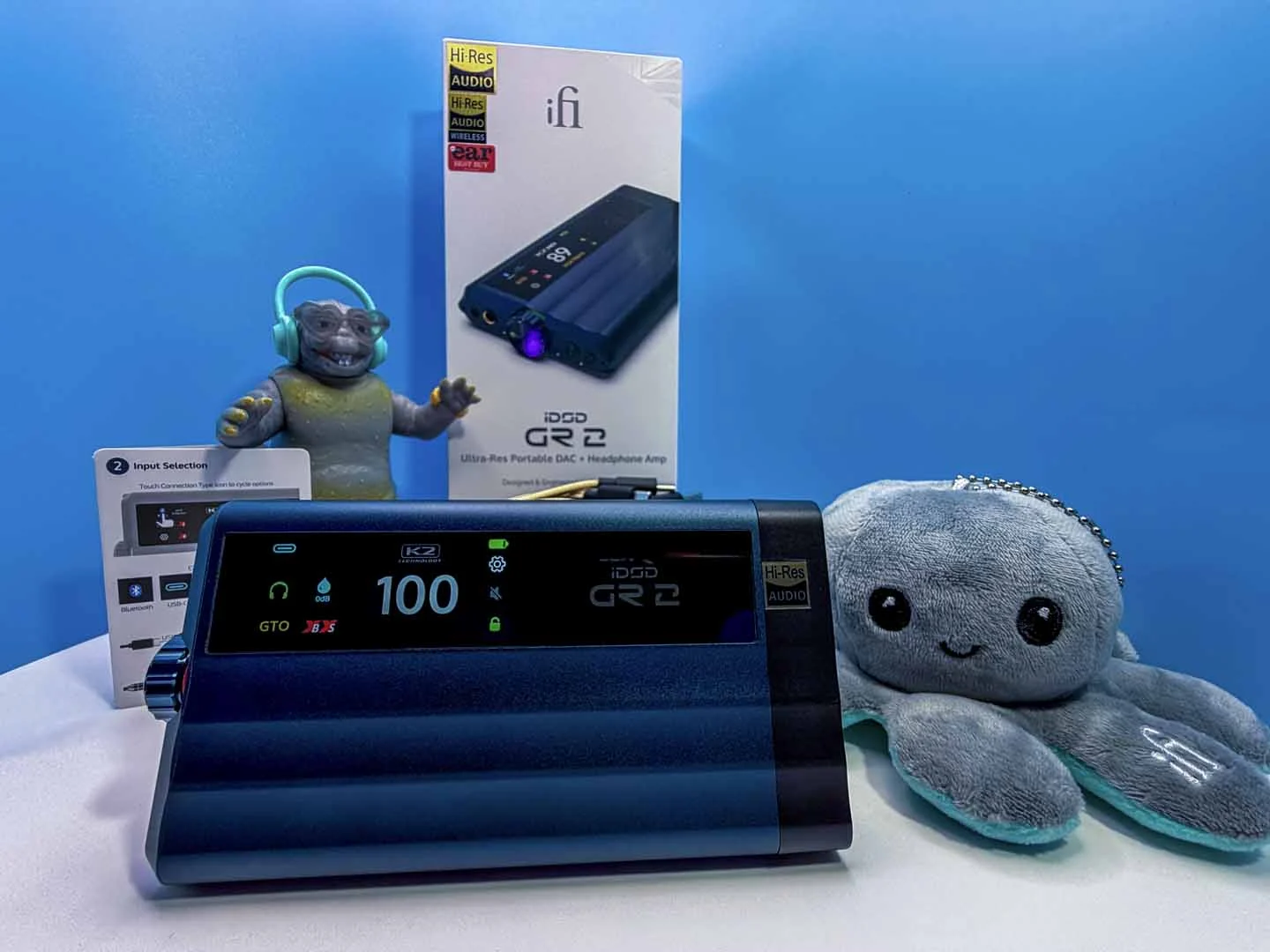
💰 Value: An Investment in Musical Exploration
At its $529 reference price, the GR 2 occupies a competitive enthusiast category where buyers have every right to expect more than clean digital conversion and sufficient headphone output.
Excellent portable DACs are available for considerably less, and many can drive sensitive IEMs without difficulty.
So what makes the GR 2 worth considering?
For me, the answer is the complete experience.
The GR 2 combines substantial amplification, sophisticated conversion, high-quality wireless connectivity, extensive analog and digital connections, K2HD processing, XBass+, XSpace, selectable digital filters, an excellent touchscreen, and intelligent power management within one carefully designed component.
Buying separate equipment to duplicate those capabilities would add complexity, connections, charging requirements, and potential compatibility challenges.
That doesn’t mean the GR 2 represents the best value for every listener.
Someone who exclusively uses sensitive IEMs through a smartphone and has no interest in additional processing or connectivity may find a compact dongle entirely satisfying.
Likewise, someone who never experiments with different settings may not appreciate the full value of the GR 2’s extensive feature set.
But for enthusiasts who actively enjoy exploring different headphones, IEMs, recordings, and sound configurations, the equation changes considerably.
The GR 2 becomes a central tool, not a simple accessory.
And after a month of daily use, that’s exactly how I see it.
The GR 2 isn’t compelling because it’s inexpensive. It’s compelling because it combines so many genuinely useful capabilities into one extraordinary enthusiast experience.
That makes its asking price much easier to appreciate.

👹 The GearZilla KAIJU DNA Scan: Anatomy of a Technological Monster
Every Kaiju has a defining personality.
Some rely on overwhelming strength, others distinguish themselves through agility or intelligence, and a few become legends because they combine extraordinary capabilities into something greater than the sum of their individual parts.
The GR 2 belongs firmly in that final category.
Its personality isn’t defined by one spectacular specification, a single processing effect, or an impressive collection of connections. It’s defined by how intelligently iFi has combined those elements into a musical experience that stays enjoyable long after the initial excitement fades.
After a month with this remarkable little machine, I’m convinced its greatest strength is how naturally its technologies work together.
🎯 K • Kill Shot: An Entire Audio Playground in One Device
The GR 2’s defining achievement is its extraordinary versatility: serious DAC and amplification performance, accessible sound-shaping tools, extensive connectivity, and an interface that makes exploration part of the enjoyment.
Plenty of portable devices deliver excellent sound. Far fewer provide this degree of control without making the listener work unnecessarily hard to access it.
The GR 2 doesn’t just offer more features. It makes me want to use them.
🧬 A • Anatomy: Engineered From the Inside Out
Beneath its substantial chassis sits a newly selected Burr-Brown PCM1795 DAC, a bespoke analog conversion stage, a fully balanced amplification architecture, a modern XMOS processing platform, and a sophisticated power-management system.
The engineering changes extend well beyond replacing a few familiar components, reflecting iFi’s ambition to create a distinct successor to the original Gryphon.
The touchscreen, upgraded Bluetooth, K2HD processing, and refined connectivity show how much attention iFi has paid to both technical capability and everyday usability.
This isn’t a cosmetic evolution. It’s a complete rethink of what a serious portable audio component can be.
🦴 I • Impact: Power With Intelligence
With more than 1,500mW available through its balanced headphone output into 32 ohms, the GR 2 offers substantial amplification capability for a portable device.
But the most impressive part isn’t the maximum figure.
It’s the combination of power modes, sensitive-IEM support, and configurable processing that lets the device handle dramatically different listening situations.
From demanding headphones to efficient in-ear monitors, iFi has created a system that adapts rather than forcing every listener into one configuration.
The monster has muscle, but its intelligence makes that muscle useful.
🎩 J • Joy: Rediscovering Music Never Gets Old
This is where the GR 2 absolutely shines for me.
K2HD, XBass+, XSpace, digital filters, and an exceptionally approachable touchscreen create a listening experience that encourages curiosity.
I can explore familiar recordings, experiment with their presentation, and discover different ways to enjoy music without turning the entire process into a technical chore.
That’s enormously valuable because it speaks directly to why I love this hobby.
I don’t simply want equipment that reproduces sound accurately. I want equipment that makes listening more rewarding.
After a month, the GR 2 still makes me excited to press play.
🎤 U • Unleashed: A Beast With a Few Limits
The GR 2’s shortcomings are largely physical, not philosophical.
Its substantial dimensions and 268g weight make it less convenient for lightweight travel, while approximately seven hours of rated battery endurance leaves me wishing for greater freedom during extended portable sessions.
Those compromises matter, and they keep an otherwise exceptional product from earning a perfect rating.
But they don’t erase the underlying design’s intelligence or the tremendous enjoyment I’ve had using it.
The GR 2 may be a substantial beast to carry, but there’s an extraordinary amount of capability inside that armor.
🦖 The KAIJU Conclusion: Born of Legend. Engineered to Roar.
The original Griffin set an ambitious vision for portable audio, bringing multiple technologies together in one exceptionally capable component.
The GR 2 builds on that heritage and develops its own identity, combining a redesigned DAC architecture, powerful amplification, sophisticated processing, modern wireless connectivity, intelligent power management, and a remarkably intuitive interface.
It’s the kind of product that demonstrates what happens when innovation is guided by an understanding of how enthusiasts actually use their equipment.
Perhaps the greatest compliment I can offer is that it doesn’t just impress me with what it can do.
It makes me want to keep discovering what I can do with it.
Born of legend. Built through innovation. Engineered to roar.
That’s the GR 2’s DNA.

🦖 GearZilla Scorecard: The Anatomy of an Enthusiast’s Dream
The GR 2’s strongest argument isn’t simply that it offers a sophisticated DAC, powerful amplifier, or unusually extensive collection of processing features. It’s that those elements work together to create an experience I genuinely enjoy, supported by exceptional craftsmanship and thoughtful engineering that make the product feel remarkably complete.
After a month of daily listening, here’s how this magnificent little monster earns its 4.7/5 GearZilla rating.
🎵 Musicality & Listening Enjoyment: 5.0/5 ⭐
The GR 2 has been an absolute pleasure to use throughout approximately a month of daily listening. Its engaging overall presentation, capable amplification, and flexible sound-processing options make it exceptionally rewarding to explore different recordings and playback combinations. More importantly, the enjoyment hasn’t faded with familiarity, which is one of the strongest endorsements I can give a piece of audio equipment. When a review sample becomes something I’m determined to buy, that’s a perfect score for listening enjoyment.
🔬 DAC Architecture & Technical Performance: 4.8/5 ⭐
The Burr-Brown PCM1795, bespoke analog output stage, and refined fully balanced architecture provide a sophisticated engineering foundation. iFi has clearly invested in more than just selecting a familiar converter, and the result is a wonderfully engaging listening experience. While I wouldn’t attribute every sonic characteristic exclusively to the DAC chipset, the complete implementation demonstrates impressive attention to musicality, clarity, and engineering quality.
⚡ Amplification & Headroom: 4.9/5 ⭐
With substantial published output power and multiple gain configurations, the GR 2 offers exceptional flexibility across different headphone requirements. The upgraded iEMatch implementation is particularly valuable for sensitive-IEM users, reinforcing the idea that sophisticated amplification should provide appropriate control as well as maximum power. Having serious muscle is impressive, but knowing when to use a lighter touch makes this monster special.
✨ K2 & K2HD Processing: 5.0/5 ⭐
One of my absolute favorite innovations in the entire GR 2 experience. K2HD introduces another fascinating way to explore harmonic texture, musical richness, and the emotional character of familiar recordings. Its appeal isn’t that it pretends upsampling magically restores missing information, but that it offers a genuinely enjoyable alternative presentation. The ability to explore K2 and K2HD so effortlessly is a huge part of why this device captured my imagination at CanJam SoCal and kept rewarding my curiosity over the next month.
🥁 XBass+ & XSpace: 4.9/5 ⭐
These analog enhancements provide wonderfully accessible control over bass authority and perceived spatial presentation, two characteristics I particularly enjoy exploring. I appreciate that both remain optional, allowing the GR 2 to preserve the original playback experience while inviting experimentation when a recording or headphone combination benefits from something different. They’re thoughtfully integrated, musically useful, and incredibly entertaining, although a full parametric EQ would make the customization toolkit even more complete.
🖥️ Touchscreen & User Experience: 5.0/5 ⭐
Absolute perfection for what this device is designed to do. The intuitive color touchscreen turns a technically sophisticated DAC/amp into something remarkably approachable, encouraging listeners to explore its capabilities instead of burying them behind confusing controls. Combined with the physical interface, it’s one of the most satisfying aspects of daily ownership and one of the clearest examples of iFi understanding how enthusiasts actually interact with their equipment.
📡 Wireless Connectivity: 4.9/5 ⭐
Bluetooth 5.4, LDAC, aptX Lossless, aptX Adaptive, and additional codec support provide outstanding flexibility across different wireless sources. Codec availability depends on the transmitting device, but iFi has equipped the GR 2 to support a remarkably broad range of modern listening environments. It’s an excellent wireless implementation that complements the device’s serious wired capabilities.
🔌 Wired & Analog Connectivity: 5.0/5 ⭐
USB, optical/coaxial S/PDIF, balanced and single-ended analog connections, and separate headphone outputs make the GR 2 extraordinarily adaptable. The dedicated USB-C charging connection deserves special recognition because it shows the kind of practical engineering that makes extended listening much more convenient. This is one of those rare products where I keep discovering another connection or feature and thinking, “They really did think of everything.”
🔋 Power Management: 4.8/5 ⭐
Hybrid Battery Mode, battery-health functionality, and separate charging arrangements demonstrate a serious approach to long-term usability. These refinements are especially valuable for enthusiasts who alternate between portable and desktop listening, and I appreciate how thoroughly iFi has considered the practical challenges of powering such a sophisticated device. Battery endurance remains a separate weakness, but the intelligence behind managing available power deserves considerable credit.
🎨 Build Quality & Craftsmanship: 5.0/5 ⭐
This thing is a UNIT, and I absolutely love how it’s built. The substantial chassis, beautifully integrated display, thoughtful controls, and premium overall presentation show the extraordinary engineering invested in the GR 2. Everything feels purposeful and cohesive, making it feel like a serious enthusiast instrument rather than another disposable electronic accessory. The same substantial construction adds weight, but that doesn’t diminish my appreciation for the craftsmanship.
☁️ Portability & Ergonomics: 3.9/5 ⭐
Here’s where the monster’s impressive physical presence becomes a genuine compromise. At 141 × 75 × 19mm and 268 grams, the GR 2 is considerably larger and heavier than I’d prefer for a portable listening device. It’s absolutely portable, and the engineering packed inside helps explain its size, but I wouldn’t call it effortlessly pocketable. I’d love to see iFi preserve this extraordinary functionality while finding ways to reduce the physical footprint in a future design.
🔋 Battery Endurance: 3.7/5 ⭐
Approximately seven hours of rated battery life is serviceable, but it feels like one of the few areas where the GR 2’s capabilities exceed its practical endurance. I routinely enjoy extended listening sessions, and a device this entertaining practically encourages me to keep exploring long after I intended to stop. The separate charging port and smart power management help a lot, but I’d welcome much longer untethered operation. When the music is this enjoyable, the last thing I want to think about is finding a charger.
💰 Value & Long-Term Appeal: 4.9/5 ⭐
At its $529 reference price, the GR 2 represents a substantial investment, but its remarkable combination of sophisticated conversion, powerful amplification, flexible connectivity, innovative processing, intuitive controls, and excellent craftsmanship makes that price increasingly compelling. Simpler DACs may satisfy listeners with narrower requirements, but for enthusiasts who genuinely enjoy exploring their equipment, the GR 2 offers an exceptional range of capabilities. After a month of daily listening, I don’t simply consider it worth recommending. I’m buying one because I believe it’ll remain a central part of my audio collection for a very long time.
🧡🦖 Overall GearZilla Score: 4.7/5 ⭐ | Born of Legend. Engineered to Roar.
Five visits to the iFi booth at CanJam SoCal. Approximately a month of daily listening. Countless hours exploring familiar music through new possibilities. And somehow, the iFi iDSD GR 2 has only become more impressive with time.
That doesn’t happen often in this hobby.
I’ve encountered plenty of equipment that delivers an unforgettable first impression, only to become considerably less exciting once the novelty wears off. The GR 2 has done precisely the opposite. What began as fascination with its engineering and capabilities evolved into genuine appreciation for how naturally it fits into my musical life. It’s not something I simply listen through. It makes me want to listen more.
There’s a term in sports for an athlete whose physical presence, intelligence, strength, and versatility make them impossible to ignore: an absolute UNIT.
That’s the GR 2.
This beast brings serious muscle, remarkable intelligence, tremendous versatility, and the craftsmanship to tie everything together. More importantly, none of it feels like technology for technology’s sake. Everything serves the experience, giving enthusiasts more freedom to discover what brings their music to life.
But even a UNIT has its limitations. At 268 grams, the GR 2 isn’t exactly pocketable, and its approximately seven-hour rated battery life won’t satisfy everyone who spends long days away from a charger. Those are legitimate compromises, and they’re why this extraordinary machine stops just short of a perfect score.
Yet here’s the part that matters most.
I’m buying one.
Not because it’s flawless. Not because I need every feature. And certainly not because I’m running out of audio equipment to explore. I’m buying one because, after a month of living with it, I genuinely don’t want to give it back.
For someone who constantly auditions new equipment, that’s about as meaningful an endorsement as I can offer.
The 4.7/5 GearZilla rating reflects the complete experience rather than a mathematical average of individual categories. Its musicality, engineering, versatility, and everyday enjoyment overwhelmingly outweigh the compromises for my listening habits. And while its considerable size and limited battery endurance deserve serious consideration, neither diminishes what iFi has accomplished here.
The original xDSD Gryphon earned its place in audiophile history. The GR 2 doesn’t need to imitate that legacy. It has the confidence, capability, and personality to establish one of its own.
This isn’t simply one of the most impressive portable DAC/amps I’ve encountered. It’s one of the few that has made me reconsider what I should expect from the entire experience.
And after a month together, this monster has earned something more meaningful than another glowing review.
A permanent place in my personal audio collection.
The Gryphon established the legend. The GR 2 was born to create its own.

🦖 Final Roar: Born of Legend. Engineered to Roar.
I’m a wine enthusiast, and one of the most important things I’ve learned about exceptional wine is that you don’t simply drink it. You experience it.
The ritual feels wonderfully deliberate. The anticipation of opening a remarkable bottle, the patience to let it breathe, the appreciation for the craftsmanship behind every vintage, and the quiet satisfaction of choosing the perfect glass. These details aren’t pretentious indulgences. They’re expressions of respect for the experience.
You don’t spend years appreciating the artistry of exceptional winemaking only to pour something extraordinary into a plastic cup and declare the job finished.
You reach for the best damn crystal you own.
Because when something matters to you, how you experience it matters, too.
And I’ve come to believe music deserves exactly the same consideration.
So, picture this.
It’s a quiet evening. The day’s obligations have finally surrendered, the phone has stopped demanding your attention, and for once, you have absolutely nowhere else you need to be.
You’ve opened a bottle of Dynamis Estate Wines’ 2019 The Mountain, a beautiful North Carolina Bordeaux-style blend of Cabernet Sauvignon and Petit Verdot. Rich, expressive, and layered with dark fruit and floral complexity, it’s the kind of wine that rewards patience rather than demanding attention.
You’ve given it time to breathe.
Now you reach for a Josephine N° 3 Red Wine Glass, a mouth-blown creation designed by Kurt Josef Zalto. Delicate in appearance, purposeful in execution, and crafted to reveal the character of what’s being poured into it.
The wine catches the evening light. You admire its color, appreciate the aromas unfolding from the bowl, and take that first unhurried sip.
Perfect.
Well, almost.
You settle into your favorite chair, reach for your favorite lush, immersive IEMs, connect them to the iFi GR 2, and cue up Leon Bridges’ “Happiness Anytime.”
And suddenly, everything falls into place.
That wonderfully soulful voice arrives with an intimacy that makes the room feel smaller and the performance somehow larger. Instruments breathe around him. Subtle textures emerge from the recording, not demanding your attention but inviting you to discover them. The music doesn’t compete with the moment. It becomes part of it.
You take another sip.
The wine reveals something different this time. A little more complexity, another layer of character, a nuance you missed moments earlier.
And the music does the same.
There’s a beautiful symmetry here. Both experiences reward curiosity, patience, and a willingness to pay attention. Neither needs to overwhelm your senses to leave a lasting impression.
And somewhere between the next sip and the next verse, you stop thinking about everything that made the evening possible.
You’re simply enjoying it.
That’s the magic.
Not the price of the bottle. Not the pedigree of the crystal. Not the sophistication of the electronics sitting beside your chair.
It’s the moment when exceptional craftsmanship becomes almost invisible, leaving nothing between you and the experience it was created to serve.
A remarkable wine deserves a glass that honors the winemaker’s vision. A beautiful recording deserves equipment that respects the artist’s intentions. Neither should steal the spotlight from what matters most.
And neither should make you feel as though you’re operating complicated machinery just to enjoy something you love.
The best tools don’t become the experience.
They make the experience possible.
That’s the connection I keep coming back to with the GR 2. Like the right crystal in the hands of a passionate wine enthusiast, it becomes part of a ritual built around appreciation rather than acquisition.
The point of this wonderful, occasionally ridiculous audiophile hobby was never to collect increasingly elaborate ways to measure sound.
It was supposed to be about falling in love with music.
Over and over again.
My sincere thanks to Ricardo and the entire iFi team for allowing me to spend meaningful time with their creation. Experiences like this remind me why I started sharing my listening adventures in the first place. Somewhere beyond the specifications, measurements, and endless debates, there’s an emotional connection worth celebrating.
When the evening finally winds down, the last of that beautiful wine rests in the crystal, and Leon Bridges delivers one final soulful phrase, I’m not thinking about DAC architecture, output measurements, or the technology beside me.
I’m thinking about how fortunate I am to have a moment like this.
A beautiful glass of wine. An extraordinary recording. A little time to myself.
And I couldn’t be anywhere else I’d rather be.
The finest equipment doesn’t just help us hear more. It reminds us to feel more.
Now that’s what I call Listening Bigger.
✅ Buy the iFi iDSD GR 2 If…
- You want a remarkably complete portable DAC/headphone amplifier that combines excellent musical performance with extensive functionality.
- You enjoy experimenting with different headphones, IEMs, recordings, and sound configurations.
- You’re interested in K2HD harmonic processing and comparing enhanced playback with the original signal.
- You appreciate analog sound-shaping features such as XBass+ and XSpace.
- You want substantial balanced amplification with adjustable output settings for different headphone requirements.
- You value a beautiful, intuitive touchscreen that makes sophisticated controls genuinely accessible.
- You need flexible wired and wireless connectivity, including LDAC and aptX Lossless support with compatible sources.
- You appreciate dedicated USB-C charging, intelligent power management, and thoughtful everyday usability.
- You’re comfortable carrying a substantial portable component for an exceptional range of capabilities.
- You want one versatile audio tool that can serve as a long-term centerpiece of your portable listening setup.
⛔ Consider Another DAC/Amp If…
- Your top priority is the smallest, lightest portable solution.
- You need considerably more than approximately seven hours of untethered battery operation.
- You primarily use one efficient IEM and don’t want additional processing, amplification, or connectivity features.
- You require full onboard parametric EQ with precise control over individual frequency bands.
- You prefer the simplicity of a basic plug-and-play USB dongle over an extensive enthusiast interface.
- You want to minimize the number of devices you carry while traveling.
- You have no practical use for the GR 2’s extensive sound-shaping tools and would be better served by a simpler, less expensive component.
🛒 Ready to Meet the GR 2?
Some audio equipment earns your admiration. The best earns a place in your collection, and the iFi iDSD GR 2 has absolutely earned mine. It’s a rare combination of musical enjoyment, meaningful innovation, and everyday versatility that makes the investment feel justified long after the initial excitement fades.
At $529, this isn’t an impulse purchase, but for enthusiasts who appreciate thoughtful engineering and the freedom to shape their listening experience, the GR 2 offers something genuinely special. Its 4.7/5 GearZilla rating reflects my confidence that I’ll enjoy this device for years, not just until the next shiny piece of audio equipment comes along.
Ready to discover what this monster can do for your music?
Explore the iFi iDSD GR 2 at iFi Audio
Born of Legend. Engineered to Roar.
Pick your monster and Listen Bigger! 🦖🎧
Share This Story, Choose Your Platform!