



A Year of Tubes, Tunes, and Beautiful Frustration
🎧 Is the écoute TH1 Worth Buying?
Absolutely! The écoute TH1 is a gloriously elegant, rich, detailed, sophisticated wireless headphone with a personality unlike anything else in my collection. Built around a genuine Korg Nutube 6P1 vacuum-tube preamplifier, dual-mono amplification, and 40mm titanium-coated dynamic drivers, the TH1 brings an ambitious slice of traditional high-end hi-fi into a modern wireless listening experience.
After a full year of ownership, these remain my favorite headphones. Period!
Their gorgeous construction, wonderfully warm presentation, and remarkable musical refinement have kept me reaching for them several times a week. They’re also the only headphones I’ve owned that seem to get even better as their tube circuitry warms up during a listening session. There’s something deeply satisfying about settling into that rich, enveloping sound and allowing the rest of the world to fade into the background.
I’ve spent a year searching for the perfect word to describe their personality. Warm doesn’t quite capture it. Refined gets closer. Luxurious describes their appearance, and soothing certainly explains how they make me feel. But one word brings it all together.
Sultry.
That’s the écoute TH1. Sultry in how it delivers music, sultry in its understated elegance, and sultry in its ability to draw me into a listening session without demanding attention with exaggerated bass or aggressive treble. It’s the sonic equivalent of a perfectly tailored evening suit, a dimly lit lounge, and a beautiful voice inviting you to stay just a little longer.
But this love affair isn’t without complications. At about 424 grams, the TH1 is heavy, and its wonderfully comfortable clamping force doesn’t always keep it securely in place when I bend forward or move suddenly. Its active noise cancellation is merely adequate, the protective carrying case is enormous, and the touch-sensitive controls occasionally behave like an overenthusiastic DJ with absolutely no respect for my musical intentions.
Still, none of those shortcomings has diminished my affection for these headphones. The TH1 represents something much more ambitious than another premium Bluetooth accessory. It’s a statement about what portable high-fidelity audio can become when a manufacturer prioritizes authentic analog architecture, thoughtful design, and emotional engagement over conventional feature-sheet competition.
This is a game-changing product, and I think every headphone manufacturer should be paying attention.
✅ Pros: Gloriously sultry, warm, rich, detailed, and refined sound; genuine vacuum-tube preamplification; sophisticated dual-mono amplification; stunning premium construction; ideal clamping comfort for my preferences; impressive Bluetooth range and reliability; physical buttons; customizable eight-band EQ; versatile wired and wireless connections; gorgeous green tube illumination; and a deeply engaging listening experience that’s kept me coming back for an entire year.
⛔ Cons: Substantial weight and insecure fit during movement; enormous protective case that limits portability; merely adequate ANC; touch-sensitive controls that can activate accidentally; unlabeled physical buttons requiring familiarization; limited EQ accessibility outside Bluetooth operation; no full parametric EQ in my experience; and a +12dB EQ ceiling that leaves my inner bass monster occasionally begging for more. There’s no automatic wear detection, but this isn’t a deal breaker since there is a playback pause button.
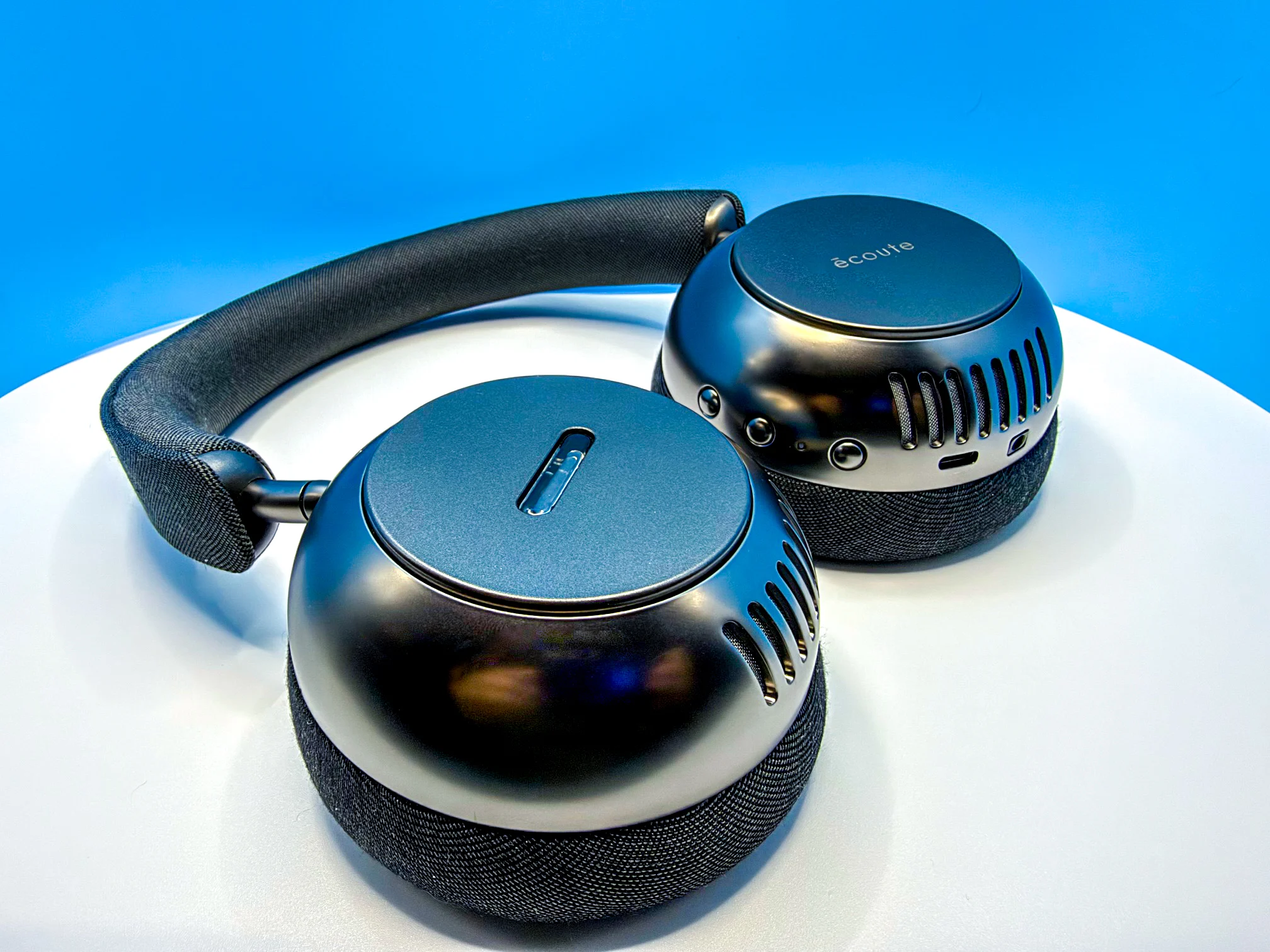
🎧 Meet Roxanne: “Power On.” Licensed to Thrill.
It happens every single time. I reach for my écoute TH1, settle those beautifully constructed earcups over my ears, and press the power button. Then, in the most wonderfully composed French accent, a mysterious woman whispers two simple words directly into my ear.
“Power On.”
And just like that, I get a little tingle.
After a full year of ownership, I’ve developed what I can only describe as a Pavlovian response to a headphone power prompt. The moment I hear her voice, my brain knows something wonderful is about to happen. The tubes are warming, the music is about to flow, and whatever madness the world has been throwing at me can kindly wait outside. I’ve actually reached the point where I crave hearing her voice. It’s become part of the ritual, an intimate little invitation to escape into my favorite music.
Naturally, after spending this much time together, I figured she deserved a proper name. Something sultry, sophisticated, unmistakably European, and just dangerous enough to get me into trouble.
I’ve decided to call her Roxanne.
Just Roxanne. No last name needed.
The Police were right about one thing. Roxanne doesn’t have to put on the red light. She’s already got that gorgeous green glow.
Roxanne sounds like the sort of powerful woman who steps out of an Aston Martin wearing a black evening gown, knows exactly how she likes her martini, and has probably broken the hearts of several MI6 operatives without revealing a single state secret. She’s sophisticated, impossibly composed, and possesses the kind of quiet confidence that makes you lean in whenever she speaks.
And that’s exactly how the TH1 makes me feel.
There’s something wonderfully James Bond about the entire experience. Not necessarily the explosions, car chases, or international espionage, although I’m reasonably certain the TH1 contains enough sophisticated electronics to earn a place in Q Branch. It’s the understated elegance, the quiet confidence, and the sense that something extraordinary is about to happen without anyone needing to announce it with unnecessary theatrics.
The TH1 doesn’t scream for attention. It doesn’t need to. Like Bond stepping out of an Aston Martin in a perfectly tailored tuxedo, it simply arrives, looks magnificent, and lets its performance do the talking. That beautiful green glow from the vacuum tube only adds to the atmosphere, like a tiny piece of classified technology hiding in plain sight.
And Roxanne? She’s my personal Bond-inspired audio concierge, welcoming me into another adventure with those two deliciously understated words. No elaborate instructions, no unnecessary chatter, just a subtle reminder that the outside world is about to become considerably less interesting.
It’s funny how something as simple as a startup voice can become such a meaningful part of an ownership experience. But after a year, that little exchange has become one of my favorite things about these headphones. It’s anticipation, familiarity, and pure listening pleasure wrapped into a two-word greeting.
Roxanne whispers, “Power On,” the tubes glow, and my mission is simple: disappear into the music.
And believe me, I accept that mission every single time.
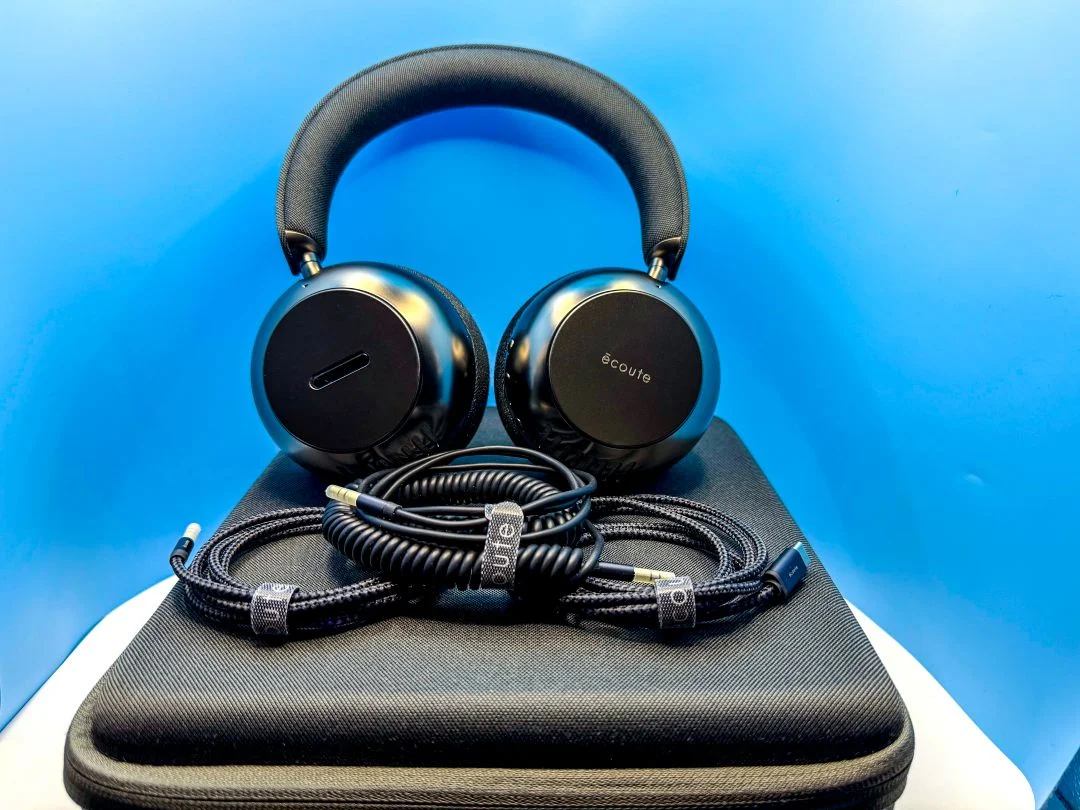
🏎️ The Aston Martin of Headphones: Performance with Seductive Restraint
I’ve spent a lot of time searching for the right automotive comparison for the écoute TH1. A Cadillac initially came to mind because of the wonderful ride quality. There’s something deeply satisfying about a luxury automobile that makes the outside world seem softer, quieter, and a little less important.
But the TH1 has too much personality, performance, and sophistication to be defined by comfort alone. A Ferrari feels too flashy for this comparison, while a Porsche emphasizes athletic precision and technical performance.
No, the TH1 belongs to another category entirely.
It’s an Aston Martin DB5 grand tourer, from “Goldfinger.”
Beautifully proportioned, powerful without being obnoxious, and luxurious without looking desperate for attention. This is the kind of machine that makes a long journey feel like an occasion, even when the destination is nothing particularly special. You don’t need fluorescent paint, an enormous rear wing, or an exhaust loud enough to announce your arrival from three counties away. The craftsmanship, elegance, and performance speak for themselves.
That’s the écoute TH1.
Its appeal lies in the little things: substantial construction, tactile controls, gentle green illumination, and wonderfully rich musical textures. Everything contributes to a sense that you’re experiencing something carefully conceived rather than simply assembled.
And like an Aston Martin, the TH1 isn’t designed to satisfy everyone. Some listeners will look at its weight, price, unconventional technology, and enormous carrying case and wonder why anyone would bother. Others will put it on, hear what it’s capable of, and understand immediately.
The latter group won’t need much convincing.
Nobody really sets out looking for an écoute TH1. Somehow, it reveals itself.
If you know, you know.
And once you know, it’s awfully difficult to forget.
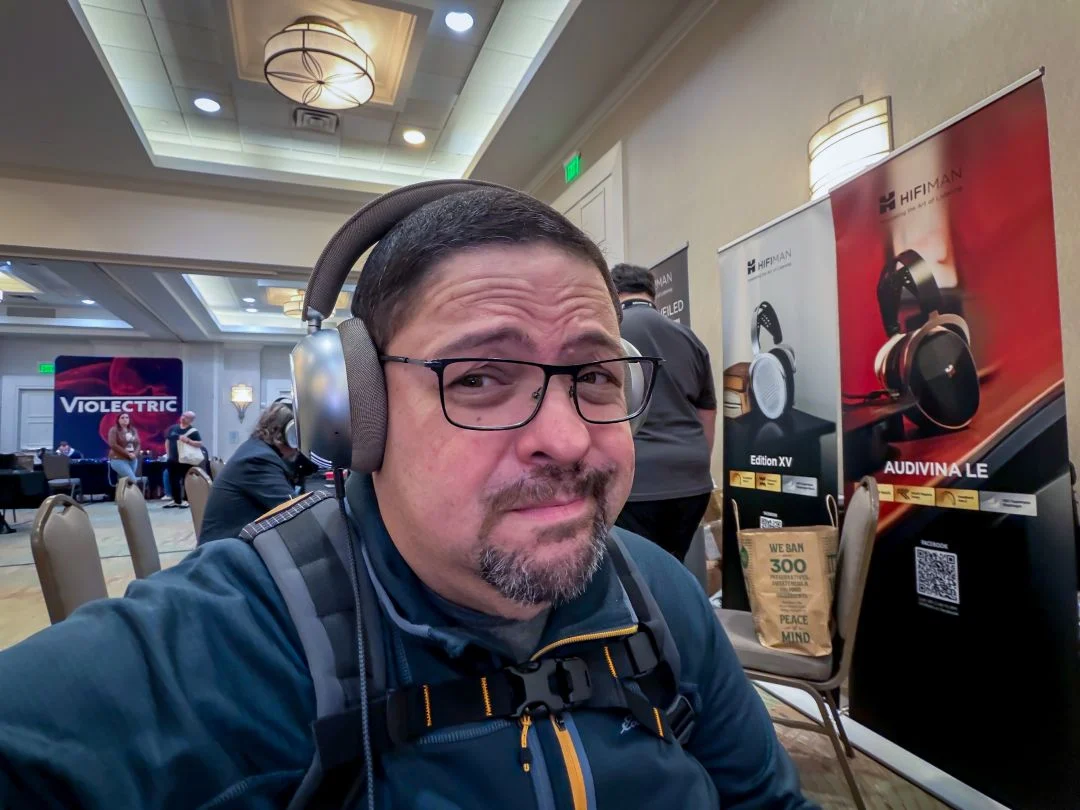
The exact moment it all began. 🎧 CanJam Dallas, 2025. That look on my face? It’s disbelief, confusion, and pure delight. My brain was desperately trying to process one question: “How the hell can these headphones sound THIS good?”
🎟️ Love at First Listen: CanJam Dallas
I started my relationship with the TH1 at CanJam Dallas last year. Anyone who’s attended one of these events knows how overwhelming they can be. Everywhere you look, there are extraordinary headphones, elaborate amplifiers, shiny DACs, and enough audio equipment to bankrupt a small municipality.
It’s an audiophile playground, and an extremely dangerous place for your wallet.
Among everything competing for my attention, the écoute TH1 left an impression that refused to fade. Something about its presentation immediately resonated with my listening preferences. It had the warmth I crave, the richness I love, the detail I appreciate, and an underlying sophistication that made the entire performance feel wonderfully inviting.
It wasn’t simply that the headphones sounded good. They sounded like something I wanted to live with.
I knew I had to have a pair.
Unfortunately, the TH1 wasn’t exactly an impulse purchase, so I kept an eye out for an opportunity. Thankfully, fate eventually intervened in the form of a first-owner pair listed for sale on Head-Fi. I didn’t hesitate. I locked them in, brought them home, and began what has become one of the most satisfying long-term relationships I’ve developed with a piece of audio equipment.
A year later, I’ve used them several times a week, experienced plenty of other headphones, and accumulated more than a few colorful stories about their occasional eccentricities.
And through all of it?
Absolutely no regrets.
🦖 Disclosure
With the écoute TH2 launch approaching and CanJam Dallas 2026 just around the corner, the timing felt perfect to revisit the headphones that started this love affair. Almost exactly one year ago, I first experienced the TH1 at CanJam Dallas, and that unforgettable audition set me on a path to owning what would become my favorite headphones. Now, on the eve of the next generation, it seems only fitting to give the original its proper moment in the spotlight. After all, what better time to look back than when everyone is looking forward?
I purchased my écoute TH1 secondhand from its original owner on Head-Fi. These are my personally purchased headphones, not a complimentary review sample, and my impressions reflect approximately one year of regular ownership. That includes extended listening sessions, EQ experimentation, everyday wireless use, comfort evaluation, and the practical quirks that only reveal themselves after you’ve lived with a product long enough to give it a name.
I’ve also had the pleasure of communicating directly with écoute co-founder Kendal Liddle about my experiences, suggestions, and occasional frustrations. His willingness to listen to customer feedback has only strengthened my appreciation for the company’s approach to product development.
I’m also a proud Kickstarter backer of the upcoming écoute TH2, which I briefly auditioned at CanJam SoCal. While I’m excited about what comes next, neither those conversations nor my support for the new model has influenced my conclusions about the TH1. My impressions and evaluations are entirely my own.
My philosophy remains simple: Listen first. Figure out the story later.
And after a year with Roxanne, I’ve got one hell of a story to tell. 💚
🏭 écoute Audio: Bringing the Soul Back to Listening
Every great audio product starts with an idea. Some emerge from engineering departments, others from market research, and occasionally something special happens because somebody asks a question that probably shouldn’t have been asked.
For écoute, aptly named after the French word for “listen,” that question was essentially this: What if you could put the soul of a high-end, tube-driven stereo system inside a pair of wireless headphones?
Not simulate the warmth with a digital preset or simply shape the frequency response to imitate traditional analog equipment. Actually incorporate genuine vacuum-tube amplification into the headphones themselves.
It’s a wonderfully ambitious concept, especially since conventional vacuum tubes are often hot, fragile, power-hungry components that aren’t particularly enthusiastic about being strapped to someone’s head.
But that’s precisely the challenge écoute set out to tackle.
What’s in a Name?
The company’s name feels beautifully appropriate. écoute is French for “listen,” a simple word that invites you to stop what you’re doing and pay attention.
The name also connects personally to the founders, whose experiences living in Montréal helped shape the company’s identity. That French connection gives the brand an elegant foundation, but I find the philosophy behind the name most compelling.
We’re living in a world where millions of songs are instantly accessible, yet music increasingly becomes background noise accompanying everything else we do. We listen while answering emails, working, driving, exercising, cooking, and performing practically every other daily activity.
That’s not wrong, of course. Music should be part of our lives.
But somewhere along the way, it’s easy to forget the pleasure of listening for no reason other than the music itself.
écoute wants to bring that experience back.
And after a year with the TH1, I understand exactly what the company is getting at. These headphones encourage me to sit down, get comfortable, close my eyes, and rediscover details in recordings I’ve heard countless times before.
They remind me that sometimes the most rewarding thing I can do with music is give it my undivided attention.
👔 The People Behind écoute: Vision, Engineering, and Intentional Listening
Behind the TH1 is a team that believed wireless headphones could be more than another collection of familiar features. Kendal Liddle and Joshua Fairbairn co-founded écoute, combining creative vision with the practical expertise needed to turn an ambitious idea into a product people could actually wear and enjoy.
Kendal brought more than two decades of multidisciplinary creative experience spanning brand strategy, art direction, and product design. As the company’s creative director and product designer, he’s helped shape the restrained elegance that makes the TH1 so distinctive. After a year with Roxanne, I can see that influence everywhere, from the proportions and materials to the tactile controls and subtle presentation of the illuminated tube. Nothing feels like it was added simply to attract attention.
Joshua contributed the complementary manufacturing and product-development expertise needed to bring that vision into the real world. Creating a beautiful prototype is one thing. Integrating genuine vacuum-tube technology, battery power, Bluetooth connectivity, digital conversion, dedicated analog amplification, and sophisticated acoustics into a finished wireless headphone is quite another.
The TH1 emerged through a Kickstarter campaign in 2023, introducing an unconventional approach to portable high-fidelity audio. Instead of producing another variation on the familiar premium wireless headphone, écoute set out to incorporate elements of serious home-audio architecture into a self-contained listening system.
What I find particularly appealing is that the philosophy extends beyond engineering. Kendal has spoken about restoring the joy of intentional listening, encouraging people to stop treating music as background noise and start experiencing it as something worthy of their undivided attention.
That resonates with me tremendously. After a year with Roxanne, I’ve come to appreciate how the TH1 encourages me to slow down, settle into a comfortable chair, and let the music take center stage. The craftsmanship, the soft green glow of the Nutube, that sultry foreign voice whispering “Power On,” and the beautifully rich presentation all create a sense of occasion.
There’s another word that describes the TH1 almost as perfectly as sultry: intentional.
The design is intentional, the engineering choices are intentional, and the distinctive sonic personality feels deliberate. Even switching Roxanne on has become a little ritual I genuinely look forward to. That doesn’t mean every decision was perfect. The weight, enormous carrying case, touch controls, and software limitations certainly leave room for improvement. But I appreciate a company with a clear vision and the conviction to pursue it.
And while I’d come to appreciate that philosophy through ownership and conversations, CanJam SoCal 2026 gave me the opportunity to connect with the people bringing it to life.
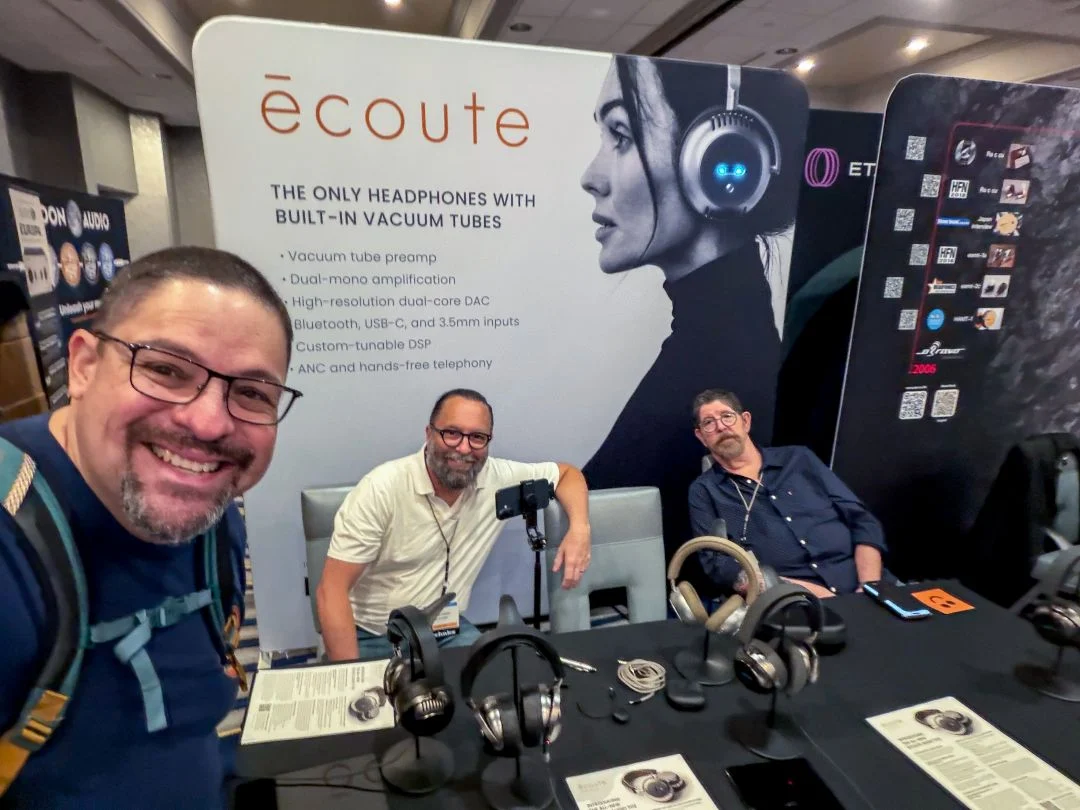
Full circle at CanJam SoCal 2026! 💚 A year after discovering the écoute TH1 at CanJam Dallas, I finally met the minds behind the magic: co-founder and product designer Kendal Liddle (center) and President and Co-Founder Andy Regan (right).
🤝 CanJam SoCal: From Conversations to Handshakes
At CanJam SoCal, I had the privilege of finally meeting Kendal in person. We’d already spent considerable time talking about headphones, HiFi, innovation, and my experiences with the TH1, including a few things that occasionally drive me absolutely crazy. But there’s something special about finally shaking hands with someone you’ve gotten to know through a shared passion.
For me, it brought the experience full circle. A year earlier, I’d discovered the TH1 on the show floor at CanJam Dallas. That unforgettable audition eventually led me to purchase my own pair, and when écoute announced the TH2 on Kickstarter, I jumped aboard as an early backer. What began with one pair of headphones had grown into an ongoing conversation about where personal audio could go next.
And then I had the pleasure of meeting Andy Regan, écoute’s President and Co-Founder.
If you’ve spent any meaningful time in the headphone industry, Andy’s background should catch your attention. He previously served as President of Dan Clark Audio and Chief Marketing Officer of HIFIMAN, along with leadership roles at Jerry Harvey Audio and Monster Cable.
That’s a remarkable amount of industry experience to bring to a company pursuing something as unconventional as écoute.
Suddenly, I wasn’t simply meeting the people behind a young headphone brand. I was spending time with industry veterans who understood the established headphone landscape and were exploring ways to challenge it.
And that’s where the conversation became particularly interesting.
We talked about gear, innovation, the thinking behind écoute, and the wonderfully ambitious idea of making elements of a serious home HiFi system wearable. Vacuum-tube preamplification, dedicated amplification, modern wireless connectivity, and sophisticated acoustics aren’t necessarily the first ingredients that come to mind when designing Bluetooth headphones.
But that’s exactly what makes the concept so fascinating.
While much of the industry focuses on improving familiar features such as ANC, battery life, portability, and software, écoute is asking a different question.
“Why can’t we do this?”
Why can’t genuine vacuum tubes live inside a wireless headphone? Why can’t portable audio borrow from the architecture of traditional high-end stereo systems? And why should the next generation of headphones be limited to refining what already exists?
That’s precisely the sort of thinking I want to see more of in personal audio.
Meeting Kendal and Andy made the innovation behind écoute feel considerably more human. We weren’t simply discussing specifications or upcoming products. We were talking about possibilities, creative ambition, and the shared belief that listening to music should still be exciting.
I also appreciated the opportunity to discuss some of my real-world frustrations with the TH1. It’s easy for a company to celebrate glowing praise, but I’ve been impressed by écoute’s willingness to engage with feedback from someone who genuinely loves the product while recognizing its shortcomings.
🚀 Looking Ahead Without Forgetting the Original
I briefly auditioned the upcoming TH2 at CanJam SoCal, and the experience only increased my curiosity about the finished product. The company was still refining the design and sound, so I’m not treating that early listen as a definitive evaluation. But I’m certainly eager to discover what the next generation can accomplish.
And yes, I’m still waiting for my Kickstarter-backed TH2.
Patiently.
Okay, not remotely patiently.
What fascinates me most is how this entire relationship unfolded. One CanJam demonstration became a purchase. That purchase became a year of listening, experimenting, and occasionally arguing with Roxanne’s touch controls. Along the way came conversations with Kendal, a Kickstarter backing, and eventually the opportunity to meet both Kendal and Andy in person.
That’s the beauty of CanJam. You might walk through the doors hoping to discover your next favorite pair of headphones, only to realize that one of the most rewarding parts of the experience is getting to know the people behind them.
And that’s what has made my journey with écoute so special.
The TH1 taught me to appreciate intentional listening. CanJam SoCal reminded me that intentional design begins with people willing to question what’s possible.
After a year with Roxanne, I can wholeheartedly get behind that philosophy.
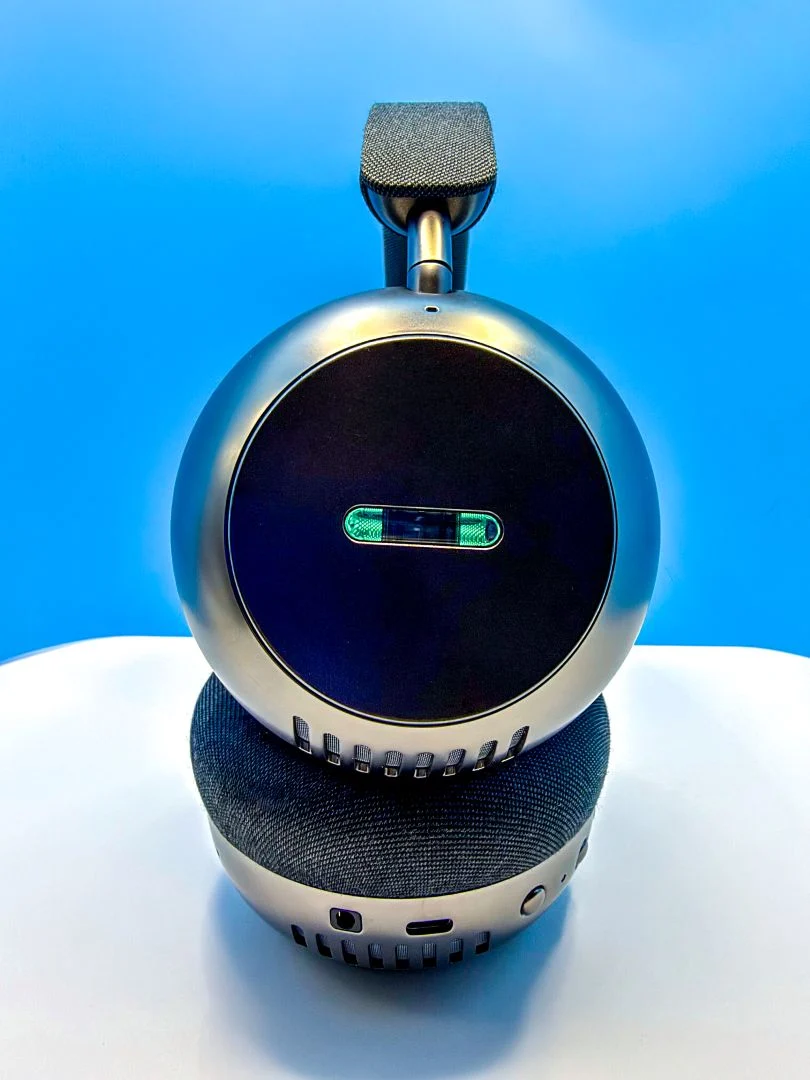
💚 The Green Glow: A Little Analog Seduction
Another Roxanne detail I absolutely adore.
That gorgeous green glow.
I love watching the illuminated Nutube inside the TH1. It’s subtle, hypnotic, and just exotic enough to make the headphones feel like a tiny piece of sophisticated technology borrowed from Q Branch.
Unlike decorative LEDs designed to imitate traditional vacuum tubes, the green illumination comes from the technology itself.
The Korg Nutube 6P1 uses vacuum fluorescent display technology, with phosphor illumination associated with the actual operating component. The device contains genuine triode structures, allowing it to function as a miniature vacuum-tube amplification stage.
In other words, that beautiful green glow isn’t simply there to make the headphones look cool.
It absolutely does that, too.
There’s something deeply satisfying about seeing a little piece of actual electronic engineering doing its job while the music flows. It’s the same appeal that makes traditional tube amplifiers so visually captivating, only miniaturized into something that can sit inside a wireless headphone.
And yes, I find it wonderfully sultry.
Roxanne doesn’t need a red light.
She’s already glowing green.
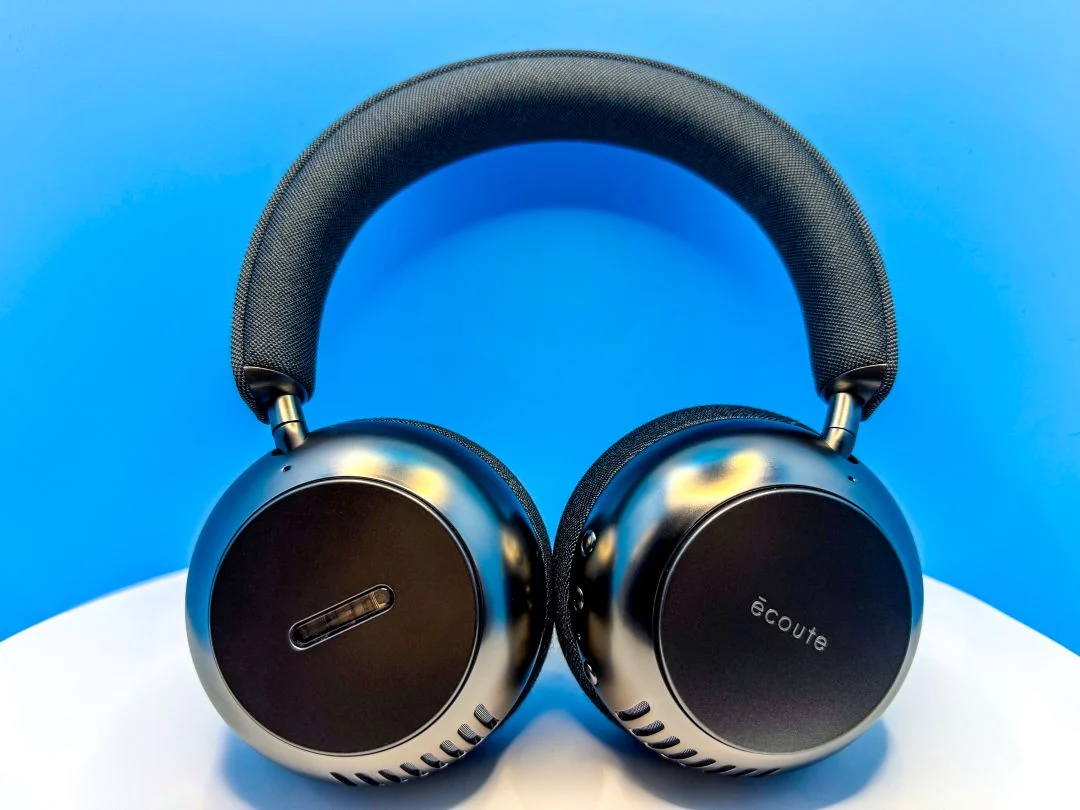
⚙️ Why Tubes Matter: More Than a Pretty Glow
Vacuum tubes have a long history in audio, dating back to early electronic amplification and continuing through radio, broadcasting, recording studios, and high-fidelity home systems.
Although transistors eventually made electronics smaller, cooler, and more efficient, tube amplification never completely disappeared. Musicians and audio enthusiasts continued appreciating the particular harmonic behavior and tonal characteristics that certain tube circuits could produce.
Of course, a tube doesn’t automatically guarantee warmer or better sound. Solid-state amplifiers aren’t inherently clinical, and tube circuits aren’t universally more musical. The complete electrical design, distortion characteristics, operating conditions, and acoustic implementation determine what ultimately reaches our ears.
But certain tube circuits can introduce even-order harmonic components that listeners may perceive as adding warmth, richness, or tonal body.
écoute embraces that behavior as part of its sonic philosophy.
The company describes the TH1’s powered digital signal architecture as a sequence of digital conversion, genuine tube preamplification, and analog amplification, arranged through dedicated left and right signal paths.
Each channel uses one of Nutube’s two triodes, creating a dual-mono configuration inspired by traditional high-end stereo systems.
That’s an ambitious engineering approach for a wireless headphone, especially in a category where highly integrated chips and compact electronics are so common.
What impresses me most is that écoute didn’t merely incorporate the tube as an interesting accessory. It made the tube stage part of the product’s fundamental identity.
Can I independently isolate exactly how much of Roxanne’s warmth comes from the Nutube rather than the drivers, DSP, amplification, and acoustic design? No.
But I can tell you that the complete result is glorious.
🔥 The Warm-Up Ritual
Here’s something I’ve never experienced quite this way with another headphone.
Roxanne seems to sound better the longer I listen in a single session.
I’m not talking about the endless debate over hundreds of hours of driver burn-in. I’m describing what I perceive during a single listening session as the tube circuitry reaches operating temperature.
When I first turn on the TH1, the sound is already excellent. But as the session progresses, the presentation seems to settle into itself. The warmth grows increasingly inviting, the richness becomes more captivating, and the music takes on a wonderfully relaxed quality that makes it hard to stop listening.
I haven’t taken controlled measurements to determine whether those changes are electrical, perceptual, or some combination of both. Auditory adaptation could certainly contribute.
But whatever is happening, I consistently enjoy the result.
It’s become part of my relationship with these headphones. Roxanne whispers “Power On,” the green tube begins glowing, and the music gradually draws me into that familiar, soothing embrace.
There’s something wonderfully old-school about experiencing that sensation through a modern Bluetooth headphone.
And after a year, it still makes me smile.
♾️ Built for the Long Game
Korg and Noritake developed the Nutube as a compact, low-power approach to genuine vacuum-tube operation. Korg publishes an expected operating life of up to 30,000 continuous hours for the Nutube component under appropriate conditions.
That’s an impressive specification, but it shouldn’t be mistaken for a guarantee that the entire TH1 will function flawlessly for decades. Batteries age, electronics can fail, and mechanical components eventually wear.
The complete product’s lifespan will ultimately depend on maintenance, replacement parts, and long-term serviceability.
Still, I appreciate écoute’s stated commitment to longevity and opposition to planned obsolescence. The company has emphasized firmware development and the idea that headphones should remain useful rather than becoming disposable accessories with every new product cycle.
That philosophy fits perfectly with how I view Roxanne.
This isn’t a catch-and-release headphone.
I want to keep it for years, potentially for the rest of my listening life, if the hardware remains serviceable.
In a hobby where buying, selling, trading, and upgrading are practically competitive sports, finding something that makes you want to stop looking is a pretty remarkable feeling.
📋 Technical Specifications
| Feature | Specification |
|---|---|
| Model | écoute TH1 |
| Headphone type | Wireless, closed-back, over-ear |
| Driver configuration | Dynamic |
| Driver diameter | 40mm |
| Diaphragm | Titanium-coated Mylar |
| Vacuum-tube preamplifier | Korg Nutube 6P1 |
| Amplifier architecture | High-bias Class A/B, dual mono |
| DAC capability | Up to 32-bit/384kHz |
| Bluetooth version | 5.3 |
| Bluetooth codecs | SBC, AAC, LDAC |
| Digital connection | USB-C |
| Analog connection | 3.5mm |
| Analog playback | Powered and passive operation |
| Noise cancellation | Hybrid ANC |
| Transparency mode | Supported |
| Equalization | Eight-band graphic EQ |
| EQ adjustment range | Up to ±12dB per band |
| Advertised battery life | Up to 20 hours |
| Charging time | Approximately 3.5 hours |
| Weight | Approximately 424g |
| Published frequency response | 20Hz–20kHz |
| Original reference price | $899 USD |
| Manufacturer sale price during research | $699 USD, October 2026 |
These are manufacturer-published specifications, not independent GearZilla laboratory measurements. Battery life, connectivity, and available playback resolution depend on operating conditions and source devices. Don’t confuse the DAC’s maximum resolution with Bluetooth transmission resolution.

📦 Design & Build: Elegance with a Dangerous Side
Roxanne is gorgeous.
There’s simply no other way to describe her.
The TH1’s construction communicates a level of premium intent that makes these headphones feel closer to sophisticated enthusiast audio equipment than a conventional wireless accessory. The materials feel substantial, the visual presentation is understated, and the illuminated tube provides just enough intrigue to distinguish the design without turning it into a theatrical spectacle.
I love that restraint.
The TH1 looks expensive because it feels carefully constructed, not because someone decided to cover the earcups in unnecessary decorative elements.
Its appearance has an appealing confidence. It’s the kind of product that doesn’t need to shout about its engineering because the engineering is already part of the experience.
Unfortunately, that substantial construction also introduces one of the TH1’s biggest practical complications.
⚖️ Comfort: Perfect Clamp, Questionable Gravity
At approximately 424 grams, these headphones are heavy. You know they’re on your head, although weight alone doesn’t determine comfort.
Here’s where my experience might surprise some listeners: the clamping force is absolutely perfect for me.
I don’t like headphones that squeeze my head or create excessive pressure during extended listening. Roxanne feels wonderfully comfortable when I’m seated and enjoying music, with just enough contact to keep the earcups positioned naturally.
The problem begins when I move.
Lean forward too far, and she starts considering an unscheduled departure. Turn my head the wrong way, and suddenly gravity seems determined to end our relationship.
It’s a strange contradiction. The gentle clamping force adds to the comfort I enjoy so much, but the substantial weight makes the headphones less secure when I move.
And that’s worth understanding before buying.
I wouldn’t choose these headphones for exercise, household chores involving repeated bending, or energetic activity. They’re designed for listeners who want to settle into a comfortable position and enjoy the journey.
Which, to be fair, is exactly where Roxanne shines.
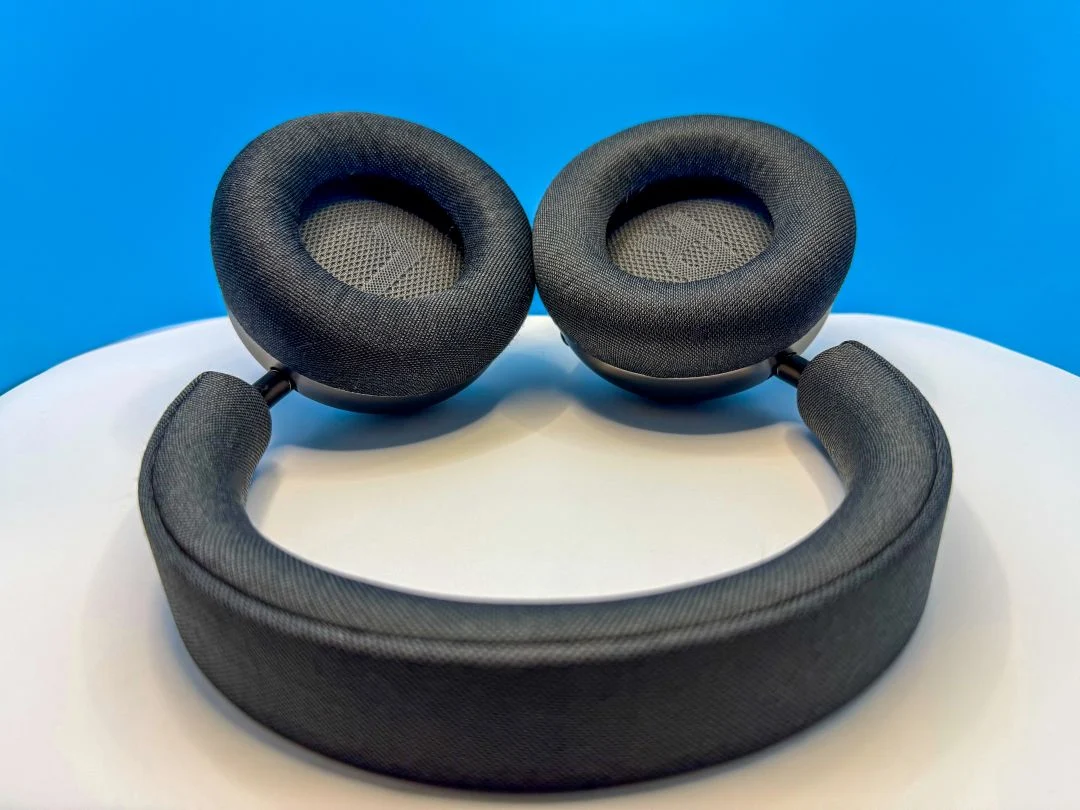
🎧 Review Setup: A Year in Roxanne’s Company
I’ve lived with the TH1 for approximately a year, reaching for them several times each week as part of my regular home listening routine.
My primary music source is Apple Music, and I’ve used these headphones in everyday life rather than during a short, isolated evaluation period.
That distinction matters.
A brief demo can make a product sound impressive. A few weeks can reveal its general personality. But a year shows whether the experience keeps mattering after the purchase excitement fades.
I’ve spent that time exploring Roxanne’s sound customization, enjoying her exceptional Bluetooth reliability, testing the controls, evaluating comfort, and discovering practical limitations that a short audition doesn’t always reveal.
I’ve also tried plenty of other headphones along the way, which makes my continued affection for the TH1 feel especially meaningful.
The novelty of owning vacuum-tube Bluetooth headphones disappeared long ago.
The pleasure of listening hasn’t.
And that’s ultimately what this review is about.
🥁 Bass: When Refinement Refuses to Misbehave
Anyone familiar with my listening preferences knows I appreciate substantial bass. I want weight, texture, authority, and enough physical presence to make the music feel alive.
Occasionally, I want bass so ridiculous that nearby geological formations begin filing complaints.
Roxanne has other ideas.
The TH1’s low-frequency presentation is rich, controlled, and beautifully integrated into the overall sound. There’s satisfying tonal body and warmth, but the bass doesn’t overwhelm the midrange or constantly demand attention.
Instead, it behaves with remarkable restraint.
And that’s one of the reasons the TH1 sounds so sophisticated.
The bass supports the music, adding substance and warmth without turning every recording into a low-frequency exercise. It’s the kind of presentation that encourages me to appreciate tonal texture rather than simply counting how many times a kick drum attempts to rearrange my internal organs.
But there’s a little bass monster living inside me, and sometimes that creature wants Roxanne to loosen her tie.
The écoute app lets you adjust low frequencies up to +12dB, which is a substantial amount of flexibility by conventional standards.
For most listeners, that’s probably more than enough.
For me?
I’d love to see what happens beyond that boundary.
Not because Roxanne needs more bass to sound wonderful. She absolutely doesn’t. I simply enjoy experimenting with extreme sound customization, and sometimes I want to push the low end into thoroughly unreasonable territory.
Unfortunately, Roxanne seems determined to maintain her dignity.
She’ll flirt with excess, but she refuses to make a scene.
Somehow, that restraint fits perfectly with the rest of her personality.
🎤 Midrange & Vocals: The Art of Seduction
If bass provides the foundation, the midrange is where Roxanne reveals her personality.
Vocals and instruments have a richness that gives the TH1 its wonderfully inviting character. The voices carry satisfying substance, the musical textures feel warm and engaging, and the overall presentation encourages me to relax into the performance rather than examine it under a sonic microscope.
I love hearing detail, but I don’t want every listening session to feel like an engineering examination.
Sometimes I want a performance’s emotional character to take priority.
The TH1 makes that wonderfully easy.
There’s something almost velvety about the way it presents familiar music. The midrange doesn’t constantly push forward demanding attention, but it has enough presence and tonal body to make voices and instruments feel substantial.
That balance is a major part of what I mean by calling the TH1 sultry.
It’s not merely about warmth. It’s about the way the sound draws me closer without ever becoming aggressive.
The invitation is subtle.
The attraction is immediate.
And the longer I listen, the more I want to stay.
✨ Treble & Air: A Whisper, Not a Scream
One recurring frustration with audio equipment is the idea that more treble automatically means more detail.
It doesn’t.
Raising upper frequencies can make certain elements of a recording more prominent, but it doesn’t necessarily make the presentation more natural or refined.
Roxanne approaches the upper frequencies with the same composure that defines the rest of her sound.
To my ears, the TH1 delivers satisfying detail without becoming unnecessarily sharp or aggressive. It has enough upper-frequency information to keep recordings articulate and engaging, but the overall presentation stays warm, soothing, and comfortable.
I particularly appreciate that balance during longer listening sessions.
The treble contributes to the performance without constantly pulling my attention away from the music.
It’s a little like Roxanne herself.
She doesn’t need to raise her voice to be heard.
🎯 Instrument Separation & Placement: Everything in Its Place
The TH1’s appeal isn’t built around aggressively isolating every instrument from the rest of the recording.
Instead, I hear a cohesive presentation that emphasizes the relationship between musical elements.
And that’s exactly what I enjoy.
I appreciate recognizing individual instruments and textures, but I also want those elements to feel like they’re part of a complete performance.
Roxanne manages that balance beautifully for my preferences.
The sound feels integrated rather than artificially dissected, giving familiar recordings a sense of flow that makes the listening experience wonderfully relaxed.
Some equipment makes me want to analyze every instrument.
The TH1 makes me want to enjoy the album.
And after a year, I know which experience keeps bringing me back.
🏟️ Soundstage & Imaging: An Invitation to Escape
Soundstage has always been one of my favorite aspects of audio reproduction.
I love width, depth, believable instrument placement, and the feeling that music exists beyond the headphones’ physical boundaries.
Give me a convincing three-dimensional listening experience with enough space for instruments and vocals to breathe, and I’m usually a very happy listener.
The TH1 fits comfortably within those preferences.
Its warm, detailed presentation creates an immersive environment that makes it easy to retreat into the music. Rather than relying on exaggerated spatial effects, the experience feels naturally inviting, with the sense of musical refinement contributing to the overall atmosphere.
That’s an important distinction.
I’m not suggesting that Roxanne produces the most enormous or holographic stage I’ve ever encountered. Her appeal is more nuanced than that.
She creates a convincing personal listening space.
And sometimes, that’s exactly what I want.
A little distance from the outside world.
A familiar recording.
And a beautiful voice inviting me to disappear.
🔬 Detail & Resolution: Sophistication Without Showing Off
The TH1 is a detailed headphone, but what I appreciate most is how naturally that detail fits into the overall presentation.
Nothing feels unnecessarily aggressive.
The sound doesn’t seem desperate to prove how much information it can extract from a recording. Instead, subtle textures and instrumental details contribute to the musical experience without constantly demanding individual recognition.
That’s a meaningful distinction.
I’ve heard equipment that makes detail retrieval feel like a competitive sport, with every recording becoming an opportunity to identify another tiny background element.
Roxanne takes a more sophisticated approach.
The information is there, but the performance remains the priority.
And that makes the TH1 especially enjoyable when I want to stop evaluating equipment and simply listen.
🦴 Slam & Dynamics: Power Without the Drama
The TH1 isn’t an unapologetic bass cannon, and I don’t think it was ever intended to be.
Its low-frequency character favors control and musical balance over sheer physical aggression. It has satisfying weight and substance, but the sound never feels driven by a desire to impress through brute force.
That’s a strength, although I occasionally wish Roxanne had a slightly wilder side.
Sometimes I want more slam, more subterranean rumble, and a little more of that outrageous basshead energy that makes certain recordings feel physically exciting.
But asking Roxanne to become a bass monster is a little like asking an Aston Martin grand tourer to enter a demolition derby.
I’m sure it could make things interesting.
I’m just not convinced that’s what it was designed to do.
⚡ Speed & Transients: Composed Under Pressure
Warmth alone isn’t enough to make a headphone enjoyable.
A presentation can become overly soft or sluggish if musical definition and rhythmic energy take too far a back seat.
Thankfully, the TH1 doesn’t strike me that way.
It has enough clarity and responsiveness to keep the music engaging while maintaining the rich, relaxed character I enjoy so much.
The result is a headphone that feels composed, not sleepy.
Roxanne doesn’t rush the performance or artificially emphasize every transient, but she also doesn’t let the music collapse into a shapeless wash of warmth.
It’s another example of her wonderfully controlled personality.
She knows when to be gentle.
And she knows when the music needs a little authority.
🎵 Tonality & Timbre: One Word, Sultry
I’ve spent a year searching for the right word to describe the TH1’s sound.
Warm was the obvious starting point.
Rich certainly belongs in the conversation.
Detailed, refined, soothing, and luxurious all apply.
But none of those words captures the whole experience.
Sultry does.
It’s warmth without excessive thickness, detail without aggression, and richness without an overwhelming sense of coloration. It’s the way the music seems to wrap itself around me rather than compete for my attention.
The TH1 has an unmistakable personality, and it aligns beautifully with my listening preferences.
I love headphones that invite me into the performance.
I love tonal richness.
I love an immersive presentation.
And I particularly appreciate equipment that makes familiar music feel emotionally engaging without resorting to exaggerated sonic tricks.
Roxanne delivers that experience with an elegance I find difficult to resist.
After a year, the attraction hasn’t faded.
If anything, it’s become stronger.
📶 Bluetooth Performance: Roxanne Doesn’t Lose Touch
For all the elaborate analog engineering inside the écoute TH1, one of its most impressive everyday strengths is how effortlessly it handles modern wireless connectivity. Roxanne supports Bluetooth 5.3 with SBC, AAC, and LDAC codecs, offering flexibility across devices while preserving the convenience that makes wireless headphones so enjoyable. LDAC is a welcome inclusion, offering compatible devices a higher-bitrate Bluetooth option that feels right at home in headphones designed for serious music listening.
Of course, the codec depends on the source. My iPhone uses AAC rather than LDAC, while compatible Android devices, including my HiBy R4, can take advantage of LDAC. That distinction matters because Bluetooth audio is still transmitted with lossy compression, no matter how sophisticated the amplification becomes afterward. Under suitable conditions, LDAC can deliver substantially higher data rates than conventional SBC connections, although a higher bitrate doesn’t automatically guarantee an audible improvement. The source, recording, connection stability, and overall headphone architecture all shape the experience.
What has impressed me most over the past year, however, is Roxanne’s extraordinary wireless reliability. I’ve left my phone upstairs beside my bed, wandered throughout the house, and even stepped outside without experiencing the irritating interruptions or mysterious dropouts that can turn a beautiful listening session into a Bluetooth troubleshooting exercise. The connection has been remarkably dependable in everyday use, letting me enjoy the music without constantly thinking about the technology that makes it possible.
And that’s what makes this combination so appealing. The TH1 brings genuine vacuum-tube preamplification and dedicated analog amplification to a platform that doesn’t demand an elaborate desktop setup or a tangle of cables. With AAC for my Apple devices, LDAC available from compatible sources, and USB-C or analog connections when I want to go wired, Roxanne gives me several ways to enjoy her distinctive musical personality.
She’s an old-school analog romantic with a thoroughly modern wireless connection. And after a year together, I can confidently say that when Roxanne and I connect, she knows how to keep the relationship going.
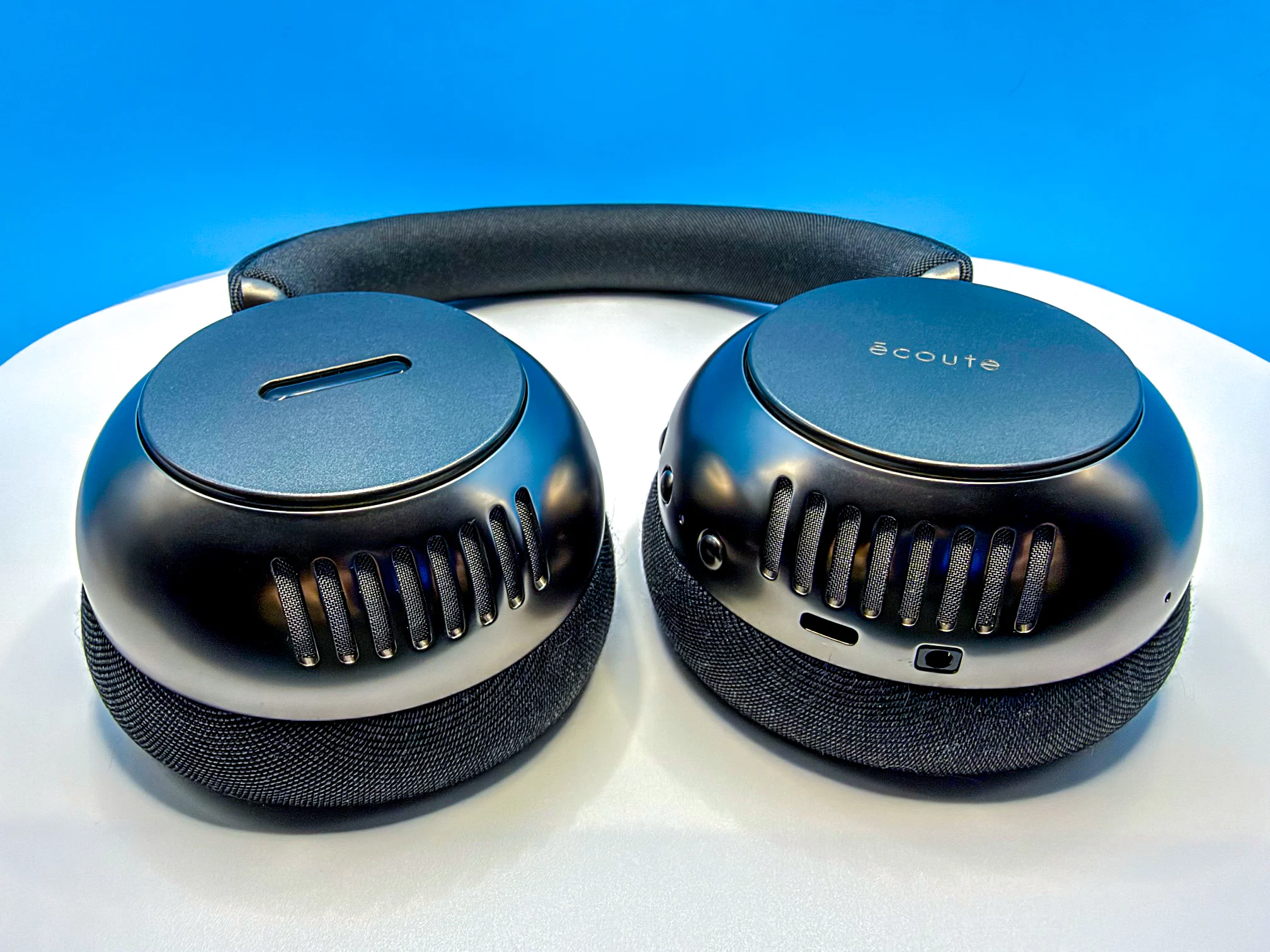
🔘 Buttons, Touch Controls, and the Great Gamelan Incident
I love physical buttons.
There, I’ve said it.
Give me something tactile that I can press confidently without performing elaborate gestures against the side of my head.
Thankfully, the TH1 includes three physical buttons on the right earcup. The top handles play and pause, the middle handles power and Bluetooth pairing, and the bottom controls ANC and transparency.
Interestingly, they’re not individually labeled.
At first, that might seem inconvenient, but their positions become familiar after just a few listening sessions. Eventually, you stop thinking about them and simply know which button does what.
I actually enjoy that minimalist approach.
Alongside the buttons, the right earcup includes a touch-sensitive surface for adjusting volume and navigating tracks. Under ordinary circumstances, it works beautifully. The controls are responsive, intuitive, and convenient.
Until Roxanne joins me in bed.
That’s when things get complicated.
Picture this. I’m lying comfortably, enjoying a perfectly lovely listening session. Roxanne delivers her usual warm, soothing performance, the tubes glow, and the world is right.
Then my pillow brushes against the touch-sensitive plate.
Suddenly, all hell breaks loose.
Tracks start skipping, my carefully selected playlist disappears, and Apple Music apparently begins exploring the outer reaches of its international catalog.
After what feels like a hundred accidental track changes, I somehow find myself listening to Indonesian gamelan music.
I’m not kidding.
Javanese Gamelan. Sample: https://open.spotify.com/playlist/37i9dQZF1DWUZKct2VUQX3
To this day, I have absolutely no idea how I got there.
The case remains open.
However, I’ve developed a theory that my pillow has a secret passion for Southeast Asian percussion traditions.
In all seriousness, the touch controls work extremely well when you intentionally activate them. The frustration comes from their sensitivity when the earcup touches a pillow or headrest.
I’d love an option to temporarily disable the touch surface.
Because while Roxanne may be sophisticated, my pillow has demonstrated absolutely no qualifications for managing a premium listening experience.
👂 Wear Detection: A Little Convenience Goes a Long Way
Another modern convenience the TH1 lacks is automatic wear detection. Removing the headphones doesn’t automatically pause playback, and putting them back on doesn’t resume it.
Now, Roxanne already has a perfectly functional physical play/pause button, which I genuinely appreciate. But after experiencing automatic wear detection on other premium wireless headphones, I’ve come to appreciate that extra layer of convenience.
Is its absence a deal breaker? Not even close.
Considering that the TH1 represents écoute’s ambitious first-generation design, I’m more than willing to forgive a few missing conveniences. After all, the company was busy figuring out how to bring genuine vacuum-tube amplification into a wireless headphone. That’s a considerably more exciting engineering challenge than adding wear sensors.
Still, innovation and everyday convenience aren’t mutually exclusive. I’d love to see automatic wear detection incorporated into the TH2, alongside other refinements that could make an already extraordinary listening experience even more effortless.
Roxanne already knows how to make me listen. Maybe her successor will know when I’ve stopped.
🌫️ Noise Cancellation: A Private Little Escape
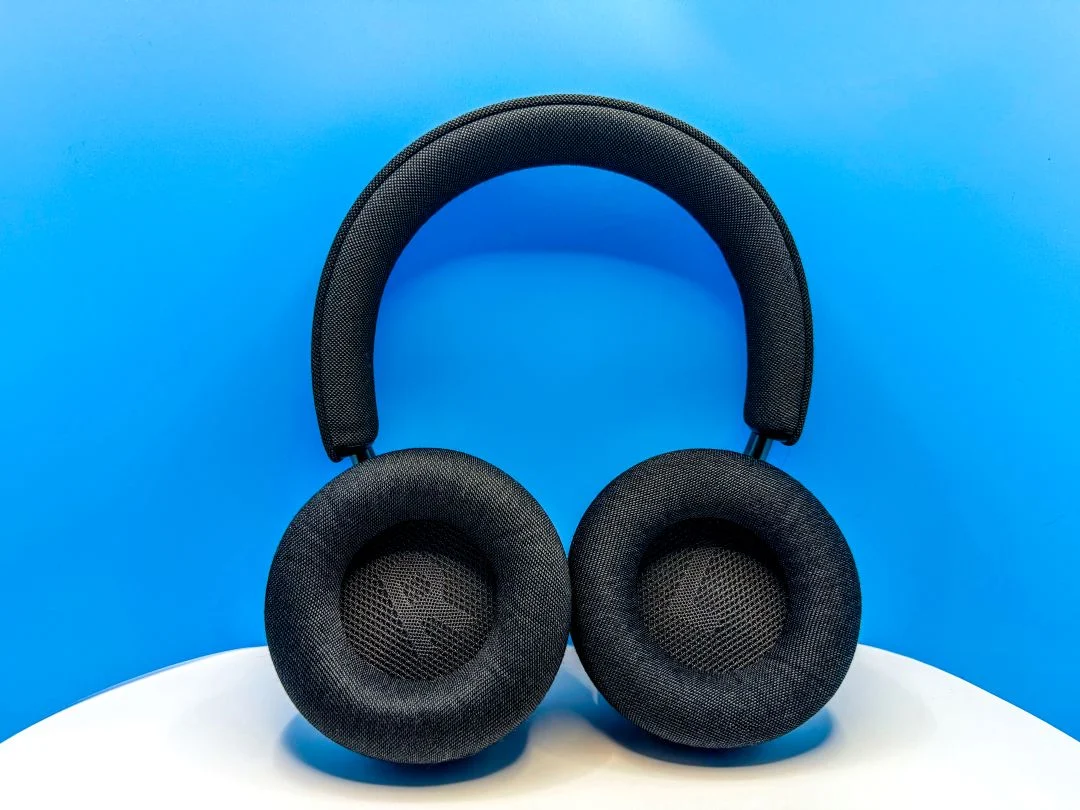
The TH1 includes hybrid active noise cancellation and a transparency mode, both of which contribute to its everyday convenience.
But let’s establish something immediately.
Roxanne isn’t an ANC champion.
Her noise cancellation works, but it doesn’t create the dramatic silence I’ve experienced with some dedicated noise-canceling headphones. Instead, it softens the surrounding environment, reducing distractions without eliminating them.
For home listening, that’s often enough.
There’s something satisfying about engaging ANC and feeling the outside world become a little less intrusive. It creates a personal listening bubble, a subtle separation that makes it easier to focus on the music.
And that fits beautifully with the TH1’s overall personality.
écoute’s published design philosophy emphasizes preserving musical quality rather than treating maximum noise reduction as the sole objective. I appreciate that approach, although I would still welcome stronger cancellation.
I haven’t taken the TH1 on an airplane yet, so I can’t speak directly to its performance against sustained engine noise. That’s one experience I’d want before making any firm claims about its effectiveness during air travel.
For my everyday listening, the ANC is perfectly serviceable.
Not extraordinary.
Not terrible.
Just another reminder that Roxanne prioritizes musical seduction over absolute isolation.
🎛️ The écoute App: Eight Bands, Endless Possibilities… Almost
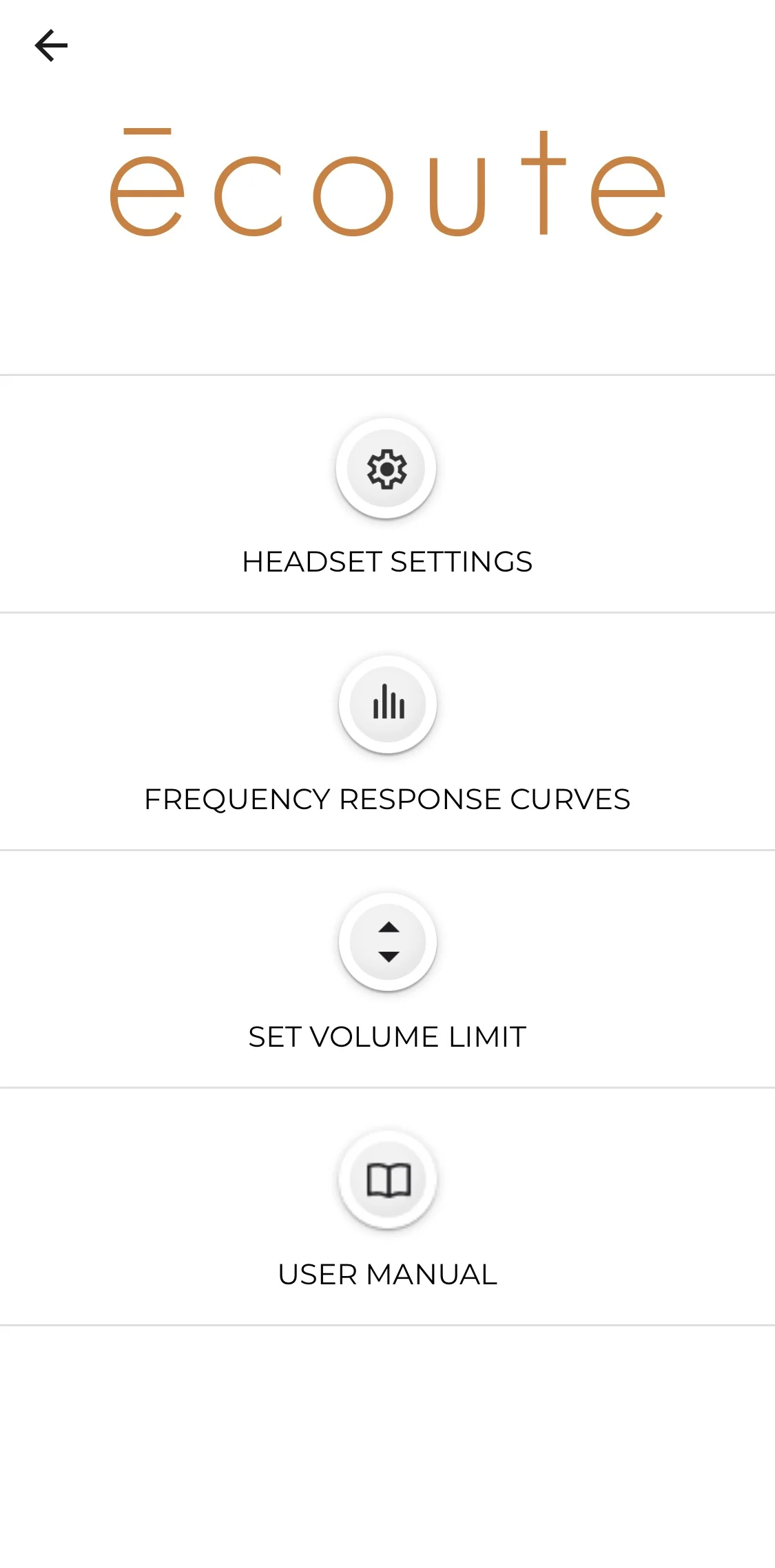
The écoute app is another example of the company’s emphasis on giving listeners control over their experience. At its heart is an eight-band graphic equalizer, but it offers much more than a collection of sliders. The app includes a library of preset frequency-response curves, custom tuning options, headset settings, a volume limiter, and access to the user manual.
The interface is clean, minimalist, and refreshingly straightforward. It feels consistent with écoute’s understated design philosophy, though I wish some features were more accessible.
🎶 A Preset for Every Occasion
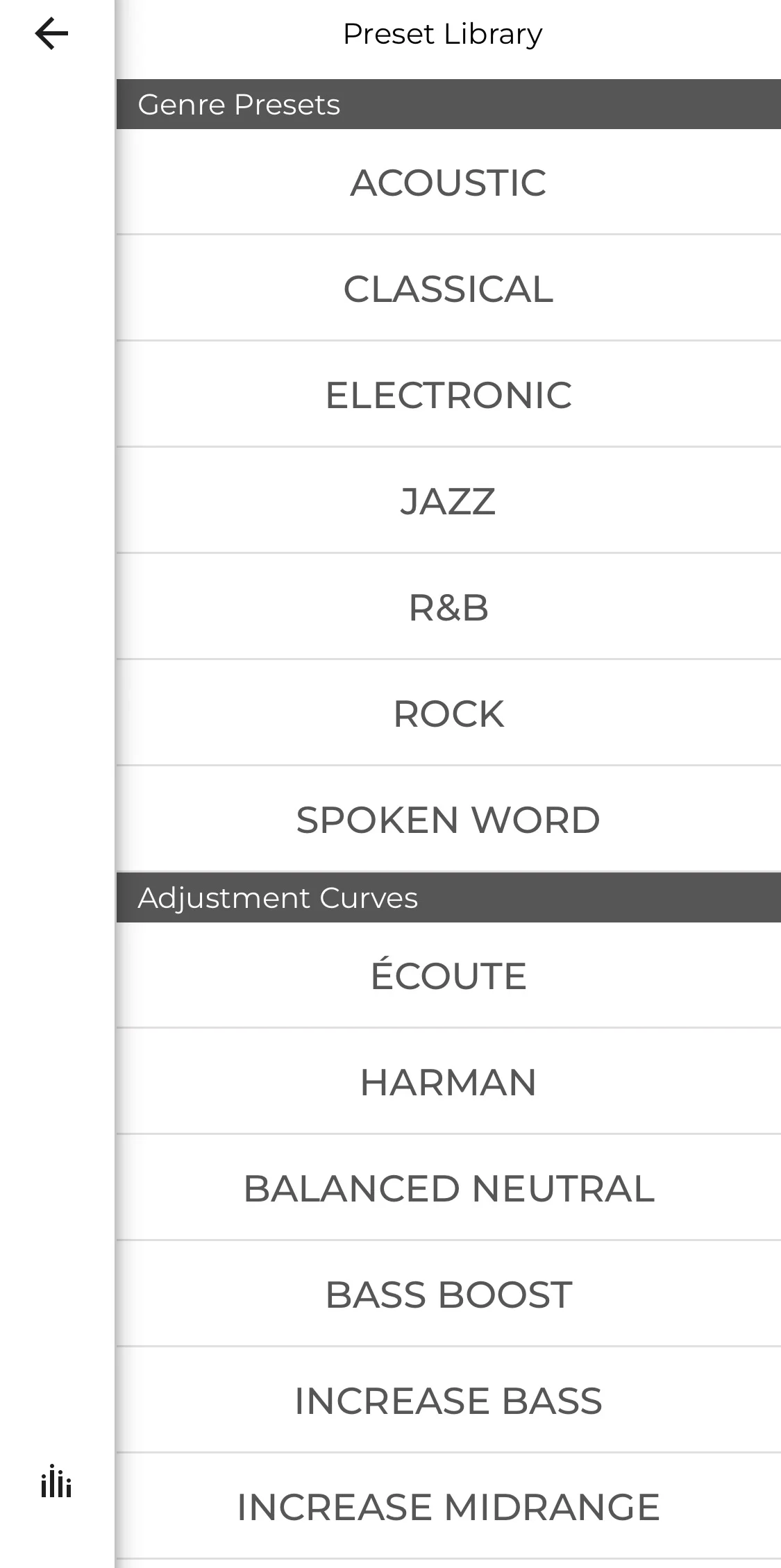
One feature I particularly appreciate is the preset library. Rather than making listeners build every adjustment from scratch, écoute provides genre-based options for Acoustic, Classical, Electronic, Jazz, R&B, Rock, and Spoken Word.
There’s also a separate collection of adjustment curves, including écoute, Harman, Balanced Neutral, Bass Boost, Increase Bass, and Increase Midrange. It’s a thoughtful selection that makes experimenting with different presentations much easier, especially for listeners who don’t want to manually adjust individual frequencies.
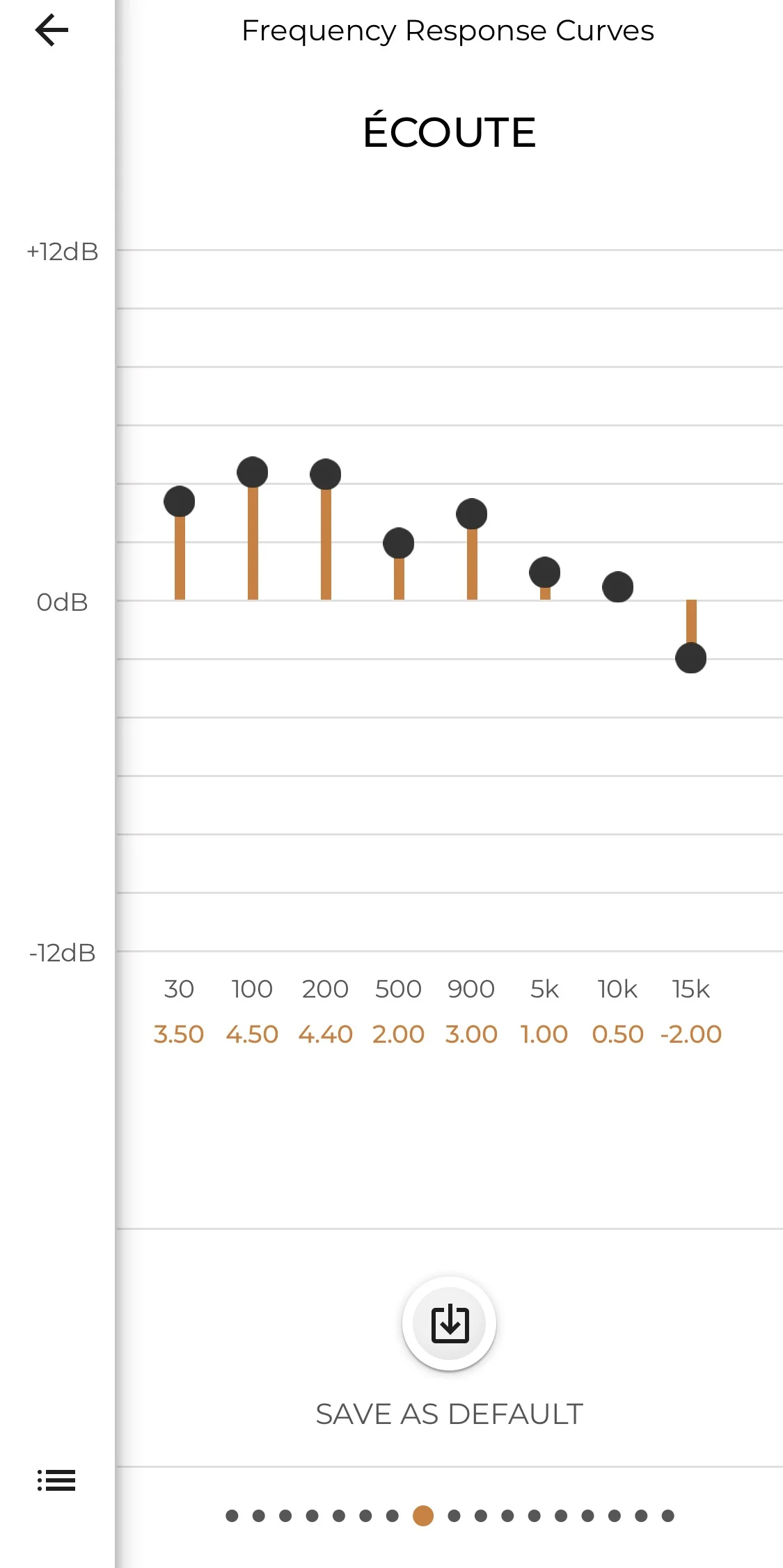
The app displays each curve visually, with eight adjustable frequency points at 30Hz, 100Hz, 200Hz, 500Hz, 900Hz, 5kHz, 10kHz, and 15kHz. The individual gain values are shown numerically, making it easy to see exactly how a particular tuning shapes the sound.
For example, the écoute curve in my screenshots adds a little extra warmth in the lower frequencies, introduces gentle midrange shaping, and slightly reduces the highest treble band. It’s a relatively restrained approach that suits the TH1’s already refined personality.
But naturally, I couldn’t leave well enough alone.
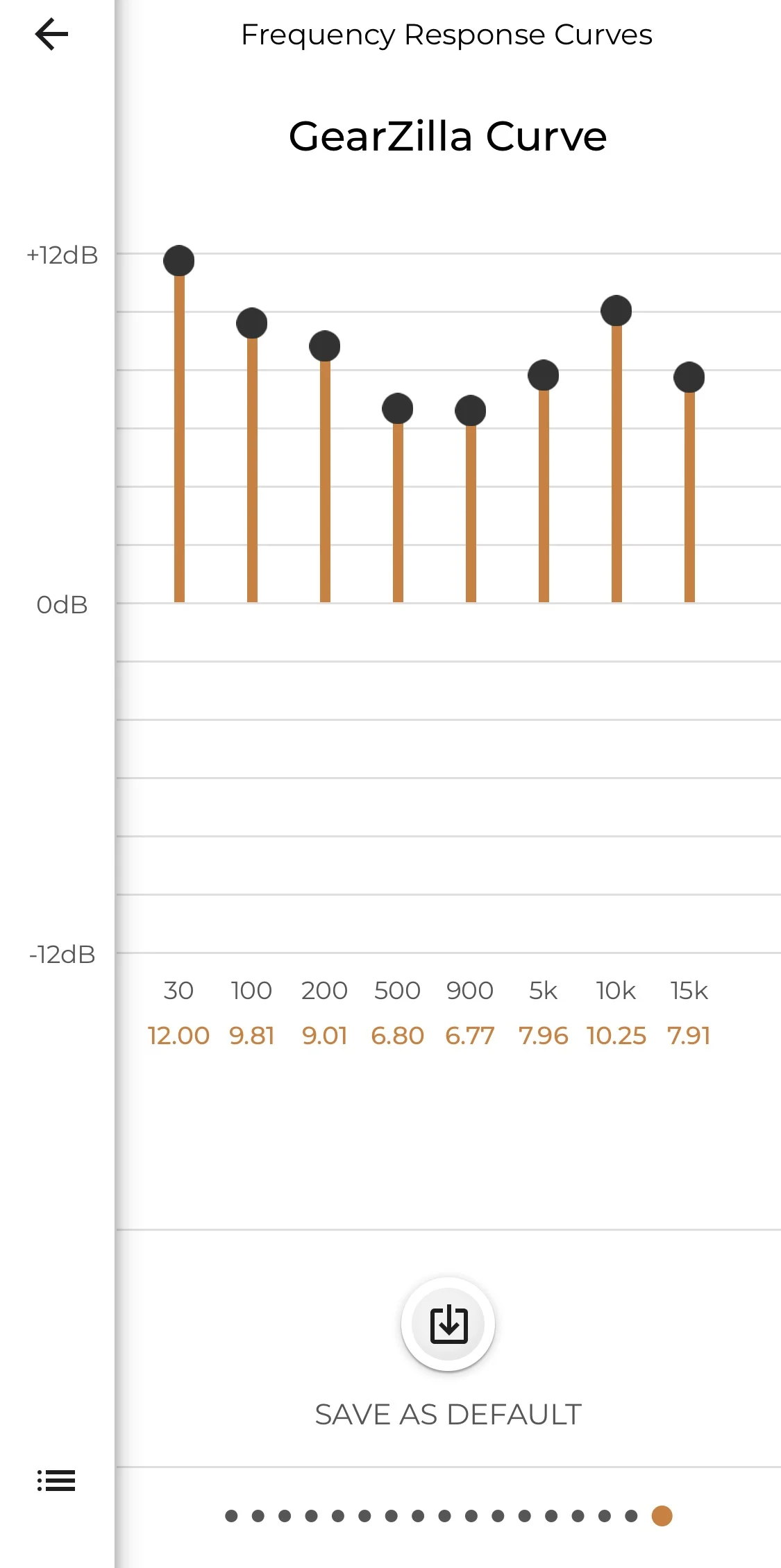
🦖 Enter the GearZilla Curve
I’ve created my own preset, appropriately named the GearZilla Curve, and let’s just say it takes a considerably less conservative approach.
My current settings are:
| Frequency | GearZilla Curve |
|---|---|
| 30Hz | +12.00dB |
| 100Hz | +9.81dB |
| 200Hz | +9.01dB |
| 500Hz | +6.80dB |
| 900Hz | +6.77dB |
| 5kHz | +7.96dB |
| 10kHz | +10.25dB |
| 15kHz | +7.91dB |
Yes, you read that correctly. I’m pushing the 30Hz band to its +12dB ceiling, adding substantial energy to the bass and lower midrange, and emphasizing the upper frequencies.
Apparently, my idea of subtle EQ is asking every frequency to participate a little more enthusiastically.
This is where Roxanne’s sophisticated personality meets my occasional desire to throw good manners out the window. I love her warm, sultry stock character, but sometimes I want more low-frequency authority, a little extra vocal energy, and a bit more sparkle.
Saving a curve as the default makes experimentation particularly convenient. I can create a tuning that suits my mood without rebuilding it every time I want to listen.
One important distinction, though: these are the actual gain values shown in my saved preset, not independent measurements of the TH1’s resulting acoustic frequency response. Because nearly every band gets a substantial boost, this curve is as much an experiment in overall tonal shaping as it is a conventional bass enhancement. It may also increase the risk of clipping or distortion depending on the reco
🧳 Portability: An Aston Martin That Needs Its Own Garage
One of écoute’s defining ideas is that a serious high-fidelity listening experience shouldn’t be confined to a dedicated listening room.
And from a sonic perspective, I absolutely understand that ambition.
The TH1 combines genuine vacuum-tube preamplification, dedicated analog amplification, sophisticated drivers, and modern connectivity in a self-contained headphone.
That’s remarkable.
But taking the complete package on the road is another matter entirely.
Roxanne is big.
And her protective carrying case?
Good grief.
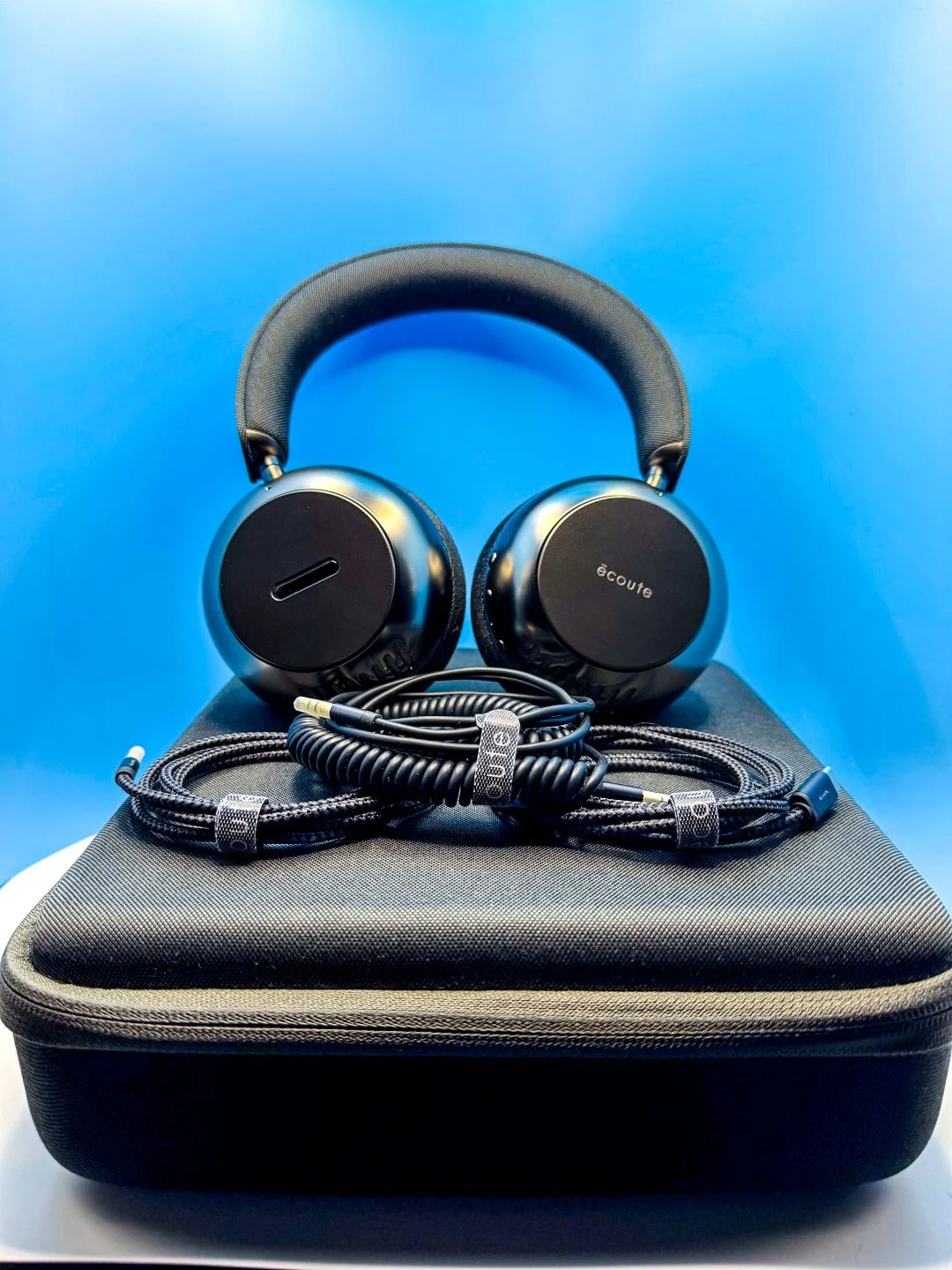
It’s a giant square fortress that appears perfectly capable of protecting the headphones from almost anything short of a direct meteor strike.
Unfortunately, it doesn’t fit in my backpack.
Not comfortably.
Not conveniently.
Not at all.
I appreciate the effort to protect such sophisticated equipment, but there’s a difference between transportable and genuinely portable.
The TH1 lives much closer to the former.
Would I make room for Roxanne on a trip because I wanted her particular listening experience when I arrived?
Absolutely.
Would I casually throw her into a backpack before heading to the airport?
Not a chance.
She’s an Aston Martin grand tourer, not a folding bicycle.
And apparently, she expects accommodations appropriate to her status.

👹 The GearZilla KAIJU DNA Scan: Anatomy of a Sultry Monster
Every monster has its own personality.
Some stomp through cities, roar at the sky, and unleash enough bass to register on nearby seismic equipment.
Others are considerably more sophisticated.
They arrive in beautifully tailored evening wear, settle into a luxurious leather chair, and invite you to enjoy a perfectly recorded album.
Roxanne belongs firmly in that second category.
This is James Bond territory: an Aston Martin in the garage, a mysterious European woman whispering in your ear, and advanced electronics hidden beneath an elegant exterior.
But don’t mistake sophistication for weakness.
The TH1 has an extraordinary personality and represents one of the most ambitious approaches to modern wireless headphone design I’ve encountered.
Let’s examine the DNA of this rather seductive Kaiju.
🎯 K • Kill Shot: That Glorious Tube Character
The TH1’s defining weapon is its ability to deliver an unusually rich, warm, and refined musical presentation through genuine tube-based preamplification.
That quality first captivated me at CanJam Dallas, and it’s why I’ve kept reaching for these headphones all year.
The sound is detailed without aggression, warm without becoming lifeless, and sophisticated without feeling sterile. As each listening session progresses, the presentation becomes increasingly inviting, encouraging me to settle deeper into the music.
The kill shot isn’t enormous bass or exaggerated technical performance.
It’s the sensation of becoming completely absorbed in the recording.
Roxanne doesn’t attack the music.
She seduces me into listening.
🧬 A • Anatomy: Sophisticated Engineering, Beautiful Execution
The TH1 combines a Korg Nutube 6P1, dual-mono amplification, titanium-coated dynamic drivers, multiple connectivity options, customizable EQ, and hybrid ANC into one beautifully constructed headphone.
That’s a fascinating engineering achievement, especially in a category where convenience often trumps unconventional audio architecture.
The premium materials and understated industrial design reinforce the sense that this is serious enthusiast equipment.
But that ambitious engineering comes with compromises.
The weight is substantial, the carrying case is enormous, and the comfortable clamping force doesn’t always provide enough security during movement.
The anatomy is impressive.
The ergonomics are complicated.
And the overall concept is wonderfully distinctive.
🦴 I • Impact: Changing the Conversation
The TH1’s greatest personal impact isn’t purely physical.
It’s emotional.
The warm tonality, soothing richness, and detailed presentation make music feel inviting in a way I find extraordinarily satisfying.
But there’s another kind of impact worth discussing.
The TH1 challenges what a wireless headphone can be.
By successfully incorporating genuine tube preamplification and a dedicated analog amplification architecture into a self-contained wireless design, écoute has demonstrated that personal audio doesn’t need to revolve exclusively around the familiar competition of ANC strength, battery life, compactness, and convenience features.
Manufacturers can still take meaningful risks.
They can pursue distinctive sonic personalities.
They can rethink established architectures.
And they can create products that give enthusiasts genuinely new reasons to get excited about listening.
That’s why I consider the TH1 a game changer.
Not because every manufacturer needs to copy its exact design.
But because every manufacturer should recognize what it represents.
There’s still room for real ambition in personal audio.
And I think the TH1 makes that point beautifully.
🎩 J • Joy: Roxanne Knows How to Make an Entrance
Roxanne makes me smile.
Sometimes because her sound is glorious. Sometimes because her construction is beautiful. Sometimes because I appreciate the combination of physical buttons, thoughtful styling, and that mysterious green glow.
And occasionally because my pillow has apparently decided that Indonesian gamelan music deserves a much larger role in my life.
It’s a wonderful mix of elegance and eccentricity.
But the greatest source of joy is something surprisingly simple.
Her voice.
“Power On.”
Two words that have become my personal invitation to a great listening session.
I’ve owned plenty of headphones with startup announcements, but none has made that little moment feel so special.
A year later, I still look forward to hearing it.
And that might be the most charming thing about Roxanne.
🎤 U • Unleashed: This One’s a Keeper
I’ve owned plenty of audio equipment, and I’ve experienced considerably more.
Some products impress me for a few days. Others stay exciting for weeks or months before the novelty fades and the next interesting piece of equipment demands attention.
But occasionally something becomes part of your listening identity.
The TH1 is one of those rare products.
This isn’t a catch-and-release headphone.
It’s a keeper.
Something I want to enjoy for years, and something I expect to continue reaching for long after the excitement surrounding its successor has settled.
Roxanne doesn’t feel temporary.
She feels intentional.
And after a year, she’s earned her permanent place.
🦖 The KAIJU Conclusion: A Gentleman Monster with a Sultry Soul
The écoute TH1 is a wonderfully sophisticated monster.
Warm, refined, elegant, beautifully engineered, and occasionally eccentric enough to remind me that ambition and perfection aren’t the same thing.
Its greatest strength is the deeply engaging musical experience it creates. Its greatest shortcomings involve weight, portability, controls, and convenience.
But those limitations haven’t diminished my affection for it.
After a year, Roxanne remains my favorite pair of headphones.
And that’s a remarkable accomplishment.
♾️ Not a Catch-and-Release Headphone: A Long-Term Affair
I’ve come to appreciate something about Roxanne that goes beyond sound quality.
This is a headphone I want to own for life.
That doesn’t mean I expect every component to operate indefinitely without maintenance. Batteries age, electronics can fail, and physical materials eventually wear.
But the TH1 doesn’t feel like something you replace the moment a newer product arrives.
It feels like serious audio equipment meant to stay part of an enthusiast’s collection.
And that’s exactly what it’s become for me.
In a hobby where buying, selling, trading, and upgrading are almost competitive sports, it’s refreshing to find a product that makes you want to stop looking.
At least for a moment.
I’ve lived with Roxanne for a year, tried plenty of other headphones, and still get excited whenever I reach for her.
That kind of long-term attraction means considerably more to me than the excitement of an impressive first audition.
The TH1 has earned something valuable.
My continued attention.
And I don’t plan on letting it go.
🤝 écoute Listens: My Conversations with Kendal Liddle
One of the most encouraging parts of owning the TH1 has been the opportunity to communicate directly with Kendal Liddle at écoute.
We’ve discussed what I love about Roxanne, as well as several frustrations that occasionally make me question her judgment.
What has impressed me most is the willingness to listen.
It’s easy for a company to celebrate glowing praise. It’s far more meaningful when it engages customers who appreciate a product enough to explain where it could improve.
I’ve felt my observations were welcomed rather than dismissed, which makes me optimistic about the company’s direction.
Because a great audio product doesn’t need to be perfect to inspire loyalty.
It needs to give people something worth caring about.
It helps even more when the people creating it stay interested in what their listeners have to say.
🚀 The TH2: A New Chapter, Not a Replacement
The upcoming écoute TH2 is particularly exciting because it aims to address several areas where the original design could improve.
écoute has described changes including a revised acoustic resonance chamber, improved tube shielding, a redesigned suspension headband, and refinements to noise cancellation and the broader listening experience.
Those are meaningful directions, especially because several directly relate to the frustrations I’ve experienced with the TH1.
I briefly heard the TH2 at CanJam SoCal, and the experience made me curious about the finished product. My understanding was that écoute was continuing to refine both the sound and production quality, so I’m not treating that early audition as a definitive evaluation.
But the potential is tantalizing.
If écoute can preserve the TH1’s sultry, rich, deeply musical character while addressing some of its practical shortcomings, the next generation could be extraordinary.
I’m excited enough that I backed the TH2 on Kickstarter.
And I can’t wait to experience the finished version.
But here’s something important.
I’m not waiting for the TH2 because I’ve fallen out of love with Roxanne.
Quite the opposite.
I’m excited about the TH2 because I love the original so much.
And regardless of what the new model brings, I don’t see Roxanne going anywhere.
She’s already earned her place.
💰 Value: Worth Every Penny?
The TH1 originally entered the premium wireless headphone category with a published reference price of $899. In my October 2026 research, écoute’s direct listing showed a sale price of $699.
Either way, this is a serious investment.
If your priorities are maximum ANC performance, lightweight portability, compact accessories, or the most advanced software features, plenty of other headphones may make more practical sense.
But comparing the TH1 exclusively through a list of conventional features misses much of what makes it special.
You’re paying for an unusual combination of genuine vacuum-tube preamplification, dedicated analog amplification, sophisticated construction, and a distinctive musical personality.
And for the right listener, those qualities can be extraordinarily valuable.
My own experience illustrates that perfectly.
I purchased my pair secondhand after falling in love with the sound at CanJam Dallas. I’ve used them several times a week for a year, experienced many other headphones in the meantime, and still consider Roxanne my favorite.
So let me answer the value question directly.
Has she been worth every single penny I’ve invested in her?
You bet your ass.
Not because she’s perfect.
Not because she’s the most practical.
And certainly not because she offers the strongest ANC or smallest carrying case.
She’s worth it because I absolutely love listening to music through her.
A year later, that pleasure hasn’t diminished.
That’s value you can’t fully capture on a specification sheet.

🦖 GearZilla Scorecard: A Year with Roxanne
A year with Roxanne has given me something a quick audition never could: perspective. Beyond the intoxicating warmth of those vacuum tubes and the unmistakable musical personality, I’ve experienced the everyday triumphs, frustrations, and quirks that define living with the écoute TH1.
This scorecard reflects the complete relationship, from sonic bliss to practical compromises. Because loving a pair of headphones doesn’t mean overlooking its imperfections, even when they’re your favorite cans.
✨ Clarity: 4.8/5
Rich, articulate, and beautifully refined.
🎤 Midrange & Vocals: 5.0/5
Warm, inviting, and gloriously sultry.
🥁 Bass: 4.5/5
Controlled and sophisticated, with limited extreme EQ headroom.
🎯 Separation & Placement: 4.7/5
Cohesive and musically engaging.
🏟️ Width & Depth: 4.8/5
Immersive and well suited to my preferences.
🔬 Detail & Resolution: 4.7/5
Sophisticated rather than aggressively analytical.
✨ Treble & Air: 4.8/5
Detailed without excessive brightness.
🦴 Slam & Dynamics: 4.3/5
Composed, with room for more basshead excitement.
🎤 Vocal Lift: 4.9/5
Rich, satisfying, and inviting.
⚡ Speed & Transients: 4.6/5
Engaging and controlled.
🎵 Tonality & Timbre: 5.0/5
Outstanding alignment with my listening preferences.
🎛️ Tuning & Pairing Flexibility: 4.1/5
Useful EQ, but no full PEQ and limited app access.
☁️ Comfort & Fit: 4.0/5
Perfect seated clamp, substantial weight, insecure during movement.
🎨 Design & Build: 5.0/5
Gloriously elegant and premium.
🔘 Controls & Everyday Convenience: 4.2/5
Physical playback buttons and responsive touch controls are welcome, but accidental touch activation, missing automatic wear detection, and a few first-generation usability quirks leave room for refinement.
📦 Accessories & Presentation: 4.2/5
Excellent protection, impractically bulky case.
📶 Bluetooth Performance: 5.0/5
Excellent reliability throughout my home.
🌫️ Noise Cancellation: 3.5/5
Adequate rather than exceptional.
💰 Value: 4.9/5
Tremendous long-term personal satisfaction.
🧡🦖 Overall GearZilla Score: 4.6/5 | A-Class Kaiju
Roxanne’s greatest strengths are exactly where they matter most to me: tonality, vocal reproduction, musical immersion, and sheer listening enjoyment.
Her shortcomings are overwhelmingly practical, not musical. Substantial weight, limited ANC, app restrictions, occasional touch-control frustrations, and an oversized travel case keep it from a perfect score.
The TH1 doesn’t earn a 4.6 because its sound falls short. It earns a 4.6 because extraordinary sound deserves an equally extraordinary ownership experience.
And after a full year together, Roxanne remains my favorite pair of headphones.
Power On. Licensed to Thrill.
🦖 Final Roar: Roxanne, My Sultry Aston Martin
Every once in a while, a product arrives that challenges more than its competitors. It challenges the assumptions that have built an entire category.
I believe the écoute TH1 is one of those products.
For years, premium wireless headphones have largely followed a familiar script. Better noise cancellation. Smarter processors. More microphones. Improved codecs. Longer battery life. Another generation of digital signal processing promising to bring us closer to audio nirvana.
That progression has nothing inherently wrong with it. Some remarkable headphones have come out of it. But somewhere along the way, I think the industry became so focused on perfecting the wireless headphone formula that it stopped asking a more provocative question.
What if we could reinvent the formula itself?
That’s what makes the TH1 so fascinating.
écoute didn’t simply introduce another premium Bluetooth headphone with a different tuning philosophy. It brought genuine vacuum-tube preamplification into a modern wireless architecture, combining an established analog technology with the conveniences of contemporary personal audio.
Think about that for a moment.
An engineering approach rooted in the golden age of HiFi, reimagined for a world of lossless streaming, smartphones, portable listening, and wireless connectivity.
It’s a fascinating collision of eras, opening the door to possibilities I find genuinely exciting.
Because the real achievement here isn’t simply squeezing a vacuum tube into a headphone. It’s demonstrating that wireless personal audio doesn’t have to surrender its analog ambitions to embrace modern technology.
That’s an important distinction.
The TH1 doesn’t prove that tubes are inherently superior to solid-state amplification, or that analog circuitry automatically produces a more authentic musical experience. Those arguments deserve considerably more nuance than the usual audiophile mythology allows.
What écoute has demonstrated is something arguably more meaningful: manufacturers can pursue entirely different approaches to the architecture, character, and emotional experience of personal listening.
And that kind of experimentation is exactly what I want to see more of.
Imagine a future where premium wireless headphones aren’t primarily differentiated by which company has the strongest ANC algorithm or the cleverest companion app.
Imagine manufacturers competing through amplification architecture, acoustic engineering, innovative driver technologies, modular design, and genuinely distinctive approaches to musical presentation.
Imagine the creative possibilities when engineers stop treating the modern wireless headphone as a largely settled concept and start approaching it as an open canvas.
That’s the future of personal HiFi I want to experience.
And while the TH1 certainly isn’t the first product to challenge conventional headphone engineering, it’s a particularly compelling example of what happens when a company refuses to accept the familiar boundaries of its category.
Another dimension of this story makes it personal.
Getting to know Kendal Liddle through our conversations, and eventually meeting him alongside Andy Regan at CanJam SoCal, gave me an appreciation for the people willing to pursue this unconventional vision.
Innovation sounds glamorous when we admire the finished product. The reality involves engineering compromises, difficult decisions, feedback that isn’t always flattering, and the willingness to put something unfamiliar into a market that often rewards predictability.
That’s what makes the upcoming TH2 so intriguing.
It’s not simply the prospect of a newer or more refined headphone, but the chance to see where this philosophy goes next. Can écoute expand on its original concept while addressing the lessons learned from its first generation? Can this architecture evolve into something even more compelling?
And perhaps the biggest question of all: Will other manufacturers respond with equally ambitious ideas?
I certainly hope so.
Because the greatest legacy of the TH1 might not be the number of headphones écoute sells. It might be the conversations it inspires, the assumptions it challenges, and the engineers it encourages to attempt something that previously seemed impractical.
That brings me back to my favorite automotive analogy.
An Aston Martin isn’t fascinating simply because it can transport you from one destination to another. Plenty of vehicles can do that, some more efficiently and with fewer compromises.
What makes a grand tourer special is the philosophy behind it. The belief that engineering should deliver more than functional performance. That craftsmanship, character, and the journey deserve as much consideration as the destination.
Roxanne is my Aston Martin for the ears.
Not because she’s the universal answer to every headphone enthusiast’s needs, but because she embodies a particular vision of what personal audio can become when a manufacturer dares to prioritize character alongside capability.
And that’s why, a year after our first encounter at CanJam Dallas, I think less about what the TH1 did for my collection and more about what it could represent for the industry.
The next great leap in personal HiFi might not come from another codec, another processor, or another algorithm.
It might come from an engineer willing to revisit an old idea, challenge a modern assumption, and ask a question nobody else thought worth asking.
It might come from a small company brave enough to build something the giants overlooked.
Or it might come from an entirely new approach none of us have imagined yet.
That’s the beauty of meaningful innovation. It doesn’t simply give us something new to purchase.
It expands our understanding of what’s possible.
And if écoute has helped push that conversation forward, then Roxanne’s significance extends far beyond one remarkable pair of headphones.
She’s not merely a product I love.
She’s proof that personal HiFi still has unexplored roads ahead.
And I can’t wait to hear where they lead.
Now, if you’ll excuse me, there’s a certain lady waiting to whisper something in my ear.
Her name is Roxanne, and as The Police taught us, she doesn’t have to put on the red light.
She’s already glowing green.
“Power On.”
Ahhhh. There it is.
The future sounds beautiful.

🎶 GearZilla Listening Playlist: The Sultry Side of Hi-Fi
After a year with Roxanne, I’ve discovered that her personality demands a soundtrack with sophistication, sensuality, and just enough attitude to keep things interesting. I’m talking velvety vocals, blues-soaked guitars, hypnotic rhythms, expansive atmospheres, and bass that knows when to behave and when to make its presence felt.
This isn’t another sterile audiophile test playlist. It’s a musical journey through what makes the écoute TH1 such an irresistible listening companion. Every selection brings something different to the experience, from the intimacy of a whispered vocal to the explosive dynamics of a full orchestra.
Naturally, The Police will open the evening in Roxanne’s honor. From there, we’ll travel through funk, psychedelic rock, seductive indie-pop, soulful R&B, and electronic experimentation before arriving at a suitably cinematic conclusion.
Each selection highlights a different aspect of the TH1’s musical personality rather than representing a controlled, track-by-track measurement session.
Pour something good, settle into your favorite chair, and allow Roxanne to work her magic.
🇬🇧 1. The Police – Roxanne
Listening focus: Vocal presence, guitar texture, bass articulation, rhythmic separation, and dynamics.
Was there ever any doubt about where we’d begin?
Sting’s unmistakable delivery, Andy Summers’ angular guitar work, and Stewart Copeland’s energetic percussion make this the perfect introduction to the headphone I’ve affectionately named Roxanne. The reggae-influenced rhythm offers an entertaining look at how the TH1 balances warmth with instrumental attack, while the relationship between bass, guitar, and drums reveals the recording’s wonderfully distinctive personality.
What makes this track particularly interesting is its rhythmic interplay. The instruments constantly weave around one another, creating an arrangement that rewards attentive listening without ever sacrificing its infectious energy.
And, of course, there’s the delicious irony. Sting keeps insisting Roxanne doesn’t have to put on the red light, while my Roxanne has been glowing green the entire time.
Something tells me these two would get along beautifully.
🎤 2. Anderson .Paak – Come Down
Listening focus: Bass groove, percussion dynamics, rhythmic timing, and instrumental cohesion.
If Roxanne is spending the evening in a sophisticated listening lounge, somebody needs to invite Anderson .Paak to the party.
“Come Down” is pure rhythmic confidence, blending funk, hip-hop, soul, and enough attitude to make standing still feel like a personal failure. Its muscular bass line and energetic percussion create a tightly interlocking groove that immediately reveals whether a headphone can deliver genuine musical momentum.
The challenge here isn’t simply reproducing bass. It’s preserving the relationship between the kick drum, bass, and rapid-fire vocal delivery without letting the arrangement get muddy.
There’s also something thoroughly enjoyable about feeding this much swagger through headphones with a personality that leans toward refined sophistication.
Roxanne may dress for the opera, but she certainly knows her way around a good party.
🎸 3. The Black Keys – Weight of Love
Listening focus: Soundstage expansion, guitar layering, atmospheric depth, and dynamic development.
“Weight of Love” is a sprawling, blues-soaked journey that feels tailor-made for an extended listening session.
Its restrained beginning gradually gives way to increasingly expansive passages, with layered electric guitars, atmospheric textures, and a substantial rhythmic foundation creating a wonderful sense of musical scale.
This is where I want to explore the TH1’s ability to create a believable sense of space. Rather than focusing on individual details in isolation, the attraction lies in how the arrangement as a whole develops and occupies the listening environment.
The transition from its quieter opening to its more powerful instrumental sections also offers a great opportunity to appreciate dynamic contrast without relying on sheer volume.
It’s smoky, soulful, beautifully unhurried, and entirely comfortable taking its time.
Frankly, if Roxanne owned a record collection, I’m convinced this would be somewhere near the front.
💋 4. KALI – I Just Wanna
Listening focus: Female vocal texture, midrange richness, bass definition, and rhythmic flow.
KALI brings a seductive blend of indie-pop attitude, understated confidence, and relaxed musical energy.
“I Just Wanna” doesn’t demand attention through overwhelming dynamics or extravagant production. Its appeal comes from an effortlessly engaging groove and a vocal presentation that feels personal without becoming overly delicate.
For the TH1, the attraction is the relationship between the lead vocal and the surrounding instrumentation. A warm headphone can give expressive voices beautiful body, but that richness needs to coexist with articulation and definition.
The song’s relaxed rhythmic foundation also lets you hear how the lower frequencies contribute to the musical flow without stealing the spotlight.
Some recordings seduce through spectacle. Others simply know exactly how much to reveal.
KALI belongs firmly in the second category.
🔥 5. Blood Cultures & Jordana – Set It on Fire (Jordana’s Version)
Listening focus: Electronic layering, vocal placement, textural contrast, and spatial separation.
Now Roxanne takes a wonderfully unexpected detour into experimental indie-electronic territory.
Blood Cultures’ production and Jordana’s distinctive vocals create a dreamy collision of electronic textures, rhythmic movement, and atmospheric complexity. It’s the kind of recording that feels equally at home in an intimate listening room or on a midnight drive through a neon-lit city.
The attraction here is textural organization. With multiple electronic elements occupying different areas of the arrangement, the TH1 can show how clearly it distinguishes individual layers without dismantling the recording’s hypnotic cohesion.
The TH1 also offers an intriguing contrast between synthetic textures and the organic character of the vocal performance.
For a headphone built around genuine vacuum-tube technology, that relationship feels particularly appropriate.
And with a title like “Set It on Fire,” Roxanne may finally be tempted to loosen up a little.
🌌 6. AURORA – All My Demons Greeting Me As A Friend
Listening focus: Ethereal vocal expression, atmospheric depth, dynamic contrast, and emotional immersion.
AURORA has always made music feel as though it exists somewhere between reality and a dream. Her voice can shift from delicate vulnerability to something almost otherworldly, carrying an emotional intensity that transcends the usual boundaries of pop music.
With “All My Demons Greeting Me As A Friend,” released in 2026, she revisits the haunting imagery associated with her earlier work, creating a fascinating opportunity to explore the relationship between atmosphere, vocal expression, and emotional storytelling.
For Roxanne, this is less about bass impact or technical fireworks and more about preserving the fragile relationship between a voice and the sonic environment surrounding it. I’m listening for subtle variations in AURORA’s delivery, the spaciousness around the performance, and how changing textures shape the recording’s emotional character.
There’s something especially compelling about feeding such ethereal material through a headphone known for its warm, almost analog personality. That contrast between otherworldly vocals and tangible musical richness is what makes the TH1 so fascinating.
And honestly, a woman named Roxanne who glows mysteriously green seems like exactly the sort of companion AURORA’s demons might appreciate.
🌙 7. Cigarettes After Sex – Apocalypse
Listening focus: Vocal intimacy, guitar ambiance, subtle decay, and spatial atmosphere.
If the word sultry could become a recording, Cigarettes After Sex would certainly deserve consideration.
“Apocalypse” builds an enveloping atmosphere from understated percussion, dreamy guitar textures, restrained bass, and Greg Gonzalez’s intimate vocal delivery.
Unlike more dynamically aggressive recordings, its musical character depends on subtlety. The delicate decay of guitar notes, the understated rhythmic pulse, and the space around the vocal all contribute to its hypnotic appeal.
This is an interesting opportunity to explore how the TH1 approaches intimacy. A presentation can feel emotionally close without collapsing the surrounding musical environment into something narrow or congested.
The best experience should feel like stepping into the recording’s atmosphere, not like every instrument is pushed directly against your ears.
Some music demands your attention through sheer energy.
This one simply invites you closer.
And Roxanne is very good at accepting invitations.
👑 8. Solya – Queen of Texas
Listening focus: Vocal character, psychedelic textures, instrumental balance, and musical tension.
Now we’re bringing a little Texas attitude into this otherwise sophisticated affair.
Solya’s “Queen of Texas” blends alternative-rock sensibility, atmospheric production, and expressive vocal character. Its combination of attitude, texture, and underlying emotional tension feels wonderfully cinematic.
This selection explores the TH1’s ability to communicate character rather than simply smooth everything into something pleasant. The surrounding instrumental textures need sufficient definition to preserve the recording’s personality.
An appealing tension exists between the song’s rougher edges and Roxanne’s warmer, more refined presentation.
A great pair of headphones shouldn’t make every recording sound identical. They should let each artist’s identity emerge while bringing their own musical character to the experience.
And frankly, a playlist featuring a mysterious lady named Roxanne deserves at least one Texas queen.
Consider it a diplomatic exchange.
🥃 9. Chet Faker – Gold
Listening focus: Deep bass texture, vocal warmth, electronic percussion, and rhythmic precision.
“Gold” has an irresistible late-night energy that feels tailor-made for Roxanne.
Chet Faker’s smoky delivery sits within a hypnotic arrangement of electronic percussion, pulsing bass, and atmospheric textures. It’s seductive without being overly dramatic, relying on rhythmic confidence and careful production rather than sheer force.
The bass foundation offers a chance to distinguish low-frequency quantity from quality. What interests me isn’t simply how deep a headphone can go, but whether it preserves the definition and movement that make electronic bass feel musical.
Meanwhile, Faker’s textured vocal delivery provides an appealing contrast to the more synthetic elements surrounding him.
There’s something wonderfully confident about music that doesn’t need to rush.
Roxanne seems like exactly the sort of headphone that appreciates taking the scenic route.
🎷 10. Masego & FKJ – Tadow
Listening focus: Saxophone timbre, instrumental realism, bass articulation, and spatial placement.
Now this is the kind of musical chemistry Roxanne deserves.
“Tadow” blends silky saxophone, warm keyboards, expressive bass, and an infectious groove into a performance that feels spontaneous, sophisticated, and effortlessly cool.
Unlike recordings constructed around densely layered electronic production, much of this track’s appeal comes from the relationship between recognizable instrumental textures.
The saxophone provides a particularly engaging opportunity to examine tonal authenticity. The instrument’s physical richness depends on more than simply reproducing its fundamental notes. Breath, articulation, and harmonic texture all contribute to its recognizable character.
The interplay between Masego and FKJ also lets you appreciate how individual musical contributions fit into a cohesive arrangement.
It’s smooth, playful, and just a little seductive.
In other words, right up Roxanne’s alley.
🌺 11. Sade – By Your Side
Listening focus: Silky female vocals, midrange warmth, subtle instrumental textures, and emotional connection.
If there’s one artist who embodies everything I mean when I describe Roxanne as sultry, it’s Sade.
“By Your Side” is a masterclass in understated elegance, blending her unmistakably smooth, velvety voice with a beautifully restrained arrangement that feels as comforting as it is seductive.
No exaggerated drama or overwhelming instrumentation is necessary. The emotion lives in the gentle rhythmic foundation, subtle instrumental details, and the performance’s effortless intimacy.
This is precisely the kind of recording that makes the TH1’s musical priorities so interesting. Richness and warmth should enhance Sade’s natural character without obscuring the delicate inflections that convey emotion.
The surrounding instrumentation also deserves attention, particularly the way subtle textures provide a supportive foundation without competing with the vocal.
And there’s something wonderfully fitting about a song devoted to being there for someone, no matter what.
After a full year together, Roxanne has become exactly that kind of musical companion.
🌴 12. Leon Bridges – Happiness Anytime
Listening focus: Soulful vocal intimacy, rhythmic ease, tonal richness, and musical flow.
Something about Leon Bridges makes the world feel a little less complicated. His voice carries a timeless soulfulness, the kind that can transport you to a dimly lit lounge or a quiet evening on the porch without ever sounding like an exercise in nostalgia.
“Happiness Anytime,” the title track from his 2026 album, is exactly the sort of recording I want playing when Roxanne and I have nowhere particular to be.
Its unhurried musical character lets you appreciate something often lost in audiophile conversations: the simple pleasure of a recording that feels good to inhabit.
For the TH1, the attraction is the relationship between vocal richness and musical ease. Bridges’ expressive delivery draws attention to the body and texture of his voice, while the surrounding arrangement lets you appreciate rhythmic continuity without demanding aggressive bass or explosive dynamics.
This is the kind of music where a headphone’s personality can become part of the emotional experience, adding warmth and intimacy without losing the natural character of the performance.
You don’t need to chase every microscopic detail when the greater reward is simply getting absorbed in the song.
Some headphones are made for analyzing music.
Roxanne reminds me why I fell in love with listening to it.
🌑 13. James Blake – Retrograde
Listening focus: Sub-bass extension, vocal layering, dynamic buildup, electronic texture, and atmospheric depth.
“Retrograde” begins with an almost haunting intimacy before expanding into a powerful electronic arrangement.
James Blake’s expressive vocals, layered harmonies, and deep synthesizer textures create a striking contrast between vulnerability and sheer sonic weight.
This is one of the playlist’s more demanding selections, especially as the arrangement expands. The electronic bass needs to establish a convincing foundation while the overlapping vocal layers retain their individual character.
The appeal lies in the progression. As the recording builds, the musical environment grows increasingly dense and emotionally intense, giving the TH1 a chance to communicate scale without letting that intensity overwhelm the performance.
It also reminds us that bass isn’t simply about impact. Deep low-frequency information can greatly contribute to a recording’s perceived size and atmosphere.
“Retrograde” is moody, sophisticated, and delivers substantial power without abandoning its emotional character.
That musical duality is exactly what makes Roxanne so fascinating.
❤️ 14. Celeste – Love Is Back
Listening focus: Vocal soulfulness, rhythmic bounce, brass texture, dynamic expression, and instrumental separation.
Now here’s a woman who understands how to make an entrance.
Celeste’s “Love Is Back” blends classic soul character with contemporary production, carried by her wonderfully expressive voice and an arrangement overflowing with infectious musical confidence.
Where Sade invites you into an intimate conversation, Celeste practically grabs you by the hand and insists you join the celebration.
This recording has a delicious sense of movement. The buoyant rhythm, prominent brass textures, and shifting instrumental accents create a colorful musical environment that rewards both emotional engagement and attentive listening.
For the TH1, the attraction lies in balancing that energetic instrumentation with Celeste’s distinctive vocal timbre. Her voice deserves body, texture, and presence, but the surrounding arrangement should retain enough definition to preserve its playful momentum.
This also contrasts with the playlist’s more atmospheric selections. Rather than using space to create mystery, “Love Is Back” uses rhythmic energy and tonal color to generate excitement.
It’s soulful, exuberant, and just a little flirtatious.
And after an evening filled with longing, mystery, and smoky musical seduction, Roxanne seems more than ready to welcome love back into the room.
🍸 15. Adele – Skyfall
Listening focus: Vocal scale, orchestral dynamics, instrumental layering, cinematic depth, and low-frequency weight.
Could there possibly be a more appropriate finale?
Adele’s “Skyfall” brings together everything that makes this playlist feel connected to Roxanne’s personality: sophistication, emotional vocal delivery, rich orchestration, and an unmistakable sense of cinematic grandeur.
The recording begins with an intimate, piano-led introduction before gradually expanding into a sweeping arrangement that demands a convincing sense of scale.
This is where the TH1 gets an opportunity to bring together many of the qualities explored throughout the evening. Vocal richness must coexist with orchestral clarity, the expanding instrumentation must retain its dramatic impact, and the lower frequencies must provide weight without obscuring the arrangement’s finer details.
There’s also something deeply satisfying about a recording that can transition from vulnerability to full cinematic intensity while maintaining a coherent emotional narrative.
And frankly, if we’re going to compare a pair of headphones to an Aston Martin grand tourer, we’re going to need a proper Bond theme.
Preferably with Roxanne whispering “Power On” in that wonderfully accented voice just before the orchestra begins.
Because after a year together, I’ve learned that a truly memorable listening experience doesn’t always begin with the music.
Sometimes it begins with an invitation.
And Roxanne certainly knows how to make an entrance.
💎 Bonus Track: Lana Del Rey – Young and Beautiful
Listening focus: Vocal warmth, orchestral depth, string detail, bass presence, and emotional impact.
Just when you think Roxanne has shown us everything she’s got, Lana Del Rey enters the room and steals the spotlight.
“Young and Beautiful,” from The Great Gatsby soundtrack, blends romance, sadness, and old Hollywood glamour. Lana’s soft, smoky voice floats above sweeping strings, deep bass, and dramatic orchestral arrangements. It’s the kind of song that makes you want to close your eyes, turn down the lights, and get lost in the music.
This is where the écoute TH1’s warm, rich sound really fits the mood. Lana’s voice needs to feel close and personal, while the instruments around her need enough space to create that big, cinematic atmosphere. As the song builds, the strings become more powerful, giving Roxanne a chance to show how well she handles both quiet moments and dramatic changes.
The bass is another important part of the experience. It doesn’t need to shake your head to make an impact. Instead, it adds weight to the music, giving the strings and vocals a stronger foundation.
What I love about this track is how easily it moves between soft, personal moments and huge, emotional ones. One minute, Lana sounds like she’s singing directly to you. The next, the orchestra fills the room, making everything feel larger than life.
After an evening filled with funky grooves, soulful vocals, dreamy soundscapes, and a little James Bond drama, this feels like the perfect encore.
And it feels fitting to end a year-long love story with a song about beauty, time, and whether love can last.
After twelve months together, Roxanne may have a few scratches, and that green glow might not turn heads quite like it did on day one. But when the music starts, none of that matters.
Some things never lose their magic. Roxanne, you’ve still got mine.
💚 The GearZilla Takeaway: An Evening with Roxanne
What I love about this playlist is that it doesn’t attempt to reduce the écoute TH1 to a collection of technical measurements. Instead, it explores what makes listening to music feel personal, emotional, and occasionally downright intoxicating.
The Police and Anderson. Paak bring swagger and rhythmic energy, while The Black Keys deliver sprawling blues-rock atmosphere. KALI, Cigarettes After Sex, and Chet Faker lean into the sultry side of the evening, where intimacy and groove matter more than sheer volume.
Blood Cultures and AURORA introduce electronic textures and otherworldly musical landscapes, while Solya contributes a welcome dose of Texas attitude. Masego and FKJ celebrate instrumental chemistry, Sade reminds us that subtlety can be profoundly moving, and Leon Bridges offers the kind of effortless soulfulness that makes a headphone disappear into the experience.
James Blake brings subterranean weight and emotional intensity, Celeste reminds us that music should occasionally make you get up and dance, and Adele delivers the kind of grand, cinematic conclusion that would make James Bond reach for another martini.
Together, these recordings celebrate what I’ve come to appreciate most about Roxanne: her ability to make listening feel like an occasion.
And perhaps that’s the most interesting thing about the future of personal Hi-Fi. We’re entering an era where convenience and sophistication no longer have to exist on opposite sides of the room. Modern wireless headphones can offer the freedom of contemporary technology while embracing the character and musical romance traditionally associated with more elaborate listening systems.
The écoute TH1 represents a fascinating expression of that philosophy. Genuine vacuum-tube technology, modern wireless functionality, and a distinctive sonic personality come together in a product that isn’t particularly interested in being ordinary.
After a full year, Roxanne still makes me smile when I turn her on. Not because of a spec, a measurement, or a feature buried in an app, but because I know another musical adventure is waiting on the other side of that familiar voice.
Some headphones impress you with what they can do.
Others make you fall in love with how they make you feel.
Roxanne doesn’t need to be the loudest headphone in the room.
She just needs to make you forget about the others.
And that’s a rather powerful trick.
Listen Bigger! 🦖
✅ Buy If
- You appreciate warm, rich, detailed, and gloriously sultry sound.
- You love the idea of genuine vacuum-tube amplification technology in a wireless headphone.
- You prioritize intentional, immersive listening over convenience alone.
- You enjoy understated luxury and premium industrial design.
- You appreciate comfortable clamping force during seated listening.
- You want reliable Bluetooth connectivity throughout your home.
- You value physical buttons alongside touch-sensitive controls.
- You enjoy personalizing your sound through a graphic EQ.
- You appreciate products designed with a distinctive philosophy.
- You want headphones that feel like a long-term investment, not a temporary purchase.
- You believe listening to music should occasionally feel like an occasion.
⛔ Skip If
- You need lightweight headphones for exercise or frequent movement.
- You prioritize maximum ANC performance.
- You require a compact travel case.
- You regularly listen while reclining against pillows or headrests.
- You want a full parametric EQ with extensive filter customization.
- You need seamless EQ adjustment across every connection mode.
- You prefer exaggerated bass slam and extreme low-frequency tuning.
- You prioritize convenience above musical character.
- You won’t accept a learning curve or practical compromises.
- You expect every premium headphone to appeal to every listener.
🧡🦖 GearZilla Verdict: 4.6/5 | A-Class Kaiju
The écoute TH1 is a beautifully unconventional headphone that combines genuine vacuum-tube technology, sophisticated engineering, luxurious construction, and an extraordinarily appealing musical personality. It’s an ambitious piece of HiFi that challenges conventional thinking about what wireless headphones can be, and after a full year of ownership, I’m still as captivated by its performance as I was during that unforgettable first audition at CanJam Dallas.
Of course, Roxanne isn’t without her eccentricities. She’s heavy, her enormous carrying case makes traveling an adventure of its own, her ANC could be stronger, and her touch controls occasionally demonstrate an alarming enthusiasm for selecting music without my permission. The software could also be more flexible. Those shortcomings are real, and as much as I adore these headphones, they prevent me from declaring this a perfect Kaiju-level 5.0 event. A great review needs to reflect the full ownership experience, including the frustrations that only surface after the honeymoon is over.
But here’s the thing: the honeymoon never really ended. A year later, Roxanne remains my favorite headphone, delivering a gloriously sultry combination of warmth, richness, detail, and refinement that makes even familiar recordings feel special. Her distinctive design, thoughtful engineering, and wonderfully engaging presentation create an experience that extends far beyond simply pressing play. I want to score her higher, I really do, but 4.6/5 feels like the right recognition of something extraordinary that still has room to improve.
But should you wait for the TH2? Absolutely not! The next generation may bring refinements, new features, and improvements to some of Roxanne’s quirks, but that doesn’t diminish what the TH1 delivers today. Its extraordinary price-to-performance ratio demands your attention. Genuine vacuum-tube warmth, luxurious craftsmanship, and a musical presentation that still captivates me a full year later make this far too special to dismiss simply because a successor is on the horizon. The TH2 may represent the future of écoute, but the TH1 is already something remarkable. Waiting for tomorrow’s promise when today’s masterpiece is ready to serenade you?
More importantly, I believe écoute has delivered something that could change the way the industry thinks about premium wireless audio. Not because every manufacturer should suddenly start stuffing vacuum tubes into headphones, but because the TH1 demonstrates what happens when a company has the courage to pursue a genuinely unconventional idea. This product is built around a philosophy that celebrates intentional listening, distinctive sonic character, and the emotional connection between people and their music. Every manufacturer exploring the future of personal audio should be paying attention.
Ultimately, that’s what makes Roxanne so unforgettable. She’s refined, beautifully flawed, occasionally temperamental, and utterly irresistible. She’s the Aston Martin of my headphone collection, a sophisticated grand tourer with a sultry voice, a gorgeous green glow, and enough musical personality to keep me coming back night after night. After a year, I still get that familiar little tingle whenever she whispers “Power On,” knowing another wonderful listening session is about to begin.
And when the music finally fades, I reluctantly reach for the button, knowing our time together has come to an end. The green glow disappears, and Roxanne delivers one final message in that wonderfully composed voice.
“Power Off.”
Until next time, darling.
Listen Bigger! 🦖
Share This Story, Choose Your Platform!