



Four drivers. One beautiful voice. A little bird that brought me closer to the music.
🎧 Is the SIVGA Lyrebird Worth Buying?
Absolutely! I spent a wonderful month reviewing the SIVGA Lyrebird, and I loved every second. That’s a pretty strong statement considering the number of IEMs that have passed through my listening room. But some products capture your attention from the first few songs and refuse to let go.
The Lyrebird is one of them.
It’s beautifully crafted, crystal clear, wonderfully intimate, and delivers in almost every way I could ask from an IEM in this price range. It has a lively, slightly bright personality that brings instruments and vocals into sharp focus, but there’s also a welcome hint of warmth that keeps the music inviting.
And let’s get something straight from the beginning. Bright doesn’t have to mean sharp.
The Lyrebird proves that beautifully. Its upper frequencies sparkle with energy and detail, but I never found them unpleasant or piercing during my month of listening. Instead, I kept coming back to its wonderful clarity and the way it made familiar recordings feel fresh and exciting.
But there’s something even more interesting happening here. The Lyrebird creates an intimacy I don’t often find at this price. It brings the music closer, making the vocals feel personal and the instruments feel more immediate. Yet it doesn’t sacrifice the width, depth, or separation I love in a great IEM.
Imagine attending a concert and discovering that you’ve somehow been given the best seat in the house. You’re close enough to connect with the performers, but the entire musical arrangement still unfolds around you.
That’s the Lyrebird.
Add gorgeous, stabilized wood faceplates, precision-machined aluminum shells, an excellent cable, a beautiful tan leather carrying case, and packaging that matches SIVGA’s higher-end headphones, and the complete experience becomes even more impressive.
I’ve reviewed several SIVGA headphones, and my appreciation for this company keeps growing. The craftsmanship is consistently excellent, the designs celebrate natural materials, and the products feel like someone genuinely cared about every detail.
And with the Lyrebird, that attention to detail comes wrapped around an IEM that sings beautifully.
✅ Pros: Crystal-clear sound with a wonderfully intimate presentation; lively treble without unpleasant sharpness; engaging vocals; impressive width and depth; excellent separation; subtle musical warmth; beautiful stabilized wood faceplates; premium aluminum construction; fantastic cable; gorgeous tan leather case; excellent packaging; comfortable design; and rewarding response to wide-bore tips, EQ, and capable amplification.
⛔ Cons: Very few meaningful flaws during my month of listening. Dedicated bassheads may want more sub-bass impact, and the intimate presentation may not suit those who prefer distant vocals. The included 4.4mm balanced cable also requires a compatible source or a replacement cable for conventional 3.5mm outputs.
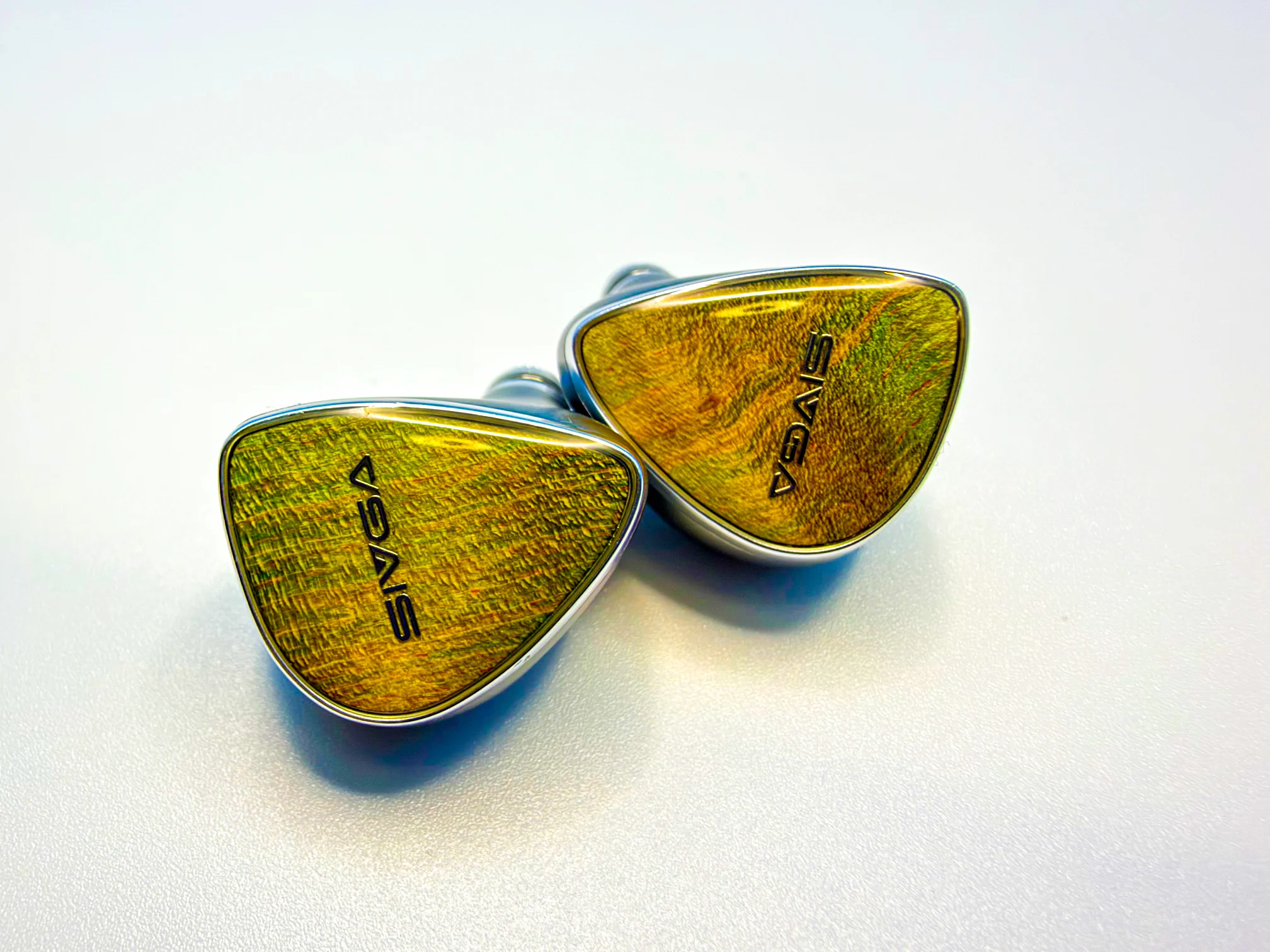
🐦 Nature’s Greatest Mimic: What’s in a Name?
Deep in Australia’s forests lives one of nature’s most talented musicians.
The lyrebird.
At first glance, it’s a rather unusual bird. The male Superb Lyrebird has a beautiful tail shaped like an ancient musical instrument called a lyre, which explains its name. But the tail isn’t what makes this bird famous.
It’s the voice.
Lyrebirds possess an amazing ability to copy sounds from their surroundings. They can imitate other birds, animal calls, camera shutters, alarms, and even mechanical noises such as chainsaws.
Think about that for a moment. One bird can reproduce sounds that seem to belong to an entire forest full of different creatures. It’s nature’s own living sound library.
And that makes the lyrebird a fascinating namesake for an IEM.
After all, isn’t that what high-fidelity audio aims to do? Reproduce a collection of sounds so convincingly that we forget we’re listening through tiny speakers in our ears?
A bass guitar, a piano, a singer taking a breath, the soft ring of a cymbal. Every sound has its own character, but together they create one complete musical experience.
SIVGA’s Lyrebird takes a similar approach. Instead of relying on a single driver, it combines four driver technologies, each designed to handle a different part of the music: a dynamic driver, a balanced armature, a micro-planar driver, and a piezoelectric ceramic driver.
Four different voices working toward one goal.
But here’s where the comparison becomes especially interesting. The real lyrebird doesn’t simply copy sounds. It combines those sounds into a performance that’s uniquely its own.
And after spending a wonderful month with SIVGA’s Lyrebird, I believe this little IEM does something similar.
It doesn’t simply reproduce music. It gives that music a beautiful personality.
🤝 Disclosure: A Little Bird Told Me
A heartfelt thank-you to the wonderful Finn and the entire SIVGA team for providing the Lyrebird for this review.
I’ve had the pleasure of owning and reviewing several SIVGA headphones, and I have to admit something. I love what this company does.
The beautiful natural materials, premium construction, careful packaging, and attention to accessories have become familiar parts of the SIVGA experience. And I appreciate that consistency.
It’s refreshing to encounter a manufacturer that clearly understands an audio product should feel special before the music even begins.
Of course, admiration for a company doesn’t guarantee a positive review. Every product has to earn its place through listening, experimentation, and everyday use.
I spent a full month with the Lyrebird, exploring its sound, experimenting with tips and EQ, and enjoying what it brought to my music. My opinions and final rating are entirely my own.
As always, my philosophy remains simple.
Listen first. Figure out the story later.
And this little bird gave me a wonderful story to tell.
🌳 SIVGA: A Company That Understands Natural Beauty
One thing I’ve always admired about SIVGA is its ability to make audio equipment feel connected to the natural world.
Wood is central to that identity.
While many manufacturers rely on plastic shells and flashy finishes, SIVGA frequently uses natural materials to create products with warmth and character. And I don’t mean sonic warmth. I mean the kind of beauty you can see and feel.
Wood grain, natural colors, smooth finishes, and the careful blending of organic materials with modern engineering. That approach feels timeless.
I’ve reviewed several SIVGA headphones, and I’ve come to recognize the same design philosophy across the company’s products. The craftsmanship is always a major part of the experience.
The Lyrebird continues that tradition, but it also feels like something different. It belongs to its own category.
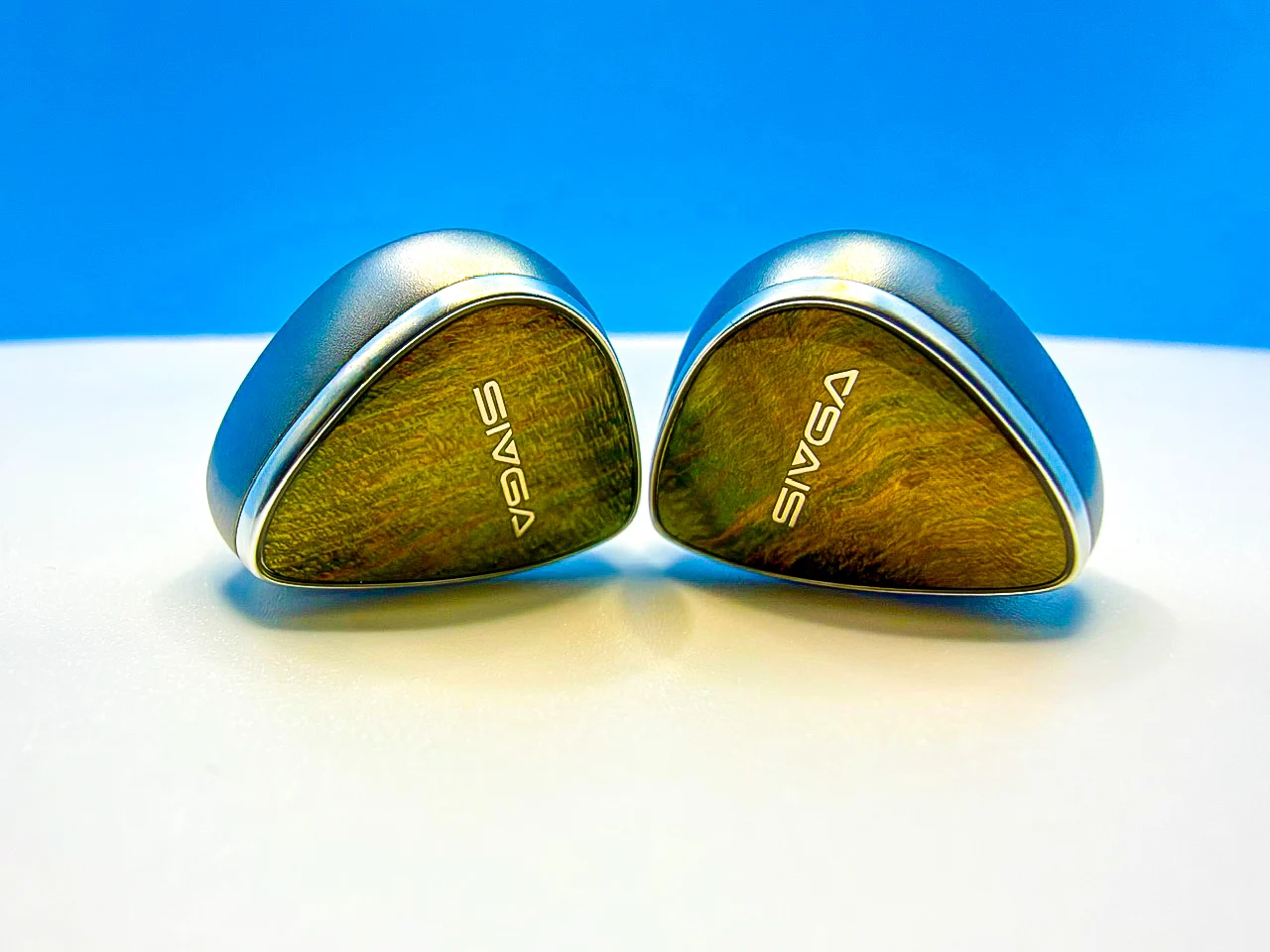
The smaller IEM shells give SIVGA a new canvas to work with, and the company has used it beautifully. Rather than making the Lyrebird look like a miniature version of one of its over-ear headphones, SIVGA has created something that feels perfectly suited to its name.
Natural wood faceplates, beautiful colors and grain patterns, clean aluminum housings, and a refined, organic appearance.
It’s almost as if the Lyrebird belongs in the forest that inspired it.
Only this particular bird comes with a balanced cable.
And sounds considerably better than the average woodland creature.

📦 Unboxing: Textbook SIVGA, and I Love It!
I’ve reached the point where opening a new SIVGA product comes with certain expectations: beautiful materials, thoughtful packaging, excellent accessories, and a sense that the company wants the entire experience to feel special.
And once again, SIVGA delivers.
The Lyrebird arrives in packaging that feels wonderfully consistent with the company’s higher-end over-ear headphones. I love that. There’s something reassuring about a brand that maintains its standards across different product categories.
You don’t get the impression that the Lyrebird received less attention simply because it’s smaller or more affordable than some of SIVGA’s full-sized headphones.
Everything feels considered.
🧳 The Tan Leather Case: Pure SIVGA
Oh, that case!
The included tan Crazy Horse leather carrying case is absolutely gorgeous. It’s one of those accessories that immediately makes me smile.
The warm color pairs beautifully with the natural wood faceplates, and the material gives the whole package a classic, almost old-world feeling.
It’s practical, handsome, and perfectly matched to the Lyrebird’s personality. This is the kind of carrying case I actually want to use.
And that’s worth celebrating.
Too many IEMs arrive with cases that seem to exist only because someone decided a carrying case needed to appear on the accessory list. SIVGA clearly had other ideas.
The Lyrebird’s case feels like part of the design.
🔌 The Cable: Another Winner
The included cable is another highlight.
SIVGA describes a hybrid construction combining Furukawa oxygen-free copper, silver-plated copper, and a gold-plated silver-copper conductor blend.
The cable looks fantastic. Its braided design gives it a premium appearance that fits perfectly with the beautiful wooden shells.
I also appreciate that SIVGA hasn’t treated the cable as an afterthought.
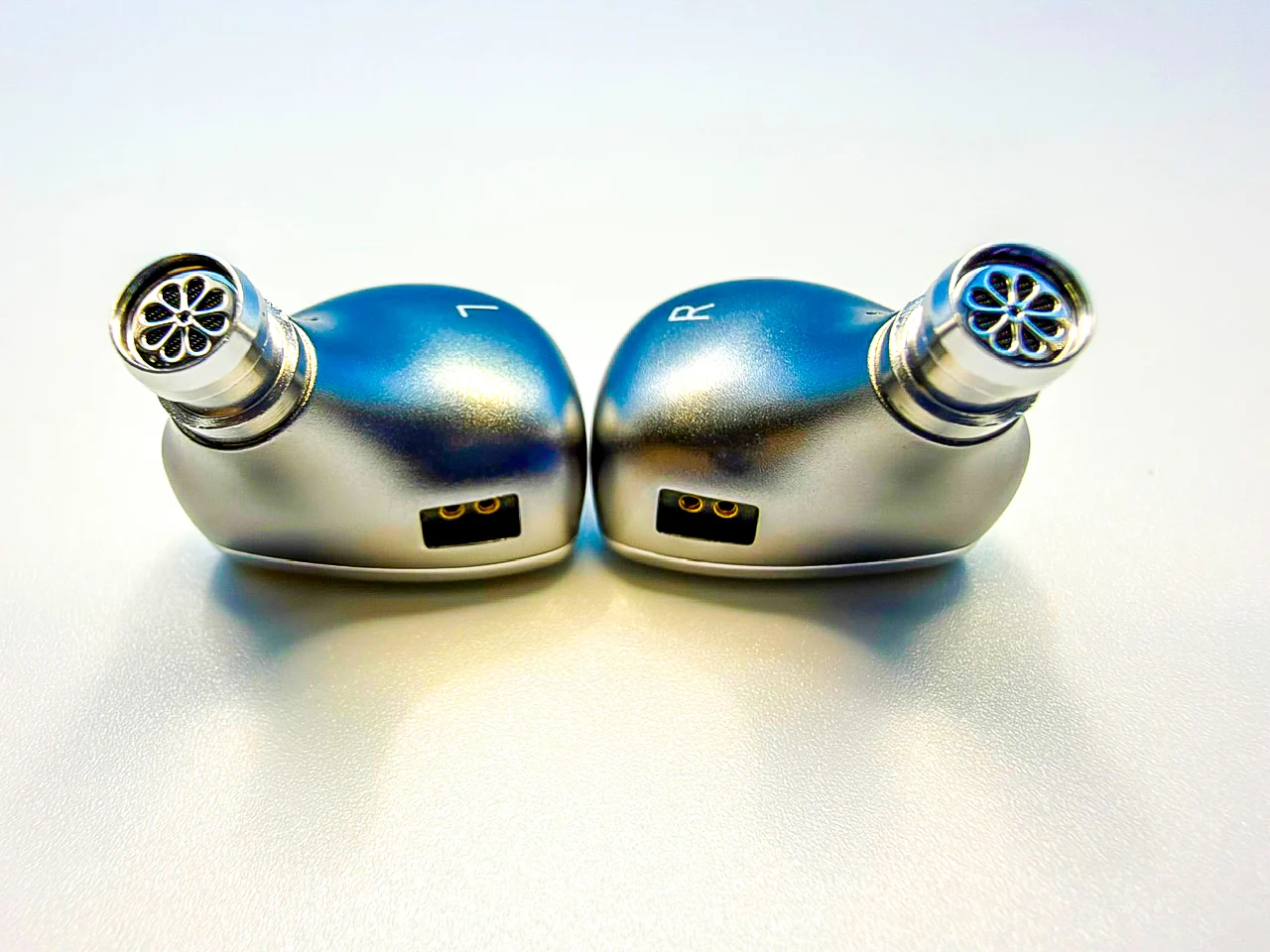
It’s detachable through standard 0.78mm two-pin connectors, making replacement or customization straightforward.
The included plug is 4.4mm balanced.
That’s a welcome choice for enthusiasts using compatible DACs and digital audio players, though newcomers should know it won’t plug directly into a standard 3.5mm headphone jack.
Fortunately, the detachable design makes changing cables easy. And no, I wouldn’t rush to replace this one.
It’s lovely.
🎧 The Complete Package
SIVGA includes seven pairs of silicone ear tips in two types, a leather case, a detachable cable, documentation, and the IEMs themselves.
It’s a thoughtful package.
That matters because a great IEM isn’t just a collection of drivers. You handle, wear, store, transport, and interact with it every day.
The Lyrebird makes all those moments feel a little more special.
Packaging & Accessories: 5.0/5
Textbook SIVGA. Beautifully done.
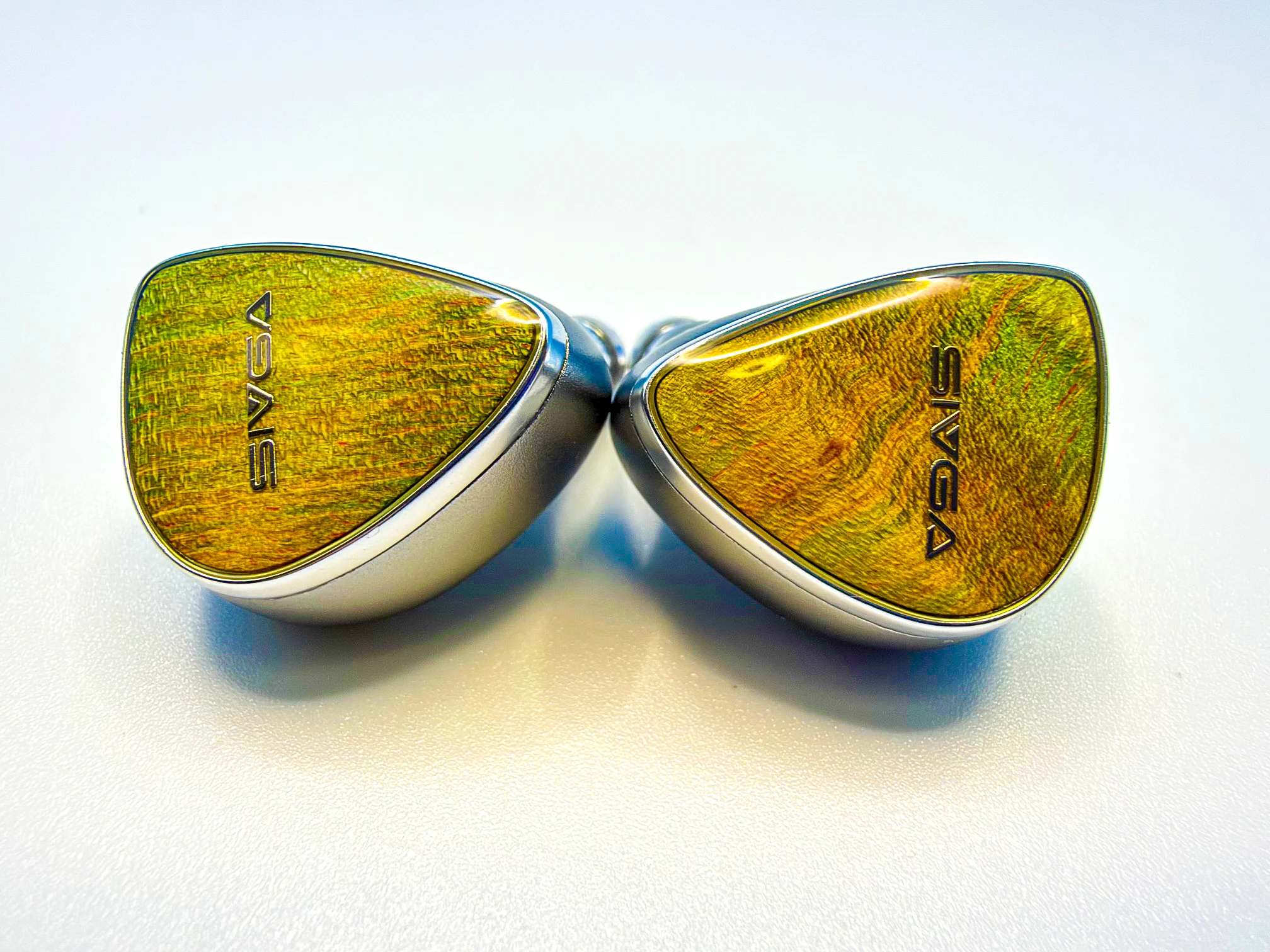
🎨 Design & Build: A Little Piece of the Forest
The Lyrebird is gorgeous.
Seriously.
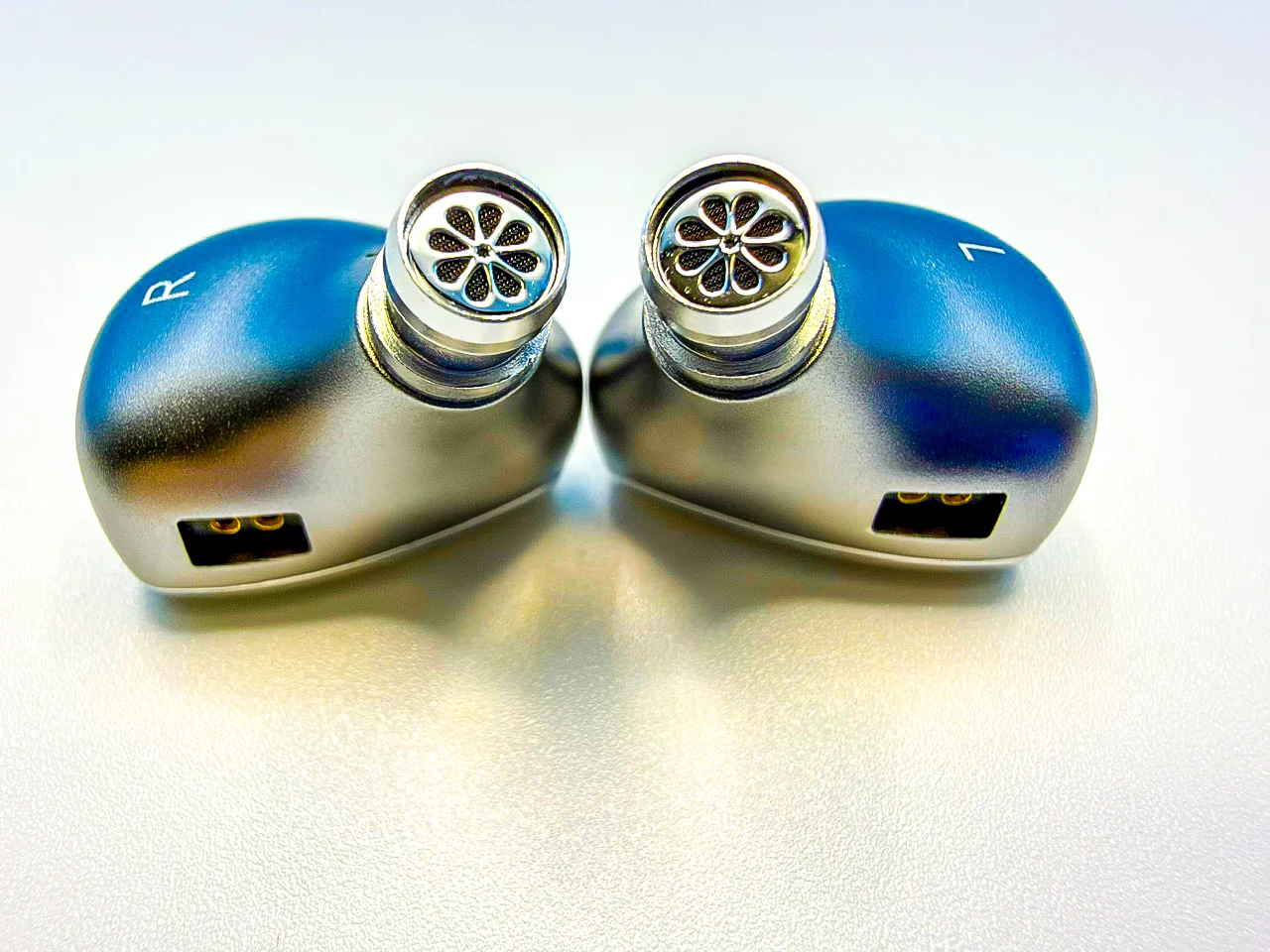
Those stabilized wood faceplates immediately catch the eye, and the natural patterns give the earpieces an elegant, unique look.
I love how SIVGA combines wood with CNC-machined aluminum housings. The wood brings warmth and natural beauty. The aluminum brings strength and precision.
Together, they create something that looks and feels more expensive than its price might suggest.
No wild colors or oversized branding are needed. The materials do the talking.
What I especially appreciate is how well the design fits the product’s identity. An IEM named after a remarkable Australian bird should connect to nature. And the Lyrebird absolutely does.
It’s beautiful without being flashy. Premium without being overdone. And distinctive without looking strange.
The shells also have an ergonomic shape intended to fit securely in the ear. For me, that contributed to a comfortable listening experience throughout my month of testing.
Comfort matters when you’re listening for extended periods, and the Lyrebird gave me no meaningful reason to complain.
Design & Build: 5.0/5
SIVGA’s consistency continues to impress me.
⚙️ Technical Specifications: Four Drivers, One Beautiful Voice
The Lyrebird uses a quad-driver hybrid design, with four different driver technologies in each earpiece.
Model: SIVGA Lyrebird
Type: Wired hybrid in-ear monitor
Driver configuration: Four drivers per side
Dynamic driver: 10mm polymer composite diaphragm
Balanced armature: One driver per side
Micro-planar driver: One driver per side
Piezoelectric ceramic driver: 9.2mm multilayer design
Impedance: 14Ω ±15% at 1kHz
Sensitivity: 108 ±3dB at 1kHz
Published frequency response: 20Hz–20kHz
Total harmonic distortion: ≤1% at 1kHz
Shell construction: CNC-machined aluminum alloy
Faceplates: Stabilized natural wood
Cable connector: Detachable 0.78mm two-pin
Plug: 4.4mm balanced
Cable length: 120 ±10cm
Included ear tips: Seven pairs across two types
Carrying case: Crazy Horse leather
Regular reference price: $149 USD
These are manufacturer-published specifications rather than independent GearZilla laboratory measurements. Current pricing and promotions may vary.
🥁 Dynamic Driver: The Foundation
The 10mm dynamic driver handles the low-frequency foundation. This is where the Lyrebird gets much of its bass body and rhythmic weight.
SIVGA uses a polymer composite diaphragm designed to provide controlled bass movement. To my ears, the result is bass that supports the music rather than overwhelming it.
🎤 Balanced Armature: The Voice
The balanced armature helps reproduce midrange information.
This is especially interesting because the Lyrebird’s vocal presentation is one of its greatest strengths.
Singers sound clear, close, and wonderfully engaging.
✨ Micro-Planar: The Detail
The micro-planar driver contributes to the upper frequencies. It helps reproduce fine musical information with clarity and control.
And the Lyrebird certainly delivers clarity.
🪶 Piezoelectric Ceramic: The Sparkle
The 9.2mm multilayer piezoelectric ceramic driver helps reproduce the highest frequencies, adding another technology to the Lyrebird’s ambitious design.
Of course, having four drivers doesn’t automatically guarantee great sound. The real challenge is making them work together.
And that’s where SIVGA deserves credit.
The Lyrebird doesn’t sound like four separate pieces of technology fighting for attention.
It sounds like one beautifully coordinated performer.
Just like its namesake.
🎧 A Wonderful Month of Listening
I’ve had plenty of IEMs make spectacular first impressions.
Sometimes the excitement lasts a day. Sometimes a week. Occasionally, a product keeps surprising and delighting me long after that initial excitement should have faded.
The Lyrebird belongs to that last group.
I spent a wonderful month reviewing these IEMs, and I loved every second.
That’s the most important thing I can tell you.
The Lyrebird isn’t perfect for every listening preference, but I found remarkably little to criticize.
Its sound consistently aligned with the things I enjoy most: clarity, engaging vocals, believable instrument placement, satisfying width and depth, and enough musical warmth to keep the presentation from feeling sterile.
I also discovered that the Lyrebird responds beautifully to experimentation.
Wide-bore ear tips made the presentation blossom. The EQ let me shape the sound. And the capable amplification was an enjoyable part of the experience.
I didn’t spend a month trying to fix this product.
It was a product I enjoyed for a month.
There’s a huge difference.
🌸 Ear Tips: Let This Bird Spread Its Wings
If you’re planning to try the Lyrebird, here’s one piece of advice.
Experiment with ear tips.
Seriously.
During my listening, the Lyrebird absolutely loved wide-bore silicone tips.
And so did I.
The wider openings seemed to let its presentation blossom, giving the sound an even more open, engaging quality.
That clarity I already loved became even more enjoyable, and the Lyrebird retained the intimate vocal character that makes it so distinctive.
It’s a wonderful combination.
I didn’t feel as though I was changing the IEM into something completely different. I was simply allowing more of its personality to shine through.
Of course, ear tips can affect seal, insertion depth, comfort, and frequency response. Different ears will produce different results.
Your favorite tips might not be mine.
But the Lyrebird rewards experimentation, and I strongly encourage owners to explore that flexibility.
Sometimes the smallest accessory makes the biggest difference.
🎛️ EQ & Amplification: This Bird Loves to Play
I enjoy experimenting with EQ. It’s one of the things that makes this hobby so entertaining.
Some days I want a little extra bass. Other days I want to adjust vocal presence or explore a slightly different tonal balance.
The Lyrebird responded wonderfully to that experimentation.
Its clear sound provided an excellent starting point, and I enjoyed discovering how small adjustments could change the listening experience.
But let me make something clear.
I didn’t use EQ because the Lyrebird was broken. I used EQ because I enjoyed seeing what else it could do.
And there’s a big difference.
I also enjoyed pairing the Lyrebird with capable amplification.
The set has no specifications suggesting it needs an unusually powerful amplifier, and more power alone doesn’t guarantee better sound.
But I appreciated how it performed with good sources and clean output.
Between the wide-bore tips, EQ, and source experimentation, I found plenty of ways to enjoy this little bird.
And that flexibility became another reason I looked forward to listening.
🥁 Bass: Controlled, Musical, and Wonderfully Balanced
Anyone familiar with GearZilla knows I love bass. I love rich bass. I love deep bass. And occasionally, I love bass powerful enough to make nearby furniture consider relocating.
But the Lyrebird isn’t that kind of monster.
And I’m perfectly fine with that.
Its bass is clean, controlled, and beautifully integrated into the rest of the music. It has enough presence to give instruments weight and rhythm, but the low frequencies never overwhelm the midrange’s wonderful clarity.
I especially enjoy that balance.
The bass guitar provides a solid foundation while the vocalist stays clear and present. The drums maintain their rhythmic character without turning every recording into a low-frequency contest.
Everything has a place.
The Lyrebird’s bass also adds to the subtle warmth I hear throughout. It’s not especially thick or heavy, just enough warmth to make the music feel natural and inviting.
Would my inner bass monster occasionally appreciate more sub-bass rumble?
Absolutely. That little beast is almost impossible to satisfy.
But the Lyrebird’s bass isn’t trying to win a demolition contest. It’s trying to support the performance.
And it does that beautifully.
Being able to experiment with EQ when I wanted more weight only added to the enjoyment.
Bass: 4.4/5
Controlled, musical, and nicely integrated, with room for more basshead excitement.
🎤 Midrange & Vocals: Come a Little Closer
This is where the Lyrebird truly stole my heart.
The vocals.
Oh, those vocals.
They’re clear, expressive, beautifully focused, and wonderfully intimate.
I love how the Lyrebird brings singers closer to me. It makes me feel like I’m sitting near the performer rather than listening from the back of an enormous venue.
And here’s what makes that experience special.
The closeness doesn’t feel crowded.
There’s still room around the instruments. There’s still depth. There’s still convincing width.
But the entire performance feels more personal.
I find that incredibly engaging.
Imagine sitting in a small jazz club as a singer steps toward the microphone. You can hear the emotion in the performance, the quiet changes in the voice, and the little details that make the music feel human.
That’s the kind of connection the Lyrebird creates for me.
And despite its remarkable clarity, there’s a welcome hint of warmth that gives vocals a natural sense of body. The presentation never struck me as cold or lifeless.
Instead, the Lyrebird strikes a wonderful balance between precision and emotion.
Some IEMs impress me by showing how much information they can separate. The Lyrebird impresses me by making that information feel meaningful.
And after an entire month, I still loved listening to those vocals.
Midrange & Vocals: 4.9/5
One of the Lyrebird’s defining strengths.
✨ Treble & Air: Bright, Beautiful, and Never Sharp
Here’s something I want to make perfectly clear.
The Lyrebird is bright. And I absolutely love it.
Audio reviews sometimes treat brightness like a warning sign. But brightness isn’t automatically a problem.
A bright presentation can reveal instrumental textures, add energy, and create a wonderful sense of openness.
The problem comes when that energy turns harsh, sharp, or exhausting.
And that’s simply not what I experienced with the Lyrebird.
During my wonderful month of listening, its treble consistently impressed me with its clarity and sparkle. The cymbals had energy, the instruments were easy to follow, the vocals stayed articulate, and familiar recordings often felt fresh and exciting.
But I never felt the need to rip these IEMs out of my ears because the treble became unpleasant.
That’s important.
The Lyrebird has an energetic upper-frequency personality, but the overall presentation stays balanced enough to keep things musical.
The hint of warmth I hear through the midrange helps complete that experience. And the result is a sound that’s lively without becoming clinical.
I especially enjoyed how the Lyrebird responded to wide-bore tips and EQ. Those changes allowed me to explore its already impressive clarity in different ways.
But I wasn’t trying to tame a troublesome bird.
I was simply encouraging a talented one to keep singing.
Treble & Air: 4.8/5
Beautiful sparkle, exceptional clarity, and no unpleasant sharpness in my listening.
🎯 Instrument Separation & Placement: Everything in Its Place
With four different driver technologies inside each earpiece, I was especially interested in how well the Lyrebird would keep the music together.
And I’m delighted to report that it does an excellent job.
Individual instruments remain clear and easy to identify. Vocals have their own space, percussion stays organized, and the various parts of a musical arrangement come together without becoming a confused collection of sounds.
That’s one of the things I appreciate most about this IEM.
The Lyrebird doesn’t simply pull instruments apart to show off its technical abilities. It allows me to enjoy their relationships.
I can focus on an individual instrument when I want to, then relax and appreciate the complete performance.
And that balance is wonderfully satisfying.
Four different driver technologies are working inside those little wooden and aluminum shells.
But I don’t hear four different technologies.
I hear music.
Which brings us right back to the real lyrebird.
The bird can imitate many different sounds, but the complete performance is uniquely its own.
SIVGA has captured a similar idea beautifully.
Separation & Placement: 4.7/5
Clear, organized, and wonderfully cohesive.
🌌 Width & Depth: Intimacy Doesn’t Mean Small
Here’s where the Lyrebird gets particularly interesting.
I’ve used the word intimate throughout this review.
But I don’t want anyone to confuse intimacy with a small or cramped presentation.
Because the Lyrebird is neither.
It brings music closer, but it doesn’t sacrifice the width and depth I enjoy in a great listening experience.
And that difference is important.
Some IEMs create a sense of space by placing vocals and instruments farther away. Others bring everything close but lose the sense of separation needed to make the recording feel believable.
The Lyrebird finds an appealing middle ground.
The vocalist feels close. The instruments have room to breathe. And the recording retains enough depth and placement to create a convincing sense of dimension.
I love that.
It’s almost like moving from the back of a concert hall to a seat near the front. The performance hasn’t suddenly lost its width. The instruments haven’t collapsed into each other. You’re simply closer to the action.
And that closeness can make the experience more powerful.
I’ve always loved expansive, holographic listening experiences. Give me a huge sense of space and believable three-dimensional placement, and I’m usually a very happy listener.
But the Lyrebird reminded me that intimacy can be just as immersive.
Sometimes more.
Because there’s something special about feeling close enough to connect with the musicians.
And this little bird delivers that connection beautifully.
Width & Depth: 4.7/5
An impressive sense of space with a more personal, front-row presentation.
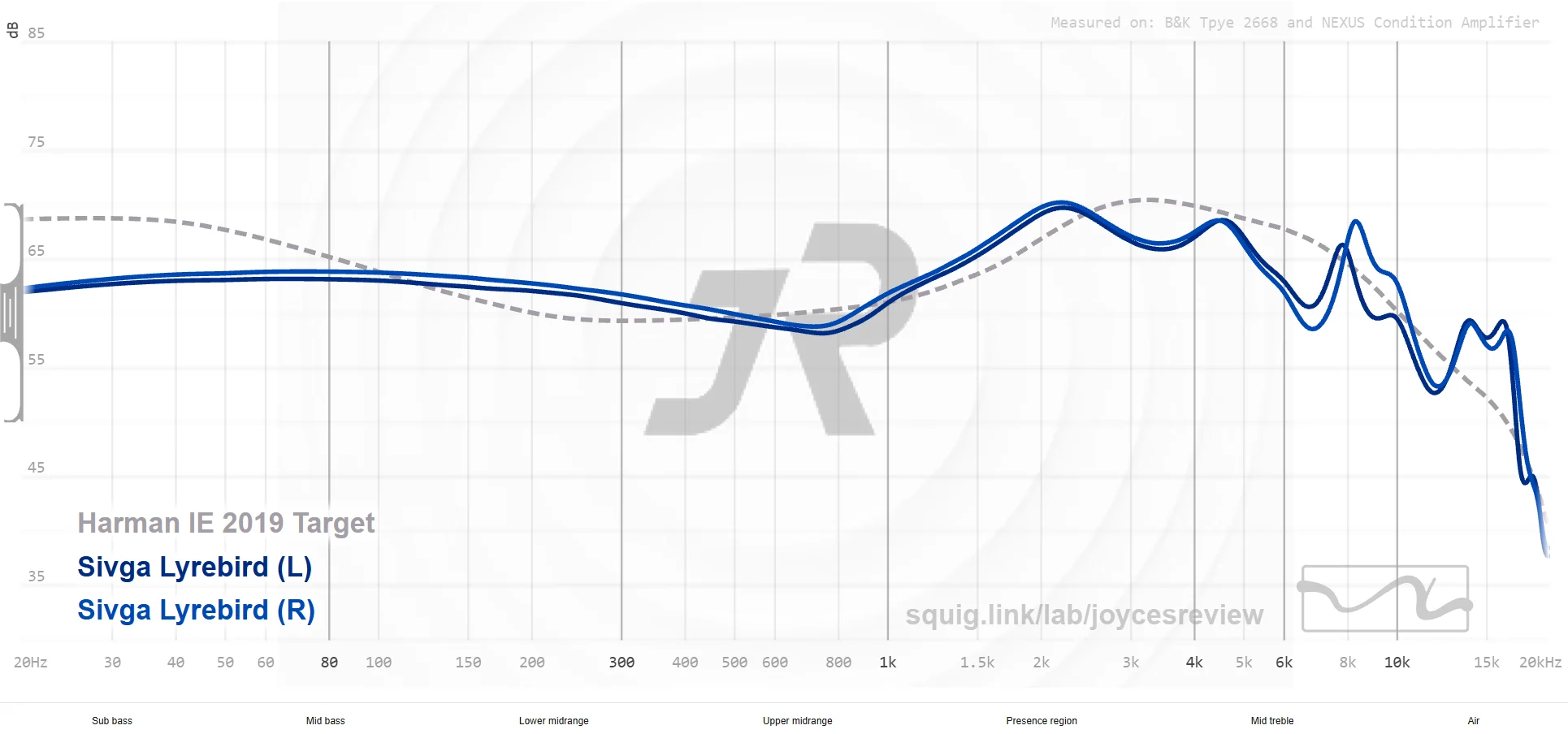
🔬 Frequency Response: What the Measurements Tell Us
I enjoy comparing my listening impressions with measurements.
Not because graphs can tell me whether I’ll love an IEM. They can’t.
But measurements can help explain why a product sounds the way it does.
And the Lyrebird’s frequency-response graph is particularly interesting.
Looking at the measurements shared by Joyce’s Review, several characteristics stand out.
🥁 Bass: A Gentle Foundation
The low frequencies are relatively restrained compared with the Harman IE 2019 target.
That fits with my listening experience.
The Lyrebird isn’t trying to deliver enormous sub-bass impact. Its bass provides a controlled foundation that keeps the midrange clear.
🎤 Upper Midrange: Why Vocals Feel Close
The graph shows a noticeable rise through the upper midrange, peaking around 2–2.5kHz.
This may help explain why vocals feel so present. The Lyrebird brings singers forward and gives them excellent clarity.
But remember, recording and individual perception also shape vocal distance. A frequency-response graph can’t fully predict where a listener will perceive a singer.
✨ Treble: The Science Behind the Sparkle
The Lyrebird’s upper frequencies contain several peaks and dips.
That suggests an energetic treble character, which is consistent with the lively brightness I hear.
But a graph can’t tell us whether that brightness will sound unpleasant.
And during my month of listening, I never found it harsh or painfully sharp.
The Lyrebird sounded clear, bright, and beautifully engaging.
🎯 Channel Matching: A Welcome Detail
Another encouraging feature is how closely the measured left and right channels track each other across much of the frequency range.
That suggests good channel consistency in the measured sample.
Of course, a measurement from one pair doesn’t guarantee identical results across every unit. High-frequency measurements can also change with fit, insertion depth, and the measurement equipment.
But the graph supports what I heard.
The measurements help explain the Lyrebird’s tonal personality. My month of listening explains why I enjoyed that personality so much.
Measurement source: Joyce’s Review, B&K Type 2668/NEXUS measurement, shown against the Harman IE 2019 target.
🔬 Detail & Resolution: Crystal Clarity
The Lyrebird is wonderfully clear.
That’s probably the first thing I noticed, and I kept appreciating it throughout the month.
Small musical details are easy to follow. The instruments have good definition, the vocal textures come through cleanly, and complex recordings stay engaging without becoming a wall of sound.
What I appreciate most is that the detail doesn’t feel disconnected from the music.
I don’t want every listening session to feel like an audio engineering exam.
Sometimes I simply want to enjoy a song.
The Lyrebird lets me do both.
I can listen carefully and appreciate subtle details, or relax and let the performance carry me along.
And thanks to its intimate presentation, those details often feel especially immediate.
Detail & Resolution: 4.8/5
Impressive clarity that serves the music.
🦴 Slam & Dynamics: A Musical Performer, Not a Bass Cannon
The Lyrebird isn’t an IEM that tries to shake my skull apart.
And that’s perfectly fine.
Its strength is balance, not brute force.
The low frequencies provide enough energy to support the rhythm, while the rest of the presentation remains clear and organized.
The drums have definition, the instrument attacks are easy to follow, and the shifts in musical energy stay enjoyable.
I appreciate the sense of control in the performance.
Of course, dedicated bassheads may want more physical impact.
I sometimes did, too.
But that’s where EQ became a welcome tool. I could experiment with a little more bass when the mood struck, then return to the Lyrebird’s natural character whenever I wanted.
It’s a flexible performer.
Not every Kaiju needs to flatten Tokyo.
Some are perfectly happy putting on an outstanding concert.
Slam & Dynamics: 4.4/5
Lively and controlled, with more finesse than brute force.
⚡ Speed & Transients: Quick, Clear, and Confident
The Lyrebird has a wonderfully responsive character.
Percussion feels clean and well-defined, instrument attacks remain easy to recognize, and busy musical passages maintain a satisfying sense of order.
I particularly appreciate how this responsiveness works with the Lyrebird’s closer presentation.
An intimate IEM can sometimes feel crowded when the music becomes complicated.
But I rarely felt that way here.
The clarity and separation help keep the performance organized. Everything has room to move, and the music keeps flowing.
Speed & Transients: 4.7/5
Excellent articulation and an engaging rhythmic character.
🎵 Tonality & Timbre: Bright with a Warm Heart
If I had to describe the Lyrebird’s sound in four words, I’d choose:
Intimate. Clear. Bright. Musical.
There’s a lovely balance happening here.
The brightness brings detail and energy. The warmth brings body and comfort. The intimacy brings emotional connection. And the width and depth prevent the presentation from feeling crowded.
That combination is what kept me coming back for an entire month.
The Lyrebird has a recognizable personality. It isn’t trying to sound like every other IEM.
And I love that.
Some products are technically impressive but leave me emotionally unmoved. Others are wonderfully musical but give up too much clarity.
The Lyrebird strikes a balance that fits my preferences beautifully.
And that’s what makes it special.
Tonality & Timbre: 4.8/5
Lively, articulate, and warmly engaging.

👹 The GearZilla KAIJU DNA Scan: Anatomy of a Musical Mimic
Every Kaiju has its own personality.
Some arrive with enormous claws, earth-shaking bass, and enough destructive power to turn an entire city into a parking lot.
Others take a more thoughtful approach.
They don’t need to destroy the world to capture your attention.
Sometimes all they need to do is sing.
The SIVGA Lyrebird belongs to that second group.
Beautifully built, wonderfully clear, and blessed with a personality that draws me closer to the music, this little creature has become one of my most enjoyable listening experiences of the month.
Let’s examine the DNA.
🎯 K • Kill Shot: Intimacy Without Compromise
The Lyrebird’s greatest strength is its wonderful sense of intimacy.
It brings music closer without sacrificing the width and depth that make a convincing listening experience so enjoyable.
Vocals feel personal, instruments remain organized, and the entire performance becomes more engaging because of that closeness.
That’s the Lyrebird’s secret weapon.
It’s not trying to make the music feel enormous.
It’s making the music feel meaningful.
🧬 A • Anatomy: Four Drivers, One Beautiful Bird
A 10mm dynamic driver, a balanced armature, a micro-planar driver, and a piezoelectric ceramic driver.
Four different technologies inside beautifully designed aluminum shells with gorgeous wood faceplates.
The engineering is impressive.
But what makes the Lyrebird special is how those technologies work together.
The sound feels coherent, the music flows naturally, and I never get the impression that the drivers are competing for attention.
Add the premium cable, leather case, and beautiful packaging, and the physical experience becomes just as impressive.
This is SIVGA at its best.
🦴 I • Impact: A Month I Didn’t Want to End
The Lyrebird’s greatest impact wasn’t physical.
It was emotional.
I genuinely loved spending a month with these IEMs.
That feeling matters more to me than a spec sheet full of impressive numbers.
The Lyrebird kept me interested. It made familiar songs enjoyable. It encouraged me to experiment with tips and EQ. And it reminded me why I fell in love with personal audio in the first place.
Sometimes a product doesn’t need to change the entire industry.
Sometimes it simply needs to make listening to music feel wonderful.
The Lyrebird did that for me.
🎩 J • Joy: The SIVGA Experience
I’ve reviewed several SIVGA headphones, and the company’s consistency still makes me smile.
The Lyrebird has everything I love about its design approach.
Natural wood, beautiful construction, excellent accessories, thoughtful packaging, and a sense that even the smallest details deserve attention.
That gorgeous tan leather case deserves another mention because I absolutely love it.
And the cable?
Fantastic.
The complete package feels like something worth owning and enjoying.
Not simply another IEM to toss into a drawer when the next shiny object arrives.
🎤 U • Unleashed: Let Her Sing!
The Lyrebird really came alive as I experimented with its setup.
Wide-bore tips helped the presentation blossom, EQ gave me more freedom to shape its sound, and capable amplification made the experience especially enjoyable.
I love when an IEM gives me that kind of flexibility.
But here’s the important part.
I didn’t spend my month trying to fix the Lyrebird.
I spent it discovering more reasons to enjoy her.
And believe me, there were plenty.
🦖 The KAIJU Conclusion: A Beautiful Little Performer
The SIVGA Lyrebird is a wonderfully complete IEM.
It’s beautiful, comfortable, clear, engaging, and has a distinctive musical personality that kept me listening for an entire month.
There are very few meaningful flaws.
Sure, some listeners will want more bass or a different vocal presentation.
But those are personal preferences, not universal problems.
For my ears, the Lyrebird delivers in almost every way.
And that’s one impressive little Kaiju.
💰 Value: Premium Quality Without the Premium Price
At its regular listed price of $149, the Lyrebird offers a compelling package.
Think about what you’re getting.
A four-driver hybrid design, gorgeous stabilized wood faceplates, precision-machined aluminum shells, an excellent detachable cable, a beautiful tan leather case, seven pairs of ear tips, and packaging that feels consistent with SIVGA’s higher-end products.
That’s a lot of thoughtful design packed into a relatively affordable IEM.
But here’s the important thing.
Value isn’t simply about how many accessories come in the box.
The sound still has to deliver.
And for me, the Lyrebird absolutely does.
After a wonderful month of listening, I found remarkably little to criticize.
Excellent clarity, engaging vocals, intimate presentation, and musical warmth made it a product I genuinely looked forward to using.
That combination of performance and craftsmanship makes the Lyrebird a strong value.
SIVGA hasn’t simply created an attractive IEM.
It’s created a complete listening experience.
Value: 4.8/5

🦖 GearZilla Scorecard: A Month with Nature’s Greatest Mimic
After spending a month with the SIVGA Lyrebird, one thing became abundantly clear.
This little bird has an extraordinary amount going for it.
Its greatest strengths lie in clarity, vocals, intimacy, craftsmanship, and the complete listening experience.
It’s also one of those rare products where my enjoyment continued growing as I became more familiar with its personality.
Here’s how the Lyrebird performed across my GearZilla categories.
✨ Clarity: 4.9/5
Crystal-clear and beautifully articulate. The Lyrebird reveals musical information with confidence while keeping the presentation wonderfully engaging.
🎤 Midrange & Vocals: 4.9/5
One of the show’s stars. Vocals feel close, expressive, and personal, bringing me directly into the performance.
🥁 Bass: 4.4/5
Controlled, musical, and nicely balanced. It has enough warmth and body to support the music, though dedicated bassheads may want more sub-bass authority.
🎯 Separation & Placement: 4.7/5
Excellent organization and instrument definition. The Lyrebird separates musical elements without making the performance feel disconnected.
🌌 Width & Depth: 4.7/5
Wonderfully dimensional for such an intimate presentation. Music feels close, but there’s still convincing width, depth, and room for instruments to breathe.
🔬 Detail & Resolution: 4.8/5
Impressive detail retrieval that supports the musical experience rather than turning every recording into an analytical exercise.
✨ Treble & Air: 4.8/5
Bright, lively, and beautifully clear without unpleasant sharpness during my month of listening.
🦴 Slam & Dynamics: 4.4/5
Responsive and engaging, with an emphasis on musical control rather than overwhelming physical impact.
🎤 Vocal Lift: 4.9/5
A defining strength. Singers feel wonderfully present and emotionally connected to the listener.
⚡ Speed & Transients: 4.7/5
Quick, articulate, and confident, keeping busy musical arrangements clear and enjoyable.
🎵 Tonality & Timbre: 4.8/5
Crystal clarity with a welcome hint of warmth. Bright enough to feel exciting, yet musical enough to keep me listening for hours.
🎛️ Tuning & Pairing Flexibility: 4.8/5
The Lyrebird responded beautifully to wide-bore tips, EQ experimentation, and capable sources, giving me several ways to enjoy its personality.
☁️ Comfort & Fit: 4.7/5
Comfortable and well-designed for the extended listening sessions I enjoyed throughout my month of reviewing.
🎨 Design & Build: 5.0/5
Absolutely gorgeous. The natural wood, aluminum construction, and careful finishing represent everything I love about SIVGA craftsmanship.
📦 Accessories & Presentation: 5.0/5
Textbook SIVGA excellence. The beautiful leather case, premium cable, thoughtful packaging, and included accessories make the complete experience feel special.
🎶 Listening Enjoyment: 5.0/5
I spent a wonderful month with the Lyrebird and loved every second. That’s the highest compliment I can give any IEM.
💰 Value: 4.8/5
A compelling combination of sound quality, beautiful construction, excellent accessories, and musical personality.
🧡🦖 Overall GearZilla Score: 4.5/5 | A-Class Kaiju
The Lyrebird earns its 4.5 because it’s an excellent IEM with a clear sense of identity.
Its strengths are exactly where they matter most to me: beautiful clarity, engaging vocals, convincing width and depth, a wonderful sense of intimacy, and craftsmanship that keeps reminding me why I love SIVGA.
What keeps it from a perfect score?
Very little, actually.
Dedicated bassheads may want more low-frequency authority, the stock presentation may not suit listeners who prefer distant vocals, and the 4.4mm cable won’t connect directly to every source.
But after a month of listening, these felt like minor considerations rather than serious faults.
The Lyrebird isn’t perfect for every listener.
No IEM is.
But for my ears and preferences, it’s a beautifully successful product.
And the fact that I enjoyed every second with it says more than any individual category score ever could.
🦖 Final Roar: The Little Bird That Taught Me to Listen Closer
There’s something extraordinary about the real lyrebird. Deep in the Australian forests, this remarkable creature can reproduce other birds’ calls, sounds from its surroundings, and even mechanical noises with astonishing accuracy. Yet what makes the lyrebird truly fascinating isn’t simply its ability to imitate. It’s how those different sounds become part of a performance that belongs entirely to the bird. When SIVGA chose this name for an IEM built around four different driver technologies, it couldn’t have found a more fitting symbol. Each driver brings something different to the performance, but together they create a wonderfully complete musical personality.
After a fantastic month with the Lyrebird, I’ve come to appreciate something beyond its impressive engineering. Great audio isn’t simply about reproducing every detail in a recording. It’s about making those details matter. I’ve experienced IEMs with thunderous bass, headphones with enormous spatial presentations, and equipment that reveals the smallest details hidden inside familiar recordings. Those experiences can be extraordinary, but the Lyrebird offers something equally rewarding. It brings the music closer, creating a wonderfully personal connection with the performers while preserving the width, depth, and clarity that make the experience believable.
That sense of closeness became one of my favorite things about the Lyrebird. The vocals feel immediate and expressive, the instruments occupy convincing positions, and the entire performance invites me into the recording rather than asking me to admire it from a distance. There’s something special about hearing a singer’s voice with such clarity while still enjoying the space surrounding the instruments. The Lyrebird doesn’t create intimacy by shrinking the music. It creates intimacy by making the performance feel more present, and I grew to appreciate that distinction with every listening session.
Its tonal character is just as captivating. The Lyrebird delivers crystal-clear detail with a lively, slightly bright personality, yet I never found that brightness unpleasantly sharp or aggressive. Instead, there’s a beautiful sense of energy and openness, supported by just enough warmth to keep everything musical. Wide-bore tips allowed the presentation to blossom, while EQ and capable amplification gave me even more ways to enjoy its character. I wasn’t experimenting because something needed fixing. I was experimenting because I genuinely loved discovering what this little bird could do.
And then there’s SIVGA’s craftsmanship, which continues to impress me across every product I’ve reviewed. The gorgeous natural wood faceplates, precision-machined aluminum shells, beautiful cable, thoughtful packaging, and fantastic tan leather carrying case all reflect a level of care I’ve come to expect. SIVGA understands that owning quality audio equipment should be enjoyable beyond the moment you press play. The Lyrebird looks and feels special, carrying the same design philosophy I’ve admired in the company’s higher-end over-ear headphones while establishing an identity entirely its own.
Perhaps the greatest compliment I can give the Lyrebird is that I spent an entire month reviewing it and loved every second. That’s not because it’s the most expensive or technically ambitious IEM I’ve experienced, or because it dominates every possible performance category. It’s because the complete experience was consistently enjoyable. The sound, comfort, craftsmanship, and flexibility all came together in a way that made me look forward to every listening session. There were remarkably few flaws worth mentioning, and even fewer moments when I wished I were listening to something else.
The Lyrebird also reminded me of something important about this hobby. We’re constantly chasing bigger bass, wider presentations, greater resolution, and the next impressive technical achievement. And I certainly understand that pursuit. After all, Listen Bigger! is practically my battle cry! But bigger isn’t always about physical scale. Sometimes it’s about a deeper connection to the music, hearing more emotion in a performance, or the simple pleasure of feeling closer to the artist. The Lyrebird reminded me that IEMs don’t need to push musicians farther away to create an immersive experience. Sometimes the magic happens when it brings them closer.
Like its remarkable namesake, the SIVGA Lyrebird brings different voices together into something uniquely its own. Four driver technologies, a wonderfully clear and engaging presentation, and craftsmanship that celebrates the beauty of the natural world. It’s an IEM with character, confidence, and a musical personality that kept me smiling all month. Many thanks again to the wonderful Finn and the entire SIVGA team for sharing this beautiful little performer with GearZilla Reviews. You’ve created something genuinely special, and I’m grateful I got to experience it.
🧡🦖 GearZilla Verdict: 4.5/5 | A-Class Kaiju
Nature’s greatest mimic has found her voice, and what a beautiful voice it is.

🎶 GearZilla Listening Playlist: The Art of Listening Closer
The SIVGA Lyrebird brings performers closer while preserving the detail and space that make music come alive. For this playlist, I’ve chosen ten recordings that explore that balance through intimate vocals, acoustic instruments, layered harmonies, delicate textures, and more energetic arrangements.
We’re traveling from the soulful vocal layers of Dominique Fils-Aimé to French cinematic beauty, Mexican acoustic traditions, atmospheric indie rock, and some wonderfully expressive male singer-songwriters. Each selection gives this little bird something different to sing about.
🐦 1. Dominique Fils-Aimé – Birds
Listening focus: Vocal layering, separation, imaging, and clarity.
Could the opening be more fitting for an IEM named after nature’s greatest mimic? Dominique builds a remarkable musical environment from overlapping vocal lines, subtle percussion, and beautifully arranged harmonies. The Lyrebird’s clarity makes this a wonderful opportunity to follow the individual voices while appreciating how they form one complete performance. It’s an almost perfect demonstration of what four different driver technologies should accomplish: many voices, one beautiful song.
☀️ 2. Laura Cahen – La complainte du soleil
Listening focus: French vocal articulation, delicacy, atmosphere, and depth.
Laura Cahen’s haunting contribution to I Lost My Body has a delicate, almost dreamlike quality that feels made for intimate listening. Her soft French delivery sits within an understated musical atmosphere, allowing small changes in her voice to become part of the experience. The Lyrebird’s lively clarity illuminates those subtle details while preserving the space around her. This recording doesn’t need to shout to make an impression.
🎤 3. Celeste & Gotts Street Park – Both Sides of the Moon
Listening focus: Vocal texture, midrange body, emotional expression, and instrumental balance.
Celeste has one of those extraordinary voices that can communicate an entire story through the smallest change in tone. “Both Sides of the Moon” pairs her expressive delivery with a wonderfully restrained arrangement, making it ideal for exploring the Lyrebird’s balance between brightness and warmth. I want her voice’s emotional character to stay front and center while the instruments keep their own space. It’s soulful, beautifully controlled, and full of personality.
🌊 4. Natalia Lafourcade & Los Macorinos – Soledad y el Mar
Listening focus: Acoustic guitar realism, string resonance, vocal intimacy, and natural timbre.
Natalia Lafourcade’s gorgeous collaboration with Los Macorinos celebrates acoustic instruments and traditional Latin American music. The guitars’ interplay offers a lovely opportunity to appreciate individual string textures and natural resonance, while Natalia’s expressive voice adds warmth and emotional depth. Through the Lyrebird, this is exactly the kind of recording where clarity should serve the performance rather than compete with it. A beautiful voice and two guitars can be every bit as captivating as an entire orchestra.
🏡 5. Chance Peña – In My Room
Listening focus: Male vocal proximity, acoustic detail, separation, and emotional connection.
The title alone makes this a natural addition to an intimate-listening playlist. Chance Peña’s earnest vocal delivery and gentle instrumental foundation create a personal atmosphere that fits the Lyrebird beautifully. The appeal lies in the relationship between his voice and the surrounding music, where clear articulation and subtle warmth can make the performance feel especially immediate. It’s an excellent example of why a convincing listening experience doesn’t always require an enormous sense of space.
🌙 6. Bedroom – Nothing Lasts
Listening focus: Dreamy guitar textures, vocal placement, atmospheric layering, and note decay.
Bedroom’s “Nothing Lasts” brings a hazy, nostalgic quality that feels wonderfully different from the cleaner acoustic recordings elsewhere on this playlist. Its washed-out guitar textures and relaxed vocal character create an atmosphere where the relationship between individual musical layers becomes especially important. The Lyrebird’s ability to preserve clarity without stripping away warmth makes this a compelling listen. I want to appreciate the recording’s dreamy character while still recognizing the instruments hiding inside that beautiful haze.
✨ 7. SYML – Believer
Listening focus: Male vocal richness, dynamic growth, melodic layering, and spatial depth.
SYML blends deeply personal songwriting with atmospheric production, and “Believer” gives us plenty to explore. Brian Fennell’s expressive vocal delivery anchors a recording that gradually develops a stronger sense of musical weight and movement. This offers an excellent opportunity to appreciate how the Lyrebird balances emotional intimacy with a growing arrangement. The vocal should remain compelling even as the surrounding music becomes more involved.
🌺 8. flipturn – Poppies
Listening focus: Guitar separation, percussion energy, vocal clarity, and rhythmic dynamics.
Now we’re giving the Lyrebird something with a little more attitude. flipturn’s “Poppies” brings indie-rock energy to our otherwise intimate listening journey, with layered guitars, expressive vocals, and a lively rhythmic foundation. It’s a useful contrast to the quieter selections because the Lyrebird needs to keep individual instruments organized as the arrangement grows more energetic. I want to hear the guitars clearly, feel the rhythmic momentum, and appreciate the vocal without letting everything become congested.
🎸 9. Zackery – Do Your Worst
Listening focus: Raw male vocals, acoustic texture, tonal detail, and dynamic expression.
Zackery’s “Do Your Worst” brings a rougher emotional edge to the playlist, offering an appealing contrast to the delicate performances that came before it. His expressive vocal character makes this a particularly interesting track for exploring the Lyrebird’s bright but comfortable upper frequencies. The challenge is preserving his voice’s texture and energy without making the stronger passages feel sharp. There’s something wonderfully honest about a performance that allows a little grit to remain, and I want an IEM that preserves that character.
🌲 10. Ben Howard – Old Pine
Listening focus: Acoustic guitar layering, natural ambiance, rhythmic precision, and width.
Ben Howard brings our journey to a beautiful conclusion with “Old Pine,” a recording filled with intricate acoustic guitar work, expressive vocals, and a wonderfully organic sense of movement. The interplay between the guitar patterns makes this an excellent final test of the Lyrebird’s clarity and separation, while the broader arrangement gives us an opportunity to appreciate its width and depth. It’s energetic without being overwhelming, intimate without feeling confined, and a fitting reminder that great musical immersion often begins with beautifully played natural instruments.
🐦 The GearZilla Takeaway: Every Voice Has Its Place
What I love about this playlist is the variety of musical personalities it brings together. Dominique Fils-Aimé explores layered voices, Laura Cahen and Celeste celebrate vocal expression, and Natalia Lafourcade brings the warmth of acoustic tradition. Chance Peña, Bedroom, SYML, and Zackery explore different sides of male vocal intimacy, while flipturn and Ben Howard provide contrasting opportunities to appreciate rhythmic energy, guitar textures, and instrumental separation.
Together, these recordings highlight what made my month with the SIVGA Lyrebird so enjoyable. It’s not simply about hearing every little detail. It’s about hearing how those details come together while feeling closer to the people creating the music.
Ten artists. Ten different musical worlds. One beautiful little bird that brings them all to life.
✅ Buy If
- You listen to a lot of vocal-centered music, including jazz, soul, acoustic, folk, and singer-songwriter recordings.
- You enjoy feeling close to the performers rather than hearing everything from the back of an imaginary concert hall.
- You appreciate the detail and energy of a brighter tuning but don’t want an overly aggressive listening experience.
- You enjoy classical, instrumental, and orchestral music where separation and the ability to follow individual musicians matter.
- You want an engaging IEM for extended listening sessions at home, in the office, or at your favorite coffee shop.
- You own a portable DAC or DAP and want a quality wired IEM for a compact, dedicated listening setup.
- You like exploring different musical genres without needing a separate IEM for every mood.
- You enjoy personalizing your listening experience through ear tips and EQ.
- You value comfortable, beautifully made equipment that feels special every time you use it.
- You’re moving beyond entry-level IEMs and want a more refined ownership experience without a major financial commitment.
⛔ Skip If
- Your listening revolves around bass-heavy EDM, hip-hop, or electronic music, and you want massive sub-bass impact without EQ.
- You prefer a dark, relaxed presentation with noticeably softened upper frequencies.
- You want vocals to sit farther away rather than taking a more immediate position in the recording.
- You need wireless freedom, active noise cancellation, or a built-in microphone for frequent calls.
- You primarily use a phone or laptop with a 3.5mm output and don’t want to purchase another cable.
- You need an IEM for exercise or other activities where a wired connection could become inconvenient.
- You prefer a completely plug-and-play experience and aren’t interested in experimenting with fit, ear tips, or sound customization.
- You want the widest, most distant concert-hall presentation possible rather than a closer, more personal listening experience.
🧡🦖 GearZilla Verdict: 4.5/5 | A-Class Kaiju
After a month with the SIVGA Lyrebird, I see it as an excellent choice for music lovers who want a more personal listening experience. I wouldn’t recommend this IEM to people who care more about technical specs or complex driver arrangements. I’d recommend it to someone who loves settling into a favorite album, following a singer’s performance, or rediscovering familiar music during a quiet afternoon. The Lyrebird is especially appealing for those moments when listening becomes the activity rather than something happening in the background.
I can easily picture the Lyrebird becoming a favorite companion for long afternoons at a coffee shop, quiet evenings at home, or those wonderful occasions when you finally have an hour to yourself and nothing on the agenda except music. Its wired design and 4.4mm connection make it a natural partner for a portable DAC or DAP, while its comfortable fit and engaging character suit listeners who enjoy extended sessions. This is also the kind of IEM I’d hand to someone who’s beginning to take personal HiFi more seriously. It offers an inviting introduction to what a thoughtfully designed audio product can bring to everyday listening, without requiring an extravagant investment.
Musically, I think the Lyrebird will particularly reward listeners who appreciate voices and natural instruments. Jazz, soul, acoustic performances, folk, and singer-songwriter recordings are obvious places to start, but I wouldn’t limit it to those genres. Rock, pop, classical, and well-recorded live performances can also benefit from its ability to keep individual musical elements easy to follow. These recommendations are based on its tuning and presentation, not a claim that every recording in those genres will sound equally impressive. What matters most is whether you enjoy feeling connected to the performers.
There are some practical considerations. The Lyrebird wouldn’t be my first recommendation for someone whose entire listening collection revolves around enormous bass drops and room-shaking electronic music. Likewise, anyone seeking the most relaxed, distant, or heavily softened presentation may be happier elsewhere. Its stock 4.4mm cable also suits enthusiasts with compatible sources better than someone planning to plug directly into a standard headphone jack. Those aren’t major faults, but knowing them before you buy will help ensure the Lyrebird ends up in the right ears.
And that’s really what a good recommendation should accomplish. Not convince everyone to buy the same product, but help the right listeners discover something they’ll genuinely enjoy. At its $149 reference price, I believe the Lyrebird offers a compelling entry point into enthusiast personal audio, especially for someone who values craftsmanship as much as musical enjoyment. It has the character to hold experienced listeners’ attention while remaining approachable for someone building their first serious portable listening setup.
My 4.5/5 rating reflects an IEM that delivers exceptionally well for its intended audience, with only a few practical limitations and personal-taste factors keeping it from a perfect score. I wouldn’t call it the universal answer to every listening preference, and I certainly wouldn’t recommend it based on driver count alone. But listeners who want to sit a little closer to the music will find the Lyrebird has a lot to offer.
And that makes it an easy recommendation from GearZilla.
🧡🦖 GearZilla Verdict: 4.5/5 | A-Class Kaiju
🔗 References & Resources
Buy Now: https://sivgashop.com/products/sivga-lyrebird
Official SIVGA specifications: https://sivgaaudio.com/product_d?id=31
Frequency-response measurement: Joyce’s Review, Squig.link – https://squig.link/lab/joycesreview
Natural history: Australian Museum – https://australian.museum/learn/animals/birds/superb-lyrebird/
Share This Story, Choose Your Platform!