



What does a $70,000-plus headphone system actually sound like? At CanJam Dallas, an unexpected scheduling break gave me 15 glorious minutes with Sennheiser’s legendary HE 1. What followed was an extraordinary journey through soul, jazz, hip-hop, vocal intimacy, and one gloriously inappropriate blast from my high school past.
🎧 Sennheiser HE 1: Just Enough Time to Be Dangerous
What does a $70,000 pair of headphones sound like?
“Pretty good!”
I know. That’s probably not the earth-shattering revelation you were expecting from one of the most extravagant personal audio systems ever created. But when you’re sitting in front of a headphone system that costs about as much as a brand-new pickup truck here in Texas, where exactly do you begin?
Do you prepare a carefully curated selection of immaculate audiophile recordings, spend your precious minutes analyzing frequency extension and transient response, or sit quietly in reverence, grateful that the audio gods have granted you admission to their inner sanctum?
Or do you throw caution to the wind, cue up your favorite music, and see whether $70,000 worth of engineering can make the songs you’ve loved for decades sound like you’re hearing them for the very first time?
Naturally, I chose the latter.
At CanJam Dallas 2026, I had the rare opportunity to experience Sennheiser’s legendary HE 1, a cost-no-object electrostatic headphone system that’s equal parts engineering marvel, luxury sculpture, and unapologetic demonstration of what happens when a company decides the sky isn’t nearly high enough.
I shared the experience with my good friend Dileep from Austin and his wife, Sravani, which made an already extraordinary opportunity even more enjoyable. Eric from Sennheiser guided our session, welcomed us, introduced us to this magnificent system, and helped us get the most out of our time. As luck would have it, our group was short a few people, so we had considerably more listening time than expected. The three of us leaned into the opportunity and went to town, or at least as far as a quarter of an hour would allow.
Fifteen glorious minutes with a $70,000-plus headphone system. Just enough time to be dangerous.
And believe me, we each made the most of it.
What surprised me, though, wasn’t simply how incredible the HE 1 sounded. It was how much I enjoyed experiencing music through other people’s ears. Between Dileep, Sravani, and the group ahead of us, I was reminded that everyone brings something different to a listening session. We all have our reference tracks—those dependable recordings we know so intimately that even subtle changes in presentation become immediately apparent. But there’s something wonderful about stepping outside your own musical universe and discovering what moves someone else.
Sometimes the most revealing song isn’t the one you brought. It’s the one somebody else introduces you to.
That unexpected sense of shared discovery became one of my favorite parts of the entire experience. Here we were, three friends from Central Texas gathered around a headphone system worth more than many people’s vehicles, trading musical discoveries and soaking up every precious minute. And despite the astronomical price tag, the experience wasn’t really about money, specifications, or extravagant engineering. It was about music, friendship, and the remarkable things that happen when familiar recordings are presented in ways we never imagined possible.
And the HE 1 made those moments extraordinary.
What struck me almost immediately was how effortlessly the system seemed to get out of the music’s way. The presentation was astonishingly open, richly textured, and so remarkably free of audible distortion that I occasionally forgot I was wearing headphones at all. Instruments occupied their own beautifully defined spaces, vocals felt almost physically present, and subtle details emerged from recordings I thought I knew inside and out.
It was expansive and intimate at once, technically precise yet wonderfully inviting. The experience had an almost surreal quality, as though the music was delivered directly to my brain rather than reproduced by a pair of transducers beside my ears.
And here’s the funny thing about that extraordinary clarity: I kept wanting to turn up the volume. Not because the HE 1 lacked presence or authority, but because everything sounded so effortless that I found myself chasing more of the performance’s physical sensation. Eventually, the sound pressure became uncomfortable, reminding me that even the world’s most sophisticated headphone system can’t make excessive listening levels harmless.
That’s when I realized just how unusual this experience really was. The HE 1 wasn’t overwhelming me with artificially exaggerated bass, aggressively sharpened detail, or some enormous sonic trick designed to justify its price. It was doing something far more compelling.
It made the equipment disappear and left me alone with the music.
Now, I’m not going to pretend that 15 minutes makes me an authority on the finest electrostatic headphone systems in existence. I’ve enjoyed extraordinary audio equipment over the years, but the HE 1 occupies a category where I simply don’t have the extensive comparative experience to call anything the absolute best.
And frankly, I’m not sure that matters.
Because for those 15 minutes, I wasn’t thinking about rankings, measurements, or whether the experience could possibly justify the astronomical asking price. I was rediscovering familiar music, enjoying the selections Dileep, Sravani, and our fellow enthusiasts brought, and having an absolute blast exploring what this magnificent machine could do.
A huge thanks to Eric and the Sennheiser team for making the experience possible, and to Dileep and Sravani for sharing what turned out to be one of my favorite moments of CanJam Dallas. It’s not every day you get to spend quality time with a $70,000-plus headphone system, and experiences like this are even better with good company along for the ride.
Did the HE 1 sound like $70,000? I have absolutely no idea what $70,000 is supposed to sound like.
But I can tell you this: it was among the most remarkable personal audio experiences I’ve ever had, and those unexpected 15 minutes left me with musical memories I’ll be talking about for years.
Not bad for something that sounded “pretty good.”
⚖️ The GearZilla Reality Check: What Shines, What Gives
Even at $70,000-plus, no headphone system exists without compromises. The Sennheiser HE 1 delivered one of the most extraordinary listening experiences of my life, but its remarkable achievements come with a few practical realities worth acknowledging. Here’s what stood out during my 15-minute audition.
✅ Standout Strengths
Breathtaking vocal realism and emotional intimacy; extraordinarily natural midrange; astonishing clarity and detail retrieval; expansive, holographic soundstage; exceptional instrument separation and three-dimensional imaging; deep, authoritative, beautifully controlled bass; virtually imperceptible distortion; rich, organic timbre with wonderfully gooey musical textures; effortless dynamics; remarkable openness and spatial depth; exquisite craftsmanship and luxury materials; and an unforgettable listening experience that makes the equipment itself seem to disappear.
⛔ Considerations
Astronomical $70,000-plus price tag; elaborate, dedicated amplification system requiring substantial space; extremely open-back design with minimal isolation and significant sound leakage; best experienced in an exceptionally quiet listening environment; occasionally energetic treble that may challenge sensitive listeners; extraordinary clarity that can tempt excessively high listening volumes; and a brief 15-minute audition that leaves long-term comfort, listening fatigue, reliability, and direct comparisons with other ultra-high-end systems unexplored.
The GearZilla Take: The HE 1 isn’t practical, affordable, or remotely necessary. It’s an extraordinary expression of what’s possible when engineering ambition meets musical passion. And while 15 minutes isn’t enough to declare it the world’s finest headphone system, it was more than enough to understand why this legendary creation commands so much attention.

🤝 Disclosure: The Truth Behind the Roar
Every GearZilla review begins with the same philosophy:
Listen first. Figure out the story later.
I experienced the Sennheiser HE 1 during an organized listening session at CanJam Dallas 2026.
I wasn’t provided a review sample, didn’t take the system home, and received no compensation for this coverage.
My time with the HE 1 totaled approximately 15 minutes, giving me a valuable firsthand impression of its sonic performance but not the opportunity to conduct the extensive testing I ordinarily perform for a full GearZilla review.
This Field Report is therefore a personal account of an exceptional listening experience, supported by published technical information from Sennheiser. It’s not a laboratory evaluation, an exhaustive comparison, or a claim that I can definitively rank the HE 1 against every high-end headphone in existence.
A sincere thank you to Eric and the Sennheiser team for making this extraordinary experience possible and for their hospitality throughout the session.
And no, Sennheiser didn’t ask me to play “Doo Doo Brown.”
That particular act of audiophile mischief was entirely my own.
🎶 The $70,000 Playlist: Audiophile Excellence Meets Questionable Musical Decisions
When someone hands you the keys to a legendary mega-kilobuck headphone system, you’re expected to treat the occasion with appropriate reverence. Perhaps cue up some meticulously recorded jazz, delicate classical arrangements, or an acoustic masterpiece guaranteed to showcase every last ounce of sonic perfection.
And sure, I could have done that…
But I also figured that if I was ever going to experience one of the most extraordinary headphone systems on the planet, I might as well have some fun with it.
Our little listening adventure became a wonderfully unpredictable musical journey, from breathtaking vocal performances and atmospheric arrangements to hard-hitting hip-hop and a rather questionable selection from my high school days. Some tracks were chosen for their technical merits, others for their emotional connection, and a few simply because I couldn’t resist hearing what $70,000 worth of engineering would do with them.
I’m fairly confident some of these songs have never graced the Sennheiser HE 1 before, and there’s a very good chance they’ll never be played on one again.
And frankly, that makes me ridiculously happy.
One of the most memorable selections wasn’t even mine. It came from the group ahead of us, proving that sometimes the best listening discoveries happen when someone else takes control of the music.
Here’s a look at the artists and recordings that turned 15 unexpected minutes into one of my favorite experiences at CanJam Dallas.
🎤 Lauryn Hill | Just Like Water (Live)
The unexpected showstopper. Courtesy of the group ahead of us.
Sometimes the best track in a listening session is the one you didn’t choose. Lauryn Hill’s performance from MTV Unplugged No. 2.0 was an extraordinary showcase of emotional intimacy, acoustic texture, and vocal realism. Through the HE 1, her voice possessed an almost physical presence, while the delicate imperfections and natural resonance of the live performance emerged with breathtaking clarity. It was one of those moments when I stopped thinking about the headphones and simply appreciated the artistry.
🎸 Leon Bridges | Motorbike
Because every extraordinary listening experience deserves a little Leon Bridges.
One of my favorite reference tracks, “Motorbike” offers a beautifully seductive combination of intimate vocals, rich instrumental textures, and a wonderfully controlled low-frequency groove. The HE 1 made Bridges feel almost impossibly present, revealing subtle expressive details while preserving the warmth and emotional character that make the recording so compelling. If I could have listened to only one song, this would’ve been a strong contender.
🎙️ Dominique Fils-Aimé | Vocal Alchemy
When the human voice becomes an entire musical universe.
Dominique Fils-Aimé’s extraordinary vocal arrangements are a playground for headphones capable of remarkable resolution and spatial separation. Her beautifully layered performances reveal subtle differences in vocal texture, harmonic relationships, and dimensional placement. The HE 1’s astonishing midrange clarity and natural timbre made this part of the session especially rewarding, letting individual vocal elements emerge without losing the performance’s emotional unity.
🎼 Celeste | Soul Laid Bare
Some voices deserve to be heard without anything getting in the way.
Celeste has one of those wonderfully expressive voices that can communicate an entire emotional journey through the smallest changes in phrasing and intensity. Her music gave the HE 1 an opportunity to demonstrate its extraordinary midrange realism, natural vocal body, and ability to reveal subtle textures without sounding clinical. The result was beautifully intimate, with an emotional immediacy that reminded me why vocal reproduction matters so much to my listening preferences.
🎻 DeVotchKa | Beautifully Organized Chaos
For the musicians who believe there’s always room for one more instrument.
DeVotchKa’s atmospheric arrangements and wonderfully unconventional instrumentation made them a natural choice for exploring the HE 1’s spatial capabilities. Their music is richly layered, with instruments occupying overlapping musical spaces that challenge lesser systems to stay clear. Through the HE 1, the separation was astonishing. Individual textures emerged with remarkable precision while the complete performance retained its natural cohesion and emotional richness.
🎤 Kendrick Lamar | A Little Controlled Chaos
Because extraordinary engineering should handle extraordinary lyrical complexity.
After spending time with delicate vocals and atmospheric arrangements, I wanted to hear how the HE 1 handled something with a little more attitude. Kendrick Lamar’s intricate production, layered vocals, rhythmic complexity, and deep bass offered the perfect change of pace. The HE 1 maintained extraordinary composure, letting individual musical elements keep their identities without sacrificing the performance’s energy and momentum.
🔥 Megan Thee Stallion | Because She’s My Girl
Sometimes an audiophile needs to stop analyzing and start having fun.
I’m not going to pretend this selection was part of some elaborate technical evaluation strategy. I love Megan Thee Stallion, and I wanted to hear what her bass-heavy, percussion-driven production would sound like through one of the most extravagant headphone systems ever created. The answer? Fantastic. The HE 1 delivered deep, controlled bass, crisp rhythmic articulation, and remarkable separation without losing the music’s infectious energy. Sometimes the best test track is simply something that makes you smile.
🕺 2 Hyped Brothers & A Dog | Doo Doo Brown
Class of 1991! Zero regrets. Absolutely no audiophile approval required.
And now for the selection that may have permanently altered the HE 1’s distinguished musical résumé.
Yes, I played “Doo Doo Brown.”
A gloriously nostalgic Miami bass classic from my high school days, and almost certainly not what Sennheiser’s engineers envisioned when they spent years perfecting this extraordinary electrostatic system.
But here’s the beautiful thing about music. Not every song needs to be a technical masterpiece to deserve a place in your listening collection. Some recordings matter because they remind you of a particular time, place, or version of yourself.
For me, this one takes me straight back to 1991.
And hearing it through a $70,000-plus headphone system?
Absolutely priceless.
Well, technically, extraordinarily expensive. But you get the idea.
If this wasn’t the first time “Doo Doo Brown” had been played through an HE 1, I’d genuinely love to meet the other person responsible. We clearly have some things in common.
🦖 The GearZilla Playlist Verdict: Listen Bigger, Not Just Fancier
Looking back, what made this playlist special wasn’t simply the variety of genres or the remarkable quality of the HE 1. It was the freedom to explore music without feeling obligated to follow some unwritten set of audiophile rules.
From Lauryn Hill’s breathtaking unplugged performance to Leon Bridges’ soulful intimacy, Dominique Fils-Aimé’s magnificent vocal arrangements, and the wonderfully ridiculous bass of “Doo Doo Brown,” every selection offered a different perspective on what this extraordinary system could deliver.
And perhaps that’s the greatest compliment I can give the HE 1.
It didn’t require pristine recordings, carefully selected genres, or an artificially serious listening session to impress me.
It simply made the music I loved more engaging.
Because the ultimate purpose of extraordinary audio equipment isn’t to make us better audiophiles. It’s to make us happier music lovers.
And for 15 unforgettable minutes, that’s exactly what happened.
🎧 Review Perspective: Chasing the Extraordinary
Anyone familiar with GearZilla Reviews knows I have a particular weakness for rich, musical, immersive sound.
I love expansive soundstages, dimensional layering, beautifully elevated vocals, textured bass with convincing authority, and enough upper-frequency air to make recordings breathe.
Give me a lush, holographic presentation that makes musicians feel as though they’ve escaped the confines of my headphones, and I’m usually a very happy Kaiju.
But I’ve also learned that technical excellence and musical enjoyment aren’t necessarily the same thing.
A headphone can reveal extraordinary amounts of detail without making the music more emotionally engaging. It can create an enormous soundstage that feels artificially stretched, or emphasize instrumental separation so aggressively that the arrangement loses its natural cohesion.
And while I appreciate equipment that can dissect complicated recordings, I don’t want every listening session to feel like a forensic investigation.
Sometimes I just want the music to sweep me away.
That’s why my approach to reviewing audio equipment always returns to one fundamental question:
Does this help me enjoy the music I already love in a more meaningful way?
The HE 1 presented a fascinating opportunity to explore that question at a level of engineering and extravagance I rarely encounter.
I’ve enjoyed remarkable planar magnetic headphones, beautifully crafted dynamic designs, and equipment capable of producing some truly unforgettable listening experiences.
But the HE 1 exists in a different category.
This isn’t simply an expensive headphone paired with a powerful amplifier.
It’s an integrated electrostatic system engineered with an almost obsessive level of attention to materials, electrical architecture, acoustic performance, and presentation.
And with a price exceeding $70,000, expectations are understandably enormous.
Can a headphone system this extravagant make music feel fundamentally more real?
That’s what I wanted to discover.

The Listening Environment: Silence Is Golden
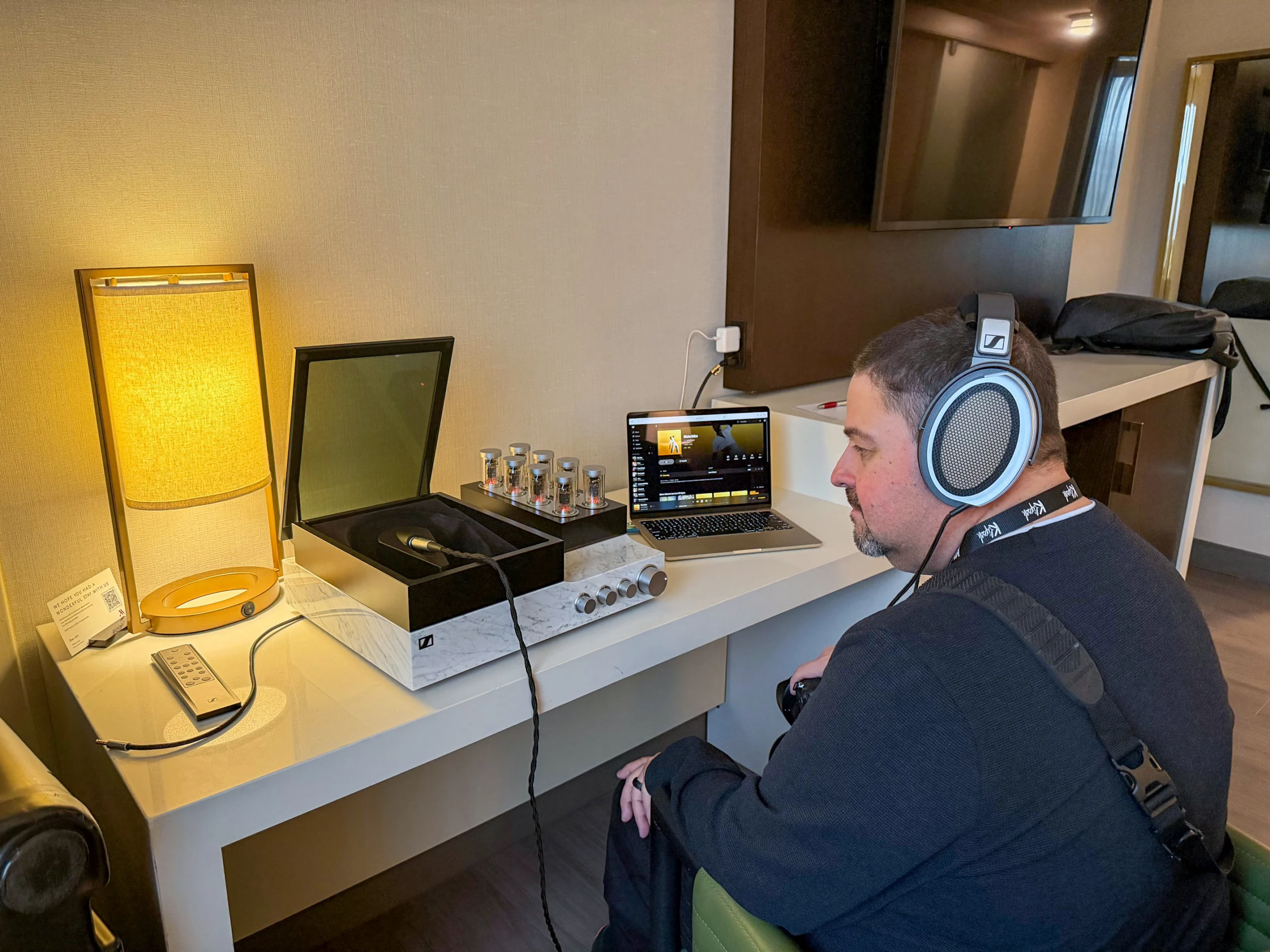
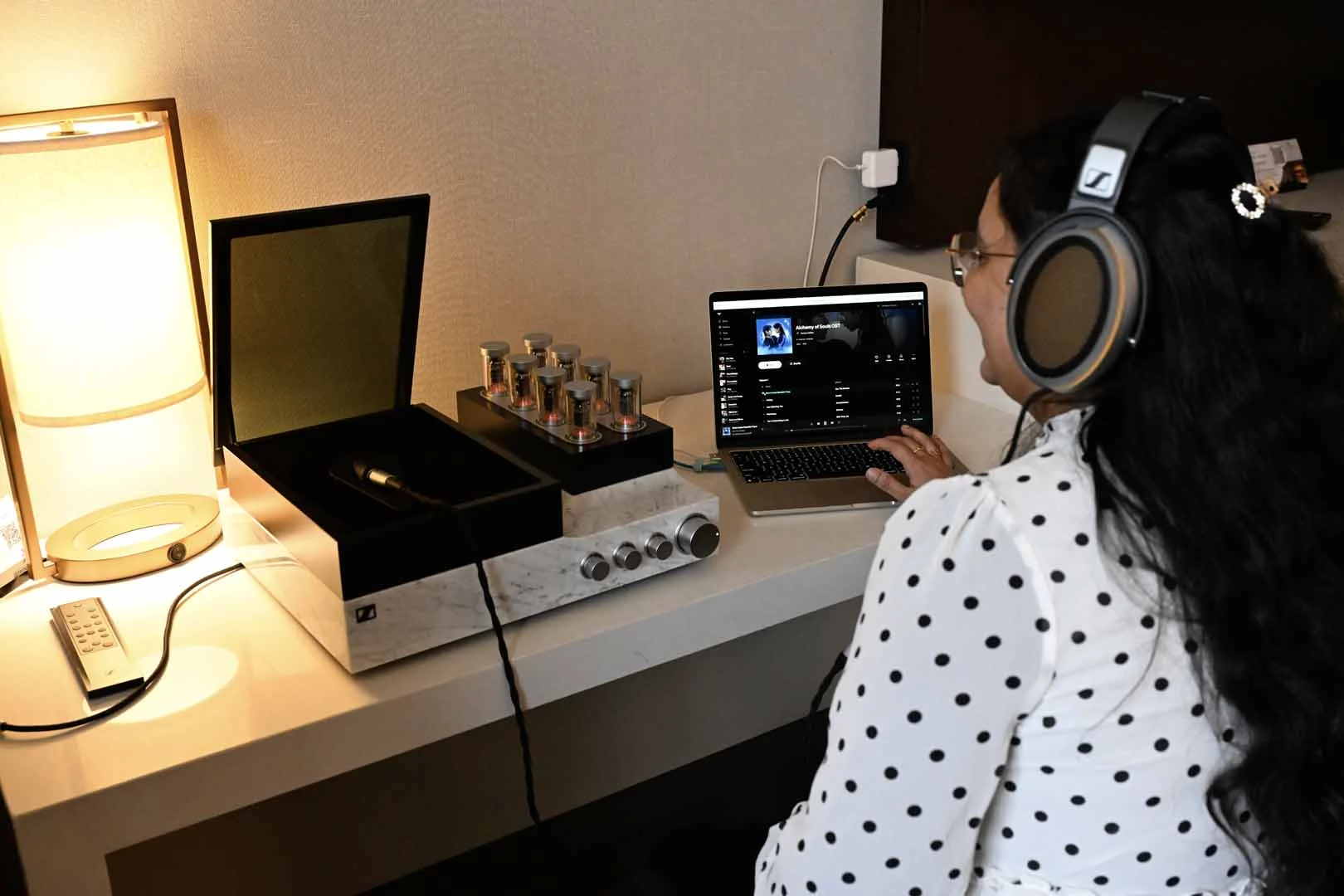
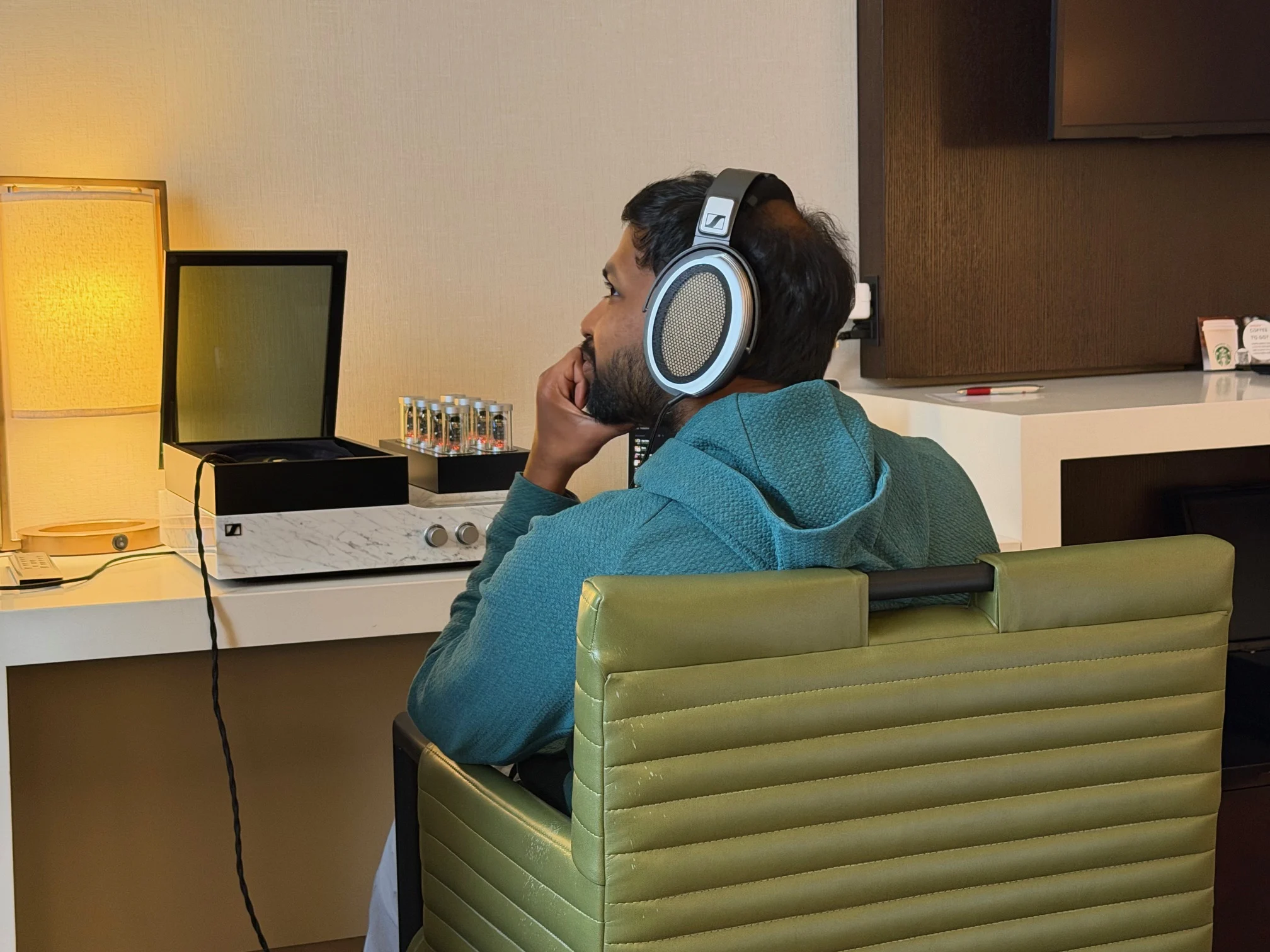
My audition took place in a relatively quiet hotel-room setting at CanJam Dallas.
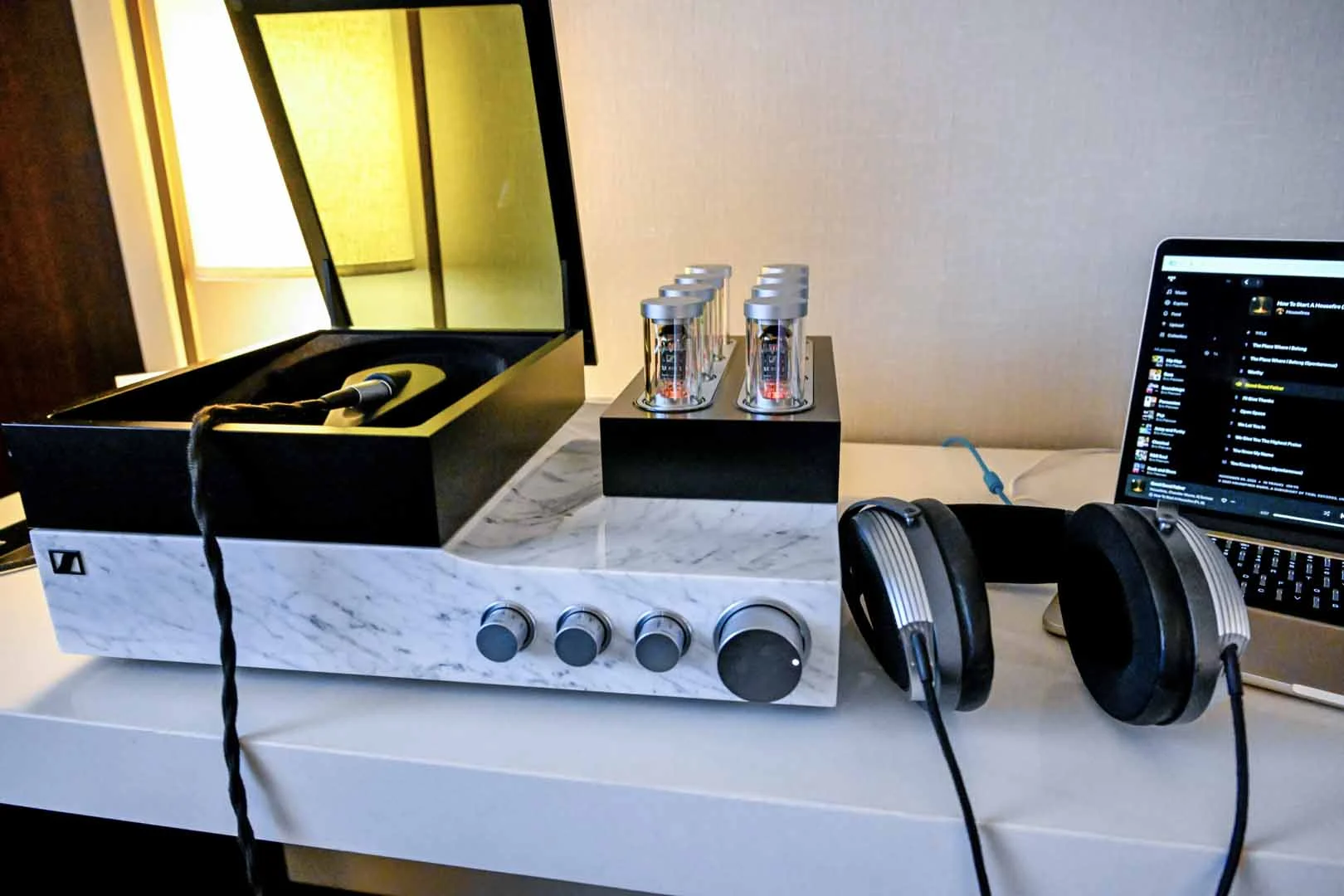
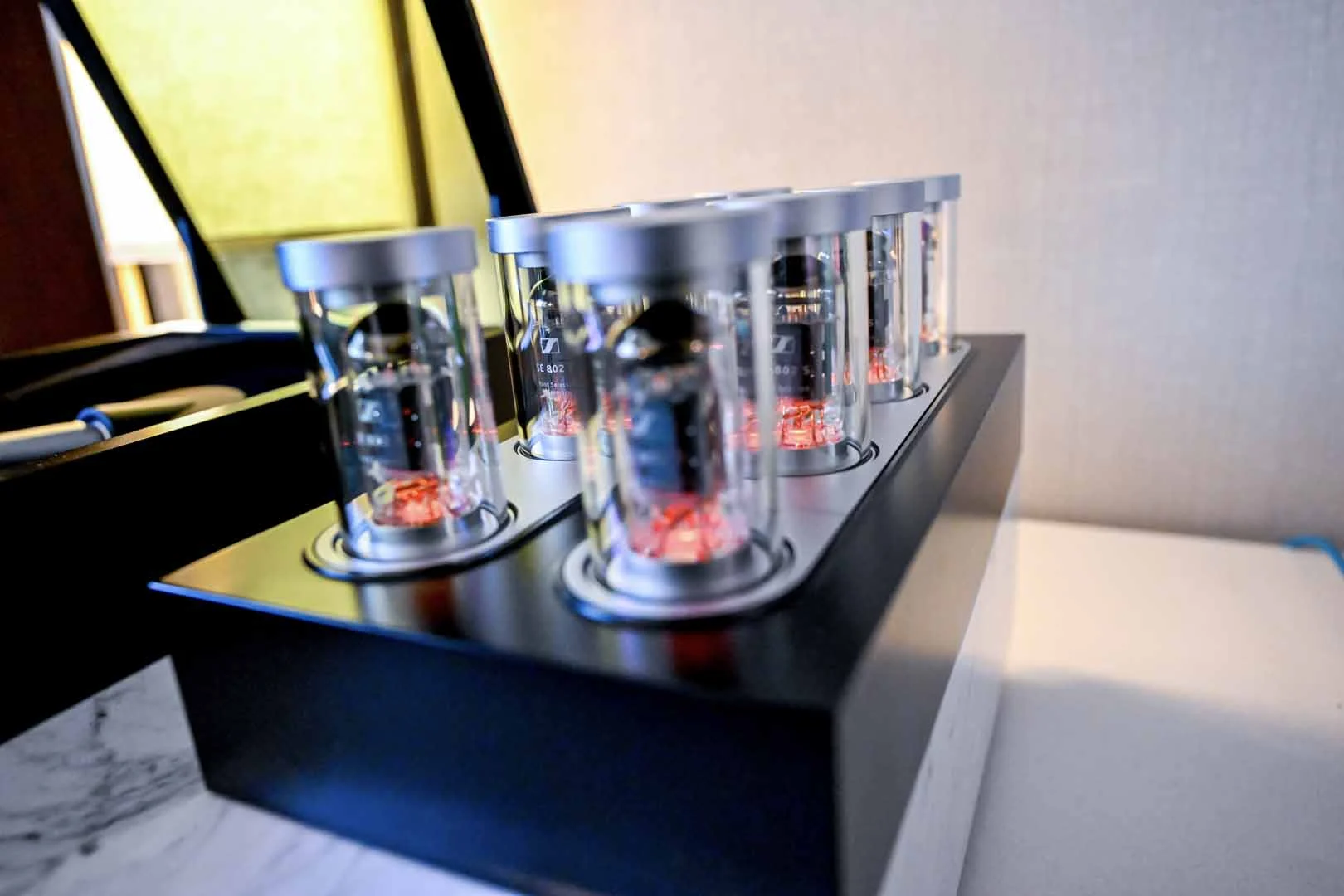
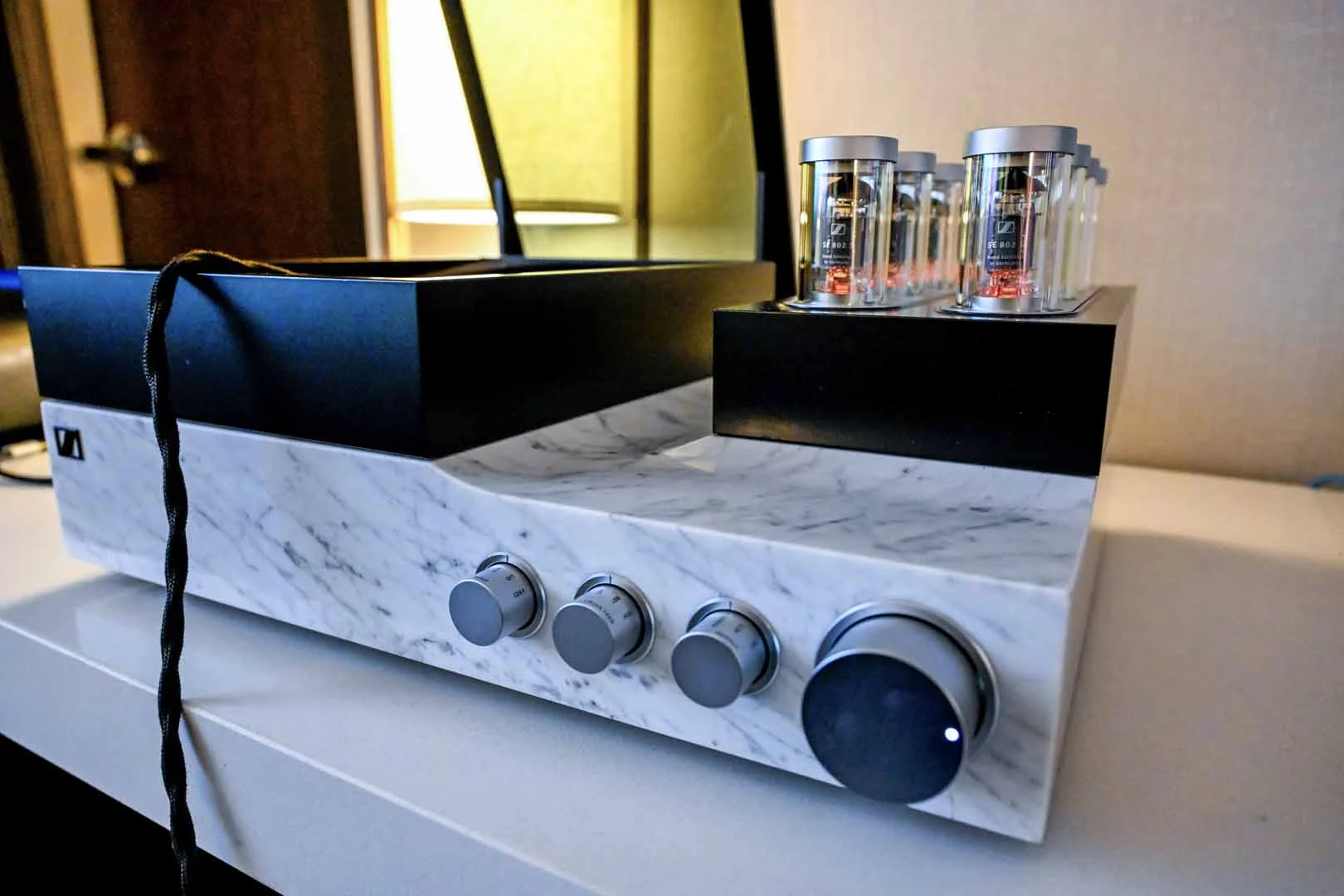
The HE 1 occupied its own dedicated space, with the famous marble amplifier chassis, illuminated vacuum tubes, integrated headphone compartment, and playback computer arranged on a table.
It was an interesting combination of high technology and relatively ordinary surroundings.
One of the most extravagant headphone systems ever created, sitting beside a laptop in a hotel room.
And that’s where I encountered one of the HE 1’s most significant practical considerations.
These headphones are extremely open.
Not moderately open.
Not the kind of open-back design that provides a little additional breathing room while maintaining some sense of isolation.
I mean exceptionally, unapologetically open.
The HE 1 offers very little isolation from the outside world, and sound can escape into the surrounding environment.
For a system capable of revealing such subtle musical information, that’s an important consideration.
I couldn’t help imagining what the experience might be like in a room approaching complete sensory isolation.
No hallway conversations. No distracting environmental noises. No interruptions.
Just the music.
At this level of resolution, environmental distractions can become increasingly noticeable, particularly during quiet passages and recordings with delicate spatial information.
The hotel-room setting was certainly enjoyable, but I suspect a carefully controlled listening environment would let the system’s subtler qualities emerge even more convincingly.
If ever a headphone deserved its own private sanctuary, this might be the one.
🏯 Sennheiser HE 1: When Engineering Becomes Art
Before we get too deep into the sound, we need to talk about the HE 1 itself.
Because this thing is ridiculous.
Wonderfully, gloriously ridiculous.
Sennheiser hasn’t simply created an extraordinarily expensive headphone.
It’s built an entire listening experience around the idea that reproducing music can be as much an artistic endeavor as an engineering challenge.
The HE 1 traces its heritage to Sennheiser’s original Orpheus system, introduced in 1991.
There’s something particularly delightful about that coincidence.
The same year I was graduating from high school and enjoying “Doo Doo Brown,” Sennheiser was creating an electrostatic headphone system that would become legendary among audiophiles.
Apparently, we were both making important musical discoveries that year.
Just in slightly different directions.
The modern HE 1 builds upon that legacy with an entirely new level of technical ambition and mechanical extravagance.
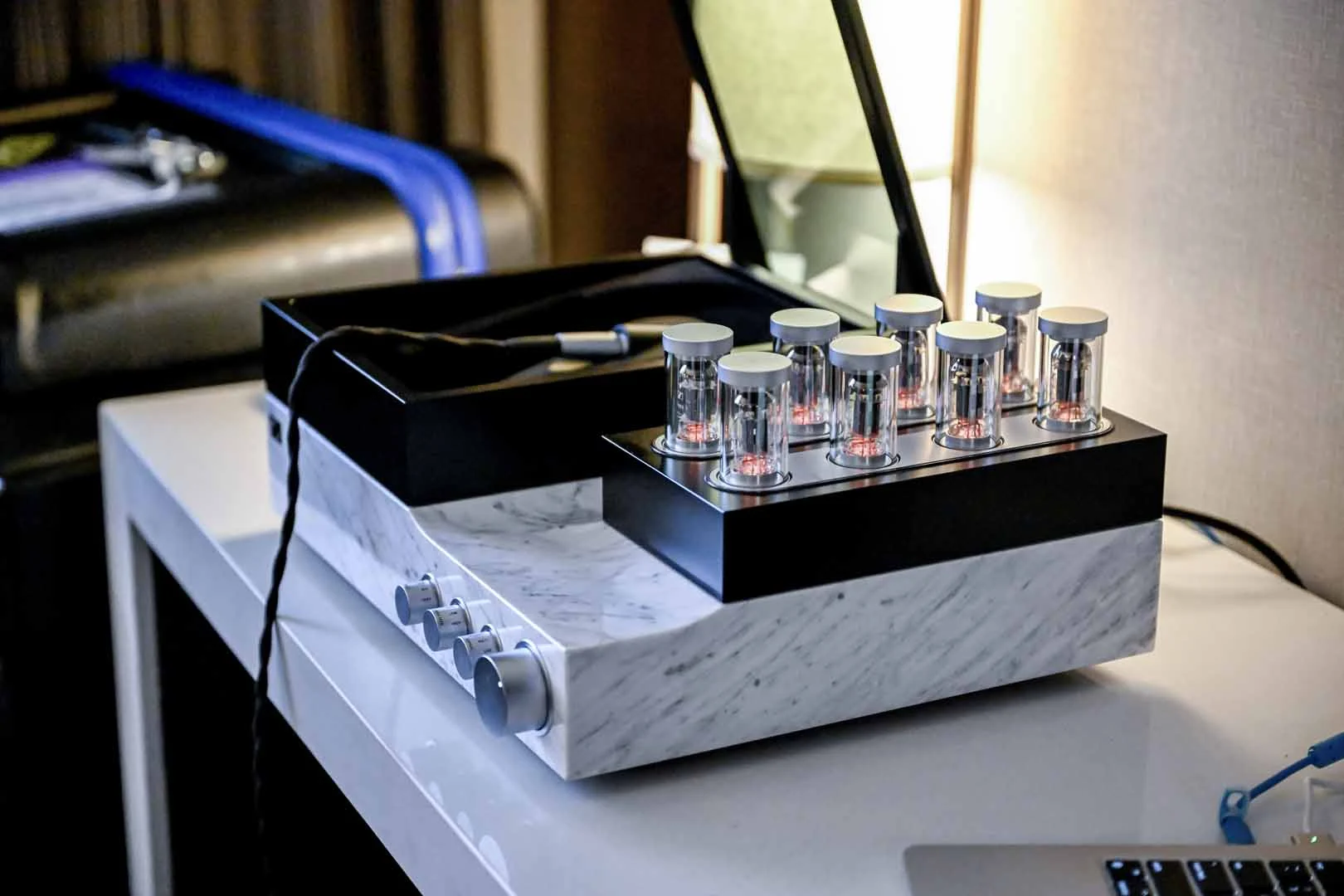
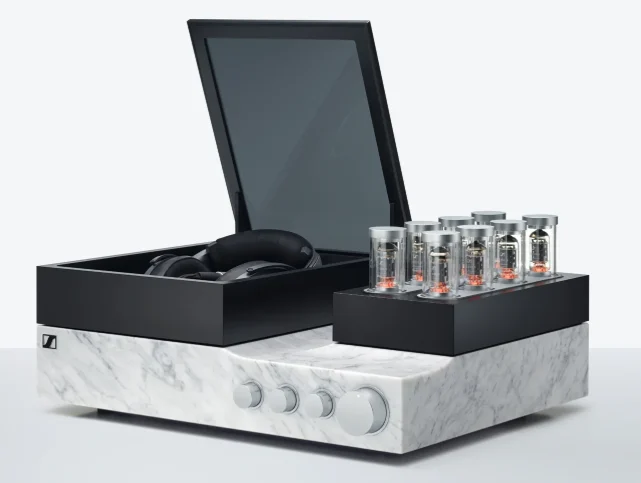
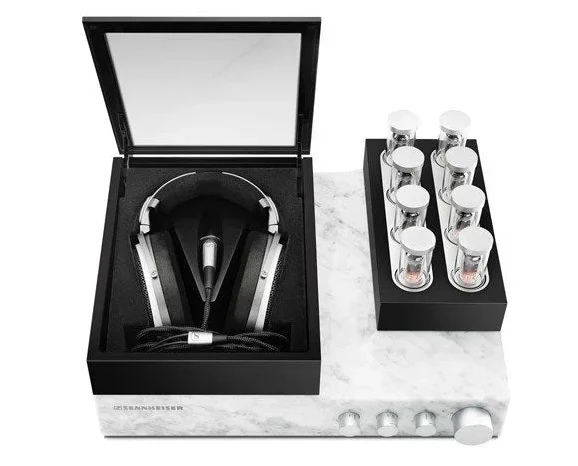
Its amplifier sits atop a substantial block of Carrara marble, a material more commonly associated with fine sculpture and luxury architecture than headphone listening.
The marble isn’t simply decorative. Its mechanical properties help reduce the transmission of structural vibrations into sensitive amplification components.
Eight vacuum tubes rise from the amplifier, enclosed in transparent quartz-glass cylinders designed to help protect them from airborne disturbances.
View this post on Instagram
The control dials are meticulously machined from brass, then given a chrome finish.
The headphones themselves feature precision-machined aluminum earcups, handmade leather detailing, and soft velour/microfiber contact surfaces.
Everything has a sense of occasion.
Even the startup process is theatrical.
At the touch of a button, the system comes to life. The controls emerge, the vacuum tubes rise into position, and the integrated headphone compartment opens to reveal the headphones.
It’s a wonderful little performance before the actual performance begins.
Completely necessary?
Of course not.
But there’s something delightful about a manufacturer deciding that preparing to listen to music should feel like an event in itself.
The HE 1 doesn’t simply ask you to listen. It invites you to participate in a ritual.
And when that ritual is complete, you’re left with one very important question.
Does all that elaborate engineering and mechanical theater translate into extraordinary sound?
Oh, yes.
It does.
⚙️ Technical Specifications: The Engineering Behind the Experience
Model: Sennheiser HE 1
Manufacturer: Sennheiser
Type: Open-back, circumaural electrostatic headphone system
Headphone technology: Platinum-vaporized electrostatic diaphragms
Diaphragm thickness: 2.4 micrometers
Electrode technology: Gold-vaporized ceramic electrodes
Amplification: Hybrid vacuum-tube and solid-state architecture
Vacuum tubes: Eight
Headphone amplification: Integrated Cool Class A MOS-FET high-voltage amplification inside the earcups
Digital conversion: Eight ESS SABRE ES9018 DAC chips
Digital inputs: USB, optical, and coaxial
Analog inputs: Balanced XLR and unbalanced RCA
High-resolution support: PCM and DSD
Published audio range: 8 Hz to more than 100 kHz
Published distortion: 0.01% at 1 kHz and 100 dB SPL
Headphone weight: Approximately 550 grams
Headphone construction: Precision-machined aluminum with handmade leather and velour/microfiber ear pads
Amplifier construction: Carrara marble, glass, chrome-plated brass, and quartz-glass tube housings
Headphone cable: Silver-plated oxygen-free copper
Price category: $70,000-plus luxury reference system, with final pricing dependent on market and ordering arrangements
Official product information: Sennheiser HE 1
🧬 Electrostatic Technology: Moving Less to Reveal More
Most headphones use dynamic or planar magnetic drivers.
The HE 1 takes a different approach.
Its electrostatic transducers employ extraordinarily thin, electrically charged diaphragms suspended between electrodes.
An audio signal creates changing electrostatic forces that move the diaphragms and produce sound.
The potential advantages are compelling.
An extremely lightweight moving element can respond rapidly to subtle signal changes, while careful engineering can minimize certain forms of distortion.
But diaphragm technology alone doesn’t determine sound quality.
The electrical system, acoustic design, amplification, and final implementation all contribute to the listening experience.
That’s where the HE 1 becomes particularly interesting.
Rather than building a headphone and leaving enthusiasts to experiment with amplifiers, Sennheiser engineered the headphones and amplification system as a complete package.
🔥 Hybrid Amplification: Tubes, Transistors, and a Very Clever Design
The HE 1 combines vacuum-tube amplification with solid-state technology, using an unusual arrangement that places high-voltage MOS-FET amplifier stages directly inside the headphone earcups.
This approach avoids sending the final high-voltage drive signal through the entire headphone cable, addressing electrical challenges associated with conventional electrostatic headphone connections.
The system also employs eight ESS SABRE ES9018 DAC chips, using parallel conversion channels to improve measured performance.
Sennheiser’s goal is clearly not technological minimalism.
It’s performance through meticulous integration.
And while I can’t independently verify every claimed engineering advantage from a brief audition, I can certainly appreciate the ambition behind the design.
The HE 1 isn’t a collection of expensive components assembled into a beautiful package. It’s an integrated system built around an uncompromising engineering philosophy.
The technology makes the experience possible.
But the music is what makes it memorable.
📈 Frequency Response: When the Measurements Meet the Magic
I’ve always believed that measurements can tell us a great deal about how a headphone behaves, but they can’t necessarily explain how it makes us feel. And when you’re talking about a $70,000-plus electrostatic masterpiece, that’s an important distinction.
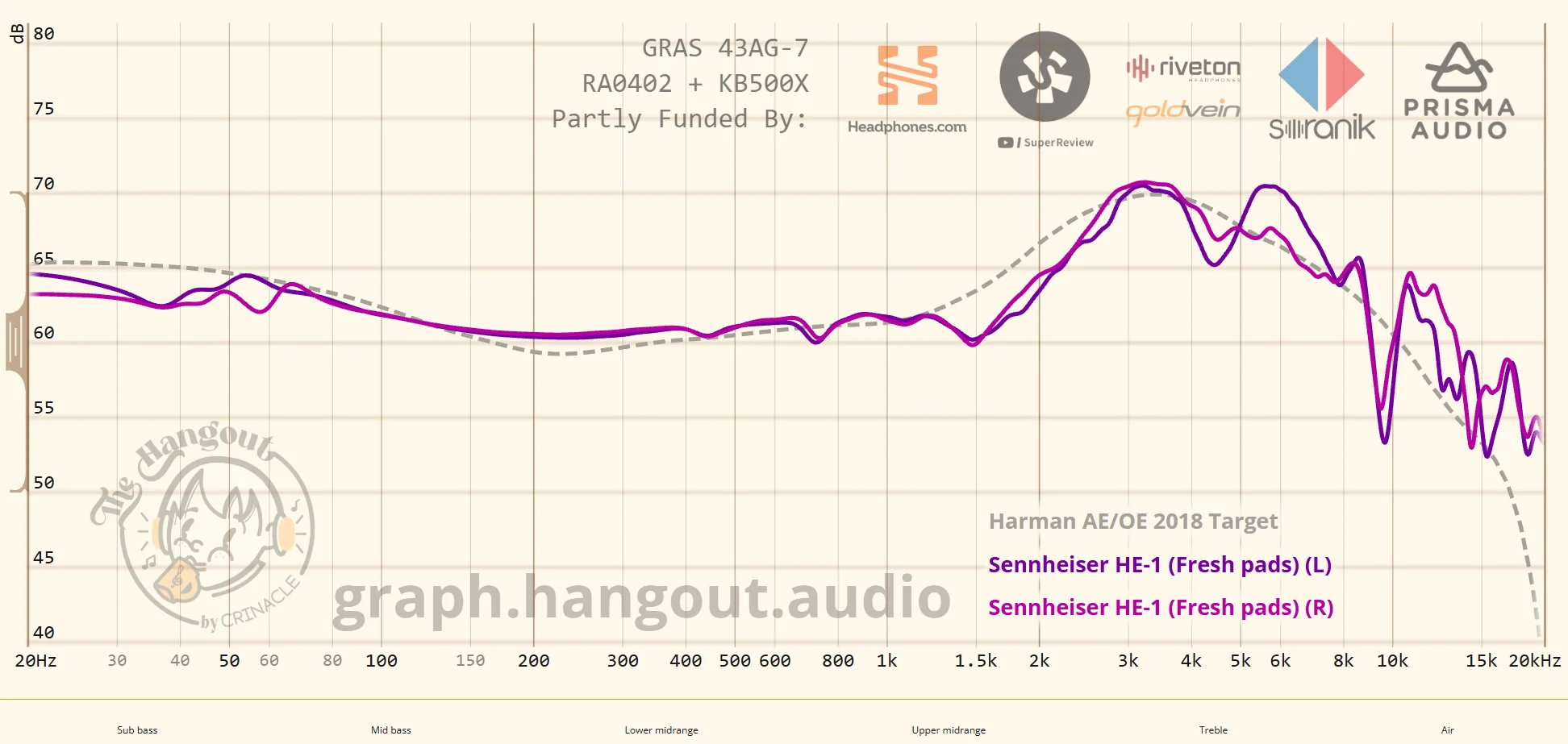
Fortunately, we don’t have to rely entirely on Sennheiser’s published specifications to understand the HE 1’s tonal character. Crinacle’s Hangout Audio graph database includes independent frequency-response measurements of the HE 1 with fresh earpads, providing a fascinating look at how this extraordinary system behaves across the audible spectrum.
The graph uses a GRAS 43AG-7 measurement fixture and displays the left and right channels alongside the Harman AE/OE 2018 target. Remember that the target is a preference-based reference, not a universal definition of perfect sound.
What the Graph Reveals
The first thing that catches my attention is the bass. The HE 1 maintains a remarkably consistent low-frequency response, with useful extension into the sub-bass region and no dramatic mid-bass hump. That aligns with my listening impressions: bass that sounded deep, authoritative, and exceptionally controlled without overwhelming the rest of the arrangement.
The midrange is equally interesting. From the lower mids through approximately 1 kHz, the response remains relatively smooth and consistent. There’s no enormous elevation suggesting an exaggeratedly thick or artificially warm presentation. That helps explain why I struggled to describe the HE 1 using conventional terms like warm or dark, even though the music possessed such wonderful body and richness.
Moving into the upper midrange, the response rises toward a broad prominence around 3 kHz before showing additional variation through the lower treble. There’s plenty of energy in the region responsible for vocal presence and instrumental articulation, which is consistent with the remarkable intimacy and expressive clarity I heard from Leon Bridges, Dominique Fils-Aimé, Celeste, and Lauryn Hill.
Then there’s the treble.
The graph shows noticeable peaks and dips above approximately 4 kHz, with some differences between the measured channels. That supports my impression of occasionally energetic treble, though we should be careful not to draw overly specific conclusions from a single measurement. Headphone positioning, individual ear anatomy, earpad condition, and the measurement fixture itself can all influence the response, particularly at higher frequencies.
And here’s where things get especially interesting.
The graph cannot explain the extraordinary holographic imaging, the seemingly effortless separation, or that wonderfully gooey, almost tactile musicality I experienced.
Those impressions involve more than a frequency-response curve can show on its own. The HE 1’s perceived spatial presentation, clarity, and emotional impact are part of a much larger listening experience.
The GearZilla Take: A Graph Can’t Measure Goosebumps
Looking at these measurements, I recognize several characteristics that match what I heard: extended bass, relatively smooth lower mids, prominent vocal presence, and an energetic but highly detailed upper-frequency presentation.
But I can’t point to a particular peak or dip and declare that it’s responsible for the HE 1’s remarkable intimacy or three-dimensional soundstage.
That’s not how headphone measurements work.
The graph provides useful context. It helps us understand the system’s tonal balance and gives enthusiasts a reference point for comparing it with other headphones.
What it doesn’t capture is that moment when Lauryn Hill’s voice seemed almost physically present, or when familiar musical arrangements revealed layers I hadn’t consciously noticed before.
And perhaps that’s the most important lesson from my brief encounter with the HE 1.
Measurements help explain what reaches our ears. Music reminds us why we listen.
*Measurement credit: Crinacle / Hangout Audio
🎧 Listening Impressions: When the Headphones Disappear
There’s a certain expectation that comes with putting on a headphone system costing more than $70,000.
You expect spectacular clarity.
You expect deep bass, remarkable detail retrieval, extraordinary imaging, and a soundstage that makes ordinary headphones feel claustrophobic.
And yes, the HE 1 delivers those characteristics in abundance.
But what struck me most wasn’t one exaggerated sonic characteristic.
It was the remarkable absence of the usual limitations I associate with headphone listening.
The music seemed to bypass the headphones altogether.
I know that sounds dramatic.
But it’s the closest description I can offer.
Rather than feeling as though sound was being reproduced by drivers positioned beside my ears, the music seemed to arrive almost directly inside my consciousness.
Not literally, of course.
But the illusion was strangely convincing.
There was no obvious audible distortion. No grainy haze. No congestion. No sense that the system was struggling to keep complicated musical arrangements organized.
Even when the music became more demanding, everything remained astonishingly composed.
And that composure created an unexpected problem.
I kept wanting to turn up the volume.
Not because the HE 1 lacked detail or presence, but because the sound was so remarkably clean that I found myself chasing a greater physical sensation from the music.
Eventually, the sound pressure became uncomfortable, and I had to remind myself that a lack of audible distortion doesn’t make high listening levels harmless.
That’s an important distinction.
When the familiar warning signs of strain seem to disappear, it’s surprisingly easy to forget how loudly you’re listening.
And beneath that extraordinary clarity was something I hadn’t entirely anticipated.
A remarkable sense of musical comfort.
The HE 1 sounded open, expansive, and spectacularly resolved, yet the presentation had an intimacy that made the performance feel wonderfully close.
I kept searching for the right description.
Warm? Not exactly.
Lush? Certainly.
Smooth? Absolutely.
But there was something else.
Cozy.
Not cozy in the conventional sense—dark, rolled-off, or closed in.
Quite the opposite.
Imagine an enormous recording space where every instrument has room to breathe, yet the musicians themselves feel close enough to touch.
That was the fascinating contradiction I encountered.
The sound was wide, yet intimate.
Precise, yet inviting.
Analytically capable, yet emotionally engaging.
And there was another quality I can only describe as wonderfully gooey.
I know. Not exactly a conventional audiophile measurement.
But hear me out.
The HE 1 didn’t sound muddy, excessively warm, or slow. Instead, notes possessed a wonderfully developed, texturally rich character that made instruments feel substantial and naturally connected to one another.
It wasn’t the kind of presentation that aggressively carved every musical element into separate pieces.
It was more organic than that.
The HE 1 sounded impossibly precise without sacrificing the music’s humanity.
And nowhere was that more apparent than in the midrange.
🎤 Midrange & Vocals: Good Grief, Those Vocals
If I had to identify the single most extraordinary part of my HE 1 experience, it would be the midrange.
Specifically, the vocals.
Good grief, the vocals.
I love a beautifully elevated, intimate vocal presentation.
Give me a singer whose voice floats naturally above the arrangement, with believable breath, texture, and emotional expression, and I’m usually a very happy Kaiju.
The HE 1 took that preference somewhere extraordinary.
Listening to Leon Bridges, I was struck by the sense that the singer wasn’t simply occupying a carefully positioned spot in an imaginary soundstage.
He felt present.
Right there.
The delicate texture of his voice, the recording’s natural resonance, and the subtle expressive qualities that communicate emotion all seemed to emerge effortlessly.
I wasn’t simply hearing more details.
I was becoming more absorbed in the performance.
And that’s a meaningful difference.
A highly resolving headphone can expose every breath, every microscopic vocal texture, and every tiny production detail without necessarily making the music more emotionally engaging.
The HE 1 seemed to accomplish both.
Dominique Fils-Aimé and Celeste reinforced that impression.
Their expressive performances gave the system an opportunity to reveal the richness, tonal complexity, and subtle nuances that make a great singer so captivating.
The midrange was wonderfully transparent, yet it didn’t feel thin or sterile.
There was body.
There was texture.
There was humanity.
And I kept thinking back to Lauryn Hill’s unplugged performance.
That same sensation of emotional immediacy.
The feeling that the performance wasn’t merely being reproduced, but somehow happening in the space around me.
The HE 1 didn’t just reproduce the singer’s voice. It helped communicate the person behind it.
For my listening preferences, that’s about as meaningful a compliment as I can give.

🥁 Bass: Deep, Powerful, and Completely Unbothered
Let’s address something that occasionally gets lost in conversations about electrostatic headphones.
Bass matters.
A lot.
I don’t care how many microscopic details a headphone can retrieve if the low frequencies sound like they’ve been politely excused from the performance.
Fortunately, the HE 1 had no such problem.
The bass reached remarkably deep and carried convincing authority.
More importantly, it remained extraordinarily controlled.
There was no obvious bloat, no sense of excessive resonance, and no low-frequency congestion obscuring the rest of the arrangement.
The bass seemed to occupy precisely the space it needed.
Nothing more.
Nothing less.
Moving into Kendrick Lamar and Megan Thee Stallion gave me an opportunity to explore how that composure translated to more rhythmically aggressive music.
The HE 1 maintained impressive separation between the low-frequency foundation and the surrounding instrumentation.
Bass lines retained their identities.
Percussion remained articulate.
The overall presentation didn’t become overwhelmed as the arrangements grew more energetic.
What impressed me most wasn’t simply how deep the bass extended.
It was how naturally everything fit together.
The low frequencies supported the music without demanding unnecessary attention, and even the more aggressive selections retained remarkable clarity.
Then came “Doo Doo Brown.”
Now, I appreciate that Miami bass from my high school days probably isn’t what Sennheiser engineers had in mind when developing one of the most sophisticated electrostatic systems ever created.
But that’s precisely why I wanted to hear it.
There’s something gloriously entertaining about playing a nostalgic party track through a system designed to reproduce some of the finest recordings in existence.
And you know what?
It was a blast.
The HE 1 didn’t magically transform the recording into a modern audiophile masterpiece, but it gave the music the same remarkable composure and clarity I’d experienced with everything else.
That matters to me.
Because I don’t want audio equipment that only sounds extraordinary when I’m listening to recordings specifically chosen to demonstrate its capabilities.
I want equipment that makes the music I genuinely love more enjoyable, even when that music happens to be ridiculous.

🌟 Treble & Air: Brilliant, Beautiful, and Maybe a Touch Too Much
Here’s where I encountered my one meaningful tonal reservation.
The HE 1 has extraordinary treble extension.
A tremendous sense of air surrounds the instruments, with delicate upper-frequency information emerging from seemingly effortless silence.
Cymbal textures, reverberation, and the finer harmonic details of instruments all benefited from that openness.
Nothing sounded obviously rolled off or lacking in upper-frequency definition.
Quite the opposite.
The HE 1 seemed capable of revealing enormous amounts of information without making the music feel brittle or artificially sharpened.
But I did occasionally find the treble a touch stronger than my personal preference.
Not painfully bright.
Not harsh.
And certainly not enough to undermine the overall experience.
Just a little more energetic than the smooth, non-fatiguing upper-frequency presentation I generally gravitate toward.
Of course, I also need to acknowledge that I was experimenting with volume during the session.
When you’re listening to a system this clean, it’s easy to push playback levels beyond what you’d normally consider comfortable, and increased volume can make upper-frequency energy more noticeable.
With only 15 minutes available, I can’t confidently separate every aspect of the system’s inherent tuning from the effects of playback level and recording differences.
But my overall impression was clear.
The HE 1 offers extraordinary treble resolution and air, with just enough upper-frequency energy to remind me that personal preference still matters, even at $70,000.
🎯 Instrument Separation & Placement: Discovering Music I Thought I Knew
One of the greatest pleasures in this hobby is rediscovering familiar music.
You know the experience.
A song you’ve heard a hundred times suddenly reveals a subtle background instrument, an unexpected harmony, or a delicate production detail you somehow never noticed before.
The HE 1 took that experience to another level.
Its instrument separation was extraordinary.
Musical elements I hadn’t consciously recognized in familiar recordings seemed to emerge naturally from the arrangement.
Not because the system artificially exaggerated them.
Not because the music sounded aggressively dissected.
But because the presentation was so remarkably organized that every instrument seemed free to occupy its own space.
This was particularly fascinating in DeVotchKa’s atmospheric arrangements.
The relationships between instruments, their individual textures, and the subtle spatial cues surrounding them all became easier to appreciate.
But what truly impressed me was how naturally everything remained connected.
I’ve heard headphones that create tremendous separation by making individual sounds seem unnaturally isolated.
The HE 1 didn’t give me that impression.
Instead, it maintained a wonderfully cohesive presentation, keeping complex arrangements musical rather than analytical.
I heard distinctions between instruments I hadn’t previously appreciated, without ever feeling like the music itself was being pulled apart.
That’s a remarkable accomplishment.
And it played directly into one of the qualities I value most in personal audio.
Holographic imaging.
🌌 Width & Depth: A Soundstage That Feels Alive
Anyone familiar with my reviews knows I have a weakness for an expansive, three-dimensional soundstage.
Give me convincing width, meaningful front-to-back depth, and instruments occupying distinct positions within a believable acoustic environment, and I’m usually hooked.
The HE 1 delivered that sensation beautifully.
But it wasn’t simply a matter of throwing musical elements as far apart as possible.
The presentation had extraordinary spatial organization.
Instruments occupied distinct locations, while the relationships between them remained natural and convincing.
There was an almost effortless sense of dimensionality.
Yet the HE 1 also delivered something I don’t always associate with extremely expansive headphones.
Intimacy.
The soundstage felt wide, but the performers could still seem remarkably close.
The space was expansive without becoming emotionally distant.
That combination was intoxicating.
With Lauryn Hill’s unplugged performance, the acoustic environment felt beautifully developed, while her voice retained an intimate presence that made the recording feel almost personal.
The same quality emerged with Leon Bridges and the other vocal selections.
It was an unusual balance.
The HE 1 created an expansive musical environment without making me feel like I was sitting in the cheap seats.
And that’s precisely the kind of immersive presentation I’ve spent years searching for.
🔬 Detail, Resolution & Transients: Precision Without the Microscope
High-end audio often equates extraordinary detail retrieval with extraordinary sound quality.
And understandably so.
Hearing subtle information that less capable equipment obscures can be fascinating.
But I’ve also encountered headphones that emphasize upper-frequency detail so aggressively that every recording becomes a microscopic examination.
The HE 1 didn’t feel that way.
Its detail retrieval was astonishing, but the information emerged naturally from the performance.
I didn’t have to search for subtle instrumental textures or delicate reverberation.
They were simply present.
The same was true of transient behavior.
Musical attacks sounded exceptionally articulate, yet note decay retained a wonderfully natural character.
There was precision without exaggerated sharpness.
Speed without sterility.
And remarkable resolution without the feeling that the system was constantly demanding admiration for its technical abilities.
That balance is hard to describe because it’s less about what the HE 1 added to the music and more about what seemed missing.
Distortion.
Congestion.
Unnecessary coloration.
The familiar sense of mechanical effort.
The HE 1’s greatest technical achievement may be how little attention it draws to its own technical performance.
🎵 Tonality & Timbre: The Art of Sounding Real
If the midrange was the most emotionally compelling part of my HE 1 experience, the overall tonal presentation was arguably its most fascinating characteristic.
The HE 1 didn’t sound conventionally warm.
It wasn’t dark, overly thick, or deliberately softened.
Nor did it sound cold, sterile, or ruthlessly analytical.
Instead, it occupied a wonderful middle ground.
It had extraordinary clarity and openness, but also a richness to the instrumental textures that made the music feel remarkably substantial.
That’s where my description of the sound as cozy and gooey comes into play.
It wasn’t a frequency-response characteristic I could neatly identify.
It was a feeling.
A sense that individual notes possessed convincing texture, body, and harmonic development.
Acoustic instruments seemed to resonate naturally.
Voices carried believable substance.
And complicated arrangements retained an organic quality that prevented the presentation from becoming clinical.
The result was a listening experience that felt simultaneously luxurious and authentic.
The HE 1 didn’t make music sound artificially beautiful. It made the beauty already present in the recordings easier to appreciate.
And for me, that may be the highest compliment of all.
☁️ Comfort, Practicality & the Realities of Ownership
For all its extraordinary achievements, the HE 1 isn’t exactly what I’d call practical.
The headphones themselves felt surprisingly comfortable during my brief session, despite their substantial construction.
The earcups accommodated my ears nicely, and the overall fit didn’t distract from the listening experience.
But 15 minutes isn’t enough time to make meaningful claims about long-term wearing comfort.
That’s especially important with headphones weighing approximately 550 grams.
Weight distribution, clamping pressure, pad materials, and individual head shape can all influence how comfortable a headphone feels over several hours.
Then there’s the dedicated amplifier.
The HE 1 isn’t a headphone you casually connect to your favorite portable DAC or toss into a bag for a weekend trip.
It’s an elaborate, integrated system designed to occupy a permanent place in a dedicated listening environment.
And because the headphones are so exceptionally open, environmental noise and sound leakage are significant considerations.
This is not a system for airplanes, cafés, noisy offices, or shared spaces where other people might prefer not to hear your music.
It’s a luxury listening installation.
Something to be experienced deliberately.
And at this level, I think that’s entirely appropriate.
The HE 1 isn’t designed to fit into your everyday routine. It’s designed to make listening to music the event around which the routine revolves.

👹 GearZilla KAIJU DNA Scan: Anatomy of an Extraordinary Experience
Every Kaiju has a personality.
Some overwhelm with raw power.
Others rely on precision, speed, or sheer physical presence.
The Sennheiser HE 1 is an entirely different kind of monster.
It’s an extraordinary combination of engineering sophistication, emotional musicality, and luxury craftsmanship.
🎯 K • Kill Shot: Vocals That Feel Alive
The HE 1’s greatest accomplishment during my audition was its extraordinary vocal realism.
Leon Bridges, Dominique Fils-Aimé, Celeste, and Lauryn Hill showed how emotionally compelling a beautifully resolved midrange can be.
The intimacy, texture, and natural timbre were remarkable.
The singer wasn’t simply in the recording. The performance felt present.
🧬 A • Anatomy: Engineering Without Apology
Electrostatic diaphragms, hybrid amplification, integrated high-voltage stages, eight DAC chips, and vibration-controlled construction create an extraordinarily sophisticated technical foundation.
But the HE 1’s real achievement isn’t its engineering complexity.
It’s how completely that complexity disappears when you listen.
🦴 I • Impact: Deep Bass, Effortless Control
The HE 1 delivered remarkably deep, authoritative bass without muddying the surrounding arrangement.
From soulful grooves to rhythmically aggressive hip-hop, its low-frequency presentation remained composed and articulate.
And yes, it even made my gloriously nostalgic Miami bass selection sound fantastic.
🎩 J • Joy: Fifteen Minutes of Pure Musical Discovery
This is where the HE 1 truly won me over.
The joy wasn’t simply hearing extraordinary equipment.
It was sharing the experience with other music lovers, discovering Lauryn Hill through someone else’s selection, revisiting beloved recordings, and having enough unexpected listening time to explore a wildly diverse playlist.
It was fun.
Genuinely, ridiculously fun.
And that’s something even the most extravagant specifications can’t guarantee.
🎤 U • Unleashed: A Glimpse of What’s Possible
The HE 1 offered a brief glimpse into a level of personal audio performance I rarely encounter.
Was it enough time to establish definitive conclusions about every technical characteristic?
Of course not.
But it was enough to leave an extraordinary impression.
Sometimes 15 minutes is all it takes to remind you why you love music in the first place.
🦖 The KAIJU Conclusion: A Different Kind of Legendary
The HE 1 doesn’t need to shout about its capabilities.
It doesn’t rely on exaggerated bass, artificially stretched imaging, or relentlessly sharpened detail to create excitement.
Instead, it delivers an extraordinarily open, natural, and emotionally convincing presentation that makes the equipment itself seem to disappear.
The HE 1 isn’t just an extraordinary headphone system. It’s an extraordinary listening experience.
💰 Value: When Reason Leaves the Listening Room
Let’s address the very expensive elephant in the room.
More than $70,000.
For headphones.
And an amplifier, of course, but still.
That’s an extraordinary amount of money to spend on personal audio equipment.
For most people, myself included, the HE 1 is well beyond a practical purchase.
You could assemble several exceptional audio systems for a fraction of the cost.
You could buy extraordinary headphones from some of the world’s finest manufacturers, pair them with superb amplification, and still have a considerable amount of money left over.
Would those systems sound as good as the HE 1?
That’s a fascinating question.
And one I can’t honestly answer without spending meaningful time comparing them.
I’ve experienced some exceptional headphones, but I don’t have the personal reference points necessary to confidently rank the HE 1 against every other ultra-high-end electrostatic system.
Nor can I say its sonic improvements justify the astronomical price difference.
But that isn’t really the point of a product like this.
The HE 1 is a luxury statement, a celebration of engineering ambition, and an example of what can happen when a manufacturer pursues an extraordinary vision without designing primarily around mass-market affordability.
It’s not the headphone equivalent of buying an efficient family sedan.
It’s closer to commissioning a bespoke grand touring automobile.
Something designed not merely to perform, but to create an experience that feels special every time you use it.
Is the HE 1 a sensible purchase? For most people, absolutely not.
Is it a magnificent expression of what’s possible in personal audio? Based on my experience, absolutely.
And I’m perfectly comfortable appreciating the second without pretending the first isn’t true.

🦖 GearZilla Scorecard: The Anatomy of a $70,000 Sonic Masterpiece
The Sennheiser HE 1 earns a perfect 5.0/5 GearZilla rating, placing it in the rarest category of personal audio experiences I’ve encountered.
Now, I have a confession to make.
I’m not entirely sure I’m qualified to give this thing a perfect score.
Not because I doubt what I heard.
Quite the opposite.
I’ve experienced extraordinary headphones, including flagship planar magnetic designs, beautifully crafted dynamic headphones, and equipment that pushes well beyond what most people would consider reasonable spending.
But the HE 1 operates in a category where I don’t have a reliable personal benchmark.
I haven’t spent enough time with competing ultra-high-end electrostatic systems to confidently declare it the best headphone system in existence.
And 15 minutes, however glorious, isn’t enough to establish long-term comfort, fatigue, reliability, or every subtle technical characteristic.
So is a perfect score scientifically defensible?
Probably not.
But did the HE 1 deliver one of the most extraordinary personal audio experiences of my life? Absolutely.
And that’s what this score represents.
These ratings reflect my subjective impressions during an exceptionally memorable listening session, not an exhaustive comparative evaluation. I’m leaving untested ownership characteristics unrated rather than manufacturing precision.
✨ Clarity: 5.0/5 ⭐
Extraordinary transparency, with musical details emerging almost effortlessly. The absence of obvious audible distortion or congestion made even complex passages sound remarkably clean and composed. It wasn’t detail for detail’s sake. It was clarity that brought me closer to the performance.
🎤 Midrange & Vocals: 5.0/5 ⭐
Arguably the most extraordinary part of the entire experience. Leon Bridges, Dominique Fils-Aimé, Celeste, and Lauryn Hill revealed just how emotionally convincing vocal reproduction can become. Natural timbres, beautiful body, intimate presence, and astonishing expressive detail made the performers seem almost physically present.
🥁 Bass: 5.0/5 ⭐
Remarkably deep, authoritative, and exceptionally controlled. The HE 1 delivered convincing low-frequency foundation without overwhelming the midrange or muddying complicated arrangements. Kendrick Lamar and Megan Thee Stallion gave me a welcome opportunity to appreciate just how confidently the system handles bass-heavy production.
🎯 Separation & Placement: 5.0/5 ⭐
One of the session’s biggest revelations. Individual instruments emerged from familiar recordings with a clarity and independence I hadn’t previously appreciated. Yet the performance never sounded artificially dissected. Everything occupied its own space while contributing naturally to the musical whole.
🌌 Width & Depth: 5.0/5 ⭐
Expansive, three-dimensional, and wonderfully immersive. The HE 1 created an extraordinary illusion of width and depth while preserving an unexpected sense of intimacy. It felt simultaneously wide-open and emotionally close—a fascinating contradiction that made the presentation feel distinctive.
🔬 Detail & Resolution: 5.0/5 ⭐
An astonishing amount of information seemed available without being aggressively pushed forward. Subtle instrumental textures, vocal nuances, and spatial cues appeared with effortless precision. I discovered details in familiar music that I hadn’t consciously recognized before.
🌟 Treble & Air: 4.9/5 ⭐
Beautifully extended, airy, and extraordinarily revealing. Upper-frequency information emerged with impressive delicacy and definition. My only hesitation was that the treble occasionally felt a touch stronger than my personal preference, particularly as volume increased. An extremely minor reservation in an otherwise spectacular presentation.
🦴 Slam & Dynamics: 5.0/5 ⭐
Excellent dynamic expression, with deep bass authority and an almost effortless ability to accommodate changes in musical intensity. The HE 1 didn’t need to exaggerate transients to create excitement. Its composure allowed the energy already present in the recordings to emerge naturally.
🎤 Vocal Lift: 5.0/5 ⭐
A personal highlight. Voices occupied beautifully convincing positions within the presentation, with an intimacy that made singers feel remarkably close. The HE 1 balanced vocal presence with the surrounding instrumentation without making the arrangement feel unnaturally separated.
⚡ Speed & Transients: 5.0/5 ⭐
Extraordinary articulation without an aggressive or overly analytical character. Musical attacks were precise, while note decay and instrumental textures retained convincing substance. The result was a beautifully fluid presentation that never felt slow, blurred, or mechanically exaggerated.
🎵 Tonality & Timbre: 5.0/5 ⭐
One of the defining achievements of the HE 1. Instruments and voices possessed a remarkable sense of realism, with rich textures and beautifully developed harmonic character. The sound was lush and inviting without becoming conventionally warm or dark. That unusual combination of technical precision and almost gooey musical richness was unforgettable.
🎛️ Tuning & Genre Versatility: 5.0/5 ⭐
From Leon Bridges and Lauryn Hill to Kendrick Lamar, Megan Thee Stallion, and the gloriously unexpected “Doo Doo Brown,” the HE 1 made an extraordinary impression across a wonderfully diverse collection of music. While 15 minutes can’t establish universal versatility, nothing in my session suggested that this system needed a carefully curated audiophile playlist to shine.
☁️ Comfort & Fit: 5.0/5 ⭐
During my brief audition, the substantial headphones felt surprisingly comfortable and well-balanced. Their luxurious materials and circumaural design created an agreeable fit that didn’t distract from the listening experience. Extended-session comfort remains untested, so this score reflects only my short-term experience.
🎨 Design & Build: 5.0/5 ⭐
An extraordinary combination of engineering, craftsmanship, and theater. The Carrara marble chassis, illuminated vacuum tubes, motorized controls, precision-machined earcups, and elaborate presentation make the HE 1 as much an objet d’art as an audio system. It’s luxury craftsmanship taken to its logical, wonderfully excessive conclusion.
📦 Presentation & Experience: 5.0/5 ⭐
From the elaborate physical design to the guided listening session, everything about the HE 1 communicates a sense of occasion. Special thanks to Eric from Sennheiser for introducing us to the system and guiding us through this rare opportunity. Sharing the experience with other music lovers—especially discovering Lauryn Hill’s extraordinary unplugged performance through someone else’s selection—made it even more memorable.
🎶 Listening Enjoyment: 5.0/5 ⭐
The easiest perfect score I’ve ever given.
For approximately 15 minutes, I was completely captivated.
I wasn’t obsessing over specifications or searching for flaws. I discovered new details in familiar recordings, enjoyed extraordinary vocal performances, and had an absolute blast exploring a wildly varied playlist.
The HE 1 reminded me why I fell in love with personal audio in the first place.
It made listening feel like an event.
And even at a price exceeding $70,000, that emotional connection remains the most important achievement.
💰 Value: Not Rated
Here’s where I refuse to pretend that ordinary value calculations apply.
At more than $70,000, the HE 1 isn’t competing with the headphones most enthusiasts are considering for their next upgrade.
It’s an extreme luxury purchase, a technical statement, and an exercise in uncompromising craftsmanship.
Is it dozens of times better than a fantastic headphone costing a fraction of the price?
I can’t make that argument.
Nor would I try.
The HE 1 isn’t a rational purchase for most listeners, and I don’t have enough experience with similarly priced alternatives to establish its comparative value.
But I can appreciate its extraordinary accomplishments without pretending that the asking price represents a sensible upgrade path.
Luxury and value aren’t always the same conversation.
🧡🦖 Overall GearZilla Score: 5.0/5 ⭐ | Legendary-Class Kaiju
Fifteen minutes. One extraordinary headphone system. An experience I’ll never forget.
The Sennheiser HE 1 earns a perfect 5.0/5 GearZilla score for the extraordinary sonic performance and sheer listening enjoyment I experienced during my CanJam Dallas audition.
That score isn’t a mathematical average of the individual categories, nor does it declare the HE 1 objectively superior to every other headphone.
Its slightly energetic treble, extraordinary cost, and limited practical versatility remain legitimate considerations.
And I recognize that 15 minutes cannot establish the long-term qualities I’d ordinarily examine before awarding a definitive rating.
But sometimes an experience transcends the normal framework we use to evaluate audio equipment.
The HE 1 didn’t simply impress me with technical performance.
It surprised me.
It entertained me.
It revealed dimensions of familiar recordings I hadn’t fully appreciated.
And perhaps most importantly, it reminded me that the greatest accomplishment in personal audio isn’t simply reproducing a recording with extraordinary accuracy.
It’s making the music feel so immediate, so emotionally convincing, and so thoroughly engaging that the equipment itself seems to disappear.
Did I hear the best headphone system in the world?
I don’t know.
Did I hear something that felt worthy of a perfect score? Without question.
And until I encounter something that changes my understanding of what personal audio can achieve, I’m perfectly comfortable letting that 5.0 stand.
The Sennheiser HE 1 didn’t just raise the bar. It made me wonder where the bar even belongs.

🦖 Final Roar: Fifteen Minutes I’ll Never Forget
I’ve spent years chasing extraordinary experiences in personal audio.
That elusive combination of holographic staging, beautifully elevated vocals, rich musical textures, deep bass, exceptional clarity, and enough emotional realism to make a familiar recording feel completely new.
I’ve experienced some remarkable equipment along the way.
Headphones that surprised me with their technical capabilities. Others that won me over with their musicality. Others revealed subtle details in recordings I thought I knew inside and out.
But the Sennheiser HE 1 gave me something different.
For approximately 15 minutes, it offered a glimpse into what personal audio can become when engineering, craftsmanship, and creative ambition converge without many of the limitations that ordinarily shape consumer products.
And yet, when I think back on the experience, the first things that come to mind aren’t the specifications.
They’re the moments.
Hearing Lauryn Hill’s unplugged performance because someone in the group ahead of me had the wonderful instinct to select it.
Listening to Leon Bridges and feeling an almost startling connection to the intimacy of his voice.
Appreciating the extraordinary instrumental separation and dimensionality that made familiar recordings feel newly discovered.
Laughing at the sheer absurdity of playing Megan Thee Stallion and “Doo Doo Brown” through a system that costs more than $70,000.
And sharing the experience with fellow music lovers who were just as excited to discover what this extraordinary creation could do.
That’s what made the day special.
Not simply that I heard an exceptionally expensive headphone system.
It’s that the HE 1 reminded me just how much joy there is in discovering music, especially when someone else’s favorite song becomes your own unexpected revelation.
Would I love to spend another afternoon with the HE 1?
Absolutely.
I’d bring a longer playlist, settle into that comfortable chair, and explore everything from delicate acoustic recordings to sprawling orchestral arrangements, soulful vocal performances, and whatever gloriously ridiculous selections happened to come to mind.
And I’d love to experience it in an environment approaching complete sensory isolation, where nothing competes with the extraordinary details the system can reveal.
But even with those unanswered questions, I’m grateful for the opportunity.
A sincere thank you to Eric and the Sennheiser team for welcoming us, guiding the session, and making such a rare experience accessible to fellow audio enthusiasts.
The HE 1 is a remarkable achievement.
It’s a luxury statement, a work of art, an engineering marvel, and a headphone system capable of delivering an almost disconcertingly transparent and emotionally convincing listening experience.
Is it worth more than $70,000?
That’s a question each prospective owner must answer for themselves.
But is it something every passionate audio enthusiast should experience at least once, given the opportunity?
Without hesitation.
Because ultimately, the HE 1 reminded me of something I’ve believed throughout my personal audio journey.
The goal isn’t simply to hear more detail, experience deeper bass, or create the widest possible soundstage.
It’s to feel something.
To connect with the music.
To discover something unexpected in a familiar recording.
To sit down with a song you’ve loved for decades and hear it in a way that makes you smile all over again.
And sometimes, the most extraordinary audio experience of your life begins with somebody else’s playlist and ends with a ridiculous Miami bass classic from 1991.
Fifteen minutes. $70,000-plus worth of headphones. One very dangerous playlist.
And a lifetime of musical memories.
Listen Bigger.
🎧 Experience the Sennheiser HE 1
The Sennheiser HE 1 is a made-to-order luxury electrostatic headphone system that combines advanced amplification, precision manufacturing, and reference-class audio engineering.
It’s not a practical purchase for most listeners, but its technical achievements and remarkable listening experience make it a fascinating example of what’s possible at the extreme end of personal audio.
Interested in learning more?
Explore the Sennheiser HE 1 Official Website
And if you ever have the opportunity to attend an organized HE 1 listening session, take it.
Bring your favorite music.
Bring an open mind.
And maybe, just maybe, bring something completely unexpected.
You never know what might sound extraordinary.
Share This Story, Choose Your Platform!